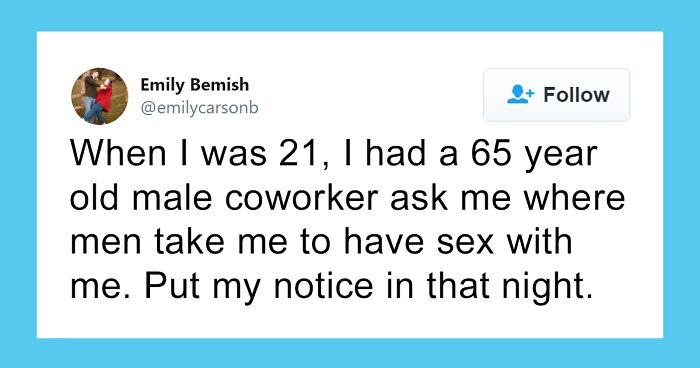
If you’ve ever opened your phone on a lunch break and thought, “Wow, this is painfully familiar”, you already
understand why “women sharing creepy coworker moments” goes viral so fast. The posts are often short, sharp, and
painfully funny in that “laugh so you don’t scream” waybecause the behaviors they describe aren’t always movie-villain
dramatic. They’re frequently small boundary-crossings that pile up until the workplace feels less like a
job and more like a never-ending group project with someone who doesn’t understand personal space.
This article breaks down what’s actually happening in those tweet-sized stories, why they matter, and how to respond
in ways that protect your peace and your paycheck. And yesbecause the internet demanded itwe’ve included
50 tweet-style moments (composite, paraphrased examples) that capture the patterns women say make them feel
uneasy at work.
Why These “Tweet-Sized” Stories Hit So Hard
A lot of “creepy coworker” behavior lives in the gray zone: not always a single headline-worthy incident, but
repeated, unwanted attention that turns everyday tasks into emotional obstacle courses. The power of these
viral posts is that they name the pattern. When dozens of people describe different versions of the same playbook,
it stops feeling like “I’m being too sensitive” and starts looking like “Ohthis is a workplace problem.”
What makes the situation especially exhausting is the hidden labor involved. Many women describe spending extra mental
energy to:
- Plan routes through the office to avoid being cornered.
- Rehearse polite “no” lines that won’t trigger backlash.
- Document incidents “just in case,” like it’s part of the job description.
- Decide whether reporting is worth the risk of being labeled “difficult.”
Humor becomes a survival tool. But the punchline is usually the same: work should not feel like you’re dodging a
low-budget thriller subplot.
50 Tweet-Style Moments Women Say Made Work Feel “Off”
Note: These are composite, paraphrased examples inspired by common themes women publicly discuss in
workplace-boundary conversations. They are not copied tweets and are not about any single identifiable person.
1) The “Compliment” That Isn’t Really About Work
- He “praised my presentation” but only talked about how I looked while presenting.
- He called me “young lady” in meetingsnever used “young man” for anyone else.
- He complimented my outfit, then asked where I live “so he could picture the vibe.”
- He rated women’s professionalism based on hair, makeup, and “approachability.”
- He said, “You should smile more,” like my face is part of the company branding.
- He called me “work wife” and acted confused when I didn’t laugh.
- He “joked” that my success was “dangerous” because men might “get distracted.”
2) Personal Questions That Turn Into a Trap
- He asked if I was dating, then acted offended when I said it’s private.
- He wanted to know my relationship status “for the team vibe.” (Sure. Totally.)
- He kept fishing for details: where I go out, who I live with, when I’m home.
- He asked if I wanted kidsthen debated my answer like it was a policy meeting.
- He asked if I was “a jealous type.” Sir, this is a spreadsheet.
- He asked if I “ever get lonely” when I work late. Instant chills.
3) The “Accidental” Touch That Somehow Keeps Happening
- He stood too close while explaining something I already knewagain.
- He touched my shoulder every time he spoke, like punctuation needed skin contact.
- He brushed past me in a wide hallway. Twice. In the same minute.
- He guided me by the small of my back “politely.” I am not a shopping cart.
- He insisted on hugging at work events and acted hurt when I offered a wave.
- He blocked the doorway and made me squeeze by, then said, “Oops.”
4) The “I’m Just Being Friendly” Follow That Feels Like Surveillance
- He showed up in the break room every time I didlike my coffee schedule was public.
- He “noticed” when I logged off and asked why I left early. I didn’t.
- He tracked my lunch spot and suddenly “loved that place too.”
- He commented on what time I arrived every day, like he’s my human time clock.
- He asked coworkers where I was if I took a meeting elsewhere.
- He watched my screen “helpfully” until I minimized everything out of spite.
5) The “Mentor” Who Confuses Guidance With Access
- He offered career help, then demanded constant one-on-one time outside work hours.
- He framed my boundaries as “lack of ambition.”
- He acted like I owed him emotional intimacy because he “invested” in my growth.
- He wanted private meetings with no agenda, then got annoyed when I brought notes.
- He called himself my “protector” in the office. I did not request a guard dog.
6) The “Joke” That Tests Boundaries
- He made “edgy jokes” about women in leadership and waited to see who’d object.
- He teased me in front of others, then said I’m “too sensitive” when I asked him to stop.
- He made comments about women’s bodies during small talk like it was weather.
- He used pet names in emails (“sweetie,” “hun”) and acted shocked when corrected.
- He turned everything into innuendo, then blamed me for “having a dirty mind.”
7) The After-Hours Pressure That Pretends to Be Networking
- He insisted “a drink is how you get ahead” and wouldn’t take no for an answer.
- He asked me to ride alone with him to an eventthen pouted when I carpooled.
- He texted late “about work,” then got personal as soon as I replied.
- He invited only women to “team bonding” at places that weren’t really about bonding.
- He kept asking until I said yes, then called it “consent.” That’s not how yes works.
8) The “Boundary Punishment” When You Don’t Play Along
- When I said no, he got cold and started “forgetting” to include me on emails.
- He hinted my work would be “easier” if I was “nicer.”
- He told others I was “stuck up” because I didn’t chat with him one-on-one.
- He escalated from “friendly” to “hostile” the moment I mentioned my partner.
- He weaponized professionalism: “I guess we can’t talk anymore,” like that’s a punishment.
9) The “I Know Your Life” Comments That Make Your Skin Crawl
- He remembered tiny details I never shared with himbecause he heard them somewhere else.
- He commented on my social media post the minute it went up. At 2 a.m.
- He asked about a weekend plan I never mentioned at work. Who told him?
- He referenced my commute route like it was casual trivia.
- He joked about “running into me” outside work. It did not sound like a joke.
Harassment vs. Awkward: What Actually Matters
Not every uncomfortable interaction is illegal harassment, and not every harassing situation looks dramatic in the
moment. The key issues are usually:
unwelcome behavior, behavior tied to sex or gender (or other protected traits), and whether it becomes
severe or pervasive enough to change the conditions of work or create an intimidating or hostile environment.
Also important: harassment doesn’t have to be “overtly sexual” to be serious. Repeated comments about women “in general,”
degrading jokes, and persistent boundary testing can create a hostile environment when it interferes with someone’s ability
to do their job without stress or fear.
One more reality check: in January 2026, the EEOC voted to rescind its 2024 anti-harassment guidance. That shift may affect
how some organizations interpret best practices, but it does not erase the underlying laws, court decisions, or a
company’s responsibility to maintain a workplace free of unlawful harassment.
What To Do If a Coworker Is Creeping You Out
1) Trust the pattern, not the single moment
A single comment might be brush-off-able; the pattern is what usually tells the truth. If you notice repeated
boundary crossing, your discomfort is data. You don’t need to “win a debate” about intent to take it seriously.
2) Name the behavior (briefly) and set a boundary
If it feels safe, be direct and boring. Creepy behavior often feeds on ambiguity. Try:
- “Please don’t comment on my appearance at work.”
- “I’m not comfortable discussing my personal life.”
- “Step back a bit, please.”
- “Let’s keep this professional.”
- “Noplease don’t touch me.”
3) Document like you’re your own witness
Write down dates, times, locations, what was said/done, who was present, and how you responded. Keep it factual. You’re
building clarity, not a novel.
4) Use your company’s reporting channels
Depending on your workplace, that could be a manager, HR, a hotline, a union rep, or a designated compliance contact.
If the person is your manager, go around themmany policies explicitly allow alternate routes.
5) Watch for retaliation
If you report or participate in an investigation, retaliation can look like sudden schedule changes, exclusion, unfair
performance write-ups, or “mystery” discipline. Keep notes. You’re not being paranoid; you’re being prepared.
If You’re the Bystander: How to Help Without Making It Weird
Bystander support can be a game-changer because it shifts the burden off the target. The goal isn’t to deliver a speech;
it’s to interrupt the behavior and back up the person being targeted.
Simple, effective moves
- Interrupt: “Hey, we need you in the meetingright now.”
- Redirect: “Let’s stick to the agenda.”
- Check in privately: “I saw that. Are you okay? Do you want support?”
- Document as a witness: Write down what you observed in neutral language.
- Escalate when askedor when it’s serious: Help them find the right reporting path.
And here’s the underrated part: believe them. Most people aren’t looking for drama at work. They’re looking for normal.
For Managers and HR: How to Stop Becoming a “50 Tweets” Workplace
The most common management failure isn’t “not having a policy.” It’s having a policy that lives in a PDF no one trusts.
Real prevention looks like culture plus systems:
Build systems that make reporting safer
- Offer multiple reporting routes (not just “tell your manager”).
- State anti-retaliation expectations clearlyand enforce them.
- Respond quickly with consistent steps, not vibes.
- Document outcomes and patterns (repeat behavior rarely happens only once).
Train for real life, not just legal checkboxes
- Teach what boundary testing looks like (and why it escalates).
- Practice bystander intervention with realistic scenarios.
- Coach managers on how to receive complaints without minimizing them.
Measure what you want to change
If the only metric is “number of complaints,” employees learn that silence is rewarded. Look at turnover, engagement,
anonymous feedback, and whether people feel safe raising concerns.
Real Talk: The Emotional Reality Behind the “Creepy Coworker” Posts
The most painful part of many stories isn’t the awkward comment itselfit’s what the comment forces the target to do next:
manage someone else’s emotions while protecting their own. That can mean smiling through discomfort, softening a boundary
so it sounds “nice,” or pretending you didn’t notice what you absolutely noticed.
Social media threads become popular because they provide something many workplaces still fail to offer: collective
validation. A chorus of “Yep, that happened to me too” can be the difference between self-blame and self-trust.
And self-trust is often the first step toward actionwhether that’s setting firmer boundaries, documenting, reporting,
or finding a workplace that doesn’t require constant vigilance.
of Experiences Related to “Women Are Sharing How Male Coworkers Creeped Them Out In 50 Tweets”
Here’s what a lot of these stories have in common, even when the details differ: the moment your brain switches from
“doing my job” to “managing a situation.” It can happen in a second. Someone says something that doesn’t quite fit the
contexttoo personal, too familiar, too focused on you as a person instead of you as a professionaland suddenly you’re
calculating.
You calculate tone. If you’re direct, will you get labeled “hostile”? If you’re polite, will they treat that like an
invitation? You calculate safety. Is this person just awkward, or do they get angry when told no? You calculate career
impact. Will reporting be taken seriously, or will it quietly follow you around like a rumor with legs?
One of the most relatable “tweet moments” is the coworker who turns normal interactions into a slow test of boundaries.
It starts smalllingering too long at your desk, finding reasons to message you outside work hours, adding little comments
about your appearance and watching your reaction. Each individual moment can be brushed off by someone who isn’t living
inside it. But when it repeats, it changes how you move through the day. You take your lunch at a different time. You
avoid being alone in a hallway. You pick a seat in meetings that gives you space. It’s not dramaticjust constant.
The most helpful experiences people share are the ones that restore a sense of control. A manager who says, “Thank you for
telling mehere’s what we’re going to do,” and actually follows through. A coworker who witnesses the behavior and steps in
without making it a spectacle. A friend who reminds you that discomfort is enough reason to set a boundary, and you don’t owe
anyone a courtroom-level argument for why you want to be left alone.
Many women also describe a weird grief: realizing how much energy they spent trying to be “nice” instead of simply being safe.
The turning point often sounds unglamorouswriting down what happened, using clear language, choosing a reporting channel,
and refusing to negotiate your own boundaries. It’s not about “winning” against the creep. It’s about reclaiming your right
to show up at work and think about work. Imagine that.
Conclusion
Those “50 tweets” threads may be funny on the surface, but the real message is serious: creepy workplace behavior is rarely
one huge momentit’s often a pattern of boundary testing. The good news is that patterns can be named, documented, interrupted,
and stoppedespecially when workplaces build real reporting systems and coworkers practice real support.
If you’ve lived this, you’re not alone, and you’re not overreacting. You deserve a workplace where your job title is the most
interesting thing about you.