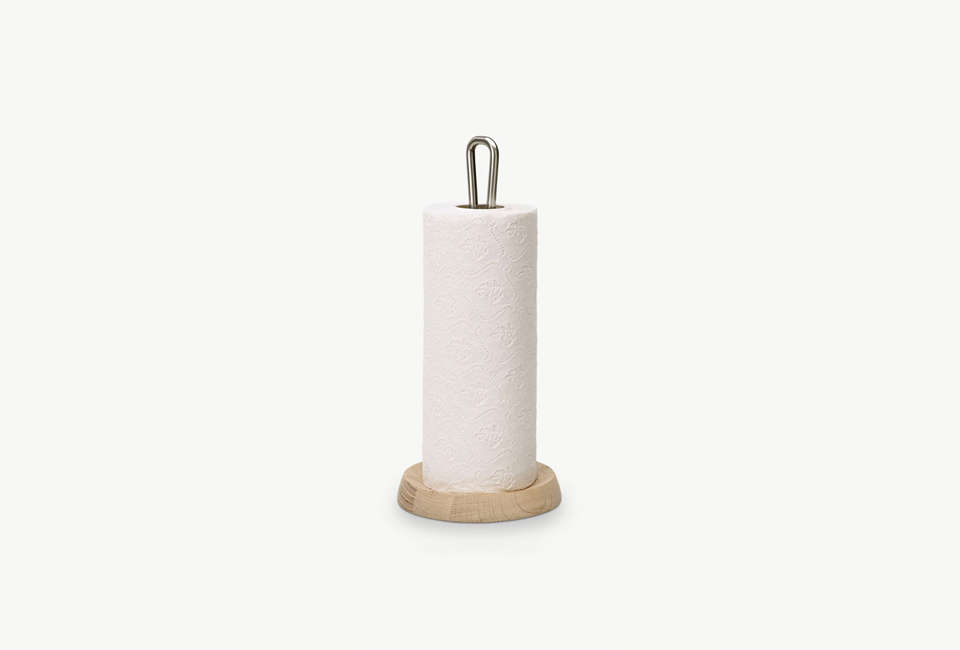
The Skagerak Bollard Paper Towel Holder – Oak proves that even a roll of paper towels can receive the Scandinavian-design treatment. Made with warm oak and a streamlined stainless-steel spindle, this countertop accessory turns an everyday cleaning supply into something you may willingly leave in full view.
That is no small victory. Most paper towel holders belong to the “hide it when company arrives” school of kitchen design. The Bollard takes the opposite approach, combining natural material, simple geometry, and practical proportions in a quietly polished object. It does not dispense towels through Bluetooth or flash when the roll is low. It simply performs its job while looking considerably more composed than anyone wiping marinara off the counter.
Skagerak Bollard Paper Towel Holder at a Glance
The Bollard was part of Skagerak’s earlier collection of Nordic kitchen accessories. An archived Skagerak catalog identifies the oak version as model S1835420, constructed from FSC Mix oak and stainless steel. The catalog lists a diameter of 14 centimeters and a height of 30.5 centimeters, equivalent to approximately 5.5 inches wide and 12 inches tall.
Some older retailer listings provide slightly different measurements, including approximately 12.5 by 12.5 by 30 centimeters. This discrepancy is probably related to rounding, measurement methods, or variations among archived listings. Anyone purchasing old stock or a preowned example should request current measurements from the seller rather than asking a kitchen shelf to participate in a surprise geometry lesson.
- Primary materials: Oak and stainless steel
- Catalog dimensions: Approximately 5.5 inches in diameter and 12 inches high
- Product number: S1835420
- Mounting style: Freestanding countertop holder
- Design character: Minimalist, warm, and distinctly Scandinavian
Why the Bollard Design Still Looks Fresh
A Familiar Form Reduced to Its Essentials
The name “Bollard” is unusually appropriate. A bollard is traditionally a sturdy upright post used on streets or docks, and this holder follows the same visual formula: a stable base supporting a strong vertical element. Skagerak refined that utilitarian shape until it became suitable for a calm, carefully arranged kitchen.
There is little visual clutter. The oak base supplies warmth and visible grain, while the stainless-steel post introduces a clean architectural line. The contrast keeps the holder from looking overly rustic or excessively industrial. It can sit beside a handmade ceramic bowl without pretending to be folk art, yet it also feels comfortable near stainless appliances and modern cabinetry.
Natural Oak Makes Every Holder Slightly Different
Oak is not a perfectly uniform material, which is part of its appeal. Grain direction, small color changes, and natural markings can differ from one piece to another. Those variations prevent the holder from feeling mass-produced in the anonymous, beige-plastic sense of the phrase.
Oak is also a sensible material for an accessory handled every day. Research on commercially important woods has long recognized oak for its strength, toughness, and durability. A paper towel holder will not encounter the demands of a bridge or ship deck, thankfully, but the same material qualities help it tolerate routine movement, loading, and countertop life.
How Well Does It Work?
Loading a Roll Is Refreshingly Simple
The open-post construction makes replacement uncomplicated. Lift off the empty cardboard tube, slide a fresh roll over the spindle, and return to whatever kitchen event required so many paper towels. There are no springs to compress, knobs to unscrew, or plastic pieces that suddenly launch themselves behind the refrigerator.
At about 12 inches tall, the Bollard is proportioned for common household rolls. Oversized or unusually wide rolls may extend beyond the base or fit more tightly, so buyers devoted to warehouse-size paper towels should compare the roll dimensions with the holder before purchasing.
It Prioritizes Simplicity Over One-Handed Dispensing
This is a traditional freestanding holder rather than a tension-controlled dispenser. It does not have a ratcheting center, weighted tearing arm, or spring-loaded brake. For the neatest tear, one hand may need to steady the roll while the other pulls along a perforation.
That tradeoff is worth understanding. The Bollard is ideal for people who value uncomplicated construction and restrained design. Someone who regularly grabs a sheet while holding a wet pan, a toddler, and the last fragment of patience may prefer a holder specifically engineered for one-handed tearing.
A Freestanding Format Adds Flexibility
Unlike wall-mounted and under-cabinet holders, the Bollard requires no drilling and can move wherever the mess happens. Place it beside the sink during meal preparation, carry it to the dining table for barbecue night, or move it outdoors for a covered-patio lunch. Its compact footprint uses a modest amount of counter space while keeping the roll upright and easy to see.
The same portability creates one limitation: it occupies a surface. In a very small galley kitchen, five or six inches of counter space may be prime real estate. Measure the intended location and remember to account for the paper roll itself, which can be wider than the wooden base.
Where the Oak Paper Towel Holder Fits Best
The Skagerak Bollard works naturally in Scandinavian, Japandi, contemporary, transitional, and modern farmhouse interiors. Its oak component connects visually with cutting boards, open shelving, knife blocks, and wooden cabinet pulls. The steel adds enough crispness to prevent the arrangement from becoming a lumber convention.
In a white kitchen, the holder introduces color and texture without disrupting a neutral palette. Against darker cabinetry, pale oak provides a subtle point of contrast. It can also soften kitchens dominated by stone, metal, and glossy appliances.
For a coordinated countertop, place the holder near one or two functional wooden objects rather than surrounding it with an entire forest of accessories. An oak tray, pepper mill, or cutting board is usually enough. Scandinavian design depends heavily on breathing room; every available inch does not need to audition for a home-decor catalog.
Oak Care and Everyday Maintenance
Wooden kitchen accessories last longer when they are protected from standing water, aggressive cleaners, and prolonged humidity. Wipe the Bollard with a soft, lightly damp cloth, then dry it promptly. A mild soap solution can handle ordinary grime, but the surface should not be soaked or placed in a dishwasher.
Clean the stainless-steel section with a soft cloth and wipe in a consistent direction to minimize streaks. Avoid abrasive pads, scouring powders, bleach, and harsh solvents. These products can damage the wood’s surface or leave scratches on the metal.
Keep the holder a reasonable distance from sinks where water routinely pools. It should also be separated from direct heat sources and intense, continuous sunlight. Wood naturally responds to moisture and temperature, so responsible placement helps reduce uneven color changes, dryness, or movement.
If an older example appears dry, consult product-specific care instructions before applying oil or another treatment. Unknown finishes do not always react well to enthusiastic home chemistry. Test any suitable product on an inconspicuous area first, use it sparingly, and remove excess promptly.
Sustainability and Product Longevity
The archived Skagerak catalog describes the oak used for the Bollard as FSC Mix. An FSC Mix label indicates that a product combines material from FSC-certified forests, recycled sources, or controlled wood under the certification system’s requirements. It is more meaningful than a vague leaf icon accompanied by the word “natural.”
Material sourcing is only one part of the environmental picture. Longevity also matters. The Bollard uses a small number of durable components and avoids trend-heavy decoration, giving it a better chance of remaining useful through several kitchen updates. A well-made object that stays in service is generally preferable to a sequence of inexpensive replacements that crack, discolor, or become clutter-drawer archaeology.
Skagerak was founded in Denmark in 1976 and later became part of Fritz Hansen. The broader Skagerak Collection continues to emphasize wooden furniture and accessories informed by Danish functionalism, durable materials, and repair-conscious design. However, sustainability claims should always be tied to the exact product and label, not automatically extended from an entire brand to every item it has ever made.
Bollard Versus the Current Norr Holder
Shoppers should not confuse the archived Bollard with Skagerak’s Norr Paper Towel Holder. The products have similar dimensions and both use oak, but they are separate designs. The Bollard pairs an oak base with a stainless-steel upright. The Norr, designed by Ditte Buus Nielsen, uses oak with leather and brass details, including a carrying loop and an edge intended to help control the loose sheet.
Current retailer searches are more likely to return the Norr. The Bollard may appear through old inventory, resale platforms, or vintage-design sellers. Verify the product number, materials, photographs, and condition before buying. A listing that shows a leather loop is describing the Norr, regardless of how creatively the title has been assembled.
What to Check Before Buying
Because the oak Bollard is an older design, availability and price can vary significantly. A discontinued label does not automatically make an object rare, and the word “vintage” should not be allowed to add three zeros without adult supervision.
- Confirm the model: Look for product number S1835420 and an oak-and-stainless-steel construction.
- Request exact dimensions: Archived sources do not agree completely, so measure both the holder and the intended space.
- Inspect the base: Ask about cracks, deep water marks, warping, dark rings, or separation around the center post.
- Examine the metal: Minor fingerprints are harmless, while corrosion, looseness, or major scratches deserve closer attention.
- Check stability: The base should rest flat and the spindle should remain straight and secure.
- Review return terms: This is especially important when buying old stock or a preowned item from photographs.
Is the Skagerak Bollard Paper Towel Holder Worth It?
The Bollard makes the most sense for someone who treats kitchen accessories as part of the room rather than equipment to be hidden. Its strengths are durable materials, compact proportions, simple loading, and a timeless combination of oak and stainless steel. It offers visual warmth without becoming decorative fluff.
It is less compelling for shoppers who need wall mounting, completely one-handed dispensing, or the lowest possible price. It also requires more thoughtful care than a plastic holder. Yet for a design-focused kitchen, the Bollard succeeds because it improves an ordinary object without making that object complicated.
Extended Everyday Experience: Living With the Bollard
The first noticeable change after placing a Skagerak Bollard on the counter is not mechanical; it is visual. A paper towel roll normally resembles temporary packaging that wandered into the kitchen and forgot to leave. On an oak-and-steel holder, the roll becomes part of an intentional arrangement. The effect is especially apparent on stone, stainless-steel, or solid-color countertops, where the grain of the oak provides a welcome organic detail.
During breakfast, the upright format keeps towels accessible without allowing the roll to travel across the counter like a very slow white tumbleweed. A sheet can be pulled for spilled coffee, sticky jam, or the mysterious puddle that appears beneath a child’s cup despite everyone insisting the cup never tipped over. For a clean tear, steadying the roll is usually the most reliable method. After a few uses, that two-handed motion becomes automatic.
The holder is equally useful during serious meal preparation. It can be moved closer to the work zone before handling vegetables, dough, or oily ingredients, then returned to its usual position when the counter is cleaned. Because it is freestanding, it adapts when the kitchen workflow changes. It can sit near the sink on an ordinary day and beside the grill tools when dinner migrates to a covered patio.
Its compact base feels manageable on an average counter, although the installed roll determines the true footprint. A bulky roll can visually overwhelm the holder and may brush nearby objects. Leaving a little open space around it makes the setup easier to use and preserves the restrained look that attracted most buyers in the first place.
Over time, the oak is likely to develop subtle character. Small shifts in tone and grain visibility are normal features of natural wood, not evidence that the holder is plotting its retirement. Promptly wiping splashes is the habit that matters most. A holder stationed directly beside a perpetually wet sink will demand more attention than one placed several inches away.
Entertaining reveals another advantage. The Bollard looks presentable enough to move onto a dining table or buffet when napkins are insufficient for ribs, fried food, or an ambitious tray of saucy appetizers. It does not resemble commercial cleaning equipment, and the combination of oak and steel works with ceramic, glass, and metal tableware.
The experience is ultimately quiet, which is appropriate. There is no dramatic feature to demonstrate to guests and no instruction manual requiring a weekend retreat. The holder makes rolls easier to locate, keeps them upright, and gives the countertop a more finished appearance. In daily use, its greatest luxury is that it performs reliably while asking for very little attentiona rare achievement for anything living in a busy kitchen.