There are organizers that merely hold your things, and then there are organizers that make you feel like you have your life together because your paper clips are living in a tiny, glossy, lidded home. Enamel bento boxes belong firmly in the second category.
Originally inspired by compartmented lunch containers, enamel bento boxes have escaped the lunch bag and wandered into every appealing corner of the house. They can hold sewing notions, tea bags, charging cords, hair ties, tiny tools, travel treasures, and the mysterious assortment of screws that apparently reproduce in kitchen drawers after dark. They are practical, durable-looking, and just decorative enough to sit out in plain sight without screaming, “I am storage!”
That is the charm. An enamel bento box is not a towering plastic bin demanding a label maker and a five-step system. It is a small, satisfying container with a lid. It asks very little of you: put the bits inside, close the lid, admire your suddenly civilized countertop.
Why Enamel Bento Boxes Feel So Special
Enamelware has a particular visual magic. The surface is made by bonding a glass-like enamel coating to a steel base, producing a finish that feels both nostalgic and clean-lined. That combination explains why enamel can look perfectly at home in a country kitchen, a modern apartment, a beach cottage, or a workspace where the desk has become a minor archeological dig.
Unlike clear plastic organizers, enamel boxes do not show every imperfect object inside them. That is a feature, not a flaw. Nobody needs to see the exact state of your spare-button collection, emergency batteries, loose guitar picks, or the tiny rubber feet that fell off something important three years ago.
The lidded format also creates visual calm. A collection of small objects can look like clutter when it spreads across a surface, but place the same items in one attractive box and suddenly it reads as intentional. It is the domestic equivalent of putting on sunglasses: the chaos is still technically there, but now it has a vibe.
What Makes a Bento Box Different From an Ordinary Tin?
In everyday American use, “bento box” usually means a compact container with compartments, removable dividers, or a neatly proportioned interior. In Japanese food culture, bento refers to the prepared meal itself, while the container is designed to keep components organized and secure during transport. Modern bento-style containers often use adjustable partitions or nesting containers because flexible spaces are easier to adapt to changing needs.
That flexible, contained logic is exactly why enamel bento boxes work so well outside the lunch category. Their shallow shape keeps small objects visible instead of allowing them to vanish beneath a pile. Their lid makes a surface look finished. Their compartments, when included, prevent a drawer from turning into a metallic soup of clips, coins, pins, and tiny objects whose purpose has been forgotten by all living humans.
Think of an enamel bento box as a little room with a roof. It gives your belongings an address, but it does not require you to become a full-time archivist.
Best Uses for Enamel Bento Boxes Around the House
1. The Entryway Drop Zone
Keys, earbuds, sunglasses, transit cards, lip balm, spare change, and the dog-walking bag clips all need somewhere to land. A medium enamel bento box placed on a console table turns the “I swear I put my keys here” problem into a much shorter conversation.
Organizing experts often recommend trays and shallow containers for daily essentials because they define a specific home for items that tend to migrate. The right container should be large enough to hold what you use, but not so oversized that it invites every random object in the house to move in permanently.
2. Desk Supplies That Deserve Better Than a Mug
A ceramic mug full of pens is fine. A ceramic mug full of pens, scissors, sticky notes, chargers, spare staples, and one suspiciously old granola bar is less fine. Enamel bento boxes are ideal for the small desk debris that does not stand upright gracefully.
Use one box for cables and adapters, another for paper clips and thumbtacks, and a third for your “I will deal with this later” items. That last category is not organizational failure. It is simply a holding pattern with excellent enamel.
3. Jewelry, Watches, and Everyday Accessories
A shallow enamel box can become a bedside landing pad for rings, watches, cuff links, hair clips, and the earring back that always disappears exactly when you are already late. Choose a box with soft corners or add a small fabric liner if you are storing delicate jewelry.
For a more thoughtful setup, divide accessories by routine: one compartment for weekday jewelry, one for hair accessories, one for travel-sized fragrance or lip products. The goal is not to recreate a luxury boutique display. The goal is to stop finding a necklace wrapped around your phone charger.
4. Craft Supplies and Small Creative Tools
Enamel bento boxes are nearly made for makers. They are excellent for embroidery floss, sewing needles, thimbles, buttons, knitting markers, watercolor pans, calligraphy nibs, stamp pads, beads, and tiny tubes of paint. A lidded box also makes it easier to pause a project without leaving the dining table looking like a very polite tornado passed through.
Give each box one job. For example, one can hold hand-sewing supplies, another can hold gift-wrapping extras, and another can serve as a portable “repair kit” with glue dots, safety pins, mini scissors, batteries, and a few spare fasteners. Small containers work best when they collect similar items rather than becoming a stylish witness-protection program for miscellaneous junk.
5. Kitchen Bits That Always Wander Off
There is no rule saying enamel bento boxes must hold food. In fact, their most useful kitchen job may be containing nonfood items: tea sachets, reusable clips, measuring spoons, loose packets of yeast, birthday candles, matches, recipe cards, cookie cutters, and those tiny tools that come with specialty appliances.
They also work beautifully as a countertop “tea station.” Fill one with tea bags, honey packets, a small spoon, and lemon candies. Place another near the coffee maker for filters, scoop clips, and single-serve treats. The kitchen becomes calmer, and you look like the sort of person who owns matching napkins on purpose.
How to Choose the Right Enamel Bento Box
Start With the Job, Not the Color
It is tempting to choose the prettiest box first and invent a purpose later. Resist, at least briefly. Measure the drawer, shelf, or tabletop where the box will live. Then decide what will go inside. Organizing advice consistently favors decluttering and measuring before buying containers, because a beautiful box that does not fit the space is just an expensive object waiting for a second chance at disappointment.
For jewelry and office supplies, choose shallow boxes. For cables, tea bags, or compact craft supplies, look for deeper sides. For travel, a box with a secure lid and rounded corners is generally easier to pack and clean. For everyday household bits, a simple rectangular format often uses drawer space more efficiently than a round container.
Consider Compartments Carefully
Built-in compartments are wonderful when your categories are stable. They are less wonderful when one section is the size of two almonds and your actual life contains charger bricks, measuring tapes, and normal human objects. Removable dividers are usually more versatile because the box can evolve with you.
One large open box can be surprisingly useful, too. Add small paper cups, fabric pouches, or mini reusable containers inside it to create flexible zones. This keeps the enamel box visually clean while letting you rearrange the interior without buying a whole new organizing system every time you discover a new hobby at 11:47 p.m.
Do Not Assume Every Lid Is Leakproof
A lidded enamel box is great for dry goods, objects, and neatly packed snacks, but it is not automatically a spill-proof container. If you plan to carry sauces, soups, dressings, or anything with the confidence of melted ice cream, choose a container specifically designed with a gasket or tested leak-resistant closure. Bento containers vary widely in seal design, portability, and cleanup needs.
Can You Use Enamel Bento Boxes for Food?
Yes, provided the product is intended and labeled for food use. Enamelware is commonly used for serving and food storage, but the exact care instructions depend on the manufacturer, the lid material, any silicone gasket, and whether the piece has decorative details or exposed hardware.
The major practical rule is simple: do not put an enamel box in the microwave unless the manufacturer explicitly says it is microwave-safe. Traditional enamelware has a steel core, and manufacturers of enamel cookware generally advise against microwave use.
For cold lunches, remember that an enamel box is not an insulated cooler. Perishable food still needs safe temperature control. The USDA recommends using an insulated lunch bag with at least two cold sources, such as gel packs or frozen drinks, to help keep cold foods at a safe temperature during transport.
In other words, an enamel bento box can make lunch look charming, but it cannot personally negotiate with mayonnaise. Pack smart.
How to Care for Enamelware Without Ruining Its Good Looks
One reason enamel bento boxes are so appealing is that they look substantial without feeling fussy. Still, they appreciate a little gentleness. Wash with warm, soapy water, avoid aggressive scouring tools, and dry thoroughlyespecially around rims, seams, and any areas where enamel meets exposed metal. Manufacturers commonly warn that prolonged soaking can encourage rust around edges or under rims.
A few small chips can be part of enamelware’s personality, much like freckles or a favorite jacket with one good story attached. But inspect a chipped piece before using it for food. If metal is exposed, follow the manufacturer’s instructions for cleaning and protecting the area. For nonfood storage, a minor chip is often more of an aesthetic decision than a functional disaster.
Skip steel wool, harsh oven cleaners, and abrasive powders unless the brand specifically recommends them. Enamel is tough, but it is not auditioning for a demolition show. Soft sponges, mild dish soap, and prompt drying will keep the finish glossy far longer.
Styling Ideas: Make Storage Look Like Decor
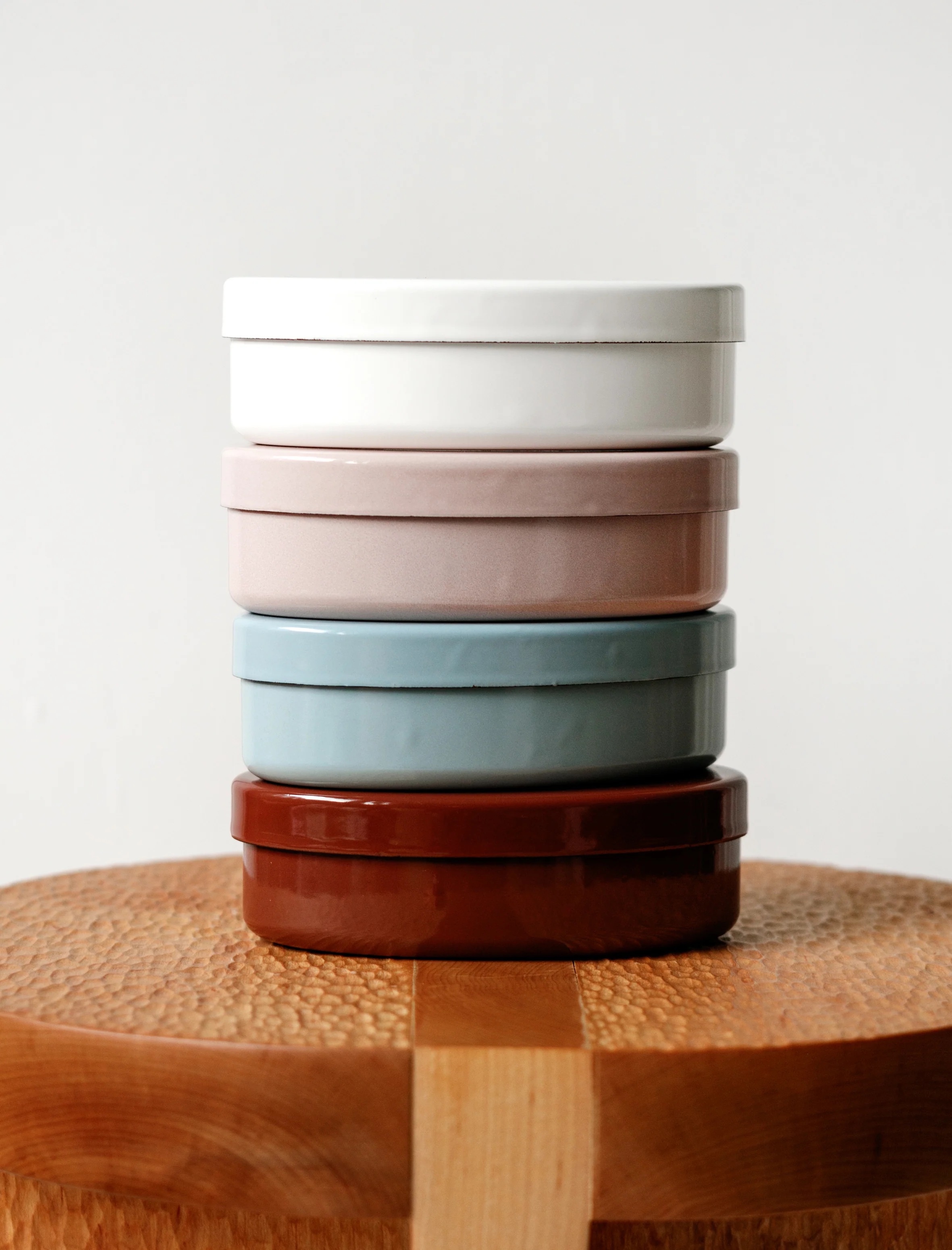
The easiest way to style enamel bento boxes is to treat them as part of a small collection. Stack two or three boxes in complementary colors on an open shelf. Pair a speckled white box with a wooden tray, a ceramic vase, and a linen towel. Use a bold box on a neutral desk for a small burst of color that has an actual purpose beyond looking photogenic.
For a quieter look, choose cream, charcoal, navy, soft green, or white with a dark rim. For more personality, try splatter patterns, tomato red, mustard yellow, cobalt blue, or playful stripes. The beauty of enamelware is that it can behave like vintage camp gear, modern Scandinavian storage, or cheerful cottage-kitchen decor depending on the color and setting.
Do not over-style them. One enamel bento box holding useful items looks intentional. Seven enamel bento boxes holding increasingly vague categories may begin to resemble a tiny, very well-dressed warehouse.
Currently Coveting: The Case for Small, Beautiful Containers
Most home organization advice focuses on going bigger: larger bins, wider shelves, deeper drawers, more systems. But small containers have their own quiet power. They force a limit. They create a boundary. They make you choose what deserves a home instead of letting every stray item build a tiny suburb on the counter.
That is why enamel bento boxes are so appealing. They are practical enough to use every day, attractive enough to leave visible, and compact enough that they encourage restraint. A box for cords means fewer cords. A box for mending supplies means you can actually find the mending supplies. A box for keys means fewer mornings spent searching under a pile of mail while muttering things that are not suitable for a lifestyle blog.
They are not going to reorganize your entire house. They will not fold your laundry, delete old emails, or convince your family that scissors have a designated drawer. But they can make one small zone easier to use, easier to reset, and nicer to look at. Sometimes that is more than enough.
Living With Enamel Bento Boxes: A Bits-and-Bobs Experience
The first enamel bento box I brought home did not have a grand purpose. It was small, cream-colored, lightly speckled, and had a lid that made a tiny satisfying click when it closed. I bought it because it looked like something that belonged on a kitchen shelf in a movie where everyone owns a bicycle with a basket and knows how to make soup without a recipe.
For several days, it sat empty on a counter while I considered important questions: Should it hold tea bags? Jewelry? Receipts? A single perfect lemon? Eventually, it became the home of the household’s most persistent travelers: charging cables, wall adapters, spare batteries, a USB drive, and a mysterious black cord that may or may not belong to a lamp from 2018.
The change was minor but weirdly satisfying. Instead of seeing the cable pile every time I walked into the room, I saw one neat enamel box. The cords had not become less tangled, more useful, or emotionally mature. They had simply stopped being visually loud.
That is the real pleasure of using enamel bento boxes for bits and bobs. They do not demand a perfect system. They work even when the contents are slightly unruly. A box can hold a category, not a spreadsheet. It can say, “These are the things that belong together enough,” which is often all the organization a real home needs.
Over time, I started noticing small pockets of clutter that could use the same treatment. A second box became the sewing repair kit: needles, thread, buttons, tiny scissors, safety pins, and a measuring tape that no longer had to live in three separate drawers. A third landed near the front door for spare keys, sunglasses, and the dog’s raincoat clips. Another became the unofficial tea box, which made the afternoon ritual of choosing a tea bag feel almost ceremonial instead of like rooting around in a cardboard package.
The boxes also turned out to be useful during those awkward transitional moments of daily life. You know the ones: when you are cleaning a room but cannot decide where something belongs; when you need to clear a table before dinner; when a guest is coming over and you have exactly seven minutes to make the living room look like no one has been living in it. An enamel bento box is a graceful temporary landing spot. It gives wandering objects somewhere to wait without turning them into a pile.
I learned, however, that every container has limits. A lovely little bento box is not permission to keep endless odds and ends forever. Once mine became difficult to close, I had to confront the truth: I did not own “useful extras.” I owned fifteen dead batteries, three pens without caps, an instruction booklet for a blender I no longer had, and a tiny key that opened nothing in the known universe.
That moment was oddly freeing. The box made the excess visible because it gave it a boundary. I kept what was useful, recycled what was not, and closed the lid again. The result was not a magazine-perfect home. It was better: a home where the small things had a place, the surfaces had room to breathe, and the ordinary act of finding a charger no longer felt like an escape room challenge.
That is why enamel bento boxes remain deeply covetable. They are little containers with outsized charm. They make everyday clutter feel considered, they age with character, and they offer a modest but meaningful promise: your bits and bobs may not be glamorous, but they can at least live somewhere beautiful.
Note: Follow the specific manufacturer’s care and food-use guidance for any enamel box, particularly when it has a gasket, exposed metal, decorative finish, or an unfamiliar lid material.