
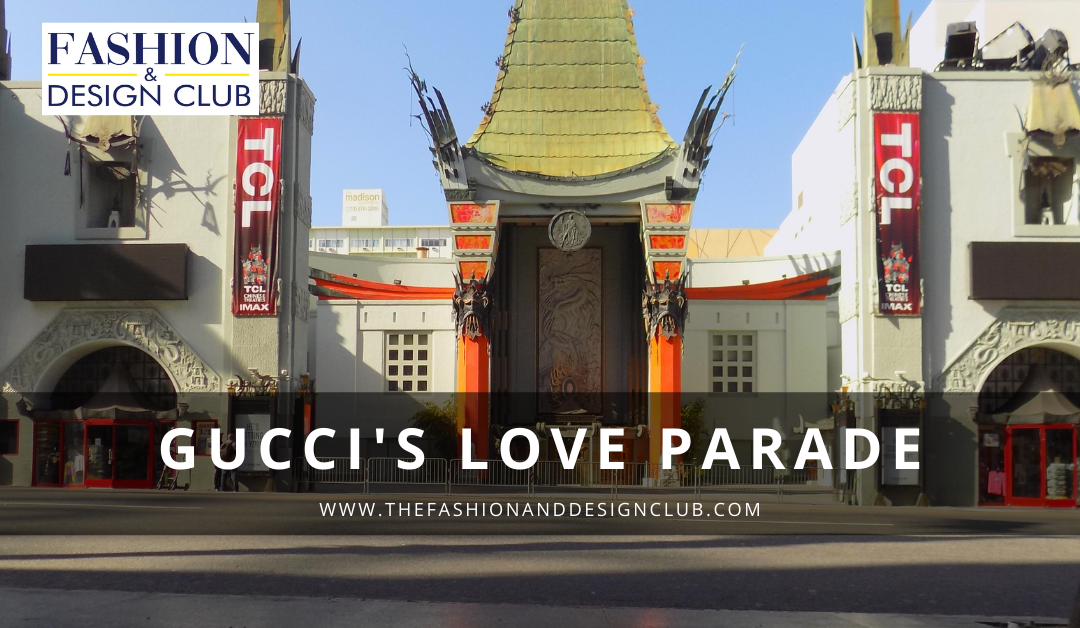
There are fashion shows, there are celebrity spectacles, and then there are moments when someone persuades Los Angeles to surrender a chunk of Hollywood Boulevard so models can walk over the stars. Gucci’s Love Parade belonged firmly to the third category.
Presented on November 2, 2021, Gucci Love Parade transformed one of the world’s most recognizable entertainment districts into the runway for the house’s Spring 2022 collection. Under creative director Alessandro Michele, Gucci did not simply borrow Hollywood glamour. It plunged into Hollywood mythology headfirst, mixing Golden Age references, decadent tailoring, lingerie, feathers, cowboy imagery, glittering gowns, and a cast in which professional models shared the pavement with famous actors and musicians.
The result was part fashion show, part movie premiere, part street party, and part very expensive fever dream. More importantly, Gucci’s Love Parade demonstrated how thoroughly Michele had turned the century-old Italian fashion house into a cultural universe rather than merely a clothing label.
Why Gucci Took Over Hollywood Boulevard
Hollywood was not chosen because somebody at Gucci found a glamorous location on Google Maps. Alessandro Michele’s fascination with cinema stretched back to childhood.
Growing up in Rome, Michele heard stories from his mother, who worked for a film production company. Through those stories, Hollywood became less a geographical place than an imaginary kingdom populated by glamorous figures, elaborate costumes, movie sets, transformation, beauty, and fantasy. His collection translated those childhood impressions into clothing decades later.
The setting therefore carried almost as much meaning as the clothes. Rather than constructing a Hollywood-inspired set in Milan, Gucci went directly to the source. Hollywood Boulevard, complete with neon signs, palm trees, the Walk of Fame, historic theaters, tourists, and the neighborhood’s slightly chaotic nighttime personality, became part of the production.
It was an inspired choice because Hollywood has never been purely elegant. It combines fantasy with grit, fame with disappointment, historic glamour with souvenir stores and street performers dressed like superheroes. Michele’s Gucci had always enjoyed similar contradictions. A crystal-covered gown could coexist happily with fetish-inspired jewelry, exaggerated tailoring, or a cowboy hat. Tasteful restraint was invited to the party, but it was not given control of the playlist.
A Gucci Centennial Celebration With Movie-Star Energy
Love Parade arrived during Gucci’s 100th-anniversary year. Founded in Florence in 1921 by Guccio Gucci, the house spent its centennial looking backward without behaving like a museum.
Earlier in 2021, Michele had already explored Gucci’s history through the Aria collection. Love Parade continued that conversation, but Hollywood provided a new stage on which different eras of Gucci could collide.
The collection contained echoes of Old Hollywood, hints of the provocative sexuality associated with Tom Ford’s Gucci years, and Michele’s unmistakable fascination with vintage references. Yet the point was not historical reenactment. These elements were scrambled together until time became pleasantly unreliable.
A dress might suggest a 1930s screen siren but feel perfectly suited to a contemporary awards show. A tuxedo could evoke classic movie stars while playing with modern ideas about gender. Western clothing appeared next to eveningwear, lingerie details appeared beside oversized suits, and extravagant accessories ensured nobody could accuse Gucci of being shy.
115 Looks and Almost No Interest in Minimalism
The Love Parade collection unfolded across roughly 115 looks, giving Michele plenty of room to explore his Hollywood obsession. Harper’s Bazaar highlighted the show’s combination of classic screen references, tailoring, marabou, sequins, lace, satin gloves, and cinematic character archetypes.
There were slinky gowns worthy of an imaginary movie premiere, tuxedos that played with masculine and feminine codes, sheer fabrics, feathers, corsetry, colorful tailoring, cowboy hats, dramatic outerwear, and enough sparkle to make the Walk of Fame look temporarily under-accessorized.
Instead of treating Hollywood glamour as a single aesthetic, Michele treated it as a costume warehouse with no closing time.
Old Hollywood Met Gucci’s Beautiful Weirdness
References to legendary cinema personalities ran throughout Gucci’s Love Parade. Marilyn Monroe, Rita Hayworth, Veronica Lake, Marlene Dietrich, Rock Hudson, Kim Novak, and other symbols of Hollywood glamour informed Michele’s visual vocabulary. But the references were usually filtered rather than copied directly.
That distinction matters. Nostalgia can become costume very quickly. Michele avoided that problem by combining familiar Hollywood signals with unexpected proportions, styling choices, and modern casting.
Tailoring Without Traditional Rules
One of the strongest themes was tailoring. Jackets appeared oversized, sharply structured, loosely worn, sometimes paired with little underneath. Tuxedo codes migrated between genders, continuing Michele’s long-running rejection of rigid men’s and women’s fashion categories.
The idea suited Hollywood perfectly. Actors transform for a living; Gucci treated clothing as another transformation device.
A jacket did not have to communicate corporate seriousness. It could be seductive, theatrical, humorous, or intentionally excessive. A tuxedo did not belong exclusively to one gender. A glamorous gown did not need to be delicate. Everything could switch roles.
Feathers, Sequins, Lingerie and Screen-Siren Drama
Elsewhere, the collection leaned enthusiastically into movie-star fantasy. Lace, satin, feathers, transparent materials, sparkling embellishments, and long evening silhouettes created the type of clothing that practically arrives with its own spotlight.
Some looks recalled boudoir dressing; others suggested fictional starlets escaping an after-party at 4 a.m. The combination of polish and deliberate dishevelment made the collection more interesting than a conventional tribute to red-carpet glamour.
Gucci’s Hollywood was beautiful, but it clearly had stories it was not telling its publicist.
The Celebrity Runway Became Part of the Story
One reason Gucci Love Parade generated attention far beyond fashion circles was its casting. Michele blurred the boundary between runway model and celebrity guest by placing recognizable performers directly into the show.
Jared Leto, Macaulay Culkin, Jodie Turner-Smith, Phoebe Bridgers, St. Vincent, Jeremy Pope, Miranda July, Steve Lacy, and other notable personalities appeared among the runway cast. Rather than functioning solely as front-row decorations, celebrities became characters inside Michele’s cinematic universe.
Macaulay Culkin’s appearance became an especially memorable surprise. Viewers accustomed to seeing him through decades of movie nostalgia suddenly found him strolling through a Gucci spectacle on Hollywood Boulevard. It was exactly the kind of pop-cultural collision Michele enjoyed creating.
Jared Leto, already closely associated with Michele’s Gucci and soon to appear in House of Gucci, naturally fit the show’s theatrical mood. His presence made the runway-film-celebrity relationship even more delightfully tangled.
The Front Row Was Practically an Awards Show
If Gucci’s runway had enough celebrities to populate a film festival, the audience was hardly suffering from a shortage.
Billie Eilish, Miley Cyrus, Lizzo, Dakota Johnson, Serena Williams, Diane Keaton, Awkwafina, Olivia Wilde, Tracee Ellis Ross, and other major names attended the Hollywood event. Gwyneth Paltrow attracted particular attention by wearing a new interpretation of the famous red velvet Gucci suit she had worn during Tom Ford’s era in the 1990s.
That outfit quietly summarized the entire evening. Gucci was celebrating its history without freezing it in place. A famous look from one creative era could return in another era, worn by the same Hollywood star, while an entirely new generation watched.
Fashion loves an archive reference. Fashion loves celebrity. Combining both is basically catnip with a velvet lapel.
Beauty Looks That Refused to Pick a Decade
The clothes were only part of Gucci Love Parade’s time-traveling experiment. The beauty direction also pulled from different periods of Hollywood history while avoiding straightforward vintage reproduction.
Makeup included relatively natural-looking skin alongside bleached eyebrows, expressive eye makeup, glossy lips, playful beauty marks, and combinations that could feel classic from one angle and eccentric from another. Vogue’s beauty coverage noted the collection’s mix of Old Hollywood cues and modern experimentation, including hand-drawn heart-shaped beauty marks.
The effect complemented the clothes perfectly. These were not supposed to look like historically accurate movie extras. They looked like people who had raided multiple decades of Hollywood dressing rooms and kept only the fun pieces.
Björk on the Soundtrack, Hollywood Underfoot
Music added another layer to the atmosphere. Models moved along Hollywood Boulevard to a soundtrack featuring Björk, including music familiar to longtime fans of the Icelandic artist.
Pairing Björk with Michele’s clothing made sense. Both artists have built careers around transformation, theatrical imagery, romance, fantasy, and the creative benefits of occasionally behaving as though ordinary rules are merely polite suggestions.
Meanwhile, the actual Walk of Fame functioned as the runway. Instead of fashion-industry flooring or a temporary stage, the models crossed pavement embedded with the names of entertainment legends.
That visual connection was almost too perfect: contemporary stars walking over literal stars while wearing a collection about Hollywood mythology. Subtle? Absolutely not. Effective? Completely.
Love Parade Was Also a Los Angeles Project
Gucci’s relationship with Los Angeles extended beyond the show itself. Around Love Parade, the company connected the event to its Gucci Changemakers initiative and support for local organizations.
Reporting ahead of the show described $1 million in grant support associated with Los Angeles organizations and programs, including groups serving LGBTQ communities, young people, education, mentorship, and people experiencing homelessness. Recipients and partners cited in coverage included YMCA Hollywood, Sole Folks, the Los Angeles LGBT Center, Happy Hippie Foundation, My Friend’s Place, and Los Angeles College Promise.
That component did not erase the obvious extravagance of closing a famous boulevard for an international luxury brand, but it broadened Gucci’s presence in the city beyond celebrity photography and product marketing.
Why Gucci’s Love Parade Mattered
Luxury fashion had already been moving away from the idea that every important collection must appear during a traditional fashion week in Paris, Milan, London, or New York. Love Parade showed what happens when a giant brand treats a runway collection as a global entertainment event.
Gucci chose its own date, selected one of America’s most recognizable streets, assembled actors and musicians alongside models, built a celebrity audience, and created images that circulated instantly across fashion magazines, entertainment outlets, social media, and celebrity news.
Fashionista described the event as Gucci’s first in-person runway presentation since 2020 and emphasized how unusual a spectacle of that scale felt in Los Angeles as the fashion world emerged from pandemic-era restrictions.
In that sense, Gucci Love Parade was not only about Spring 2022 clothing. It was evidence that modern luxury brands increasingly operate like entertainment studios. Collections become episodes. Celebrities become recurring characters. Locations become sets. Archive references become Easter eggs for devoted fans.
And everyone with a phone becomes part of the distribution department.
The Collection’s Larger Cultural Message
Underneath the spectacle was a serious idea about identity. Hollywood is built on people becoming somebody else. Michele’s Gucci similarly treated dressing as performance and experimentation rather than obedience to fixed categories.
The cast included different generations, backgrounds, body types, professions, and gender presentations. The clothes moved freely between conventional masculine and feminine codes. A person might appear tough, glamorous, vulnerable, eccentric, seductive, or all five before reaching the end of the block.
That openness had become central to Michele’s work at Gucci. Love Parade simply gave it the most appropriate possible backdrop: a neighborhood whose entire mythology is based on reinvention.
The show’s diversity also prompted deeper conversations about representation in fashion. Participants such as Janaya Future Khan discussed the importance of moving beyond symbolic inclusion toward meaningful, sustained change within the industry.
Experiencing Gucci’s Love Parade Beyond the Front Row
Rewatching the Show Feels More Like Watching a Movie
For someone discovering Gucci Love Parade through runway footage today, the most noticeable difference from a conventional fashion presentation is its sense of place. You are constantly aware that this is Hollywood Boulevard.
The pavement matters. The theater façades matter. The lights matter. The palm trees matter. Even the slightly surreal combination of luxury fashion and an ordinary public street matters.
Watching the looks emerge one after another feels less like browsing a catalog and more like meeting characters midway through a movie whose plot has mysteriously disappeared.
One person looks ready for a decadent premiere. Another appears to have wandered out of a Western. Someone else could be heading toward a nightclub in 1978, while the next seems dressed for a 1930s cocktail party that somehow has excellent Wi-Fi.
That inconsistency is the experience.
The Details Reward a Second Look
A quick viewing delivers celebrities and spectacle. A slower viewing reveals why the collection remains interesting.
Look at how masculine tailoring is softened or sexualized. Notice how lingerie elements appear beneath formal clothing. Watch old-fashioned gloves interact with contemporary proportions. Pay attention to sunglasses, jewelry, shoes, hats, and styling combinations that initially seem almost ridiculous but become strangely convincing after several seconds.
This is where Michele’s approach worked best. Individual pieces could be recognizableeven traditionalbut styling changed their personality completely.
A classic jacket was rarely allowed to remain merely a classic jacket. It might become oversized, worn against bare skin, combined with an unexpected accessory, or placed next to an item from an entirely different fashion vocabulary.
Hollywood Boulevard Makes the Fantasy More Complicated
Anyone who has walked Hollywood Boulevard knows it does not resemble an endlessly polished movie premiere. That is precisely why the location improves Love Parade.
Hollywood’s tourist shops, historic buildings, theaters, traffic, street characters, glamorous mythology, and urban rough edges sit side by side. Gucci did not need to create that tension because the neighborhood already supplied it.
Against that backdrop, the clothes feel less like precious objects protected inside a luxury bubble. They become costumes moving through a real city.
The contrast also explains why the event continues to produce memorable images years later. Place and fashion became inseparable. Remove Hollywood Boulevard and you still have an ambitious Gucci collection. Put it back, and you have Gucci Love Parade.
What Fashion Fans Can Take From the Show
You do not need a Gucci budgetor permission to close a major streetto borrow something from the Love Parade philosophy.
The easiest lesson is that clothing becomes more personal when references are mixed instead of copied. Vintage inspiration does not require dressing like an extra from a period drama. Western boots can work with formal clothing. An oversized blazer can coexist with something delicate. Evening pieces can appear during daylight. Men’s and women’s departments can be treated as suggestions rather than constitutional law.
The second lesson is that glamour becomes more interesting when it is slightly imperfect. Love Parade frequently balanced sophistication with eccentricity. A polished outfit could contain one element that felt rebellious, strange, or funny.
Finally, the collection offered a reminder that getting dressed can still be playful. Fashion sometimes becomes trapped in discussions about trends, investment pieces, resale value, algorithms, and what supposedly looks expensive. Michele’s Hollywood fantasy suggested another possibility: occasionally, clothing can exist simply because becoming a different version of yourself for an evening is fun.
That may be the most lasting experience of Gucci’s Love Parade. Beneath the celebrity casting, elaborate logistics, cinematic references, and luxury-industry machinery was a wonderfully simple proposition: dress up, invent a character, walk outside, and make an entrance.
Conclusion: Gucci Made Hollywood Part of the Collection
Gucci’s Love Parade succeeded because Hollywood was more than scenery. Alessandro Michele used the city as a bridge between childhood imagination, cinema history, Gucci’s own archive, contemporary celebrity culture, and his fascination with identity and transformation.
The November 2021 spectacle captured Gucci at peak Michele: maximalist, romantic, provocative, historically curious, inclusive in ambition, and completely uninterested in disappearing quietly into the background.
From Macaulay Culkin unexpectedly joining the runway to Gwyneth Paltrow revisiting a famous Gucci look, the evening continually folded different decades of popular culture into one another. Hollywood’s legends, contemporary celebrities, fashion history, and new design all occupied the same street.
Plenty of luxury brands can organize an expensive runway show. Love Parade did something harder: it created a recognizable world.
For one evening, Hollywood Boulevard stopped being merely the place where entertainment history is commemorated in brass stars. It became a moving Gucci moviecomplete with costumes, famous faces, dramatic lighting, a Björk soundtrack, and absolutely no shortage of sequins.
SEO Information
Note: This article is an original synthesis based on reporting and reference material from Gucci, Vogue, WWD, GQ, Variety, The Hollywood Reporter, Vanity Fair, Harper’s Bazaar, ELLE, Interview, Fashionista, the Los Angeles Times, and other established fashion and culture publications. The wording and analysis have been independently written for publication.













