
Editorial note: This article is written for web publication and is based on verified public information about Agnieszka Nienartowicz, her 2018 oil painting The Great Wave, and the historic artwork that inspired it: Katsushika Hokusai’s Under the Wave off Kanagawa.
A Contemporary Wave With an Old Soul
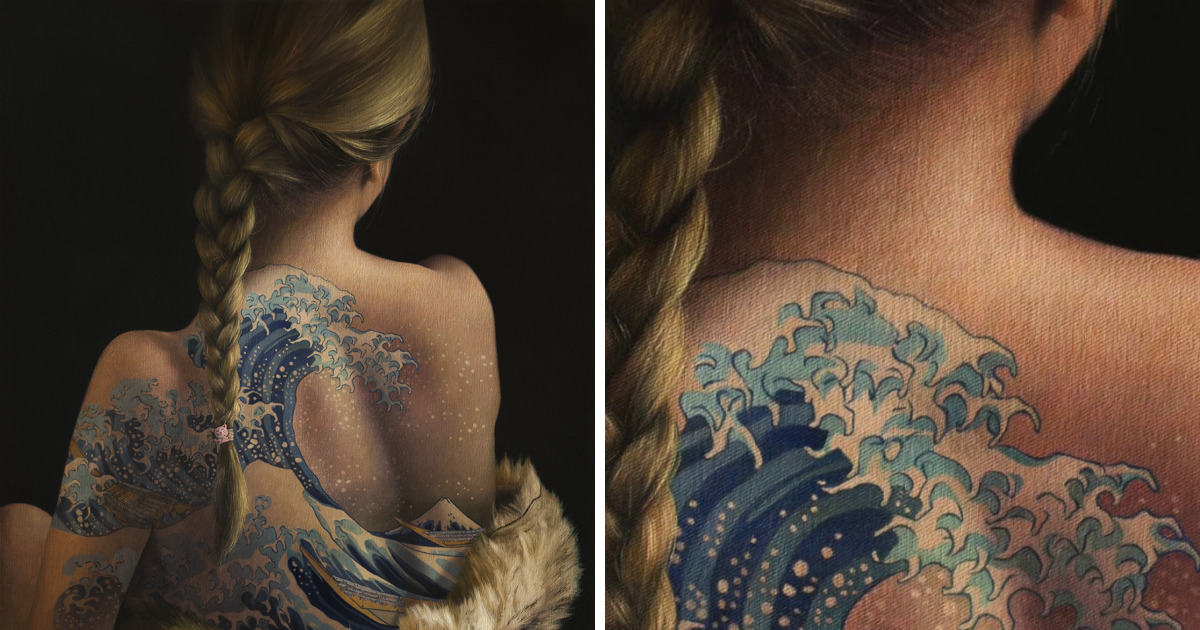
The Great Wave by Agnieszka Nienartowicz is one of those paintings that makes viewers do a double take. At first glance, the eye recognizes something familiar: the famous curling wave inspired by Katsushika Hokusai’s legendary Japanese print. Then the surprise arrives. This is not a museum reproduction, a poster, or a decorative art-history tribute. It is an oil painting in which the iconic wave appears as a tattoo-like image on the back of a contemporary female figure.
That twist is what gives the work its spark. Nienartowicz does not simply copy the past; she lets the past move onto the body. The result is elegant, strange, and quietly dramatic. It feels like art history went to a modern tattoo studio, asked for something meaningful, and walked out looking fabulous.
The painting, completed in 2018, measures 80 x 55 cm, or about 31.5 x 21.7 inches. It is painted in oil on canvas and directly references Hokusai’s The Great Wave off Kanagawa. Yet Nienartowicz’s version is not only about Hokusai. It is also about memory, identity, beauty, and the way famous images continue to live in new places.
Who Is Agnieszka Nienartowicz?
Agnieszka Nienartowicz is a Polish figurative realist painter known for highly detailed oil paintings that combine contemporary portraiture with references to Old Master, Renaissance, religious, and classical art. Born in Jelenia Góra, Poland, in 1991, she studied painting at the Academy of Fine Arts in Gdańsk and received her Master of Fine Arts in 2016. She lives and works in Kraków, Poland.
Her paintings often feature women whose skin carries elaborate images inspired by art history. These are not casual decorations. They function like emotional maps. A back, shoulder, or face becomes a living canvas where inherited culture, personal feeling, and historical memory meet. In other words, Nienartowicz paints people who seem to carry centuries on their skin.
This approach has made her work stand out in contemporary realism. While many modern painters move toward abstraction, digital aesthetics, or conceptual minimalism, Nienartowicz embraces technical precision. Her brushwork is polished, patient, and deeply observant. Fabric, skin, hair, shadow, and miniature detail are handled with impressive control. The result is realism with a pulse.
What Is The Great Wave Painting About?
The Great Wave by Agnieszka Nienartowicz shows a female figure from behind, with Hokusai’s famous wave reimagined across her back like a large tattoo. The body becomes the site where the old image is reborn. The painting is not loud or crowded. Its power comes from contrast: quiet skin against violent water, still posture against explosive movement, modern figure against historic masterpiece.
That contrast invites viewers to ask several questions. What does it mean to wear art history? Can a famous image become personal when placed on the body? Is the wave a symbol of danger, beauty, inheritance, or transformation? Nienartowicz does not answer these questions with a lecture. She lets the painting whisper, which is often far more interesting.
The wave itself carries emotional weight. In Hokusai’s original print, boats struggle beneath a towering surge, while Mount Fuji appears small and calm in the distance. The image can suggest nature’s power, human vulnerability, and the strange beauty of danger. When Nienartowicz moves that wave onto the human back, the drama becomes intimate. The storm is no longer only outside the body; it seems to live within memory, experience, and identity.
The Hokusai Connection
To understand Nienartowicz’s painting, it helps to understand the source image. Hokusai’s Under the Wave off Kanagawa, often called The Great Wave, was created around 1830–32 during Japan’s Edo period. It is a woodblock print from the series Thirty-six Views of Mount Fuji. The composition shows a huge claw-like wave curling over small boats, with Mount Fuji tucked into the distance.
Hokusai’s print became one of the most recognizable images in world art. Its influence spread far beyond Japan, inspiring artists, designers, collectors, and popular culture. You can find the wave on museum walls, notebooks, clothing, coffee mugs, phone cases, and probably on at least one tote bag owned by someone who says, “I just love Japanese art,” while also using it to carry groceries.
But the image remains powerful because it is more than decorative. The wave is dynamic and beautifully composed. It balances motion and stillness, fear and grace, scale and intimacy. Hokusai used strong design, rhythmic curves, and the famous Prussian blue pigment to create an image that still feels fresh nearly two centuries later.
Why Nienartowicz’s Version Feels So Modern
Nienartowicz’s The Great Wave works because it does not treat Hokusai’s image as a frozen relic. Instead, it asks what happens when a globally recognized artwork becomes part of a personal body. In modern life, people use tattoos to express memory, belief, grief, rebellion, beauty, faith, and belonging. By painting Hokusai’s wave as if it were a tattoo, Nienartowicz connects museum culture with contemporary self-expression.
This is not a simple “classic meets modern” formula. The painting has deeper tension. A tattoo is permanent, or at least it promises permanence. A wave is temporary, always moving, always disappearing. Placing a wave on skin creates a poetic contradiction: motion made still, water made flesh, an instant made lasting.
The painting also speaks to how famous images circulate today. Hokusai’s wave has been reproduced so many times that it can feel familiar even to people who do not know the title. Nienartowicz slows that familiarity down. She asks us to look again. By changing the context, she restores the image’s mystery.
Technique: Realism, Detail, and the Illusion of Tattooed Skin
One of the most impressive aspects of Nienartowicz’s painting is the technical illusion. The viewer is looking at oil paint on canvas, but the image suggests skin, tattoo ink, and three-dimensional form. That requires more than copying a famous wave. It requires understanding how an image bends across the body, how light touches skin, and how detail can remain readable without becoming stiff.
Nienartowicz’s realist method gives the painting its credibility. If the body were loosely painted, the tattoo effect might feel decorative. If the wave were too flat, it would not belong to the figure. Instead, the work balances both. The figure feels present and physical, while the wave retains its iconic rhythm.
This is where the painting becomes quietly clever. It is not only an artwork about another artwork. It is also a painting about painting itself. Nienartowicz is showing that oil paint can imitate skin, tattoo ink, fabric, light, and art-historical imagery all at once. That is not a small task. That is artistic multitasking without dropping the brushes.
The Symbolism of the Body as a Canvas
In many of Nienartowicz’s works, the body becomes a place where larger cultural stories appear. This idea is especially strong in The Great Wave. The figure’s back is not passive. It holds the wave like a secret, a burden, or a chosen emblem.
The back is also meaningful because it is both visible and hidden. We cannot see the figure’s face, so we are not guided by expression. Instead, we read posture, surface, and symbol. The absence of a face makes the painting feel universal. The viewer is not studying one individual’s biography. The viewer is considering how images attach themselves to human experience.
The wave may suggest emotional pressure, transformation, resilience, or the beauty of forces beyond control. It may also suggest the way culture moves through time. Hokusai created a print in nineteenth-century Japan. Nearly two centuries later, a Polish painter reimagined it in oil on canvas as a tattooed image on a modern figure. That journey alone is a wave.
Why the Painting Appeals to Art Lovers and Casual Viewers
One reason The Great Wave by Agnieszka Nienartowicz is so appealing is that it offers multiple entry points. Art historians can appreciate the Hokusai reference. Fans of contemporary realism can admire the technique. Tattoo enthusiasts can connect with the body-art concept. Casual viewers can simply enjoy the visual surprise.
The painting is also easy to remember. In a digital world packed with endless images, memorability matters. Nienartowicz’s concept is clear enough to catch attention, yet rich enough to reward a longer look. That combination is rare. Many artworks are either instantly catchy but shallow, or intellectually rich but visually quiet. This painting manages to be both accessible and layered.
It also fits beautifully into today’s broader interest in reinterpreting classical art. Modern audiences often enjoy seeing old images transformed in new contexts. But the best reinterpretations do more than remix the past. They create fresh meaning. Nienartowicz’s painting succeeds because it respects Hokusai’s image while giving it a new emotional setting.
How The Great Wave Fits Into Nienartowicz’s Larger Work
The Great Wave belongs naturally within Nienartowicz’s broader artistic practice. She often paints women whose bodies are marked by imagery from older masterpieces. Some works reference religious scenes, Renaissance painting, or Old Master compositions. These references are not random name-drops from art history. They are used to explore how inherited images shape emotion, belief, and identity.
Her work often feels meditative. The figures are usually calm, but the imagery on or around them can be intense. This contrast creates a psychological charge. A quiet figure may carry a dramatic biblical scene, a mythological image, or a turbulent wave. The stillness makes the symbol feel even stronger.
In The Great Wave, that formula is especially elegant. Hokusai’s image already contains drama. By placing it on a still figure, Nienartowicz compresses a vast seascape into a private, human-scale moment. The ocean becomes intimate. The famous becomes personal. The historical becomes alive again.
SEO-Friendly Art Analysis: Main Themes in the Painting
1. Art History Reimagined
The painting reinterprets Hokusai’s The Great Wave off Kanagawa through contemporary figurative realism. It turns a world-famous Japanese woodblock print into a body-based image, creating a dialogue between East Asian art history and European oil painting.
2. The Tattoo as Identity
The wave appears like a tattoo, suggesting that images can become part of personal identity. Tattoos often tell stories, and Nienartowicz uses that language to make art history feel intimate rather than distant.
3. Stillness Versus Motion
The figure is still, but the wave is full of energy. This contrast gives the painting its emotional rhythm. It feels calm and stormy at the same time, which is also an accurate description of many Monday mornings.
4. The Body as Museum
Instead of hanging the masterpiece on a wall, Nienartowicz places it on skin. The body becomes a museum, archive, and canvas all at once. This idea gives the painting a powerful contemporary edge.
5. Beauty With Tension
The painting is beautiful, but not merely pretty. The wave carries danger and force. The figure’s calmness makes that force feel internal, as if beauty and struggle are sharing the same quiet room.
What Viewers Can Learn From This Painting
The Great Wave by Agnieszka Nienartowicz reminds us that great images never really stay in one place. They travel across countries, centuries, materials, and meanings. Hokusai’s wave began as a woodblock print. In Nienartowicz’s hands, it becomes oil paint, tattoo, symbol, and psychological landscape.
The painting also teaches viewers to look beyond first impressions. At first, it may seem like a clever visual reference. But the longer one looks, the more questions appear. Why this image? Why on the back? Why this quiet pose? Why does the wave feel both decorative and deeply emotional?
That is the mark of a strong artwork. It gives pleasure immediately, then keeps opening doors.
Experiences and Reflections Related to The Great Wave Painting By Agnieszka Nienartowicz
Spending time with The Great Wave Painting By Agnieszka Nienartowicz feels different from scrolling past another attractive art image online. This is the kind of painting that slows the viewer down. At first, the famous wave grabs attention because almost everyone has seen some version of it before. But then the eye notices the human body beneath it, and the experience changes. The viewer is no longer looking at only a tribute to Hokusai. The viewer is looking at the relationship between image and identity.
One experience that makes the painting memorable is the feeling of recognition followed by surprise. Recognition says, “Ah, I know that wave.” Surprise says, “Wait, why is it here?” That small pause is where the painting becomes powerful. It transforms a familiar icon into something personal. Many people have seen The Great Wave reproduced on posters, shirts, mugs, and phone wallpapers. Nienartowicz’s version feels more intimate because it suggests that the image is not merely owned, displayed, or consumed. It is carried.
This idea connects strongly with modern experiences of tattoos. People often choose tattoos not simply because an image looks good, but because it means something. A tattoo may represent survival, memory, family, faith, grief, freedom, or a chapter of life that refuses to be forgotten. In that sense, Nienartowicz’s painted wave can be read as a symbol of inner weather. Everyone carries storms. Some are visible. Some are private. Some are beautiful only after enough time has passed.
The painting also creates an interesting viewing experience because the figure’s face is hidden. Without facial expression, the viewer cannot easily assign a mood. Is the person calm, burdened, proud, vulnerable, or transformed? The answer depends partly on the viewer. That openness makes the painting more universal. It allows different people to bring their own emotional history to the image.
For someone who loves museums, the painting may feel like a conversation between old and new art. For someone interested in tattoos, it may feel like a meditation on the body as a storytelling surface. For someone facing change or uncertainty, the wave may feel like a symbol of pressure and resilience. That flexibility is part of the painting’s strength.
There is also a practical lesson for artists and creative people. Nienartowicz shows that inspiration does not mean imitation. She borrows from Hokusai, but she does not flatten his work into decoration. Instead, she changes the context and creates a new emotional structure. That is a useful reminder for anyone making art, writing, designing, or building ideas from existing culture. The goal is not to pretend the past does not exist. The goal is to meet it honestly and add something alive.
In the end, the experience of this painting is both visual and reflective. It is beautiful enough to attract attention, but thoughtful enough to keep it. Like the original wave, Nienartowicz’s version suggests motion, danger, elegance, and endurance. But by placing the wave on a human back, she adds one more idea: sometimes the greatest waves are the ones we carry quietly.
Conclusion: Why This Great Wave Still Moves
The Great Wave by Agnieszka Nienartowicz is a compelling example of contemporary figurative realism that respects art history while refusing to leave it untouched. By reimagining Hokusai’s famous wave as a tattoo-like image on the human body, Nienartowicz creates a painting that feels both historic and modern, quiet and dramatic, familiar and surprising.
The work succeeds because it understands the emotional life of images. Hokusai’s wave has traveled through time as a symbol of beauty, danger, nature, and resilience. Nienartowicz gives that symbol a new home on the body, reminding viewers that art history is not locked behind museum glass. It can live on skin, in memory, and in the private storms people carry every day.
For collectors, art students, tattoo lovers, and curious readers, this painting offers a rich subject to explore. It is technically impressive, conceptually sharp, and visually unforgettable. In a world overflowing with images, The Great Wave Painting By Agnieszka Nienartowicz still manages to rise above the noise.














