
Note: This article is written for web publication and is based on verified flag-history, museum, encyclopedia, government, and news-reference information. No source links are inserted in the body copy.
Spotting a red, black, and green flag can feel like playing a tiny, high-stakes round of “Guess Who?” except the clues are stripes, symbols, and whether a shield, sun, crescent, star, or triangle decided to join the party. The quick answer is this: if the flag has three simple horizontal stripes in red, black, and green, it is most often the Pan-African flag, also called the Black Liberation flag, UNIA flag, or Marcus Garvey flag. But several national flags use the same powerful color family, including Kenya, Malawi, Libya, and the former Islamic Republic of Afghanistan tricolor.
This guide gives you a fast, practical way to identify the red, black, and green flag without falling into the classic internet trap of declaring every tricolor “definitely Kenya” while ignoring the giant shield in the middle. We will look at the most common versions, what the colors mean, and how to tell similar flags apart in seconds.
Quick Answer: Which Red, Black, and Green Flag Are You Seeing?
The most common red, black, and green flag is the Pan-African flag. Its classic design has three equal horizontal stripes: red on top, black in the middle, and green on the bottom. It is widely used as a symbol of Black pride, African diaspora identity, liberation, unity, and cultural heritage.
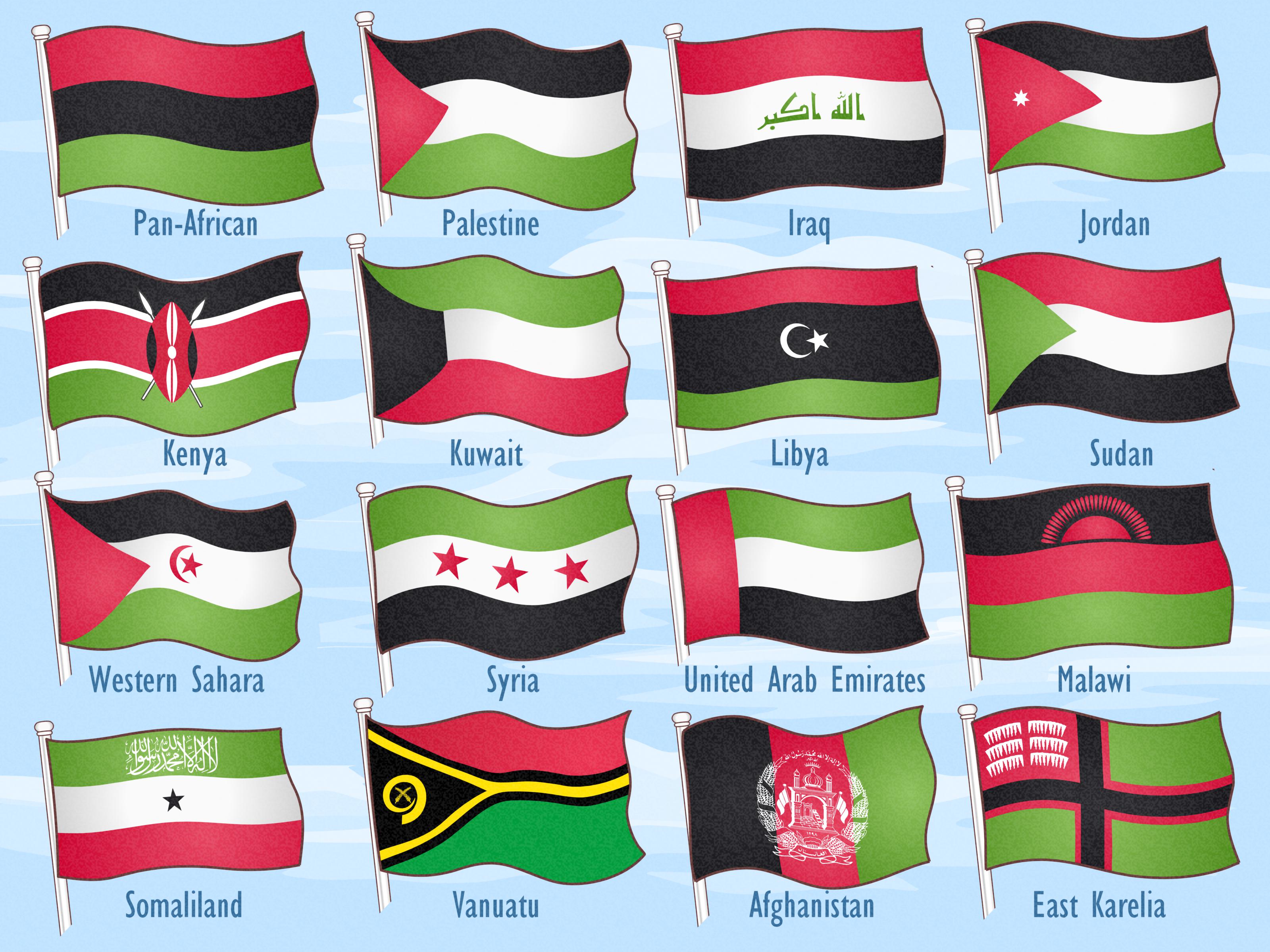
However, the same color combination appears in several national and political flags. The easiest way to identify the right one is to check three things: stripe direction, extra symbols, and whether white is also part of the design. A plain red-black-green horizontal tricolor usually points to the Pan-African flag. A black-red-green horizontal flag with a red rising sun is Malawi. A black-red-green horizontal flag with white divider lines and a central shield is Kenya. A red-black-green flag with a white crescent and star is Libya. A black-red-green vertical tricolor with an emblem is associated with Afghanistan’s former republic-era flag.
The Pan-African Flag: Red, Black, and Green in Its Most Recognized Form
The Pan-African flag is the design many people mean when they ask, “What’s the red, black, and green flag?” It features three horizontal bands: red, black, and green. It was adopted in 1920 by the Universal Negro Improvement Association, an organization led by Marcus Garvey. The flag became a lasting symbol of Black liberation, African pride, and solidarity among people of African descent around the world.
In everyday American life, you may see this flag during Black History Month, Juneteenth celebrations, cultural festivals, campus events, community marches, art installations, and family gatherings. It also appears on clothing, pins, murals, posters, and window displays. It is not a national flag of one country. Instead, it represents a broader identity and movement.
What Do the Colors Mean?
The color meanings are often explained this way:
- Red represents the blood shed in the struggle for freedom and liberation.
- Black represents Black people and people of African ancestry.
- Green represents Africa’s land, natural wealth, growth, and future hope.
The flag’s strength comes from its simplicity. No coat of arms, no busy icon, no tiny detail that requires binoculars and a history degree. Just three bold colors with deep cultural meaning. It is a flag that says a lot without trying to win a design contest by adding thirteen stars, a bird, a sword, a mountain, and a tiny scroll nobody can read from across the street.
How to Identify Red, Black, and Green Flags Fast
Use this quick ID method when you see a red, black, and green flag online, at a protest, in a classroom, on a sticker, or flying outside a building.
1. Plain Horizontal Red-Black-Green? Pan-African Flag
If the stripes are horizontal and the order is red on top, black in the middle, and green on the bottom, with no extra symbol, it is most likely the Pan-African flag. This is the classic Black Liberation flag associated with Marcus Garvey and the UNIA tradition.
2. Black-Red-Green With a Shield? Kenya
The flag of Kenya has horizontal black, red, and green bands separated by thin white stripes. In the center, it features a Maasai shield and crossed spears. The white lines help distinguish it from the plain Pan-African flag, while the shield makes the identification almost instant. If the flag looks like it is ready to defend itself, you are probably looking at Kenya.
3. Black-Red-Green With a Rising Sun? Malawi
The flag of Malawi has three horizontal bands: black at the top, red in the middle, and green at the bottom. A red rising sun appears in the black stripe. That sun is the big clue. If the red, black, and green flag has a sunrise on it, think Malawi.
4. Red-Black-Green With Crescent and Star? Libya
The Libyan flag has three horizontal bands: red on top, a wider black band in the middle, and green at the bottom. A white crescent and star sit in the center of the black stripe. The black band is thicker than the red and green bands, which makes Libya’s flag stand out from other tricolors. If you see the crescent and star, Libya is the quick ID.
5. Vertical Black-Red-Green With Emblem? Afghanistan’s Former Republic-Era Tricolor
The black, red, and green vertical tricolor is strongly associated with Afghanistan’s former Islamic Republic flag. It includes a central national emblem. Since the Taliban returned to power in 2021, Afghanistan’s flag status has been politically complicated: the Taliban uses a white flag with black religious script, while the black-red-green tricolor remains visible in diaspora, diplomatic, sporting, and resistance contexts. So if you see a vertical black-red-green flag with an emblem, the safest wording is: “the former Afghan republic-era tricolor” or “Afghan tricolor,” depending on context.
Red, Black, Green, and White: Common Look-Alikes
Some flags are close cousins but not exactly red, black, and green only. They add white, yellow, or other symbols. These flags can confuse quick searches because the eye sees the three main colors first and politely ignores the extra details until someone in the comments section arrives with a correction.
Palestinian Flag
The Palestinian flag has horizontal black, white, and green stripes with a red triangle at the hoist. It is often mentioned in the same conversation because it includes red, black, and green, but white is a major part of the design. The red triangle is the fastest clue.
Jordanian Flag
Jordan’s flag also has black, white, and green horizontal bands with a red triangle at the hoist, plus a white seven-pointed star inside the triangle. If there is a star in the red triangle, Jordan becomes a strong candidate.
Syria and Arab Revolt-Inspired Flags
Several flags in the Arab world use black, white, green, and red because those colors are associated with Arab historical dynasties and the Arab Revolt tradition. Syria-related flag designs, for example, have used these colors in different stripe arrangements. The key lesson: if white is a full stripe, do not call it simply “the red, black, and green flag.” It belongs to a different family of flags.
Mozambique
Mozambique’s flag includes green, black, yellow, white, and red, with a red triangle at the hoist and national symbols inside it. It is not a plain red-black-green flag, but it may appear in search results because the major colors overlap. The yellow star and emblem details are the giveaway.
Why Red, Black, and Green Became Such Powerful Colors
Red, black, and green are not random “looks good on a banner” choices. In the Pan-African tradition, they create a visual language of memory, peoplehood, sacrifice, land, and future possibility. That is why the colors appear in community spaces and cultural observances far beyond formal flagpoles.
During Juneteenth celebrations, for example, many people display red, black, and green alongside the official Juneteenth flag, which is red, white, and blue. Both can be meaningful, but they do not mean exactly the same thing. The Pan-African colors emphasize Black liberation and African diaspora unity. The Juneteenth flag emphasizes the delayed but historic announcement of emancipation in Galveston, Texas, on June 19, 1865, and the ongoing place of Black Americans in the United States story.
That overlap explains why stores, schools, cities, and families sometimes use both sets of colors. The visual language can be layered: one flag points to a specific American historical date, while the red-black-green palette points to a broader global heritage.
Quick ID Table: Red, Black, and Green Flags
| Flag | Main Design | Fastest Clue | Best Quick ID |
|---|---|---|---|
| Pan-African Flag | Horizontal red, black, green stripes | No symbol, red on top | Black Liberation / Pan-African identity |
| Kenya | Black, red, green with white dividers | Shield and crossed spears | National flag of Kenya |
| Malawi | Black, red, green horizontal stripes | Red rising sun on black stripe | National flag of Malawi |
| Libya | Red, wide black, green horizontal stripes | White crescent and star | National flag of Libya |
| Afghan Tricolor | Vertical black, red, green stripes | Central emblem | Former republic-era Afghan tricolor |
| Palestine | Black, white, green stripes with red triangle | White stripe and red hoist triangle | Palestinian flag |
| Jordan | Black, white, green stripes with red triangle | White star inside triangle | Jordanian flag |
Common Mistakes When Identifying the Red, Black, and Green Flag
Mistake 1: Ignoring Stripe Order
Stripe order matters. The Pan-African flag is red, black, green from top to bottom. Malawi is black, red, green. Libya is red, black, green, but the black stripe is wider and has a crescent and star. Kenya is black, red, green with white separators and a shield. The same colors can tell completely different stories depending on their order and symbols.
Mistake 2: Treating Every Similar Flag as a Country Flag
The Pan-African flag is not the flag of one modern nation-state. It is a cultural and political symbol. Calling it “the flag of Africa” is also too broad. Africa is a continent with many countries, each with its own flag. The Pan-African flag represents a movement, identity, and heritage, not a single government.
Mistake 3: Forgetting White Changes the Category
If a flag includes a major white stripe, you may be looking at a different design family. Palestine, Jordan, Sudan, the United Arab Emirates, Syria-related flags, and other Arab-color flags use red, black, white, and green. They are not the same as the plain red-black-green Pan-African flag.
Mistake 4: Not Checking the Context
Context matters. A red-black-green flag at a Juneteenth event in the United States probably signals Pan-African pride or Black liberation. The same color set at a soccer match, embassy, or international conference might be a national flag. On a social media profile, the meaning may depend on the user’s identity, politics, or cultural message.
Real-World Examples: Where You Might See the Red, Black, and Green Flag
You might see the Pan-African flag at a Black History Month program, on a city building during a commemorative event, or in a classroom lesson about Marcus Garvey and the African diaspora. You might also see it in art, especially works that reimagine American symbols through Black cultural identity. David Hammons’s famous African-American Flag, for instance, replaces the red, white, and blue of the U.S. flag with Pan-African colors, creating a powerful visual conversation about national belonging and Black identity.
You may see Kenya’s flag during international athletics events, tourism campaigns, cultural festivals, or news coverage from East Africa. You may see Malawi’s flag in travel, geography, or African independence history lessons. Libya’s red-black-green flag is common in news coverage and diplomatic contexts. The Afghan tricolor can appear in sports and diaspora settings, especially when athletes or communities are representing pre-Taliban national identity.
Experience Notes: What It Feels Like to Identify This Flag in Real Life
The first time many people notice the red, black, and green flag, it is not in a textbook. It is usually on a porch, a T-shirt, a festival booth, a mural, a graduation stole, a car decal, or a photo from a community event. That is part of what makes the flag interesting. It travels easily. It does not need a formal flagpole to carry meaning. It can show up on a handmade poster, stitched into a jacket, painted on a wall, or printed on a small button at a neighborhood market.
In real life, the fastest way to identify it is to pause before guessing. That pause is useful because red, black, and green can lead you in several directions. If the flag is plain and horizontal, red-black-green, it is probably Pan-African. If there is a shield, it is Kenya. If there is a rising sun, it is Malawi. If there is a crescent and star, it is Libya. If the stripes are vertical and there is an emblem, it may be the Afghan tricolor. The process feels a little like reading a visual sentence: the colors are the nouns, the stripe order is the grammar, and the symbols are the punctuation marks.
One practical experience is seeing the flag during Juneteenth. A person may expect only the official Juneteenth flag, then notice red, black, and green banners everywhere. That can be confusing at first, but it makes sense when you understand the difference. Juneteenth is a specific historical commemoration, while the Pan-African colors connect the celebration to a wider story of African heritage, Black freedom, and cultural pride. In that setting, the red-black-green flag often feels less like decoration and more like a family tree in color form.
Another common experience happens online. Someone posts a red, black, and green flag emoji-style graphic, and the comments immediately become a miniature geography quiz. One person says “Kenya,” another says “Pan-African,” another says “Malawi,” and someone else arrives with the confidence of a substitute teacher holding a laminated world map. The solution is usually simple: look for the extra marks. Symbols settle the debate faster than vibes.
The flag can also be personal. For some families and communities, the Pan-African flag is not just historical information; it is a statement of belonging. It can honor ancestors, express pride, mark resistance, or connect a local celebration to a global African diaspora. That is why it appears in solemn spaces and joyful spaces alike. It can hang near a speaker’s podium during a lecture, wave over a parade route, or appear in the background of a family photo where nobody explains it because everyone in the room already knows.
From a practical standpoint, learning to identify red, black, and green flags makes you more visually literate. You start noticing how flags compress history into simple shapes. A stripe can represent land. A color can carry memory. A shield can speak of defense. A sun can signal hope. A crescent and star can point toward regional and religious heritage. A triangle can place a flag in a completely different political tradition. Once you know that, flags stop being random rectangles and start behaving like tiny history books flapping in the wind.
Conclusion: The Fastest Way to Name the Red, Black, and Green Flag
If you need the quickest answer, remember this: a plain horizontal red, black, and green flag is usually the Pan-African flag. If it has a shield, it is Kenya. If it has a rising sun, it is Malawi. If it has a crescent and star, it is Libya. If it is vertical with an emblem, it likely points to Afghanistan’s former republic-era tricolor. If white is a major stripe, slow down because you may be looking at Palestine, Jordan, or another Arab-color flag instead.
The red, black, and green flag is powerful because it is both easy to recognize and rich with meaning. It can represent liberation, identity, sacrifice, land, unity, heritage, and hope. That is a lot of weight for three stripes to carry, but somehow they manage. Flags are dramatic like that.













