
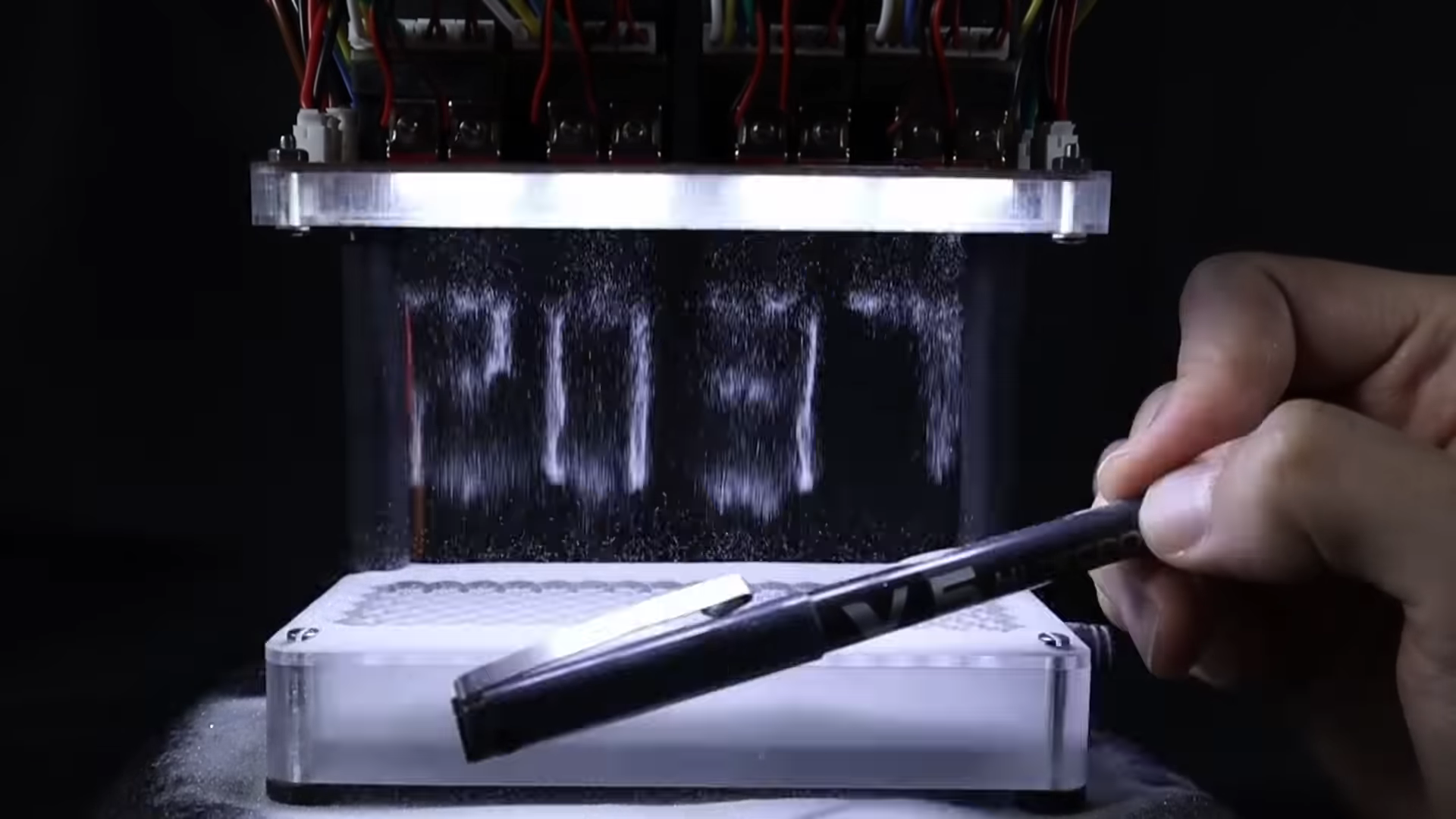
Most clocks are a little too good at being boring. They sit there on a wall, on a phone screen, or on a microwave, quietly judging your time management while doing almost nothing to earn your attention. Then along comes a POV digital clock that tells time with falling sand, carefully timed light, and a delightful amount of engineering audacity. Suddenly, the humble clock is no longer just a machine. It is a performance.
That is what makes the idea behind a persistence-of-vision clock built from literal grains of sand so irresistible. Instead of using a traditional display, this concept relies on precisely released slugs of sand and well-timed LEDs to form readable digits in mid-fall. It sounds like something a mad scientist would sketch on a napkin while waiting for coffee. Yet it also feels weirdly poetic. After all, sand clocks and hourglasses have symbolized the passing of time for centuries. Marrying that ancient image with digital control turns the old “sands of time” phrase into an actual user interface.
And that is the magic here. This is not just a novelty clock. It is a collision of history, physics, design, and maker culture. It takes one of humanity’s oldest visual metaphors for time and rebuilds it with microcontrollers, LEDs, and precision mechanics. In a world where most gadgets are trying to disappear into sleek black rectangles, this one practically throws glitter in the air and says, “No, no, watch this.”
Why This POV Digital Clock Grabs Attention So Fast
The reason people stop scrolling when they see a digital sand clock is simple: it makes time visible in a way most modern devices do not. A normal digital clock gives you numbers. This one gives you motion, material, and drama. You are not just reading the time. You are watching it happen.
That difference matters. For centuries, timekeeping devices were physical things with presence. Hourglasses had to be flipped. Mechanical clocks ticked. Pocket watches snapped shut with theatrical flair. Modern timekeeping is more accurate than ever, but it is also emotionally flatter. The time on your phone is useful, sure, but it has all the romance of a spreadsheet cell.
A POV clock made from sand brings back some of that presence. It turns time from abstract data into an event. You can almost feel the connection between ancient sandglasses and modern display technology: one measures time through falling particles, the other tricks the eye into seeing a stable image from carefully timed flashes. Put them together and you get something that feels both futuristic and oddly prehistoric, like a smartwatch designed by an archaeologist with access to a soldering station.
How the Clock Actually Works
Persistence of Vision, Minus the Textbook Headache
The “POV” in POV digital clock stands for persistence of vision. In plain English, your eye and brain briefly hold onto an image after it disappears. When visual information changes fast enough, separate flashes blend into what looks like one continuous image. It is the same basic principle that helps movies feel smooth and lets certain LED displays appear to draw pictures in midair.
Many maker-built POV displays use spinning LEDs. A row of lights rotates quickly, and the timing of the flashes creates letters, symbols, or even 3D-looking forms. That is already cool. But the sand-based version adds a glorious twist: instead of using a spinning strip of LEDs as the main visible medium, it uses falling grains of sand that are illuminated at precisely the right moment. The result is a readable set of digits made from moving particles. Yes, actual sand. Because apparently regular engineering was not dramatic enough.
Why Sand Is a Brilliantly Difficult Material
Using sand in a time display sounds charming until you remember that sand is stubborn. It clumps, jams, scatters, abrades, and generally behaves like a tiny beige union of chaos. Unlike pixels on a screen, sand does not naturally line up and cooperate. So the engineering challenge is not just making light appear in the right place. It is making the sand fall in consistent, well-formed bursts.
That is why the clock’s design is so impressive. The system relies on a hopper and solenoid-controlled gates to release small amounts of fine sand at specific moments. Each digit is built through coordinated control of multiple gates, while LEDs illuminate the falling grains so the eye perceives a complete number. In other words, the clock is doing a tiny dance between mechanics, electronics, timing, and physics every time it shows the hour.
Even the material choices matter. Sand quality, particle size, dryness, neck width, and flow consistency have always been crucial in traditional hourglass design. Those same concerns still matter here, just in a more modern and far more theatrical package. This is not merely a light trick. It is granular choreography.
Why “The Literal Sands of Time” Is Such a Perfect Description
An Ancient Symbol Gets a Digital Upgrade
The phrase “sands of time” works because hourglasses are one of humanity’s clearest symbols for life passing moment by moment. You do not need a manual to understand them. Sand falls. Time goes with it. That visual metaphor has survived for centuries because it is intuitive, tactile, and just a little dramatic in the best possible way.
This POV digital clock keeps that symbolism intact while updating the technology. Traditional hourglasses are calibrated to track a fixed duration. This device borrows the imagery but uses digital control to display changing numbers. It is not replacing the meaning of the hourglass. It is remixing it. Think of it as the ancient sandglass getting a firmware update and suddenly realizing it can do tricks.
That blend of old and new is what gives the concept real design value. It is not innovation for innovation’s sake. The form and function actually speak to each other. Sand is not just decorative. It is the message. The clock uses a material long associated with time to render time itself. That is the kind of design move that makes people lean in a little closer and say, “Wait, what am I looking at?”
Analog Emotion, Digital Precision
Great design often happens when emotional meaning meets technical control. This clock nails that balance. The digital clock side brings precision, repeatability, and programmability. The sand side brings texture, fragility, motion, and metaphor. Put them together and you get something more memorable than either one alone.
That is also why the project feels more like an art object than a mere gadget. It does not chase perfect efficiency. In fact, a normal LCD panel would be cheaper, quieter, and much easier to live with. But nobody writes love letters to an LCD panel. Nobody gathers around one like it is a campfire for nerds. This clock is valuable because it turns a simple function into an experience.
What This Says About Modern Timekeeping Design
People Want Objects That Feel Alive
One reason unusual clocks keep attracting attention is that timekeeping has become almost invisible. Phones, laptops, smart speakers, TVs, car dashboards, ovens, and fitness bands all show time constantly. Accuracy is abundant. Meaning is not. So designers and makers keep experimenting with ways to make clocks feel alive again.
That is why you see continued fascination with kinetic clocks, projection clocks, LED matrix clocks, Nixie-inspired builds, and smart hourglass concepts. Some lean into nostalgia. Others chase minimalism. But the best ones do something deeper: they make the passage of time feel embodied. A persistence-of-vision clock made from sand does exactly that. It reminds us that time is not only measured. It is witnessed.
Less Screen, More Spectacle
There is also a quiet rebellion here against screen fatigue. Many people are tired of needing a glowing rectangle for everything from directions to dinner recipes to timers. A physical object that performs one job beautifully can feel refreshing. Not because it is more convenient, but because it is more intentional.
That is part of the charm of hourglass-inspired devices in general. They ask for attention without demanding interaction. You look, you understand, and you move on. No notifications. No app update. No message bubble ruining the mood. Just time, falling right in front of you like it is trying to make a point about your unfinished to-do list.
Specific Examples of Why the Idea Works So Well
Imagine this clock in a design studio lobby. It would do more than tell visitors the time. It would communicate curiosity, craft, and a willingness to play with physical computing. Put it in a maker space and it becomes a conversation starter about optics, microcontrollers, granular flow, and fabrication. Place it in a museum exhibition about timekeeping and it suddenly becomes a bridge between the hourglass, the mechanical clock, and digital display culture.
Even in a home setting, the clock would have a different emotional footprint than a standard digital display. A bedside clock whispers utility. This one announces itself like a tiny theatrical installation. To be fair, it may also be noisier and fussier than the average nightstand accessory, which means it is probably not ideal for people who want silence, darkness, and zero drama before bed. But for anyone who likes objects with personality, that tradeoff may be part of the appeal.
Where a Sand-Based POV Clock Could Go Next
The future possibilities are deliciously nerdy. A refined version could improve readability in brighter rooms, reduce mechanical noise, or vary the visual style of the digits. Designers could explore different granular materials, warmer lighting, larger scales, or hybrid displays that combine falling particles with projected information. A museum-grade version might show time, date, and animation sequences. A luxury version might become a statement piece for interiors. A teaching version could turn into a classroom demonstration for optics and engineering.
And that may be the biggest compliment you can pay a project like this: it does not feel finished in the boring sense. It feels fertile. It opens doors. It invites imitation, improvement, and weird offshoots. That is usually a sign that a concept has real creative life.
Conclusion
POV Digital Clock Is The Literal Sands Of Time is such a great title because it tells the truth in the most dramatic way possible. This clock really does turn sand into a digital display, and in doing so, it reconnects modern timekeeping with one of the oldest symbols time has ever had. It is smart, theatrical, slightly ridiculous, and genuinely beautiful.
More importantly, it proves that even the most ordinary object can still surprise us when someone rethinks the materials and the experience. A clock does not have to be just a utility. It can be a story, a sculpture, a science lesson, and a tiny philosophical crisis all at once. One moment you are admiring the clever control of LEDs and solenoids. The next moment you are thinking about how every day is basically a fancy hourglass with meetings in it.
That is the power of a great design idea. It does not merely solve a problem. It makes you see the problem differently. In this case, the problem is “What time is it?” The answer, gloriously, is “Time is falling through a beam of light, and now you cannot look away.”
Experiences Related to “POV Digital Clock Is The Literal Sands Of Time”
The most interesting thing about a POV digital clock like this is the experience of watching it, because the experience is completely different from reading time on a normal display. A phone gives you information instantly, but it rarely gives you a feeling. This clock gives you both. The numbers are there, but they arrive through motion, light, and material, which makes the whole act of checking the time feel oddly cinematic.
There is also a small moment of disbelief the first time you see it work. Your brain knows what digital numerals are supposed to look like: crisp, stable, flat, and obedient. Sand, on the other hand, is supposed to be messy. It belongs on beaches, in playgrounds, and in shoes you can never fully clean out. So when those two ideas meet and the sand suddenly becomes a readable clock face, the effect feels a little magical. Not fantasy-movie magical. More like “someone in this room definitely owns both a milling machine and too much caffeine” magical.
Watching the display for longer than a few seconds can also change your sense of pace. That is because the clock is not only showing time; it is embodying time. The movement of the particles gives the display texture. It makes each digit feel earned rather than merely printed. That can create a more mindful experience, especially compared with the way we usually encounter time now: as a tiny status-bar number squeezed between battery life and Wi-Fi.
For makers and engineers, the experience is different again. Instead of just admiring the visual result, you start mentally unpacking the mechanism. How cleanly is the sand being released? How accurate is the synchronization? How much tuning did it take to get the brightness, timing, and flow just right? The clock becomes one of those wonderful objects that can be appreciated at two levels at once: as a cool thing and as a deeply complicated thing.
There is a social experience to it too. Unusual clocks invite conversation in a way normal clocks never do. Nobody walks into a room and says, “Wow, that microwave clock is emotionally resonant.” But a sand-based digital hourglass will absolutely make people stop, stare, and ask questions. It becomes a shared point of curiosity. In that sense, it behaves less like an appliance and more like interactive art.
And maybe that is why the phrase “literal sands of time” lands so well. The experience of this clock is not just about knowing the hour. It is about seeing time translated into something physical, fleeting, and a little fragile. The display exists because everything happens at the right moment, in the right sequence, for just long enough for your eye to believe it. That is a pretty good description of life too, which is either profound or proof that clocks become philosophical after midnight.












