Note: This article is written as a publisher-ready feature. The image sections are structured with SEO-friendly captions and alt text so editors can insert licensed artwork, embeds, or original illustrations before publication.
Disney villains are not just “bad guys.” They are drama in a cape, eyeliner with a business plan, and proof that a single raised eyebrow can do more storytelling than a three-page monologue. For decades, characters like Maleficent, Ursula, Jafar, Cruella de Vil, and Captain Hook have been animated with exaggerated silhouettes, impossible cheekbones, theatrical gestures, and color palettes so memorable they practically deserve their own agent.
But what happens when those animated features are translated into real-life portraits? That is the deliciously spooky appeal behind the idea of what Disney villains would look like in real life. Instead of flat cartoon shapes, we imagine pores, wrinkles, tailored fabric, messy hairlines, tired eyes, and expressions that feel like they belong to someone you might accidentally meet in an expensive hotel lobby, a foggy courtroom, or a suspiciously dramatic antique shop.
The most famous modern version of this concept comes from realistic Disney character reimaginings that use digital painting, compositing, and photo manipulation to make animated icons feel like living people. The result is not simply “cartoons with human skin.” The best real-life Disney villain art keeps the personality intact: Cruella still looks like fashion chaos in human form, Jafar still looks like he has never once used his indoor voice, and Maleficent still looks like she would ruin your week with perfect posture.
Why Real-Life Disney Villains Are So Fascinating
The reason these portraits work is that Disney villains are designed around instant recognition. Many heroes are built to be warm and inviting, but villains are allowed to be angular, strange, glamorous, frightening, funny, or all of the above before breakfast. Their faces often reflect their flaws: vanity, greed, obsession, control, jealousy, revenge, or ambition. When artists translate those features into realistic human portraits, the designs become less like fantasy costumes and more like psychological character studies.
Real-life versions also reveal something surprising: many villains are stylish. Terrible, yes. Good at boundaries, absolutely not. But stylish? Unquestionably. Their looks often include strong silhouettes, high-contrast colors, sharp accessories, dramatic grooming, and expressive body language. This is why Disney villain-inspired fashion shows, makeup collections, Halloween costumes, fan art, and live-action adaptations continue to attract attention. The villains have brand identity. Unfortunately, their brand identity is usually “I own a mirror and possibly a dungeon.”
12 Disney Villains Reimagined as Real People

1. Cruella de Vil: The Fashion Editor Who Terrifies the Elevator
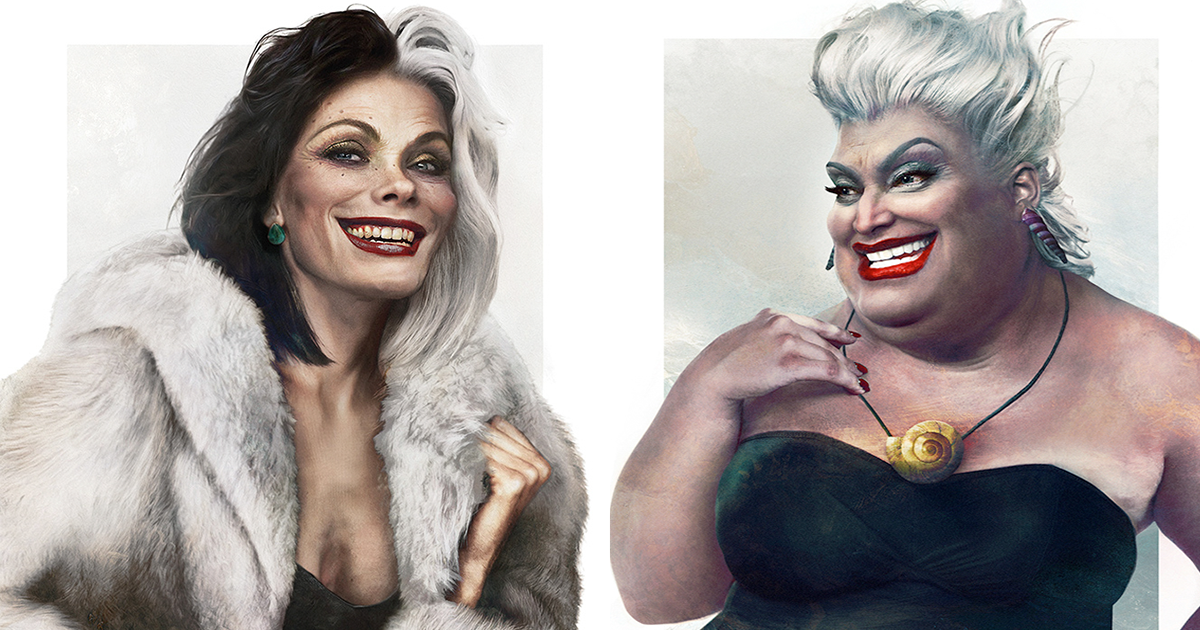
In real life, Cruella de Vil would probably look like the kind of woman who enters a room and makes every coat rack nervous. Her black-and-white hair is not just a hairstyle; it is a warning label. A realistic portrait of Cruella works best when it preserves the sharp cheekbones, cigarette-holder elegance, and frantic couture energy of the animated character while adding human texture: pale skin, narrow eyes, bold lipstick, and the slightly sleep-deprived glamour of someone who considers “calm” a personal insult.
What makes Cruella unforgettable is the clash between luxury and lunacy. She is fashionable, wealthy, loud, and theatrical, but the real-life version should never look merely glamorous. She should look like glamour after three espressos and a bad idea. Her wardrobe would be structured, expensive, and dramatic, but her expression would do the real work: amused, impatient, and ready to turn a polite conversation into a headline.

2. Hades: The Underworld CEO With Excellent Sarcasm
Hades is one of Disney’s funniest villains because he does not just scheme; he complains while scheming. A real-life Hades would not need blue flaming hair to feel dangerous, although it certainly helps the mood. The key is his face: narrow, expressive, exhausted by everyone’s incompetence, and always one second away from a sarcastic rant. He would look less like a monster and more like a high-powered executive who has spent 4,000 years in middle management.
To make Hades realistic, an artist would focus on gaunt facial structure, deep-set eyes, sharp eyebrows, and a smirk that says, “I already explained the plan, and somehow you still ruined it.” The best version would keep his theatrical energy but ground it in human irritation. He is not scary because he shouts. He is scary because he can joke while destroying your entire afternoon.

3. Vanessa: The Pretty Face With a Terrible Contract
Vanessa is one of the cleverest villain disguises in Disney history because she is not designed to look monstrous. She is designed to look trustworthy, romantic, and almost too perfect. A realistic Vanessa would have glossy hair, soft makeup, delicate features, and the unsettling calm of someone who knows exactly what she is doing. Her villainy is not loud; it is hidden behind a smile and a necklace with extremely suspicious energy.
The real-life version should feel like a beautiful stranger in a seaside town who definitely has a secret. The danger comes from contrast. She looks gentle, but the audience knows she is Ursula in disguise, using charm as a weapon. That makes her realistic portrait more chilling than a creature design. She reminds us that not every villain enters with thunder. Some arrive with perfect hair and a fake engagement story.

4. Jafar: The Royal Advisor Who Definitely Read the Fine Print
Jafar is a masterclass in visual villain design. He is tall, narrow, elegant, and sharp enough to cut bread by standing near it. A real-life Jafar would look controlled and severe, with a carefully groomed beard, intense eyes, and clothing that communicates power before he says a word. The cobra-headed staff may be fantasy, but the attitude is painfully realistic: he is the person in the meeting who says, “I have concerns,” and suddenly everyone’s weekend disappears.
What makes Jafar work in human form is restraint. He is not chaotic like Hades or explosive like Cruella. He is calculating. His realistic portrait should show patience, ambition, and a face trained to hide contemptthough not very well, because Jafar’s contempt has a full-time job. His villain look is all about vertical lines, dark fabrics, jewel tones, and a gaze that suggests he has already planned three betrayals and scheduled them efficiently.

5. Ursula: The Sea Witch With Broadway-Level Confidence
Ursula is unforgettable because she understands performance. Every gesture is big. Every line feels like a spotlight just turned on. In real life, Ursula would not be a quiet villain hiding in a cave; she would be a magnetic, dangerous diva who knows how to sell a deal even when the terms are terrible. Her portrait should be bold: dramatic eye makeup, platinum hair, a confident smile, and a presence that fills the frame.
Unlike many villains who rely on fear, Ursula relies on persuasion. That is what makes her realistic version so interesting. She should look charming enough that you understand why someone might listen to her, but intimidating enough that you know signing anything would be a catastrophic life choice. A great real-life Ursula captures the character’s humor, confidence, and predatory intelligence. She is fabulous, funny, and absolutely not someone you should trust with your voice, your secrets, or your credit card.

6. Mother Gothel: The Beauty Influencer From Your Nightmares
Mother Gothel is terrifying because her villainy feels intimate. She does not conquer kingdoms or summon armies. She manipulates, flatters, criticizes, isolates, and smiles while doing it. A realistic Mother Gothel would look elegant, dramatic, and unnervingly youthful, with rich curls, expressive eyes, and the kind of theatrical warmth that makes you feel both complimented and trapped.
Her real-life portrait should lean into contrast: soft fabrics, warm colors, and motherly gestures paired with eyes that reveal control. Gothel’s obsession with youth gives the character a modern edge, especially in an age of filters, anti-aging trends, and curated perfection. She would not need a tower to be scary today. She would just need a ring light, a velvet robe, and a comment that sounds supportive until you think about it for five minutes.

7. Captain Hook: Pirate Drama in Human Form
Captain Hook is a villain with excellent tailoring and terrible emotional regulation. In real life, he would look aristocratic, theatrical, and deeply offended by casual clothing. The curls, mustache, red coat, and elaborate cuffs are essential, but the real magic is his expression: proud, nervous, vain, and constantly aware that a crocodile could ruin his schedule.
A realistic Hook should not look like a generic pirate. He should look like a man who treats piracy as a formal dinner with occasional swordplay. His fear of the crocodile gives him a comic vulnerability, while his cruelty keeps him firmly in villain territory. That mix is why Hook remains visually compelling. He is dangerous, but also ridiculous, which is one of Disney’s most reliable villain formulas. Give him a dramatic hat and a minor inconvenience, and the man becomes a full opera.

8. Gaston: The Gym Bro Who Became a Red Flag
Gaston is frightening because he looks like the heroat least at first. Tall, handsome, strong, popular, and confident, he has all the surface-level traits of a classic leading man. But the more realistic he becomes, the more obvious the problem is. A real-life Gaston would look like someone who has never heard the word “no” without assuming it was a typo.
His portrait should be charming but smug, rugged but performative, handsome but exhausting. The square jaw, heavy brow, broad shoulders, and self-satisfied smile are essential. Gaston’s villainy comes from entitlement, not magic. That makes him one of the most realistic villains on the list. You do not need a castle or a curse to recognize him. You just need someone flexing in a tavern and turning rejection into a community crisis.

9. Prince Hans: The Nice Guy With a Spreadsheet
Prince Hans is a modern Disney villain because he weaponizes likability. A realistic version would not look obviously evil. That is the whole point. He would look polished, friendly, symmetrical, and emotionally available in a suspiciously convenient way. He is the villain you do not notice until the twist, which makes his real-life portrait especially tricky.
To make Hans work, an artist would need to avoid overdoing the menace. No sneering in every frame. No shadowy villain lighting from scene one. Instead, he should look like a prince who practiced empathy in the mirror. His clothes would be neat, his smile warm, and his eyes just a little too calculating when nobody is watching. Hans reminds us that some villains do not announce themselves. They network.

10. The Evil Queen: Cold Royal Perfection
The Evil Queen is one of Disney’s original icons of vanity, control, and icy elegance. In real life, she would look severe, regal, and perfectly composed, as if even her rage had been professionally tailored. Her portrait should emphasize symmetry, stillness, and a gaze that could make a mirror nervous. The high collar, crown, deep colors, and sculpted features create a look that is both beautiful and deeply unfriendly.
What makes the Evil Queen fascinating is that she is not messy. She is controlled. Cruella spins; Hades fumes; Hook panics. The Queen freezes the room. Her real-life version should feel like someone who speaks softly because she knows everyone will lean in. Her jealousy is dangerous because it is wrapped in discipline. She does not look like chaos. She looks like order taken way too far.

11. Judge Claude Frollo: The Most Uncomfortable Real-Life Villain
Judge Claude Frollo is one of Disney’s darkest villains because his evil is not glamorous. It is ideological, hypocritical, and cold. A realistic Frollo would not need fantasy styling to be frightening. He would look stern, narrow, tired, and self-righteous, with a face that suggests he has mistaken cruelty for moral clarity.
His portrait should avoid making him charming. The best real-life version would be unsettling because it feels plausible: a powerful man who believes his authority excuses his behavior. His long robe, severe features, and rigid posture all communicate control, but his expression reveals obsession. Unlike the more flamboyant villains on this list, Frollo does not entertain. He disturbs. He is a reminder that realism can make a villain less fun and far more chilling.

12. Maleficent: The Final Boss of Elegant Threats
Maleficent may be the ultimate Disney villain silhouette. The horns, staff, black robes, green fire, and razor-sharp cheekbones create an image so strong that even her shadow has stage presence. In real life, she would look regal, supernatural, and almost impossibly composed. Her face should be angular, her eyes cool, and her expression calm enough to be terrifying.
The interesting challenge with Maleficent is balancing beauty and menace. If she looks too human, the magic disappears. If she looks too monstrous, the elegance fades. A successful realistic portrait keeps her otherworldly without turning her into a creature effect. She should look like someone who could attend a royal event, insult everyone there, curse a baby, and still be the best-dressed person in the kingdom. That is villain efficiency.
What Makes These Real-Life Villain Portraits Work?
The best realistic Disney villain portraits do three things well. First, they preserve the silhouette. Even if the face becomes human, the viewer should instantly recognize the character from shape, posture, hair, costume, or color. Second, they translate exaggeration into believable anatomy. A cartoon chin, nose, brow, or smile cannot simply be copied; it has to be interpreted. Third, they keep the emotional truth of the character intact.
For example, Jafar’s long face and sharp beard become elegance and calculation. Ursula’s bold shapes become confidence and charisma. Gaston’s heroic proportions become vanity and entitlement. Mother Gothel’s beauty becomes manipulation. The Evil Queen’s symmetry becomes icy control. These are not random makeovers. They are visual essays about personality.
This is why real-life Disney villain art is so shareable. Fans enjoy comparing the animated design with the realistic version, but they also enjoy asking a bigger question: Would I recognize this person’s personality if I met them? With the best portraits, the answer is yes. You may not know their name, but you would know not to sign their contract, eat their apple, follow them into a tower, or accept a promotion from them in Agrabah.
The Fun of Turning Animation Into Real-Life Character Design
Animation is built on exaggeration. Real faces are built on tiny contradictions. That makes the translation from cartoon to realism surprisingly complex. A real-life Disney villain cannot simply have a bigger nose, sharper chin, or dramatic costume. The design must answer practical questions: How would that hair sit on a real head? What kind of fabric would that robe be? How much makeup is theatrical without looking silly? What age does the character appear to be? What emotion is hiding behind the eyes?
These questions are why realistic villain portraits often feel richer than simple fan art. They turn familiar characters into casting puzzles. Cruella becomes a fashion-world nightmare. Hades becomes a sarcastic power broker. Hans becomes the polished political climber. Frollo becomes institutional menace. Maleficent becomes dark royalty. Each interpretation pulls the villain out of fantasy while keeping the story DNA intact.
There is also a nostalgia factor. Many viewers grew up with these villains as colorful, larger-than-life figures. Seeing them as real people creates a strange emotional double take. The designs are familiar enough to feel comforting, but realistic enough to feel uncanny. It is like discovering that your childhood nightmares upgraded to high-definition.
Experience: What It Feels Like to Look at Real-Life Disney Villains
Looking through realistic Disney villain portraits is a very specific kind of entertainment experience. At first, you laugh because the concept sounds playful. “What would Disney villains look like in real life?” feels like internet candy: easy, visual, nostalgic, and fun. Then you see the portraits, and the mood changes. Suddenly, the characters feel less like drawings and more like people who might live somewhere, work somewhere, or appear in the background of a historical drama looking suspiciously well-lit.
The first reaction is usually recognition. You spot Cruella’s hair, Jafar’s beard, Maleficent’s horns, Hook’s mustache, or Ursula’s expression, and your brain happily says, “I know that menace!” But the second reaction is analysis. You start noticing how much of the character comes from tiny visual choices. Cruella without wild eyes is just a stylish woman. Gaston without smugness is just a handsome guy. Hans without the too-perfect smile loses the twist. Ursula without confidence loses her power. These portraits teach you how character design works without making you sit through a lecture with a laser pointer.
There is also a fun social element. These images are perfect for “Which one is the most realistic?” debates. Some viewers prefer the glamorous villains because they look like magazine covers with moral issues. Others prefer the unsettling ones, like Frollo or the Evil Queen, because they feel closer to real-world personality types. Then someone inevitably says Hades looks like a celebrity, Hook looks like a pirate-themed restaurant owner, or Gaston looks like he would sell protein powder online. That is part of the joy. Realism invites comparison.
For writers, artists, and editors, the topic is especially useful because it connects pop culture, visual design, nostalgia, and humor. You can discuss color theory, facial structure, costume translation, character psychology, and fan culture while still keeping the article light enough for casual readers. The “12 Pics” format also works because it gives readers a clear path. Each villain becomes a mini-story, and each portrait offers a new angle: beauty, vanity, manipulation, power, comedy, fear, or charm.
My biggest takeaway from this kind of art is that villains are memorable because they are specific. A vague villain disappears. A specific villain becomes iconic. Maleficent is not just evil; she is elegant evil. Ursula is not just manipulative; she is theatrical manipulation. Cruella is not just cruel; she is couture cruelty. Jafar is not just ambitious; he is ambition with a cobra staff and a patience problem. When these traits are translated into real-life portraits, they become even easier to understand.
That is why realistic Disney villain art remains so popular. It gives fans the pleasure of rediscovery. We already know these characters, but seeing them with human detail makes us look again. The result is creepy, funny, stylish, and strangely educational. It proves that great character design does not depend only on magic, monsters, or animation. Sometimes all it takes is a sharp silhouette, a dangerous smile, and the unmistakable feeling that this person should not be trusted with a kingdom.
Conclusion
Real-life Disney villain portraits work because they preserve what fans love most: personality. The best versions do not simply make animated characters look human. They reveal why those characters were so memorable in the first place. Cruella becomes fashion madness. Hades becomes sarcastic burnout with supernatural authority. Ursula becomes charisma with a contract. Gaston becomes entitlement in a handsome package. Maleficent becomes elegance sharpened into a weapon.
Whether you are a Disney fan, an art lover, a character-design nerd, or someone who just enjoys seeing villains look like they could ruin a dinner party, these 12 real-life reimaginings prove that Disney’s baddies have lasting visual power. Heroes may get the happy endings, but villains get the cheekbones, the lighting, and apparently the better wardrobes.