Finding your zodiac sign sounds easy until Hindu astrology enters the room wearing a scholarly shawl, carrying a panchang, and asking for your exact birth time. In Western astrology, many people know their “sign” by birthday alone. Born in early May? Taurus. Late November? Sagittarius. Simple enough. Hindu astrology, also called Vedic astrology or Jyotisha, goes deeper. Your zodiac sign is often your Rashi, especially your Moon sign, and it depends on the position of the Moon at the exact moment and place of your birth.
That means two people born on the same date may have different Hindu zodiac signs if they were born at different times or in different locations. It also means your familiar Western Sun sign may not match your Hindu astrology sign. No, the universe is not trolling you. Hindu astrology uses a different zodiac system, a more lunar approach, and a chart-based method that considers the Moon, Ascendant, planets, houses, and nakshatras.
This guide explains how to know your zodiac sign according to Hindu astrology, what information you need, why your birth time matters, and how Rashi, Lagna, and Nakshatra work together in a Vedic birth chart.
What Is Hindu Astrology?
Hindu astrology, traditionally known as Jyotisha, is an ancient Indian system used to study time, planetary movements, birth charts, rituals, compatibility, and life patterns. The word Jyotisha is often translated as “science of light,” referring to the lights of the sky: the Sun, Moon, planets, and stars.
In Hindu tradition, astrology is closely connected with the calendar, religious observances, auspicious timing, and personal horoscopes. A Hindu birth chart, called a Kundli, Janma Kundali, or Janma Patrika, maps the positions of celestial bodies at the time of birth. From this chart, an astrologer identifies your Rashi, Lagna, Nakshatra, planetary placements, and other important details.
Is Hindu Astrology the Same as Western Astrology?
Not exactly. Both systems use twelve zodiac signs, but they calculate them differently. Western astrology usually uses the tropical zodiac, which is tied to the seasons and the spring equinox. Hindu astrology generally uses the sidereal zodiac, which is connected to fixed star positions.
Because of this difference, your Western zodiac sign and Hindu zodiac sign may not be the same. Many people discover that their Hindu sign appears one sign earlier than their Western Sun sign. For example, someone who has always called themselves a Western Leo may find that their Vedic Sun sign is Cancer. Cue the dramatic identity crisis and maybe a cup of chai.
What Does “Zodiac Sign” Mean in Hindu Astrology?
In Hindu astrology, the phrase “zodiac sign” can mean more than one thing. This is where beginners often get confused. When someone asks, “What is my zodiac sign according to Hindu astrology?” they may be asking about one of three major signs:
1. Rashi or Moon Sign
Your Rashi, often called your Janma Rashi or birth Moon sign, is the zodiac sign where the Moon was located when you were born. In many Hindu astrology traditions, this is the most commonly used personal zodiac sign. It is important for personality reading, daily horoscope predictions, compatibility, naming traditions, and emotional tendencies.
2. Surya Rashi or Sun Sign
Your Surya Rashi is the zodiac sign where the Sun was located at your birth. This is closer to what many Western astrology readers think of as a zodiac sign. However, because Hindu astrology uses the sidereal zodiac, your Vedic Sun sign may differ from your Western Sun sign.
3. Lagna or Ascendant Sign
Your Lagna, also called the Ascendant or rising sign, is the zodiac sign rising on the eastern horizon at the moment of birth. This sign changes roughly every two hours, so it requires an accurate birth time. In Vedic chart interpretation, Lagna is extremely important because it forms the first house of the birth chart and helps determine how the entire chart is read.
The 12 Zodiac Signs in Hindu Astrology
The twelve Hindu zodiac signs are called Rashis. They correspond to the familiar twelve zodiac signs, but their Sanskrit names are commonly used in Vedic astrology.
| Hindu Zodiac Sign | Sanskrit Name | Western Equivalent | Symbol |
|---|---|---|---|
| Mesha | Mesha Rashi | Aries | Ram |
| Vrishabha | Vrishabha Rashi | Taurus | Bull |
| Mithuna | Mithuna Rashi | Gemini | Twins |
| Karka | Karka Rashi | Cancer | Crab |
| Simha | Simha Rashi | Leo | Lion |
| Kanya | Kanya Rashi | Virgo | Maiden |
| Tula | Tula Rashi | Libra | Scales |
| Vrischika | Vrischika Rashi | Scorpio | Scorpion |
| Dhanu | Dhanu Rashi | Sagittarius | Bow |
| Makara | Makara Rashi | Capricorn | Crocodile or Sea-Goat |
| Kumbha | Kumbha Rashi | Aquarius | Water Pot |
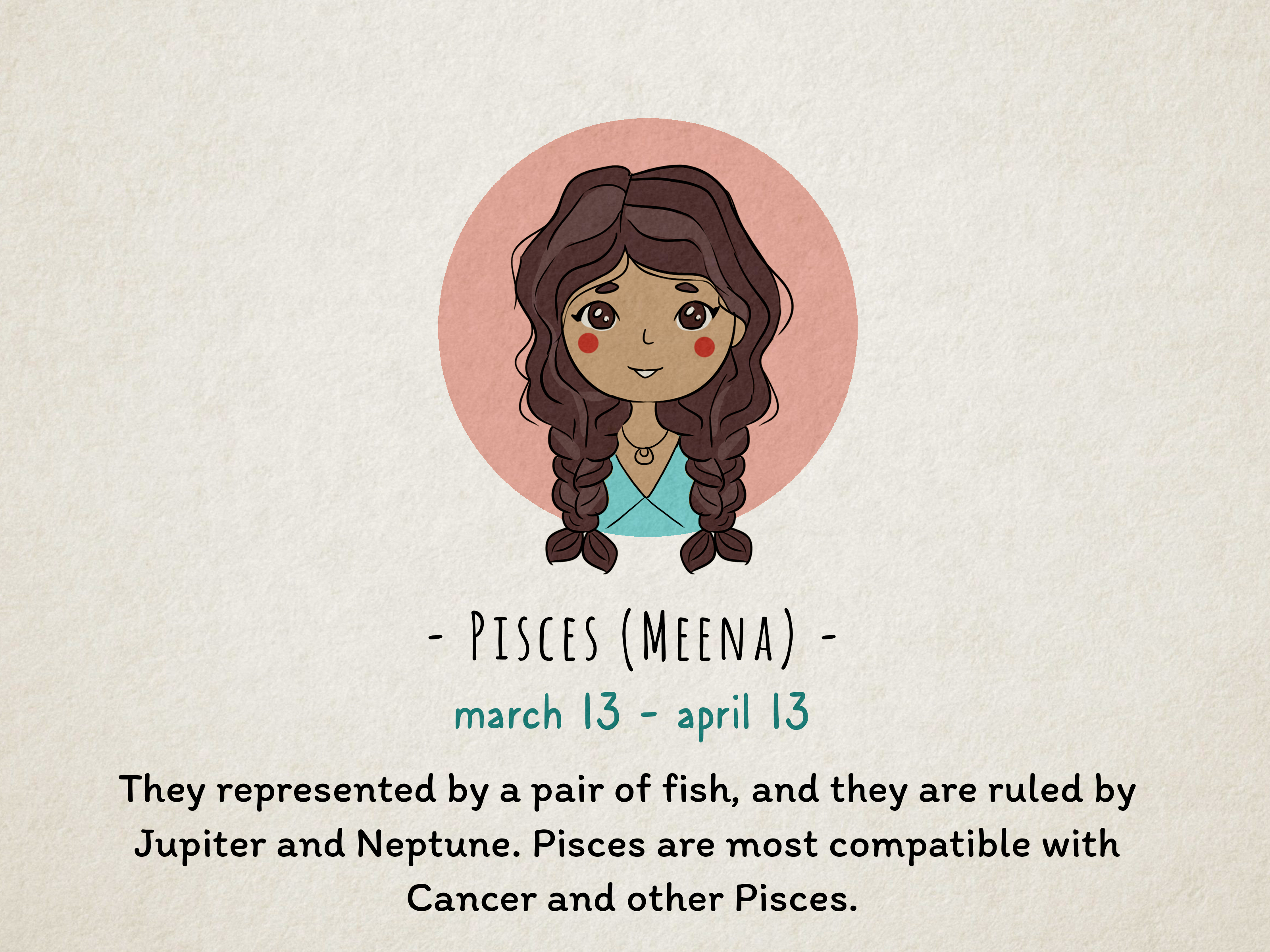
| Meena | Meena Rashi | Pisces | Fish |
How to Know Your Zodiac Sign According to Hindu Astrology
To know your Hindu zodiac sign correctly, you need to calculate your birth chart. Guessing by birthday alone is like trying to cook biryani by staring at a rice bag. You may be in the kitchen, but you are not there yet.
Step 1: Collect Your Birth Details
You will need three details:
- Date of birth: The day, month, and year you were born.
- Exact time of birth: The closer to the official recorded time, the better.
- Place of birth: City, state, and country are needed to calculate time zone and geographic coordinates.
Your birth time matters because the Moon moves relatively quickly, and the Ascendant changes even faster. If your birth time is wrong, your Lagna may change, and in some cases, your Moon sign or Nakshatra may change too.
Step 2: Use a Vedic Rashi Calculator
The easiest method is to use a reliable Vedic astrology calculator. Enter your birth date, time, and place. The calculator will generate your Moon sign, Sun sign, Ascendant, Nakshatra, and often a full Kundli.
Look specifically for the result labeled Moon Sign, Chandra Rashi, Janma Rashi, or simply Rashi. This is usually the zodiac sign people mean when they ask for your Hindu astrology sign.
Step 3: Check Your Janma Rashi
Your Janma Rashi is the sign occupied by the Moon at your birth. For example, if the Moon was in Karka when you were born, your Rashi is Karka, equivalent to Cancer. If the Moon was in Dhanu, your Rashi is Dhanu, equivalent to Sagittarius.
In Hindu astrology, Moon sign is important because the Moon is associated with the mind, emotions, memory, comfort, instincts, and inner responses. This is why Vedic horoscope predictions are often read from the Moon sign rather than only from the Sun sign.
Step 4: Find Your Nakshatra
Your Nakshatra is the lunar mansion where the Moon was placed at birth. There are 27 main nakshatras, and each covers 13 degrees and 20 minutes of the zodiac. Nakshatra adds another layer of detail to your Rashi.
For example, two people may both have Taurus Moon signs, but one may be born under Rohini Nakshatra while another may be born under Mrigashira Nakshatra. Their Rashi is the same, but their emotional style, personality tendencies, and traditional interpretations may differ.
Step 5: Identify Your Lagna
Your Lagna or Ascendant sign is the sign rising in the east when you were born. It sets the structure of your birth chart and determines the twelve houses. Vedic astrologers often read the chart from both Lagna and Moon sign to understand personality, life direction, health, relationships, career, and timing.
If you do not know your exact birth time, your Lagna may be uncertain. In that case, your Moon sign may still be easier to estimate, unless the Moon changed signs close to your birth time.
Why Your Hindu Zodiac Sign May Differ From Your Western Sign
The main reason is the difference between the sidereal and tropical zodiacs. The tropical zodiac begins Aries at the spring equinox. The sidereal zodiac used in Hindu astrology aligns signs more closely with fixed star positions. The gap between the two systems is called ayanamsha.
This difference is roughly 23 to 24 degrees in modern calculations, depending on the ayanamsha used. Since each zodiac sign covers 30 degrees, this gap can shift many planetary placements into the previous sign when compared with a Western tropical chart.
Example: Western Sun Sign vs. Vedic Sign
Suppose someone was born on April 10. In Western astrology, that person is usually Aries. In Hindu astrology, the Sun may still be in Pisces depending on the year and calculation method. Their Moon sign may be something else entirely, such as Virgo, Libra, or Scorpio, depending on the exact time and location of birth.
This is why birthday-only zodiac lists can be misleading for Hindu astrology. They may give you a rough Sun sign, but they cannot reliably identify your Moon sign, Ascendant, or Nakshatra.
Can You Know Your Hindu Zodiac Sign Without Birth Time?
Sometimes, yesbut with limitations. If you know your birth date and place but not the exact time, a calculator or astrologer may estimate your Moon sign by checking whether the Moon stayed in the same sign all day. Since the Moon remains in a sign for about two and a half days, many people can still identify their Moon sign without a perfect birth time.
However, if the Moon changed signs on your birth date, you will need a more accurate birth time. Without it, your Rashi may be uncertain. Your Lagna will also be difficult to determine because the Ascendant changes quickly throughout the day.
What If You Only Know Your Name?
In some Hindu naming traditions, a child’s name begins with a syllable connected to the birth Nakshatra and Rashi. Because of this, some tools attempt to identify a probable Rashi from a person’s name. This can be culturally useful, but it is not as accurate as calculating from birth details.
If your name was not chosen according to Nakshatra-based naming rules, a name-based Rashi method may not apply. In other words, do not panic if your name refuses to cooperate astrologically. It may simply have missed the memo.
Important Terms You Should Know
Rashi
Rashi means zodiac sign. In everyday Hindu astrology, it often refers to the Moon sign, also called Chandra Rashi or Janma Rashi.
Chandra Rashi
Chandra Rashi is the sign occupied by the Moon at birth. It is central to many horoscope readings and emotional interpretations.
Surya Rashi
Surya Rashi is the sign occupied by the Sun at birth. It represents vitality, identity, authority, and personal radiance in traditional interpretation.
Lagna
Lagna is the Ascendant or rising sign. It is one of the most important points in the birth chart because it begins the first house.
Nakshatra
Nakshatra is the lunar mansion of the Moon at birth. It provides a more precise layer of personality and timing analysis.
Panchang
A Panchang is a Hindu almanac that tracks important calendar elements such as tithi, vara, nakshatra, yoga, and karana. It is used for festivals, rituals, auspicious timing, and daily astrological references.
Common Mistakes When Finding Your Hindu Zodiac Sign
Mistake 1: Using Only Western Zodiac Dates
Western zodiac date ranges are not enough for Hindu astrology. They usually refer to the tropical Sun sign, not your sidereal Moon sign.
Mistake 2: Ignoring Birth Time
Birth time can change your Ascendant and sometimes your Moon sign or Nakshatra. If you are serious about accuracy, use the most reliable birth time available.
Mistake 3: Confusing Rashi With Lagna
Your Rashi and Lagna can be different signs. Rashi is usually your Moon sign, while Lagna is your rising sign. Both matter, but they are not interchangeable.
Mistake 4: Assuming Every Calculator Uses the Same Settings
Different calculators may use different ayanamsha settings or chart styles. The Lahiri ayanamsha is commonly used, but not every system applies the same calculation method. If results differ slightly, check the calculator settings.
Practical Example: How a Hindu Zodiac Sign Is Found
Imagine a person named Maya was born on August 18, 1995, at 6:30 a.m. in Chicago, Illinois. To find her Hindu zodiac sign, she enters her birth details into a Vedic astrology calculator. The calculator shows:
- Moon Sign: Meena Rashi
- Sun Sign: Simha Rashi
- Ascendant: Kanya Lagna
- Nakshatra: Revati
So, what is Maya’s zodiac sign according to Hindu astrology? In most everyday contexts, her sign is Meena Rashi, because that is her Moon sign. But if she is reading a full Kundli, her astrologer will also consider Simha Sun, Kanya Lagna, Revati Nakshatra, planetary houses, aspects, and dashas.
This example shows why Hindu astrology is more layered than a single zodiac label. Your Rashi may describe your emotional nature, your Lagna may show how you approach life, and your Nakshatra may add subtle texture to your personality. It is less like a name tag and more like a cosmic spreadsheetonly with more mythology and fewer formulas that make your laptop cry.
How to Read Your Result Once You Find It
After you calculate your Rashi, do not stop at the sign name. Read the full context. Ask these questions:
- What is my Moon sign?
- What is my Nakshatra and Pada?
- What is my Lagna?
- Which planets are placed in my first, seventh, tenth, and twelfth houses?
- Which dasha period am I running?
A beginner does not need to master everything at once. Start with your Moon sign, then learn your Nakshatra, then explore your Lagna. That sequence gives you a solid foundation without turning your first astrology session into a three-day research retreat.
Experience-Based Insights: What It Feels Like to Discover Your Hindu Zodiac Sign
Many people begin their Hindu astrology journey with curiosity and a little confusion. They know their Western zodiac sign, maybe they have read a dozen memes about it, and suddenly a Vedic chart tells them they are something else. A lifelong Gemini may discover a Vrishabha Moon. A proud Scorpio may learn they have Tula Rashi. At first, it can feel like the stars changed the Wi-Fi password without telling anyone.
The most common experience is surprise. People often expect Hindu astrology to confirm what they already know, but it may reveal a different emotional pattern. Someone who identifies strongly with a fiery Western sign may discover a watery Moon sign that better explains their private sensitivity. Another person who seems calm on the outside may have a bold Lagna or strong Mars placement that explains their inner drive.
A helpful way to experience your Hindu zodiac sign is to treat it as a reflective tool rather than a fixed label. Your Rashi does not lock you into one personality type. Instead, it gives language to tendencies: how you react under pressure, what comforts you, how you process emotions, and what kind of rhythm feels natural to your mind.
For example, a person with Karka Rashi may notice that emotional security, family bonds, familiar spaces, and memory play a large role in daily decisions. A person with Dhanu Rashi may relate to themes of learning, movement, freedom, and philosophical curiosity. A Makara Rashi person may recognize a serious, disciplined, long-game approach to life. These are not prison sentences. They are mirrors, and like all mirrors, they work best when used with good lighting and reasonable expectations.
Another experience many beginners have is discovering the value of birth time. A few minutes may not matter when ordering pizza, but in astrology, timing can change important chart details. People who obtain their official birth certificate often feel more confident because they can finally calculate Lagna and Nakshatra with better accuracy. In families where birth times are remembered approximately, astrologers may use chart rectification, comparing life events with possible birth times to narrow the estimate.
Learning your Hindu zodiac sign can also connect you with cultural practices. In many Hindu households, Rashi and Nakshatra are not just personality tools. They may be used in naming ceremonies, temple rituals, marriage compatibility, festival observances, and choosing auspicious times. Even for people who approach astrology casually, understanding these terms can make Hindu calendars and family traditions easier to appreciate.
The best experience comes from staying balanced. Hindu astrology can be meaningful, poetic, and culturally rich, but it should not replace personal judgment, medical advice, financial planning, or honest communication. Your Rashi may offer insight, but it should not be blamed for every late email, dramatic text message, or suspiciously strong craving for snacks at midnight. Sometimes the Moon is in Scorpio; sometimes you simply skipped lunch.
In practice, knowing your zodiac sign according to Hindu astrology is a starting point. Your Rashi introduces the emotional tone of your chart. Your Nakshatra adds detail. Your Lagna shows how life is structured around you. Together, they create a more complete picture than a birthday-based sign alone.
Conclusion
To know your zodiac sign according to Hindu astrology, you need your birth date, exact birth time, and birthplace. Then calculate your Vedic birth chart and look for your Janma Rashi or Chandra Rashi, which is your Moon sign. This is the sign most commonly used when people refer to a Hindu astrology zodiac sign.
For a fuller understanding, also check your Lagna and Nakshatra. Your Moon sign reveals emotional tendencies, your Ascendant shapes the structure of your chart, and your Nakshatra adds refined detail. Hindu astrology is not just about finding a label; it is about reading a layered map of time, temperament, and tradition.
If your Hindu zodiac sign differs from your Western sign, do not worry. The systems use different calculations. Think of it as getting a second opinion from the cosmosone that arrives with Sanskrit names, lunar mansions, and a strong preference for accurate birth times.