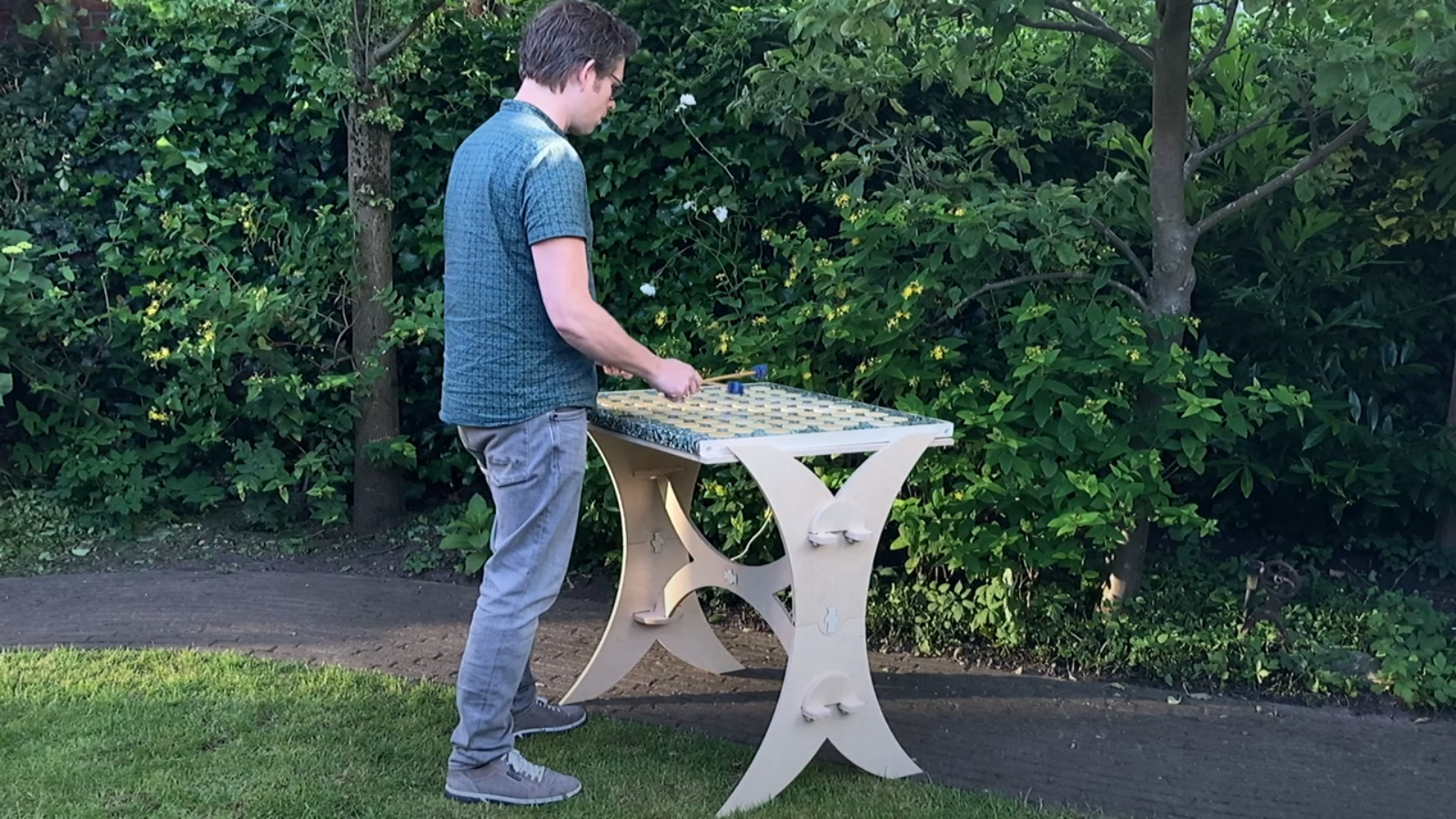
The Marimbatron sounds like something a futuristic jazz robot would order at a coffee shop, but it is much more interesting than that. It is a digital marimba prototyping project that blends percussion, electronics, digital fabrication, MIDI control, and a bold rethink of how musicians interact with notes. Instead of simply copying a traditional marimba and plugging it into a computer, the Marimbatron asks a better question: what would a marimba become if it were designed from the ground up for modern makers, drummers, composers, and electronic musicians?
Created by Leo Kuipers as a Fab Academy 2024 final project, the Marimbatron is a MIDI-based USB musical instrument played with drumsticks or mallets. It keeps the physical joy of striking pads while moving the sound generation into the digital world. That means it can trigger virtual marimbas, synthesizers, sampled percussion, ambient textures, bass lines, or whatever other sound a musician dares to map onto it. In other words, it is a mallet instrument with a passport to the entire software studio.
What makes the project especially exciting is not just that it works. Many prototypes work once, usually while everyone holds their breath and nobody bumps the table. The Marimbatron stands out because it is modular, documented, playable, and conceptually smart. It explores pressure-sensitive pads, fast sensor scanning, microcontroller communication, MIDI output, and an isomorphic note layout that makes musical patterns easier to transfer between keys.
What Is the Marimbatron?
The Marimbatron is best understood as a digital marimba controller. A traditional marimba uses wooden bars arranged like piano keys. A performer strikes those bars with mallets, and resonator tubes beneath the bars amplify and shape the tone. The Marimbatron borrows the performance gesturehitting a surface with sticks or malletsbut replaces acoustic bars and resonators with pressure-sensitive pads, electronics, and MIDI messages.
That shift changes the instrument’s personality. A wooden marimba has a beautiful, warm, resonant voice, but it is also large, expensive, sensitive to environment, and tied to one acoustic sound. A digital marimba prototype can be compact, configurable, modular, and capable of controlling any MIDI-compatible software or hardware sound source. It can become a marimba one minute, a vibraphone the next, and a cinematic thunder machine after lunch.
The Marimbatron was designed as a four-octave instrument made from octave modules. Each octave module contains 19 pressure-sensitive pads and its own microcontroller. The modules communicate with a main controller, which outputs MIDI over USB. This architecture matters because it makes the instrument easier to build, test, repair, and expand. Instead of treating the whole instrument as one giant electronic puzzle, the project divides it into repeatable blocks.
Why a Digital Marimba Needs More Than Digital Notes
A basic MIDI controller can be simple: press a button, send a note, make a sound. A musical instrument, however, needs to feel alive. Mallet players care about dynamics, timing, rebound, sensitivity, and response. If a player hits softly, the instrument should whisper. If the player strikes harder, it should speak with more energy. If the system lags, double-triggers, misses notes, or responds like a vending machine keypad, the magic disappears quickly.
This is where the Marimbatron becomes a serious prototyping project rather than a novelty. It has to detect strikes, read pressure changes, interpret velocity, avoid false triggering, scan many pads quickly, and send useful MIDI data fast enough for real performance. The project documentation notes high-speed readout and a MIDI response target under 10 milliseconds, which is important because percussion instruments expose latency brutally. A keyboardist might forgive a tiny delay. A drummer will notice it, glare at it, and possibly write a strongly worded paradiddle.
The Isomorphic Layout: Same Shapes, New Musical Freedom
One of the most important design choices in the Marimbatron is its support for an isomorphic key layout, specifically the Wicki-Hayden concept associated with concertinas and bandoneons. In an isomorphic layout, musical intervals keep the same physical shape no matter what key the musician is playing in. A chord shape learned in C can be moved to another starting note and still work as the same kind of chord.
This is a huge deal for players who think in patterns. On a piano-style keyboard, the visual layout is historically familiar but musically uneven. The distance and shape between notes changes depending on whether black keys are involved. That creates different fingerings for different keys. On an isomorphic grid, the geometry is more consistent. For a drummer or percussionist who wants to explore harmony without years of piano muscle memory, the layout can feel like someone finally turned the lights on.
The Marimbatron still supports a traditional piano-style layout, which is smart. Familiarity matters, especially for performers trained on standard mallet percussion. But the isomorphic option gives the project its own identity. It is not merely a digital copy of an acoustic instrument. It is a reimagining of how a mallet instrument can organize pitch.
How the Marimbatron Compares With a Traditional Marimba
A traditional marimba is an acoustic marvel. Wooden tone plates are tuned carefully, and metal resonator pipes beneath them make the sound richer and louder. The lower the note, the longer the resonator pipe generally needs to be. Instrument makers also shape tone bars with great care, checking fundamental pitches and harmonics so the instrument speaks with a balanced, musical voice.
The Marimbatron does not try to duplicate that acoustic process. Instead, it separates the performance interface from the sound source. The pads do not need to resonate like rosewood bars because the tone can come from software instruments, samplers, synthesizers, or external MIDI hardware. This makes the physical construction more flexible. The designer can focus on touch response, layout, modularity, and durability rather than carving every bar into acoustic perfection.
Traditional Marimba Strengths
A real marimba offers natural resonance, expressive nuance, and a tone that fills concert halls without pretending to be anything else. It is visually beautiful and emotionally immediate. There is no laptop anxiety, no driver issue, and no mysterious update deciding that now is the perfect time to break your audio setup.
Digital Marimba Strengths
A digital marimba prototype offers portability, sound flexibility, easier recording, alternate layouts, and deep integration with digital audio workstations. It can trigger samples, control effects, layer sounds, or send MIDI to multiple instruments. For composers and experimental performers, that opens creative doors that an acoustic-only instrument cannot easily access.
Pressure-Sensitive Pads and Sensor Design
The heart of a digital mallet instrument is the strike sensor. Many DIY electronic percussion projects use piezo sensors because they are affordable and good at detecting impacts. However, piezos can be tricky when the goal is stable velocity, consistent triggering, and pressure-aware response. Force-sensitive resistors and custom pressure sensors offer another path by changing resistance when pressure is applied.
The Marimbatron uses fab-made pressure sensors, demonstrating the advantage of digital fabrication education: the builder is not limited to off-the-shelf parts. A custom sensor stack can be designed, cut, tested, revised, and integrated into the physical instrument. That is exactly the kind of iterative making that turns a rough idea into a working prototype.
In practice, sensor design is a balancing act. Pads must be sensitive enough to detect soft strikes but not so sensitive that vibrations from neighboring pads cause accidental notes. They must survive repeated impacts without drifting wildly. They must feel playable under sticks or mallets. And they must produce data that the microcontroller can scan, filter, and translate into musical events.
The Electronics: Modular Octaves and Fast MIDI Output
The Marimbatron’s modular architecture is one of its strongest engineering decisions. Each octave operates as a self-contained unit with 19 pads and a microcontroller. Those octave modules connect to a central controller using I2C communication, and the main controller sends MIDI data over USB.
This approach solves several practical problems. First, it keeps wiring more manageable. Second, it makes debugging easier because one octave can be tested independently. Third, it makes future expansion more realistic. If the designer wants to adjust the range, improve one module, or replace a damaged section, the whole instrument does not have to be rebuilt from scratch.
MIDI output is also a smart choice because MIDI remains the shared language of electronic music. A MIDI controller does not generate audio by itself; it sends performance instructions such as note number, velocity, timing, and control data. Software or hardware then turns those instructions into sound. For a prototype like the Marimbatron, that means immediate compatibility with virtual instruments, samplers, synthesizers, and DAWs.
Why MIDI Still Matters in a Modern Digital Marimba
MIDI has survived because it is useful, not because musicians are unusually nostalgic for 1980s technical standards. It lets instruments, computers, controllers, and sound modules communicate in a predictable way. For the Marimbatron, MIDI is the bridge between physical performance and digital sound.
Modern MIDI development is also moving forward. MIDI 2.0 expands resolution, improves expressive control, supports better device communication, and keeps backward compatibility with MIDI 1.0 concepts. For future versions of digital mallet instruments, higher-resolution velocity and per-note control could be especially valuable. A mallet instrument is all about nuance: strike speed, pressure, damping, rolls, accents, and articulation. The more detail the system can capture, the more natural the digital performance can feel.
Prototyping Lessons From the Marimbatron
The Marimbatron is inspiring because it shows how a complex instrument can emerge from disciplined prototyping. It combines mechanical design, electronics, embedded programming, interface design, music theory, and documentation. That combination is not easy. A project like this can fail in many exciting ways: the pads may misfire, the wiring may become spaghetti with opinions, the firmware may lag, the enclosure may flex, or the layout may be theoretically brilliant but physically awkward.
Good prototyping treats these problems as information. A first version does not have to be perfect. It has to reveal what needs improvement. The Marimbatron’s modular design supports that process beautifully. Builders can test pad response, scan speed, firmware thresholds, MIDI mapping, and playing ergonomics in sections rather than waiting until the entire instrument is complete.
Key Takeaways for Makers
The first takeaway is to design for iteration. A musical controller is not just an electronic circuit; it is something a human body must enjoy using. The second takeaway is to prioritize latency early. If timing feels bad, no amount of fancy sound design will save the instrument. The third takeaway is to document everything. In maker projects, documentation is not paperwork; it is a second version of the invention that other people can learn from.
Creative Uses for the Marimbatron
A digital marimba controller can live in many musical worlds. In a studio, it can trigger orchestral percussion libraries with a more natural mallet gesture than a piano keyboard. In electronic music, it can control synthesizers, pads, basses, and granular textures. In education, it can help students visualize intervals and chord shapes through an isomorphic layout. In live performance, it can combine percussion technique with software instruments, loops, and effects.
Imagine a player using the Marimbatron to perform a marimba line with the right hand while triggering soft synth chords with the left. Or using velocity layers to move from wooden tones to shimmering bells as strikes get harder. Or mapping different octaves to different instruments: bass marimba below, vibraphone in the middle, glassy FM synth above. The result is not just a digital marimba; it is a performance surface for musical imagination.
Challenges That Still Matter
No digital instrument escapes trade-offs. The Marimbatron has to compete with the tactile beauty of acoustic bars and the mature reliability of commercial mallet controllers. It must handle repeated strikes, calibration drift, sensor variation, crosstalk, mechanical wear, and software compatibility. It also has to feel good. Musicians are extremely sensitive to feel, even when they describe that feel using scientific terms such as “nope” and “weird.”
Another challenge is expressive mapping. A traditional marimba naturally converts physical energy into sound. A digital instrument must decide how pressure data becomes velocity, aftertouch, damping, or other MIDI control values. That mapping can make the difference between an instrument that feels expressive and one that feels like hitting office supplies with sticks.
Experience Notes: Building, Testing, and Playing a Digital Marimba Prototype
Working on a project like the Marimbatron teaches a lesson that every maker eventually learns: musical instruments are brutally honest prototypes. A lamp can flicker slightly and still be charming. A shelf can be a little crooked and call itself rustic. But a musical instrument has to respond in real time to human intention. If one pad triggers late, if one note is too sensitive, or if one octave feels different from the next, the player notices immediately.
The most valuable experience in a digital marimba project is not soldering the first board or cutting the first panel. It is the moment when someone actually plays it. Suddenly the design stops being a diagram and becomes a conversation. The player may strike harder than expected, roll across pads, hit near the edge, use different mallets, or rest a hand where the designer never imagined a hand would go. These interactions reveal whether the instrument is merely functional or genuinely playable.
A practical testing session should begin with single-note response. Each pad should trigger reliably at soft, medium, and hard dynamics. Then the builder should test fast repeated notes, because percussionists love making electronics nervous. After that, adjacent pads should be tested for crosstalk. If hitting one pad accidentally triggers its neighbor, the firmware may need better thresholds, the physical structure may need damping, or the sensor stack may need adjustment.
Another useful experience is comparing layouts. A traditional piano-style marimba layout feels familiar to trained percussionists, but the isomorphic layout invites pattern-based exploration. A beginner may find that chords and scales become less intimidating because shapes stay consistent. An experienced player may need time to unlearn old habits, but once the layout clicks, transposition becomes much more intuitive. This is where the Marimbatron becomes more than a controller; it becomes a musical learning tool.
Sound design is its own adventure. A dry sampled marimba can make the instrument feel close to its acoustic cousin, while a layered synth patch can make it feel like a new species entirely. Velocity mapping deserves special care. If the softest hits are too loud, the instrument loses intimacy. If hard strikes do not open up the sound, it loses drama. The best mappings make the player forget about the technology and focus on phrasing.
The biggest lesson is that a digital marimba prototype should be judged by both engineering and emotion. Does it scan quickly? Good. Does it send clean MIDI? Excellent. But does it make someone want to keep playing after the demo is over? That is the real test. The Marimbatron succeeds as an idea because it respects the body of a percussionist while expanding the mind of a digital musician. It keeps the joy of striking, shaping, and moving through rhythm, then connects that joy to a universe of sound.
Conclusion
Marimbatron: A Digital Marimba Prototyping Project is a compelling example of how digital fabrication can reshape musical instrument design. It honors the marimba’s physical performance tradition while exploring modular electronics, pressure-sensitive pads, USB MIDI, and isomorphic note organization. The result is not just a clever student project. It is a thoughtful prototype that points toward a future where musicians can build instruments around how they think, move, and create.
For makers, the Marimbatron is a roadmap. For percussionists, it is an invitation. For electronic musicians, it is a reminder that performance interfaces do not have to look like piano keyboards forever. Sometimes the next great controller begins with a mallet, a sensor, a microcontroller, and the wonderfully dangerous thought: “What if I build the instrument I actually want to play?”