
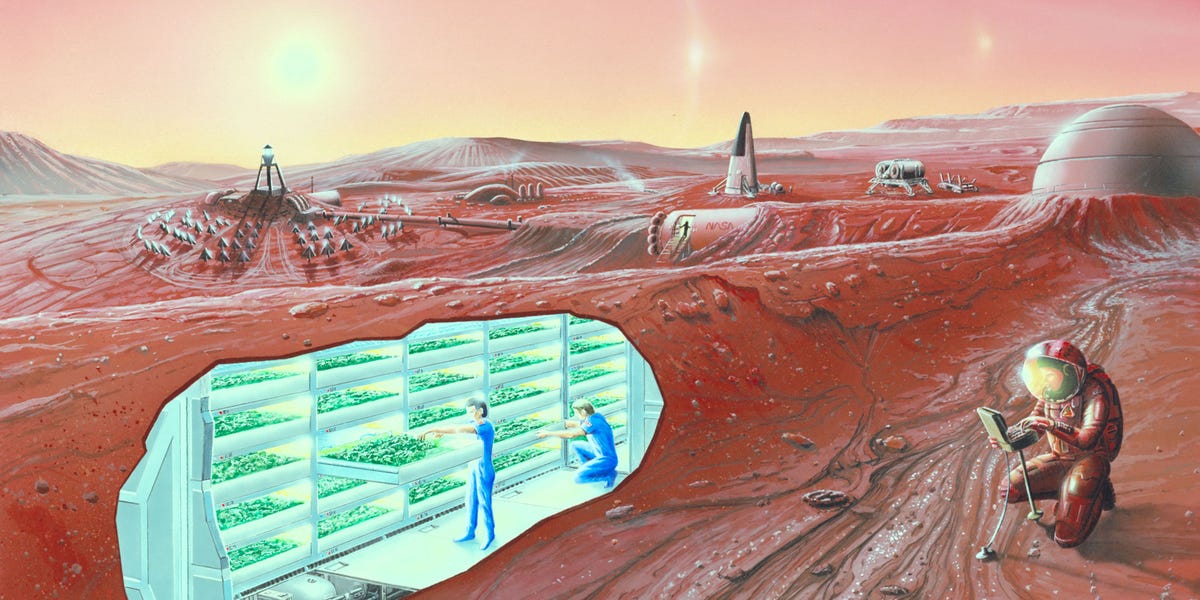
Mars has many charming qualities if your idea of charming includes freezing temperatures, global dust storms, low air pressure, radiation, and a landscape that looks like someone spilled cinnamon over a planet-sized parking lot. Yet for space agencies, engineers, architects, chemists, and materials scientists, that dusty red surface is not just scenery. It is a potential building supply aisle.
The effort to turn Martian soil into rock solid concrete is one of the most practical, strange, and surprisingly creative parts of planning for human settlement on Mars. The basic problem is simple: future astronauts cannot pack a Home Depot in the cargo bay. Every pound launched from Earth is expensive, and construction materials are very heavy. If humans ever build long-term shelters, roads, landing pads, radiation barriers, storage vaults, or laboratories on Mars, they will need to use what is already there.
That idea is called in-situ resource utilization, or ISRU. In plain English, it means “use local stuff instead of dragging everything from home.” On Mars, the most obvious local stuff is regolith: the loose blanket of dust, sand, crushed rock, minerals, and chemical salts that covers the planet. It is not soil in the garden sense. There are no worms, no leaf compost, and no friendly neighborhood microbes waving from between the grains. Martian regolith is more like a harsh mineral powder with an attitude.
Still, researchers see possibility in it. If regolith can be bound, melted, printed, compressed, or biologically cemented into strong shapes, Mars construction changes from science fiction into an engineering challenge. A difficult challenge, yesbut one with fewer moving parts than shipping millions of bricks across interplanetary space like the world’s most stressful furniture delivery.
Why Martian Concrete Matters
The first human habitats on Mars will probably arrive as compact, prefabricated modules from Earth. That makes sense for early missions. Astronauts will need something dependable the moment they land, not a construction project that begins with “Step one: survive the planet.” But prefab habitats alone are not enough for a permanent or semi-permanent base.
Mars settlers will need protective structures. Radiation is a major concern because Mars does not have Earth’s thick atmosphere or global magnetic field. Micrometeorites are another issue. Dust can damage equipment, clog mechanisms, and sneak into spacesuits like glitter at a craft party. Landing rockets may blast loose material at high speeds, which is why landing pads are not a luxury. They are infrastructure.
Concrete-like materials made from Martian regolith could help solve several problems at once. Thick walls can provide radiation shielding. Printed or cast surfaces can stabilize dusty ground. Regolith-based bricks or panels could expand a base without requiring every wall, floor, and foundation to be launched from Earth. A Mars settlement that uses local construction material would be cheaper, more flexible, and more resilient than one dependent entirely on supply missions.
What Makes Martian Soil So Difficult?
Martian regolith is tempting because it is everywhere. Unfortunately, “everywhere” does not automatically mean “easy to turn into a cozy condo.” Mars is cold, dry, and low-pressure. Water behaves differently there. Traditional Portland cement, the backbone of everyday concrete on Earth, needs water for hydration reactions. Water on Mars is precious, difficult to access, and needed for drinking, life support, agriculture, fuel production, and probably coffeebecause even astronauts deserve emotional support beverages.
The Martian atmosphere is mostly carbon dioxide and extremely thin compared with Earth’s. Temperatures can swing dramatically. Materials must tolerate freezing, thermal cycling, dust abrasion, internal pressure from sealed habitats, and possible chemical reactions with perchlorates, which are salts found in Martian regolith. Perchlorates are important because they can be toxic to humans and challenging for biology, but recent research also suggests they may influence certain construction processes in useful ways.
Another issue is that real Mars samples are rare. Most experiments use Martian regolith simulantsEarth-made mixtures designed to mimic the mineral composition and grain behavior of Martian dirt. These simulants are helpful, but they are not perfect copies. A brick that performs beautifully in a lab on Earth still has to prove itself under Mars-like pressure, temperature, radiation, and dust conditions.
The Main Approaches to Making Martian Concrete
Researchers are not betting on just one recipe. The field is more like a futuristic bake-off where every contestant is trying to make a house out of hostile dirt. Some methods use heat. Some use sulfur. Some use biology. Some use plant-based binders. A few have sounded so weird at first glance that they practically arrive wearing a lab coat and tap shoes.
1. Sulfur Concrete: Hot, Fast, and Water-Free
Sulfur concrete is one of the most discussed candidates for Mars construction because it does not require water in the same way ordinary cement does. The idea is to melt sulfur, mix it with regolith, pour or shape the material, and let it cool into a hard composite. Since sulfur is believed to be available on Mars in useful forms, this method could fit the ISRU dream: use local minerals, avoid hauling heavy cement, and save water for more important jobs.
On Earth, sulfur concrete has been studied for industrial uses, especially where chemical resistance matters. For Mars, its advantages include rapid setting and the possibility of recycling. Heat it, reshape it, cool it again. That sounds almost too convenient, like construction with a reset button. However, sulfur concrete also has limits. It can be sensitive to high temperatures, and Mars structures must survive repeated thermal stress. Researchers continue to study how sulfur-regolith mixtures behave under Mars-like conditions, including carbon dioxide-rich atmospheres and low temperatures.
2. Sintered Regolith: Turning Dust Into Stone With Heat
Another approach is sintering, which means heating regolith until particles fuse together without fully melting into liquid. Imagine making a ceramic tile from planetary dust. Solar concentrators, microwaves, lasers, or electric furnaces could potentially heat the material. The result might be bricks, tiles, landing pad surfaces, or structural panels.
Sintering has a major benefit: it may need little or no binder. That is attractive on Mars because every extra ingredient complicates the supply chain. The downside is energy. Heating large volumes of regolith requires power, and early Mars bases will have limited energy budgets. Solar power is possible, but dust storms and distance from the Sun reduce reliability. Nuclear power may help, but any construction method that demands constant high heat must compete with life support, communications, fuel processing, and science operations.
3. 3D-Printed Habitats: Robots With Giant Nozzles
NASA and private partners have spent years exploring additive construction for the Moon, Mars, and Earth. The logic is powerful: send robotic construction systems ahead of the crew, let them print protective structures from local material, and give astronauts a safer place to live when they arrive. NASA’s 3D-Printed Habitat Challenge encouraged teams to design and fabricate habitat concepts using advanced materials and autonomous printing methods.
This is where Mars construction starts to look like the world’s boldest architecture studio. Designs such as AI SpaceFactory’s MARSHA reimagined habitats not as squat bunkers, but as vertical, pressure-aware structures optimized for Martian conditions. ICON’s Mars Dune Alpha, a 3D-printed habitat built for NASA’s CHAPEA analog missions in Texas, shows how Earth-based construction technology can help researchers study crew life, layout, psychology, and operations before anyone tries building on Mars.
The real Martian version would be far harder. A printer must work in low pressure, cold temperatures, dust, reduced gravity, and limited human supervision. The material must flow through equipment, hold shape after deposition, bond between layers, resist cracking, and cure or harden properly. In other words, a Mars printer cannot behave like an office printer that jams because it sensed fear.
4. StarCrete: Potato Starch Meets Space Dust
One of the most headline-friendly breakthroughs is StarCrete, a material developed by researchers at the University of Manchester. It uses simulated Martian soil, potato starch, and a small amount of salt to create a concrete-like material. In testing, the Mars version achieved impressive compressive strength compared with ordinary concrete.
Why potatoes? Because starch can act as a binder, and potatoes are already discussed as a potential crop for controlled-environment space agriculture. If a Mars base grows food, agricultural byproducts could become construction ingredients. That is the kind of circular economy engineers love: eat the potato, build with the starch, and try not to make too many jokes about living inside a side dish.
StarCrete is exciting because it uses relatively simple, low-energy ingredients. It also points to a broader principle: Mars construction may not copy Earth concrete exactly. Instead, it may borrow ideas from food science, materials chemistry, agriculture, and manufacturing to create something that behaves like concrete but has a completely different recipe.
5. AstroCrete: The Weird Human-Binder Idea
Before StarCrete, the same general research area gained attention with AstroCrete, a concept using extraterrestrial dust combined with human serum albumin, a protein found in blood plasma. Some versions also explored urea, a compound found in sweat, tears, and urine, as a performance enhancer. Yes, this is the part where space construction briefly turns into a biology class you did not emotionally prepare for.
AstroCrete is not likely to become the preferred way to build Martian suburbs. It raises obvious practical, medical, and ethical issues. Astronauts are not construction supply dispensers. However, the research was useful because it demonstrated that biological binders can create strong regolith composites. It also expanded the imagination of the field. If proteins can bind dust, what else can? Plant starches? Microbial minerals? Recycled mission waste? The lesson is not “build houses out of astronauts.” The lesson is “look for binders in unexpected places.”
6. Biocementation: Let Microbes Do Some Masonry
Biocementation uses microorganisms to help bind particles together, often through a process called microbially induced calcite precipitation. In simple terms, certain bacteria can encourage calcium carbonate crystals to form, and those crystals can glue grains of material into a brick-like solid.
This approach is attractive because it may work at relatively low temperatures compared with sintering. It could also fit into biological life-support systems, where microbes already play roles in recycling waste, processing nutrients, or supporting agriculture. Recent studies have looked at how perchlorates affect biocementation-capable bacteria and Martian brick formation. Interestingly, although perchlorates can stress microbes, they may also change bacterial behavior in ways that promote binding structures under some conditions.
The big question is whether biocementation can be reliable on Mars. Microbes need controlled environments. They may need water, nutrients, warmth, and protection from radiation. That means biocementation might happen inside sealed construction units rather than directly out in the open. Still, the idea is powerful: grow part of your building material instead of manufacturing every ounce by brute force.
What Would Martian Concrete Be Used For First?
The first uses will probably be practical, not glamorous. Nobody needs a Martian shopping mall before they need a stable landing pad. Rocket exhaust can blast dust and rocks into nearby equipment, so hardened pads are a top priority. Roads or prepared paths could reduce dust problems around habitats. Berms and protective walls could shield equipment from radiation and debris. Storage shelters could protect supplies, tools, and scientific instruments.
Habitat shielding may be another early use. Instead of building entire pressurized homes from regolith concrete, astronauts might cover inflatable or metal modules with printed shells, blocks, or packed regolith barriers. This hybrid strategy makes sense: Earth supplies provide the airtight living space, while Mars materials provide bulk protection.
Over time, stronger regolith-based materials could support garages, greenhouses, workshops, emergency shelters, observatory pads, and underground access structures. A mature Mars base might use different materials for different tasks: sulfur concrete for fast casting, sintered tiles for landing zones, printed composites for walls, and biocemented blocks for lower-load applications.
The Engineering Tests That Matter
A Mars concrete candidate cannot win by being strong only on a good day in a comfortable lab. It has to pass a long list of tests. Compressive strength is important because walls, blocks, and pads must withstand loads. Tensile strength and fracture toughness matter because materials crack when pulled, bent, or thermally stressed. Abrasion resistance matters because dust and wind can wear surfaces. Thermal cycling matters because Mars gets cold, then colder, then “who left the freezer open on another planet?” cold.
Engineers also need to know how materials behave in low pressure and carbon dioxide-rich environments. They must test whether a printed wall bonds properly between layers, whether a sulfur mix becomes brittle, whether a starch binder attracts microbial contamination inside habitats, whether perchlorates interfere with chemistry, and whether the material can be repaired using simple tools.
Repairability may be just as important as strength. On Mars, a cracked panel cannot be replaced by calling a contractor. The best material may be the one astronauts can inspect, patch, recycle, and remake using limited equipment. A slightly less perfect material that is easy to repair may beat a super-material that requires a delicate machine, rare ingredients, and three engineers chanting politely at it.
Why This Research Helps Earth Too
Martian concrete research is not only about Mars. Earth has a concrete problem. Cement production is energy-intensive and contributes significantly to global carbon dioxide emissions. Researchers studying low-water, low-energy, alternative binders for space may discover methods useful for sustainable construction on Earth.
For example, starch-based binders, recycled materials, autonomous 3D printing, and low-carbon composites could influence disaster-relief housing, remote construction, military field structures, and affordable housing. If a material can be designed for a planet with no construction supply chain, it may also help places on Earth where shipping cement and steel is expensive or environmentally costly.
Space research often looks extravagant until its tools come home. Satellite navigation, water recycling, advanced insulation, and robotics all grew through extreme requirements. Mars construction has a similar flavor. Build for the worst jobsite imaginable, and Earth suddenly looks a bit easier.
The Human Side of Building With Martian Soil
Imagine being one of the engineers assigned to a Mars-regolith construction test. Your “dirt” arrives in bags with labels that sound like props from a science fiction movie. It is not actually from Mars, but it is designed to behave like the real thing. You pour it, weigh it, sieve it, mix it with binders, heat it, press it, print it, break it, measure it, and then do it again because science has a strict policy against letting anyone have a normal sleep schedule.
The experience is part chemistry lab, part construction site, and part cooking show. One recipe calls for sulfur. Another needs starch. Another uses a precise amount of salt. Another asks whether bacteria can help form minerals in the gaps between grains. The samples may look unimpressive at first: gray-red cylinders, dusty blocks, rough printed strips, little tiles that would not win any interior design awards. But when a compression machine squeezes one until it fails, the numbers tell a story. A humble chunk of simulated Mars dirt can become a serious structural material.
There is also a strange emotional shift that happens when you stop seeing regolith as dirt and start seeing it as infrastructure. The same powder that looks like a nuisance becomes a wall, a road, a heat shield, a foundation, or a landing pad. That shift is central to space settlement. Mars will not provide forests, rivers, limestone quarries, or friendly neighborhood hardware stores. It will provide minerals, sunlight, carbon dioxide, ice in some regions, and a lot of problems. The job is to turn those problems into systems.
For students and young engineers, Martian concrete research is a reminder that the future is not built only by astronauts and rocket designers. It also needs civil engineers, materials scientists, microbiologists, architects, chemists, roboticists, software developers, safety specialists, and people who are unusually patient with broken test equipment. A Mars base is not just a spacecraft that landed. It is a tiny city trying to be born in a place that does not care whether humans are comfortable.
The most realistic Mars construction experience may begin on Earth with small failures. A printed wall slumps. A sulfur sample cracks. A starch mixture absorbs moisture differently than expected. A simulated regolith batch behaves oddly because its grain size distribution changed. These failures are not embarrassing. They are the tuition fee for building on another planet. Every cracked brick teaches researchers what not to do when the nearest repair shop is millions of miles away.
There is something inspiring about that. Martian concrete is not glamorous in the movie-trailer sense. It does not roar like a rocket or sparkle like a spacesuit visor. It sits there, dense and practical, doing the unromantic work of keeping people alive. Yet that is exactly why it matters. Exploration becomes settlement only when humans learn to build. Not just visit. Not just plant a flag. Build.
Conclusion: Mars May Be Built From Its Own Dust
The effort to turn Martian soil into rock solid concrete is really an effort to change the economics and survival strategy of space exploration. If future crews can transform local regolith into strong, useful construction material, they can reduce dependence on Earth, expand habitats, protect equipment, and create the first true infrastructure on another planet.
No single recipe has won yet. Sulfur concrete, sintered regolith, StarCrete, biocemented bricks, and 3D-printed composites each bring strengths and weaknesses. The winning approach may be a toolbox rather than a single material. Mars settlers might print one structure, cast another, sinter a landing pad, and grow mineral bonds in bricks inside a controlled chamber.
That may sound complicated, but so is Mars. The Red Planet is not going to make construction easy. It is cold, dusty, dry, chemically tricky, and deeply uninterested in building permits. But its surface contains the raw ingredients for shelter, and researchers are learning how to unlock them. One day, the first permanent Martian neighborhood may not be shipped from Earth. It may rise from the ground under astronauts’ boots.
Note: This article synthesizes real public research and reporting from NASA programs, university materials-science projects, space architecture work, peer-reviewed studies on Martian regolith construction, and recent research into sulfur concrete, starch-based binders, 3D-printed habitats, and biocementation.













