
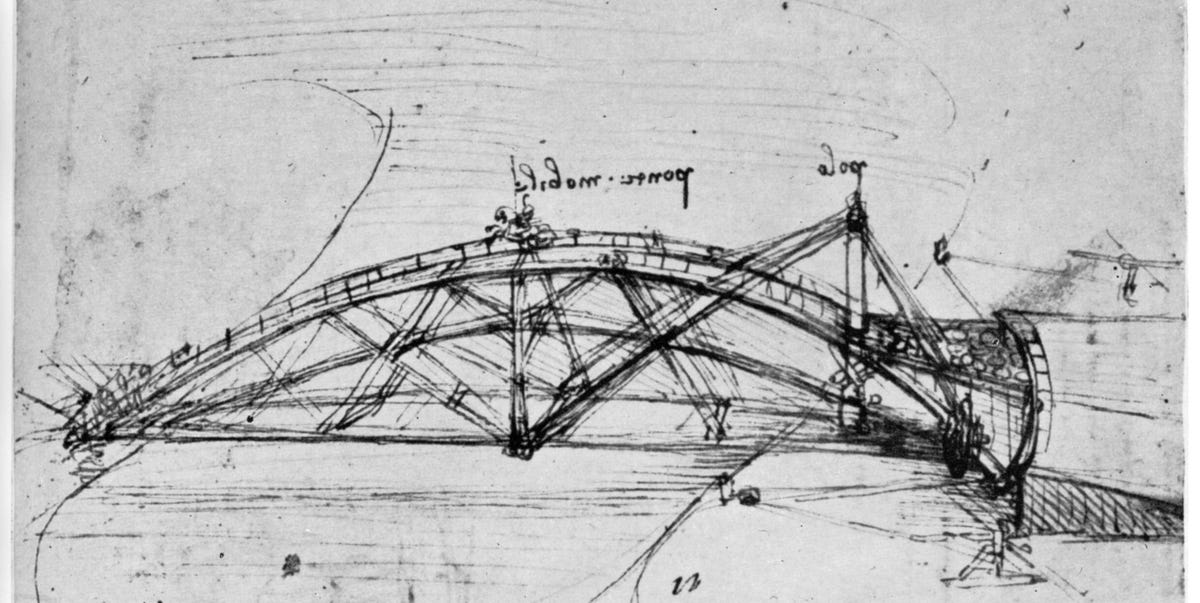
Leonardo da Vinci had a habit of making the future look slightly embarrassed. While most people in the early 1500s were busy trying to keep their boots out of the mud, Leonardo was sketching flying machines, studying anatomy, designing military devices, and proposing bridges so bold that even powerful rulers looked at them and said, in effect, “Interesting… but absolutely not.” One of those rejected ideas was a bridge across the Golden Horn in what is now Istanbul. More than 500 years later, scientists and engineers finally tested the concept. The verdict? Leonardo’s bridge design works.
That statement sounds almost too neat, like the kind of headline that deserves a dramatic drumroll and a Renaissance lute solo. But the science behind it is real. A team at the Massachusetts Institute of Technology studied Leonardo’s bridge proposal, analyzed the geometry, considered materials that would have been available in his time, and built a physical scale model to test whether the structure could stand using the principles Leonardo likely intended: compression, gravity, and smart design. No modern steel trickery. No hidden glue. No tiny construction workers in powdered wigs.
The result is more than a charming story about a famous genius being right again. It is a lesson in structural engineering, historical imagination, and the strange power of a good sketch. Leonardo’s Golden Horn bridge was not merely pretty. It was mathematically daring, structurally clever, and centuries ahead of common bridge-building practice. The design shows how beauty and function can shake hands without one stealing the other’s wallet.
The Bridge Leonardo Designed for the Ottoman Empire
Around 1502, Sultan Bayezid II of the Ottoman Empire wanted a bridge to connect Constantinople with Galata across the Golden Horn, a natural harbor and busy waterway. This was not a small backyard creek project. The bridge needed to span a wide inlet, allow ships to pass, and stand in a region where unstable ground and seismic activity were serious concerns. In short, it was the Renaissance version of a difficult municipal infrastructure bid, except with more robes and fewer PowerPoint slides.
Leonardo submitted a design that was startlingly different from typical masonry bridges of his time. Most long bridges relied on multiple semicircular arches supported by piers placed in the water. That approach worked well enough for many sites, but it would have created problems in the Golden Horn. Too many piers could interfere with boats, water flow, and navigation. Leonardo’s solution was a single, enormous flattened arch stretching across the span with enough clearance for sailing vessels.
Depending on the measurement interpretation, the proposed bridge was roughly 280 meters long, or about 918 to 919 feet. For the early 16th century, that was outrageous in the best possible way. It would have been dramatically longer than typical masonry spans of the period. The design also included wide, splayed supports or abutments that helped resist sideways movement. That detail matters because bridges do not only need to fight gravity. They also need to deal with shifting foundations, wind, soil movement, and, in some places, earthquakes. Leonardo seemed to understand that a bridge is not a frozen sculpture. It is a structure negotiating with nature every second of its life.
Why the Design Was Rejected
Leonardo did not get the commission. The bridge was never built in Istanbul during his lifetime, and the idea sat in history like a brilliant note stuffed into the wrong drawer. From the Sultan’s perspective, the rejection was understandable. Leonardo’s proposal was radical. A single flattened masonry arch of that size would have looked risky, maybe even impossible, to builders accustomed to more familiar methods.
It is easy, five centuries later, to laugh at the decision. But imagine being responsible for approving a massive public project and receiving a sketch from a man who also had ideas about flying machines. Even if that man was Leonardo da Vinci, a certain amount of eyebrow-lifting would be reasonable. The design lacked the full construction documentation modern engineers would expect. It also required exceptional confidence in geometry, stonework, foundation behavior, and construction sequencing.
Still, the rejection does not mean the idea was flawed. It means the idea arrived in a world that may not have been ready to trust it. History is full of concepts that looked ridiculous until someone built a working model. Leonardo’s bridge belongs in that proud club of “too early, not too wrong.”
How MIT Tested Leonardo da Vinci’s Bridge Design
In 2019, MIT researchers Karly Bast, Michelle Xie, and John Ochsendorf revisited the bridge as an engineering puzzle. They were not asking whether a modern contractor could build a Leonardo-inspired bridge with steel, concrete, cranes, and computer modeling. That would be interesting, but it would not answer the historical question. The real question was sharper: could Leonardo’s bridge have worked using the materials and construction principles available in his own time?
The team examined historical documents, the bridge geometry, the proposed site conditions, and the likely materials. Although Leonardo did not specify every construction detail, the researchers reasoned that stone masonry was the most plausible material for a bridge of such scale. Wood and brick would not have offered the same structural possibilities for the massive single-span form he imagined.
To test the concept, the team created a 1:500 scale model. The model was about 32 inches long and divided into 126 individual blocks. These blocks were 3D printed so the researchers could reproduce the complex geometry accurately. The 3D printer was not used to give the bridge modern strength; it was used to shape the model pieces precisely. The structural behavior still depended on the same old-school forces Leonardo would have relied on: compression, gravity, and the locking action of the arch.
The Keystone Moment
Like traditional masonry arches, the model needed temporary support during assembly. The blocks were placed into position, and the final wedge-shaped keystone locked the structure together. Once the support was removed, the bridge stood. That moment was not just visually satisfying; it was the whole argument in miniature. If the model could stand without mortar, glue, fasteners, or hidden reinforcement, then the geometry was doing the heavy lifting.
Arches work by redirecting loads into compression. Stone is excellent in compression, which is why ancient masonry structures can survive for centuries when their geometry is right. Pull stone apart and it complains. Push it together along the proper lines of force and it becomes wonderfully stubborn. Leonardo’s design took advantage of that stubbornness. The flattened arch distributed forces through the blocks and into the abutments, turning a huge span into a carefully balanced system.
Why the Flattened Arch Was So Innovative
The most striking feature of Leonardo’s Golden Horn bridge is its flattened arch. In many traditional masonry bridges, semicircular arches rise high and repeat across multiple spans. Leonardo flattened the curve and stretched it across a far greater distance. That was brave engineering. A flatter arch tends to create greater horizontal thrust at the supports, meaning the abutments must be strong and stable enough to resist the outward push.
Leonardo’s splayed abutments appear to answer that problem. They widen at the ends like a bridge doing a power stance. This shape helps stabilize the structure against lateral movement and foundation spreading. The result is not just elegant; it is practical. The bridge’s form responds to its forces. That is the difference between decoration and design.
The MIT study also tested how the model responded to foundation movement. The researchers placed the bridge on movable supports and simulated spreading that might occur from weak soil or seismic motion. The model deformed only slightly before eventually reaching failure under extreme movement. That finding does not mean the bridge would have been earthquake-proof in the superhero sense. It means Leonardo’s concept included a surprising level of resilience for its time.
What the Scientists Actually Proved
It is important to be precise. The researchers did not prove that a full-scale version would have been easy to build in 1502. They did not prove that every construction challenge had a ready answer, or that the Ottoman builders of the period would have had perfect access to the stone, labor, scaffolding, and project management required. Large masonry structures are difficult, and construction logistics can humble even the best design.
What the researchers did prove is that the concept was structurally feasible. The bridge’s geometry was not fantasy. The single flattened arch could stand. The forces could travel through the structure in a stable way. The design could support itself through compression. In engineering terms, that is a very big deal.
This distinction matters because Leonardo is often described as a dreamer whose notebooks were packed with impossible inventions. Some of his ideas were speculative, and some lacked the technology needed to become reality. But the Golden Horn bridge shows another side of him: a designer capable of producing a concept that was ambitious yet physically sound. He was not merely doodling a grand shape. He was thinking like an engineer.
The Bridge in Norway: Leonardo’s Idea in Modern Form
Leonardo’s Istanbul bridge was never built at full scale in stone, but his concept has inspired modern projects. A notable example is the Leonardo da Vinci Bridge in Ås, Norway, a pedestrian bridge inspired by the original design. Built with modern materials and adapted for a smaller site, it shows how Leonardo’s visual idea can be translated into contemporary public infrastructure.
However, the Norwegian bridge does not prove that the original Renaissance design could have worked with Renaissance materials. It is a modern interpretation, not a historical reconstruction. That is why the MIT model is so valuable. It focused on the structural principle behind the original proposal, not simply the appearance of a Leonardo-inspired arch.
Together, the two examples tell a richer story. The Norwegian bridge shows the design still has aesthetic and civic appeal. The MIT model shows the underlying geometry has real structural logic. One makes the public look up and say, “That’s beautiful.” The other makes engineers nod and say, “That checks out.” Ideally, a bridge should do both.
Why Leonardo’s Bridge Still Matters Today
Modern bridge designers have materials Leonardo could not have imagined: reinforced concrete, high-strength steel, advanced composites, digital modeling tools, and sensors that monitor structural health. Today’s engineers do not need to copy a 1502 masonry arch to solve most transportation problems. But Leonardo’s bridge still matters because it demonstrates a timeless principle: good design begins with understanding forces.
A structure is not strong because it looks strong. It is strong because its shape, material, and load paths cooperate. Leonardo’s bridge is a master class in that cooperation. The arch form carries weight through compression. The abutments resist outward thrust. The clear span protects navigation. The height allows boats to pass. The design answers several problems at once, which is why it feels so modern.
There is also a sustainability lesson hiding in the stonework. Leonardo’s concept used geometry to do work that modern designs sometimes solve by adding more material. This does not mean ancient methods are automatically greener or better. But it does remind us that efficiency is not only about new technology. Sometimes it is about shaping matter intelligently so nature helps instead of fights.
Engineering, Art, and the Renaissance Mind
Leonardo’s bridge is fascinating because it refuses to stay in one category. Is it art? Yes, because its form is graceful, balanced, and visually memorable. Is it engineering? Absolutely, because its beauty comes from structural logic. Is it history? Of course, because it reveals the ambitions and limits of Renaissance technology. Is it science? Yes again, because testing the design required hypothesis, modeling, observation, and analysis.
That blend is exactly what makes Leonardo feel so contemporary. Today we often divide knowledge into separate rooms: art over here, engineering over there, history down the hall, and science wearing safety goggles in the basement. Leonardo walked through all those rooms as if the walls were optional. His bridge reminds us that many of the best ideas happen when disciplines start borrowing each other’s tools.
For students, the story is especially powerful. It shows that drawing is not merely decoration. A sketch can be a laboratory. A model can be an argument. A historical question can become an engineering experiment. And a rejected proposal can wait 500 years for someone to say, “Let’s test it.” That is patience. Most of us get annoyed when an email sits unanswered for two days.
Common Misunderstandings About Leonardo’s Bridge
Misunderstanding 1: The bridge was a simple self-supporting wooden bridge
Leonardo is also associated with a different self-supporting bridge concept made from interlocking wooden beams. That portable design is often demonstrated in classrooms and science fairs. The Golden Horn bridge is not the same thing. It was a massive masonry arch proposal intended for a major urban waterway.
Misunderstanding 2: MIT built the actual bridge
The MIT team built a scale model, not a full-size bridge across the Golden Horn. The point was not to complete Leonardo’s construction project but to test structural feasibility. A scale model, when designed carefully, can reveal whether the geometry and force behavior make sense.
Misunderstanding 3: The study proves everything would have gone smoothly
Engineering feasibility is not the same as construction simplicity. Building the full bridge in the 1500s would have required extraordinary materials, skilled labor, accurate stone cutting, temporary supports, and careful foundation work. The design worked in principle, but the real-world project would still have been extremely challenging.
What This Discovery Teaches About Innovation
The story of Leonardo’s bridge teaches that innovation is not always about inventing a brand-new material or gadget. Sometimes it is about seeing a familiar principle at a scale no one else dares to attempt. Arches were not new in 1502. Masonry was not new. Bridges were certainly not new. Leonardo’s genius was in combining existing ideas into a form that solved the problem differently.
That is a useful lesson for modern creators, engineers, and entrepreneurs. Many breakthroughs come from recombination. You take a known material, a known principle, a known challenge, and you arrange them in a way that makes people blink twice. Leonardo did not need a futuristic alloy. He needed geometry, confidence, and a client willing to believe that a flattened arch could cross an impossible-looking span.
He got two out of three. Five centuries later, science supplied the third.
Experiences and Reflections: What Leonardo’s Bridge Feels Like in the Real World
One of the best ways to understand Leonardo da Vinci’s bridge design is to stop treating it like a museum object and start treating it like a hands-on problem. Anyone who has built a small arch from blocks, books, cardboard, or 3D-printed pieces knows the emotional rhythm of the process. At first, it feels impossible. The pieces lean, slide, complain, and behave like tiny architectural rebels. Then the final piece goes in, the supports come away, and suddenly the structure stands. It feels a bit like magic until you remember that magic, in engineering, is usually physics wearing a nice hat.
That experience helps explain why the MIT model is so compelling. A computer simulation can show stress paths and movement, but a physical model makes the idea visible to the body. You can see the curve. You can feel the uncertainty during assembly. You can understand why the keystone matters. When the bridge holds, the lesson becomes memorable because it is not just information; it is a moment.
For teachers, Leonardo’s bridge is a near-perfect classroom topic. It brings together history, geometry, physics, architecture, and design thinking without feeling like a worksheet disguised as fun. Students can compare semicircular arches with flattened arches, discuss why piers might block boats, and test how different support shapes affect stability. They can also debate why a ruler might reject a design that later proves sound. That conversation leads naturally into risk, trust, evidence, and the gap between having a good idea and convincing others to build it.
For makers and hobbyists, the bridge offers a satisfying challenge. A simple paper or wooden model can demonstrate compression, while a more advanced 3D-printed version can explore geometry with greater accuracy. The key experience is not perfection. It is discovery. The builder learns that small changes in shape can make a big difference. A slightly misplaced block can weaken the structure. A better support angle can improve it. The bridge becomes a quiet coach, teaching patience without giving a lecture.
For designers, the story is a reminder that elegance often comes from constraints. Leonardo had no reinforced concrete, no structural software, and no modern cranes. Those limits forced the design to depend on form. Today, when technology can sometimes encourage brute-force solutions, his bridge encourages a more disciplined question: can the shape solve more of the problem before we add more material?
For ordinary readers, the experience is simply delightful. There is something deeply satisfying about learning that a 500-year-old rejected sketch was not a wild fantasy after all. It suggests that some ideas are not dead; they are waiting for the right tools, the right questions, and the right people to test them. Leonardo’s bridge works because stone, gravity, and geometry agree with it. The rest of us can enjoy the fact that, once again, Leonardo saw a little farther down the road than almost everyone else.
Conclusion: Leonardo Was Not Just Dreaming
Scientists did not prove that Leonardo da Vinci was perfect. They proved something more interesting: one of his boldest unbuilt engineering ideas was structurally sound. His Golden Horn bridge design, with its enormous flattened arch and stabilizing supports, could have worked in principle using the logic of masonry construction. That is remarkable not because Leonardo was famous, but because the design was so ambitious for its time.
The bridge story also gives us a better way to talk about genius. Genius is not only mysterious inspiration. Sometimes it is careful observation, disciplined geometry, practical imagination, and the courage to propose a solution that looks unreasonable until the evidence catches up. Leonardo’s bridge did not cross the Golden Horn in 1502. But across five centuries, it still managed to connect art, science, history, and engineering. Not bad for a sketch that was once turned down.











