
Note: This publish-ready article is written from verified public information about USS New Jersey (BB-62), including official museum history, U.S. naval history records, and reporting on the ship’s 2024 dry-dock maintenance project.
Most people meet the Battleship New Jersey from the top down. They see the enormous gray superstructure, the long teak-colored deck, the famous 16-inch gun turrets, and enough steel to make a hardware store feel emotionally inadequate. But in 2024, visitors were given a rare chance to look at the ship from the bottom up. The USS New Jersey, also known as “Big J,” left her Camden waterfront berth and returned to the Philadelphia Navy Yard for dry-dock maintenance, allowing workers, historians, and lucky tour guests to walk beneath one of the most famous battleships in American naval history.
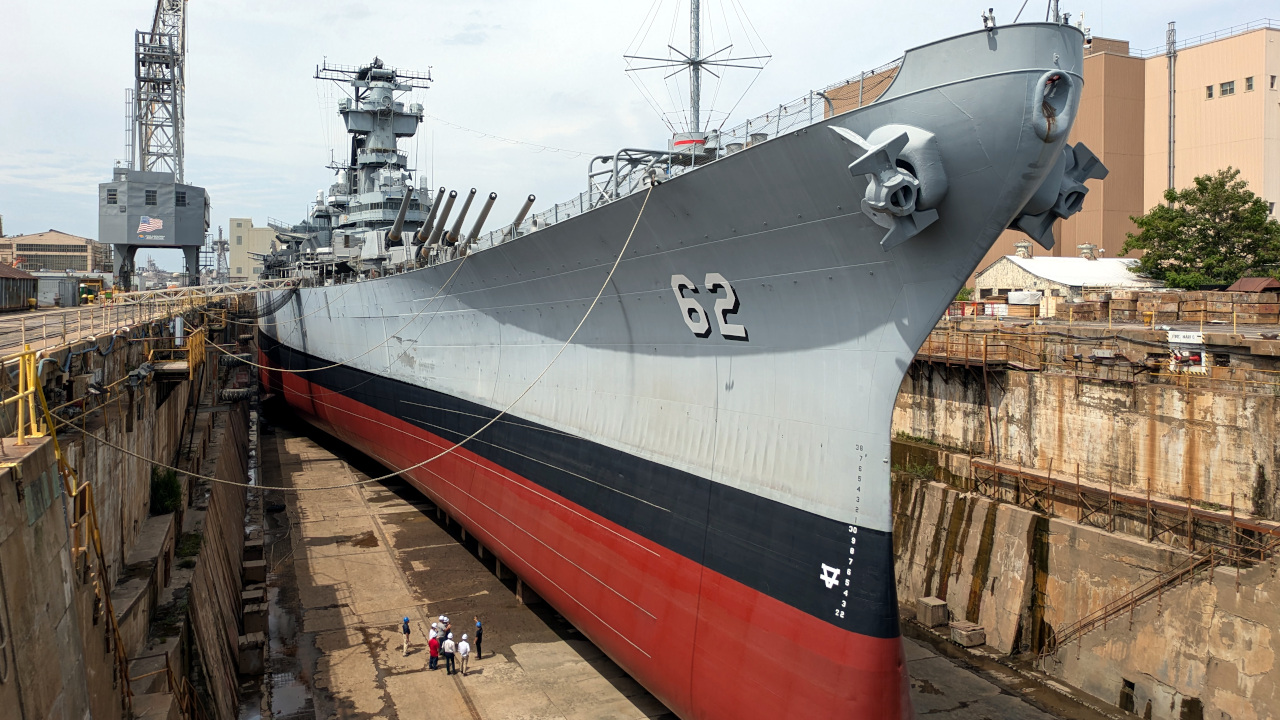
That view changes everything. From above, the Battleship New Jersey feels like a museum, a memorial, and a floating city. From underneath, she looks like engineering mythology with propellers. Her hull rises like a steel cliff. Her keel, rudders, through-hull openings, anodes, and underwater paint tell a quieter story than the guns do, but it is just as important. This is the part of the ship that spent decades doing the unglamorous work: resisting corrosion, cutting through water, supporting thousands of tons, and keeping the whole legend afloat.
Taking a look underneath the Battleship New Jersey is not just a cool photo opportunity, though yes, your neck may complain from staring upward. It is a lesson in preservation, naval architecture, American industrial history, and the surprisingly dramatic life of ship maintenance. Even a battleship needs a checkup. In fact, when the patient is 887 feet long and weighs tens of thousands of tons, the checkup becomes a major event involving tugboats, divers, paint systems, dry-dock blocks, inspections, and a level of planning that makes moving apartments look like carrying a sandwich across the room.
Why The Battleship New Jersey Matters
The USS New Jersey (BB-62) is an Iowa-class battleship, one of the last and fastest American battleships ever built. Constructed at the Philadelphia Naval Shipyard, she was launched on December 7, 1942, exactly one year after the attack on Pearl Harbor. She was commissioned in May 1943 and went on to serve in World War II, the Korean War, the Vietnam War, the Cold War, and operations in the Middle East. That is not a résumé; that is a steel autobiography.
Today, the ship is preserved as the Battleship New Jersey Museum and Memorial on the Camden Waterfront. Visitors can explore berthing spaces, command areas, exhibits, and engineering spaces, but the 2024 dry-dock project created a temporary view almost no museum visitor normally gets: the underside of the hull. It was a once-in-a-generation opportunity to see the ship the way maintenance crews and naval engineers see it.
The New Jersey is often described as the nation’s most decorated battleship. That reputation comes from her long service record, repeated recommissionings, and active participation across several eras of U.S. naval power. But the dry-dock view reminds us that history is not preserved by admiration alone. It takes paint, inspections, repairs, funding, and plenty of people willing to deal with rust before breakfast.
What Dry Docking Actually Means
A dry dock is exactly what it sounds like, although the real thing is much more impressive than the phrase. A ship enters a large basin filled with water. Once the vessel is properly positioned and supported, the water is pumped out, leaving the ship resting on carefully arranged blocks. Suddenly, the underwater portion of the hull becomes visible and accessible. For a vessel the size of the Battleship New Jersey, this is not a casual weekend errand. It is a major engineering operation.
In 2024, the Battleship New Jersey left Camden and traveled down the Delaware River, with tugboats guiding her toward the Philadelphia Navy Yard. Before entering dry dock, she stopped at the Paulsboro Marine Terminal for ballasting. Ballasting helps adjust the ship’s balance so it can sit correctly when the water is removed. Imagine asking an 887-foot museum ship to stand still on giant blocks. Now imagine the ship has opinions, physics has rules, and gravity has never been known for its sense of humor.
The dry-dock project focused on essential preservation work. Crews cleaned and repainted the hull, repaired corrosion-related issues, examined through-hull openings, and worked on the cathodic protection system. That system uses sacrificial anodes to help protect the hull from corrosion. The term “sacrificial anode” sounds like something from an ancient temple, but it is actually practical chemistry: the anodes corrode instead of the ship’s steel. If a battleship could send thank-you cards, the anodes would deserve a whole stationery budget.
Underneath The Hull: What Visitors Could See
Walking beneath the Battleship New Jersey during dry dock offered a view that is difficult to understand until you are standing there. The ship’s underside is not a smooth bathtub bottom. It includes curves, seams, plates, openings, appendages, shafts, rudders, and propellers. From below, the hull shows the ship’s real shape: long, powerful, and carefully designed to move fast for something that weighs more than a small downtown.
The red underwater hull coating is especially noticeable. Ships use specialized coatings below the waterline to help reduce marine growth and protect the hull. Above that, the color zones shift at the waterline and up toward the gray freeboard. On a normal museum visit, these paint boundaries are partly hidden by the river. In dry dock, the color bands become a visible map of where water usually lives.
The propellers are another highlight. The Battleship New Jersey has four propellers, and seeing them out of the water helps explain how this massive ship could reach high speeds for a battleship. The rudders, too, are impressive. They are not decorative fins. They are serious steering equipment built for a ship that once operated with carrier task forces, crossed oceans, and maneuvered in demanding naval environments.
Then there are the through-hull openings. These are openings in the hull designed for functions such as seawater intake and discharge. In service, they helped support cooling, engineering, and other ship systems. During dry dock, these areas can be inspected properly. To a casual visitor, a through-hull opening may look like a heavy-duty industrial detail. To preservation crews, it is one more place where the future of the ship depends on careful inspection and maintenance.
The Hidden Battle: Corrosion
When people think of battleships, they usually think of armor, guns, speed, and command. Preservation experts think about corrosion. That may sound less exciting until you realize corrosion is the villain that never retires. Saltwater, river conditions, dissimilar metals, oxygen, moisture, and time all work against a ship’s hull. The Battleship New Jersey may be famous for firepower, but in museum life, rust is the enemy that keeps showing up without an invitation.
This is why dry docking matters. A museum ship can look majestic from the pier while still needing serious attention below the waterline. Cleaning the hull removes buildup. Repainting adds protection. Replacing anodes keeps the cathodic protection system doing its job. Inspecting plates, seams, blanks, and openings helps identify problems before they become expensive emergencies. Maintenance is not glamorous, but neither is flossing, and dentists have made their point pretty clearly.
The 2024 project was especially important because the ship had not been out of the water for decades. Museum ships are not active naval vessels with regular shipyard cycles. They depend on public support, grants, donations, planning, and careful budgeting. Dry docking a battleship is expensive, complex, and rare. But without it, historic ships cannot be responsibly preserved for future generations.
Why The Philadelphia Navy Yard Made The Moment Special
The dry-dock project was more than maintenance; it was a homecoming. The Battleship New Jersey was built at the Philadelphia Naval Shipyard, and returning there connected the ship’s present-day preservation with her original construction. Dry Dock No. 3 became a stage where history folded back on itself. The place that helped bring Big J into the world also helped keep her around for the next chapter.
This matters because ships are not just machines. They are built environments full of human labor. Welders, shipfitters, engineers, sailors, officers, maintenance crews, museum staff, volunteers, historians, and visitors all become part of the ship’s continuing story. When the New Jersey returned to Philadelphia for hull work, it was not just steel going back to a basin. It was a landmark returning to its birthplace for the kind of care only a giant dry dock can provide.
For the Philadelphia and Camden region, the movement of the ship was also a public spectacle. Watching a battleship move along the Delaware River is not something you see every Thursday. The journey required tugboats, planning, bridge clearance considerations, and coordination across multiple locations. It briefly turned naval preservation into a regional event, complete with cameras, crowds, and probably at least one person saying, “Wow, that is bigger than I thought.” That person was correct.
What The Underside Reveals About Battleship Design
Looking underneath the Battleship New Jersey teaches a simple but powerful lesson: every famous feature above deck depends on the shape and strength below. The big guns, command spaces, radar equipment, armor, and living quarters all sit on a hull designed to carry weight, resist damage, and move efficiently through water. The underside is where naval architecture becomes visible.
The Iowa-class battleships were designed as fast battleships. That speed required powerful machinery, a long hull form, and a design that balanced armor, firepower, and propulsion. From below, the New Jersey’s length and underwater lines help explain how a ship so large could still be fast. She was not just a floating fortress. She was a carefully engineered machine intended to operate with fast carrier groups and project power across vast distances.
The propeller shafts, rudders, and hull form tell a story of movement. The armor and heavy internal structure tell a story of protection. The through-hull fittings and engineering openings tell a story of systems. A battleship is not one thing; it is thousands of things agreeing to work together while the ocean tries to win the argument.
The Museum Ship Challenge
Keeping the Battleship New Jersey open as a museum is a balancing act. Visitors want access, education, exhibits, overnight programs, tours, and memorable experiences. Preservation teams need safety, structural care, conservation planning, and funding. The ship must remain compelling to the public while also receiving the sort of behind-the-scenes maintenance that rarely fits into a postcard.
That is why the dry-dock tours were so clever. They turned necessary maintenance into public education. Instead of hiding the repair work, the museum used the moment to show visitors what preservation really looks like. Guests could see the scale of the hull, the protective coatings, the dry-dock environment, and the physical reality of keeping a historic battleship alive. It is one thing to donate to a preservation project. It is another thing to stand under the ship and think, “Oh. That is what the money is doing.”
Experiences like this help museums build deeper relationships with visitors. A person who walks through a deck exhibit may learn history. A person who walks beneath the hull may feel responsible for it. That emotional connection matters. Historic ships survive because communities decide they are worth saving.
Lessons From Beneath The Battleship
1. Preservation Is Active Work
Historic preservation is not simply leaving something alone and hoping it behaves. Ships age. Coatings fail. Metal corrodes. Systems need inspection. The Battleship New Jersey’s dry-dock project proves that preservation is active, technical, and ongoing. It requires both passion and practical maintenance.
2. The Less Visible Parts May Be The Most Important
The underside of the ship does not appear in most tourist photos, but it is essential to the vessel’s survival. Hull coatings, anodes, plates, and openings are not glamorous, yet they keep the ship safe and stable. In that sense, the underside of the Battleship New Jersey is a useful metaphor: important work is often done where fewer people are looking.
3. Engineering Can Be Beautiful
Standing beneath the hull, visitors saw curves, proportions, machinery, and scale that were never meant primarily as art. And yet, the result is strangely beautiful. Industrial beauty is not delicate. It is confident, functional, and occasionally covered in protective paint. The ship’s underside has that kind of beauty.
4. History Needs Access
The dry-dock tours gave the public a rare chance to connect with history in a physical way. Reading about a battleship is useful. Touring one is better. Walking underneath one is unforgettable. Access turns facts into memory, and memory is what keeps history from becoming wallpaper.
A Visitor Experience: What It Feels Like To Walk Under Big J
Imagine arriving at the Philadelphia Navy Yard knowing you are about to see a battleship from the wrong angle, which is exactly what makes it feel right. Normally, a ship belongs in water. Your brain expects waves, reflections, and a tidy museum entrance. Instead, you descend into a dry dock, surrounded by concrete walls, safety gear, work platforms, and the heavy atmosphere of a place built for serious industrial tasks. This is not a polished lobby with soft music. This is where steel goes to have an honest conversation with maintenance crews.
The first sensation is scale. The Battleship New Jersey is already huge when viewed from the pier, but from underneath, her size becomes almost ridiculous in the best possible way. The hull rises above you like a man-made cliff. The waterline, usually hidden by the Delaware River, is suddenly overhead. You are not just looking at a ship; you are standing in the space where the river usually is. That little realization has a way of making everyone quieter for a moment.
Then details start appearing. You notice the red underwater coating, the curve of the bow, the stern arrangement, the propellers, the rudders, the supports beneath the ship, and the marks that show where preservation work has been done. A guide might point out anodes or explain why certain openings matter. Someone nearby may ask a technical question. Someone else may simply stare upward with the expression of a person trying to resize their entire understanding of naval history.
The experience also feels oddly personal. Above deck, the Battleship New Jersey tells the story of admirals, sailors, battles, and technology. Underneath, she seems more vulnerable. You see the places where age matters. You see why paint, corrosion control, and inspections are not optional. A battleship may symbolize strength, but preservation reveals dependence: on experts, on donors, on volunteers, on museum staff, and on visitors who care enough to keep showing up.
There is also a bit of humor in the whole thing. You may find yourself wearing protective gear while admiring a ship that once represented peak naval power. You may take a photo of a propeller taller than a person and then realize your camera has absolutely failed to capture the scale. You may leave with dusty shoes, a stiff neck, and a new respect for anyone whose job involves explaining cathodic protection to a tour group before lunch.
By the time you climb out of the dry dock, the ship looks different. The guns still impress. The deck still invites exploration. The museum still tells its grand stories. But now you understand that the real magic is not only in the dramatic parts. It is in the maintenance, the hidden systems, the underside, and the stubborn effort to keep a legendary ship from becoming only a memory. Taking a look underneath the Battleship New Jersey turns a famous museum visit into something deeper: a reminder that history floats only when people keep it afloat.
Conclusion
Taking a look underneath the Battleship New Jersey reveals a side of Big J that most visitors never get to see. The 2024 dry-dock project was not merely a maintenance stop; it was a rare public lesson in how historic ships survive. Beneath the famous decks and towering guns is a complex underwater world of hull plates, coatings, propellers, rudders, through-hull openings, and corrosion-control systems. These details may not receive the same attention as the ship’s combat history, but they are essential to preserving that history.
The Battleship New Jersey remains powerful because she connects engineering with memory. She was built for speed, strength, and endurance, but today her mission is education. Her dry-dock experience showed that preservation is not passive nostalgia. It is hands-on, technical, expensive, and deeply worthwhile. Whether you are a naval history enthusiast, a museum lover, an engineering nerd, or just someone who enjoys standing next to objects that make buildings feel small, the underside of the Battleship New Jersey offers a view worth remembering.














