
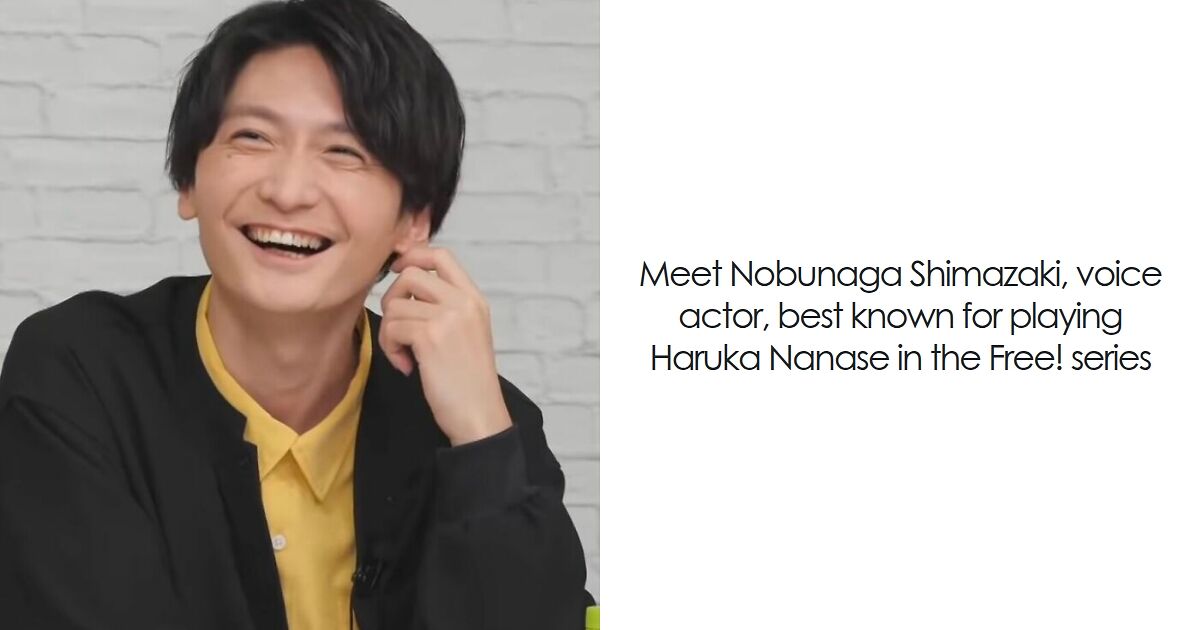
Nobunaga Shimazaki is one of those voice actors whose name can quietly sneak up on you. One minute you are watching a calm swimmer stare dramatically at a pool, the next you are hearing a cursed villain laugh like chaos found a microphone, and then suddenly you realize: yes, it is the same performer. That range is exactly why Shimazaki has become one of the most recognizable Japanese voice actors of his generation.
Known for roles such as Haruka Nanase in Free!, Yuki Sohma in Fruits Basket, Shido Itsuka in Date A Live, Yuno in Black Clover, Mahito in Jujutsu Kaisen, Seishiro Nagi in Blue Lock, and Shin Asakura in Sakamoto Days, Shimazaki has built a career that moves smoothly across sports anime, fantasy adventures, emotional dramas, action series, games, and film dubbing. He is not just “the guy with a nice voice.” He is the guy who can make silence feel heavy, kindness feel fragile, and villainy feel disturbingly playful.
Who Is Nobunaga Shimazaki?
Nobunaga Shimazaki, also written as Shimazaki Nobunaga in Japanese name order, was born on December 6, 1988, in Miyagi Prefecture, Japan. He is affiliated with Aoni Production, one of Japan’s major talent agencies for voice actors. His official profile lists his training at Aoni Juku Tokyo School, along with hobbies that include gaming, baking sweets, herbal tea, and swimming. In other words, his hobbies sound like the perfect weekend for an anime protagonist who has already completed the tournament arc.
Shimazaki began appearing in anime roles around 2009 and gradually grew from smaller parts into lead and major supporting roles. His rise was not overnight, but it was steady. By the early 2010s, he had started appearing in more visible projects, and by 2013, Free! pushed him into broader fan recognition. Since then, he has remained busy across television anime, theatrical animation, video games, character songs, radio, narration, and Japanese dubbing for international productions.
Early Career: Building A Voice One Role At A Time
Like many successful seiyuu, Shimazaki’s early career included supporting parts, background characters, and smaller roles that helped him sharpen his timing. Voice acting is not just reading lines into a microphone. It requires breath control, emotional precision, coordination with animation, and the ability to make a character feel alive even when the screen gives you only a few seconds to work with.
His early work in titles such as Waiting in the Summer, Kuroko’s Basketball, Tari Tari, and Say “I Love You” helped establish him as a flexible young performer. These projects gave him chances to play different types of young male characters: earnest, reserved, comedic, romantic, and athletic. That variety became important later because Shimazaki’s career would not be defined by just one tone.
The Breakthrough: Haruka Nanase In Free!
For many anime fans, Nobunaga Shimazaki became unforgettable through Haruka Nanase in Free!. Haruka is calm, quiet, and emotionally guarded, but he is not empty. That makes him deceptively difficult to perform. A loud character can announce feelings with fireworks. Haruka often has to express an entire emotional weather system with a pause, a breath, or a carefully controlled sentence.
Shimazaki’s performance captured Haruka’s deep attachment to swimming, his awkwardness with direct emotional communication, and his slow growth from instinct-driven athlete to someone forced to consider his future. His voice gave Haruka a cool surface without making him cold. The result was a character who felt distant yet deeply human, like a cat who has strong feelings but refuses to file the paperwork.
Free! also helped connect Shimazaki with music and character-song culture. As part of the franchise’s cast, he participated in songs associated with the series, further expanding his presence beyond dialogue performance. The role remains one of his signature achievements and is often one of the first characters fans mention when discussing his career.
Major Anime Roles That Defined His Career
Yuki Sohma In Fruits Basket
Yuki Sohma in the 2019 Fruits Basket adaptation gave Shimazaki one of his most emotionally layered roles. Yuki is admired as a “prince” by classmates, but the polished image hides years of loneliness, trauma, and self-doubt. Shimazaki’s performance helped reveal the gap between how others see Yuki and how Yuki sees himself.
The role earned major recognition because it required restraint, tenderness, pain, and gradual healing. Yuki’s journey is not about becoming louder. It is about becoming freer. Shimazaki’s voice work made that transformation believable without overplaying it.
Mahito In Jujutsu Kaisen
If Yuki Sohma shows Shimazaki’s gentle dramatic side, Mahito in Jujutsu Kaisen shows the “please do not invite this man to brunch” side. Mahito is playful, cruel, curious, and terrifying. He treats human suffering like a science project with jokes. Shimazaki’s performance gives Mahito a disturbing lightness, making the character feel even more dangerous because he sounds amused by horror.
This role became a strong example of Shimazaki’s range. He can perform soft introspection, but he can also create a villain whose laughter makes the room temperature drop. For many newer fans, Mahito introduced Shimazaki as a performer capable of turning charm into menace.
Seishiro Nagi In Blue Lock
In Blue Lock, Shimazaki voices Seishiro Nagi, a soccer prodigy whose genius is matched only by his legendary laziness. Nagi is calm, sleepy, and almost aggressively unbothered until competition awakens something sharper inside him. Shimazaki makes Nagi sound relaxed without making him boring, which is harder than it looks. Too little energy and the character disappears; too much energy and the character stops being Nagi.
The performance works because Shimazaki understands negative space. He lets Nagi’s pauses, flat reactions, and sudden bursts of interest become part of the character’s rhythm. The result is a fan-favorite role that fits perfectly into the intense, ego-driven world of Blue Lock.
Yuno In Black Clover
Yuno in Black Clover is another cool, talented character, but he is different from Haruka or Nagi. Yuno is composed and gifted, yet he carries ambition, loyalty, and quiet competitiveness. Shimazaki gives him a controlled confidence that contrasts well with Asta’s explosive energy. Their dynamic works because Yuno does not need to shout to prove he belongs in the fight.
Shido Itsuka In Date A Live
As Shido Itsuka in Date A Live, Shimazaki plays a more openly warm and reactive lead. Shido has to navigate comedy, romance, supernatural stakes, and emotional rescue missions. The role shows Shimazaki’s ability to anchor a high-concept series with sincerity. Even when the plot gets wild, Shido needs to feel emotionally grounded, and Shimazaki provides that center.
Shin Asakura In Sakamoto Days
Shimazaki’s role as Shin Asakura in Sakamoto Days adds another modern highlight to his résumé. Shin is a clairvoyant former assassin working beside the legendary Taro Sakamoto. The series blends action and comedy, so the performance requires sharp timing: one moment cool and capable, the next caught in absurd chaos. Shimazaki’s experience with both serious and comic roles makes him a strong fit for that balance.
Work In Video Games And Dubbing
Nobunaga Shimazaki’s career is not limited to anime. His game roles include major titles such as Fate/Grand Order, where he is associated with characters including Arjuna, Arjuna Alter, Edmond Dantès, and Ritsuka Fujimaru in animated adaptations. He also voices Kaedehara Kazuha in the Japanese version of Genshin Impact, a role that fits his talent for graceful, poetic delivery.
His official profile also lists dubbing work for international productions, including roles connected to Game of Thrones, Death Note, Alita: Battle Angel, Mortal Engines, and Barbie. Dubbing requires a different discipline from anime because the actor must match existing timing, lip movement, and performance intention while still making the Japanese version feel natural. Shimazaki’s presence in this field shows his versatility as a working voice actor.
Awards And Recognition
Shimazaki’s industry recognition includes the Best Rookie Actor Award at the 7th Seiyu Awards and the Best Supporting Actor Award at the 15th Seiyu Awards. These honors matter because they reflect both early promise and sustained professional growth. Many actors have a breakout moment; fewer continue expanding their range across more than a decade of high-profile work.
The 15th Seiyu Awards recognition is especially meaningful because it came after years of increasingly complex roles, including emotionally demanding performances such as Yuki Sohma. By that point, Shimazaki was no longer simply a rising voice. He had become a trusted performer capable of carrying major characters in major franchises.
Why Fans Connect With Nobunaga Shimazaki
Fans often connect with Shimazaki because his performances feel controlled but not stiff. He does not rely on one loud signature style. Instead, he adjusts texture: soft for vulnerability, clean for heroic leads, airy for dreamy characters, sharp for rivals, and unsettlingly bright for villains. His voice can sound young and transparent, but it can also become sly, intense, or emotionally wounded.
Another reason fans enjoy his work is the contrast between roles. Haruka Nanase and Mahito do not sound like they should live in the same actor’s résumé, yet there they are, sitting together like a peaceful aquarium beside a cursed disaster zone. That contrast keeps viewers paying attention. Once you recognize Shimazaki’s voice, you start noticing how carefully he reshapes it from role to role.
Career Highlights At A Glance
- 2009: Early anime appearances begin, marking the start of his professional voice acting career.
- 2013: Gains major recognition as Haruka Nanase in Free!.
- 2013: Wins Best Rookie Actor at the 7th Seiyu Awards.
- 2019: Voices Yuki Sohma in the acclaimed Fruits Basket reboot.
- 2020: Delivers a memorable villain performance as Mahito in Jujutsu Kaisen.
- 2021: Wins Best Supporting Actor at the 15th Seiyu Awards.
- 2022: Reaches new sports-anime fans as Seishiro Nagi in Blue Lock.
- 2024–2025: Continues appearing in major projects such as Wind Breaker and Sakamoto Days.
Acting Style: Calm, Precision, And Emotional Control
Shimazaki’s best performances often rely on precision rather than volume. He is excellent at playing characters who hide their emotions, which means the emotion has to leak through tiny details. A slight change in breath can suggest hesitation. A softer ending to a sentence can suggest fear. A colder tone can turn a polite line into a warning.
This skill is especially valuable in anime, where characters often carry big symbolic roles. A sports prodigy, a cursed spirit, a traumatized prince, or a magical swordsman can easily become a type. Shimazaki’s work helps them feel specific. He finds the human rhythm inside the archetype, and that is why his performances tend to stay with viewers.
Experiences Related To Nobunaga Shimazaki: Why His Work Rewards Rewatching
Watching Nobunaga Shimazaki’s career unfold is a bit like revisiting a favorite playlist and realizing one musician secretly played five different instruments. The first experience many fans have with him is usually character-based. They fall for Haruka’s quiet intensity, Nagi’s sleepy genius, Yuki’s emotional growth, or Mahito’s terrifying playfulness. Only later do they connect the dots and discover that the same actor is behind all those voices. That discovery is part of the fun.
One of the best ways to appreciate Shimazaki is to compare two completely different roles back to back. Try listening to Haruka Nanase and then Mahito. Haruka’s voice feels contained, almost waterlike, with emotion moving below the surface. Mahito, on the other hand, is loose, slippery, and unpredictable. He sounds amused even when the scene is horrifying. The difference is not just pitch; it is attitude, breath, timing, and emotional temperature. That is real craft.
Another rewarding experience is watching Fruits Basket with attention to Yuki Sohma’s development. Early Yuki often sounds polished and distant, as though he has learned to survive by becoming the version of himself others expect. As the story progresses, Shimazaki gradually lets more warmth and uncertainty enter the performance. It is not a sudden transformation. It feels like someone slowly opening a window in a room that has been closed for years.
For sports-anime fans, comparing Haruka in Free! with Nagi in Blue Lock is especially interesting. Both characters are talented and calm, but their energies are not the same. Haruka is emotionally tied to swimming in a deeply personal way; Nagi treats soccer like an inconvenience until it becomes interesting enough to wake him up. Shimazaki gives each athlete a different internal rhythm. Haruka feels meditative. Nagi feels like a genius who accidentally downloaded motivation.
Gamers may have a different entry point. His work as Kaedehara Kazuha in Genshin Impact highlights a lyrical, composed side of his voice. Kazuha’s lines often carry a poetic calm, and Shimazaki’s delivery helps the character feel gentle without becoming dull. In Fate/Grand Order, his association with multiple characters shows another layer of range, especially for fans who follow both the game and its animated adaptations.
The larger lesson from Shimazaki’s career is that voice acting is not invisible labor, even when the actor never appears on screen. A strong voice performance changes how a character breathes in the audience’s imagination. It shapes memes, fan edits, emotional reactions, and even how people remember entire scenes. Shimazaki’s work proves that a voice can be quiet and still iconic, gentle and still powerful, funny and still dangerous. That is why his career remains worth following, one role at a time.
Conclusion
Nobunaga Shimazaki’s career is a strong example of modern seiyuu versatility. From the restrained emotional world of Free! and Fruits Basket to the explosive popularity of Jujutsu Kaisen, Blue Lock, Genshin Impact, and Sakamoto Days, he has shown that great voice acting is not about sounding the same everywhere. It is about knowing exactly what each character needs.
His best performances are memorable because they feel carefully built. He can make a quiet character compelling, a villain magnetic, a hero sincere, and a genius athlete hilariously detached. With major awards, a long list of beloved roles, and ongoing appearances in high-profile anime and games, Nobunaga Shimazaki remains one of the most important Japanese voice actors for fans to know.
Note: This article is written in clean, body-only HTML for web publication and avoids embedded source links or citation placeholders inside the publishable article text.











