
For more than a century, the “flying car” has been the shiny carrot dangling in front of futurists, engineers, and anyone who has ever sat in bumper-to-bumper traffic wondering whether pigeons have a better commute. Most flying car ideas either look like small airplanes with an identity crisis or helicopters that accidentally joined a car show. Airbus, however, approached the dream from a different angle: what if the future vehicle did not have to be one machine that does everything, but a smart, modular system that transforms depending on the trip?
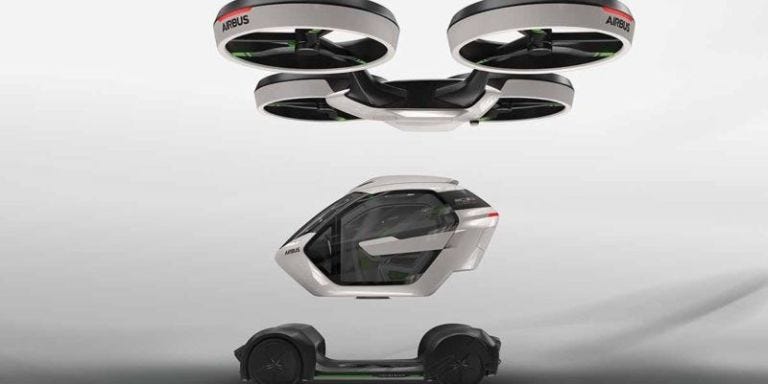
That is the big idea behind Airbus’ Pop.Up concept, developed with Italdesign and later evolved with Audi into Pop.Up Next. It is not just a car with wings bolted on like a weekend garage experiment gone viral. Instead, it is a passenger capsule that can connect to a ground module for road travel or attach to an air module for vertical takeoff and landing. In simple terms: your cabin stays with you, while the wheels or rotors swap in as needed. It is part electric car, part passenger drone, part sci-fi taxi, and part “please let this be real before my next airport transfer.”
The concept was designed for crowded megacities where roads are packed, time is wasted, and commuters spend an alarming portion of life staring at brake lights. Airbus and Italdesign imagined a fully electric, zero-emission urban mobility system that could use both streets and airspace more intelligently. While Pop.Up is still a concept rather than a vehicle you can order with heated seats and a cup holder, it remains one of the most interesting examples of how aerospace, automotive design, artificial intelligence, and urban planning could merge into one transportation ecosystem.
What Is the Airbus Pop.Up Flying Car Concept?
The Airbus Pop.Up concept is best understood as a modular transportation system. Instead of asking one vehicle to drive like a car, fly like a drone, park like a scooter, and somehow remain affordable, Pop.Up separates the mission into interchangeable parts. The core piece is a two-passenger capsule. This capsule can ride on an electric ground platform when roads make sense, or it can detach and connect to an air module when flying is faster.
The original Pop.Up was unveiled in 2017 at the Geneva International Motor Show as a collaboration between Airbus and Italdesign. The idea was bold but surprisingly logical. If cities already combine buses, trains, taxis, bikes, and walking, why should future mobility be limited to only one layer of movement? Pop.Up proposed a system where software would analyze traffic, timing, user preference, and available infrastructure, then choose the best combination of ground and air travel.
In 2018, the concept evolved into Pop.Up Next with Audi joining the project. That version leaned more heavily into the luxury autonomous vehicle experience, combining a self-driving electric car platform with a passenger drone. The companies even demonstrated a quarter-scale working model at Amsterdam Drone Week, where the capsule connected with modules and completed an autonomous ground-and-air sequence. It was not a full-size vehicle carrying real passengers, but it was more than a pretty sketch on a designer’s tablet.
How the Transforming Flying Car Works
The magic of Pop.Up is not that it sprouts wings. The clever part is modularity. The passenger capsule acts like the “living room” of the trip. The ground module provides the wheels and road-going electric drive. The air module provides vertical takeoff and landing through multiple rotors. When the passenger needs to travel by road, the capsule locks onto the ground module. When traffic becomes a four-lane parking lot, the capsule can transfer to the air module and fly over the congestion.
The Passenger Capsule
The capsule is the heart of the system. It is designed as a compact two-seat cabin, providing a consistent passenger environment whether the journey happens on pavement or in the sky. In the Pop.Up vision, riders would not have to climb out, drag luggage across a terminal-like transfer point, and find another vehicle. The cabin itself moves between modules, which makes the transition feel seamless.
This design also solves one of the classic weaknesses of flying car concepts: compromise. A road car needs tires, crash structures, lights, suspension, and a shape that works in traffic. An aircraft needs lift, propulsion redundancy, stability, and strict safety systems. Combining everything into one vehicle often creates a machine that is not great at either job. Pop.Up dodges the problem by letting each module specialize.
The Ground Module
The ground module is essentially an autonomous electric vehicle platform. It carries the passenger capsule through city streets like a small self-driving car. For shorter routes, dense downtown areas, or places where flying is unnecessary or restricted, the ground module would do the job quietly and efficiently.
This matters because not every trip needs to become an airborne event. Nobody wants a swarm of flying taxis launching just to cross the street for tacos. The ground module keeps Pop.Up practical by using roads when roads are the smartest option. Air travel becomes a tool, not a default setting.
The Air Module
The air module is where the futuristic drama enters. It uses electric rotors to lift the capsule vertically, similar in principle to an electric vertical takeoff and landing aircraft, often called an eVTOL. Vertical takeoff is important because cities do not have spare runways hiding between coffee shops and apartment buildings. A practical urban air mobility system needs to launch and land from compact vertiports, rooftops, or specially designed hubs.
The Pop.Up concept imagined a passenger drone that could pick up the capsule, fly it across congested areas, then place it onto another ground module near the destination. That final handoff is crucial. A flying vehicle may save time in the air, but if passengers still need a taxi at both ends, the convenience fades quickly. Pop.Up tries to solve the first-mile and last-mile problem by keeping the passenger in one capsule throughout the journey.
Why Airbus Built a Flying Car Concept
Airbus is not known for making commuter hatchbacks. It builds aircraft, helicopters, satellites, and aerospace systems. So why would a company famous for jets explore a flying car? The answer is urban air mobility.
Cities are growing, roads are overloaded, and traditional infrastructure is expensive to expand. Building new highways through dense cities is often politically difficult, financially painful, and environmentally questionable. Airbus saw an opportunity to apply aerospace expertise to short-distance urban transportation, especially as electric propulsion, lightweight materials, autonomy, and battery technology improved.
Pop.Up was not Airbus’ only experiment in this space. Airbus also developed Vahana, an all-electric single-seat eVTOL demonstrator, and CityAirbus NextGen, a four-seat eVTOL prototype designed for short urban and regional flights. These projects show that Airbus was not simply chasing a viral headline. The company was exploring different pieces of the same puzzle: how to move people through crowded areas using clean, quiet, highly automated aircraft.
The Role of Artificial Intelligence in Pop.Up
One of the most overlooked parts of the Airbus Pop.Up concept is the artificial intelligence platform. The vehicle itself gets the spotlight because, frankly, a drone-car capsule is easier to photograph than an algorithm. But the AI layer is what would make the system usable.
In the proposed model, a passenger would enter a destination through an app. The system would then calculate the best route based on traffic, weather, cost, availability, travel time, passenger preferences, and possibly even energy use. If the roads were clear, the rider might stay on the ground. If congestion was severe, the system could route the capsule to an air module. If public transportation made more sense for part of the trip, the concept could theoretically integrate with trains or other mobility networks.
This is where Pop.Up becomes more than a flying car. It becomes a mobility platform. The actual vehicle is only one component in a larger network that includes software, charging stations, landing pads, fleet management, air traffic coordination, and city infrastructure. In other words, the flying car is the fun part; the boring backend is what determines whether it works in real life.
Pop.Up Next: When Audi Joined the Flying Taxi Conversation
Pop.Up Next took the original Airbus and Italdesign idea and added Audi’s automotive design language. The result looked more polished, more premium, and more like something that might appear in a luxury showroom where the espresso machine costs more than a used sedan.
The Audi collaboration helped frame the concept as a bridge between self-driving electric cars and passenger drones. On the ground, the capsule would sit on an Audi-style electric chassis. In the air, it would connect to a flight module developed with Airbus expertise. The passenger would remain in the same cabin while the system handled the transformation.
At Amsterdam Drone Week in 2018, the partners demonstrated a 1:4 scale model. The flying module carried the capsule, placed it onto the ground module, and the ground platform drove autonomously. Of course, a quarter-scale demonstration is not the same as a certified passenger vehicle. A toy poodle is also technically a wolf relative, but you would not ask it to guard a castle. Still, the demo showed that the docking concept, automation sequence, and modular thinking were not pure fantasy.
Why the Airbus Flying Car Still Matters
Even though you cannot hail a Pop.Up today, the concept remains important because it reframed the flying car debate. Instead of asking, “Can we build a car that flies?” it asked, “Can we build a transportation system that uses the right module at the right time?” That is a smarter question.
Many modern eVTOL companies focus on air taxis that operate between vertiports. That model may work for airport transfers, business districts, emergency services, tourism, and regional trips. However, it still requires passengers to get to and from landing sites. Pop.Up’s modular capsule directly addressed that inconvenience. It imagined a future where the vehicle follows the passenger’s journey instead of forcing the passenger to adapt to separate vehicles.
The design also encouraged serious conversations about shared mobility. A Pop.Up fleet would likely work more like a premium rideshare network than private car ownership. That is important because the economics of urban air mobility depend on utilization. A flying car parked in a private garage most of the day is not efficient. A fleet vehicle that moves many passengers throughout the day has a better chance of making financial sense.
The Big Challenges: Safety, Noise, Batteries, and Rules
For all its futuristic charm, the Airbus transforming flying car faces real-world obstacles that cannot be solved with a glossy concept video. The first and most important challenge is safety. Aircraft must meet extremely high standards, especially if they fly over populated areas. A road vehicle failure can be dangerous; an aircraft failure over a dense city adds a whole new level of “no thank you.”
Electric vertical takeoff aircraft need redundant propulsion, reliable batteries, advanced flight control systems, weather tolerance, and emergency procedures. Autonomy adds another layer of complexity. A self-flying passenger vehicle must detect obstacles, communicate with air traffic systems, handle unexpected conditions, and protect against cybersecurity risks. That is not impossible, but it is not easy.
Noise is another major issue. Electric aircraft can be quieter than helicopters, but “quieter” does not automatically mean “welcome above my apartment every four minutes.” Cities would need strict noise planning, route design, operating hours, and community input. Public acceptance may decide the future of air taxis as much as engineering does.
Batteries also limit range and payload. Vertical takeoff uses a lot of energy, and every extra pound matters. A flying capsule, passengers, safety systems, and reserve power all add weight. Battery technology is improving, but physics remains stubborn. It does not care how attractive the concept renderings are.
Then there are regulations. In the United States, the Federal Aviation Administration is working on advanced air mobility and air taxi integration, but certification takes time. Vehicles, pilots or autonomous systems, vertiports, maintenance procedures, airspace rules, and emergency planning all need approval. The future may be electric and autonomous, but paperwork still flies first class.
How Airbus’ Concept Compares With Today’s eVTOL Industry
Today’s advanced air mobility industry is full of companies developing electric aircraft for short trips. Some focus on piloted air taxis. Others aim for cargo, medical transport, airport shuttles, or regional mobility. Compared with those designs, Pop.Up is more ambitious because it combines air travel with autonomous ground travel in one modular passenger experience.
That ambition is both its strength and its weakness. A standard eVTOL aircraft already has to solve certification, battery performance, manufacturing, infrastructure, and public acceptance. Pop.Up adds robotic docking, swappable modules, autonomous ground operation, and a more complicated fleet network. It is elegant from a user-experience perspective, but complex from an operational one.
Still, complexity does not mean failure. Many technologies we take for granted started as overcomplicated dreams. Smartphones combined cameras, computers, music players, maps, and phones into one pocket device. Ride-hailing changed how people think about car access. Electric vehicles forced automakers to rethink platforms and charging. Pop.Up belongs to that tradition of bold concepts that may not arrive exactly as shown but influence what comes next.
Could a Transforming Flying Car Actually Become Common?
A personal flying car in every driveway is unlikely in the near future. The more realistic path is shared aerial mobility in limited routes. Think airport-to-downtown transfers, medical flights, island connections, emergency response, or high-value business routes. These use cases are easier to manage because they can operate between known locations with controlled infrastructure.
A Pop.Up-style transforming vehicle could become practical if cities develop vertiports, autonomy matures, batteries improve, and regulators approve safe operations. It would also need strong business logic. Passengers may love the idea of flying over traffic, but they will still ask the ancient transportation question: “How much does it cost?” If the price is closer to a helicopter charter than a rideshare, the market will be narrow.
The most likely influence of Airbus’ concept may be indirect. Future mobility systems might borrow its modular thinking without copying the exact design. We may see autonomous ground shuttles that connect with eVTOL hubs, standardized passenger pods for airports, or AI platforms that combine road and air options in one booking system. The Pop.Up may not be the final product, but it is a useful blueprint for thinking beyond the car.
Experience-Based Reflections: What the Airbus Flying Car Concept Feels Like in Real Life Thinking
Anyone who has traveled through a major city during rush hour can understand the emotional appeal of the Airbus transforming flying car. Picture trying to get from a downtown hotel to an airport when every navigation app turns red, orange, and emotionally damaging. The driver sighs. The passenger checks the flight time. A delivery truck blocks one lane. Somewhere ahead, a mystery slowdown develops for no visible reason, as if traffic itself has decided to become performance art.
In that moment, the Pop.Up concept feels less like science fiction and more like common sense wearing propellers. The dream is not really about flying for fun. It is about control. It is about turning a stressful, unpredictable commute into a planned, seamless journey. The passenger capsule idea is especially appealing because it removes the most annoying part of multimodal travel: the transfer. Anyone who has dragged luggage from car to curb, curb to shuttle, shuttle to terminal, terminal to train, and train to another curb knows that transportation is often less about speed and more about friction.
That is why the Airbus concept is emotionally powerful. It understands that people do not simply want faster vehicles. They want fewer interruptions. They want a trip that feels smooth from beginning to end. If the same capsule could pick you up at home, drive through quiet neighborhood streets, fly over the worst congestion, and reconnect to a road module near your destination, the experience would feel almost magical. Not because the aircraft is flashy, but because the journey finally stops making you do all the work.
There is also something refreshing about the modular design. Traditional flying car concepts often feel like they are trying too hard to win an argument. They want to prove that one machine can be a car and an aircraft at the same time. Pop.Up is more mature. It admits that ground travel and air travel are different jobs. Then it says, “Fine, let each module do what it does best.” That is the sort of engineering humility that makes futuristic ideas more believable.
Of course, the experience would not be perfect. Many passengers would need time to trust an autonomous flying capsule. The first ride in a pilotless air taxi would probably involve nervous laughter, white knuckles, and someone pretending not to read the safety card three times. Weather delays would still happen. Vertiport locations might not be convenient at first. The price could be high during early deployment. And yes, someone would eventually try to bring an oversized suitcase and ruin the boarding rhythm for everyone.
But the broader experience points toward a better transportation future. The best version of Pop.Up would not replace buses, trains, bikes, sidewalks, or conventional cars. It would become one more layer in a smarter mobility network. For urgent trips, airport runs, medical transport, or routes where geography makes ground travel inefficient, a transforming flying car system could be genuinely useful. For casual errands, the ground module or public transit would remain more sensible. The key is flexibility.
From a user’s perspective, the ideal Airbus-style system would feel less like ordering a flying car and more like booking the best route. You would enter your destination, see the time, cost, and mode options, then choose what fits your day. Some days, the answer would be road-only. Some days, it would be air-assisted. Some days, the best option would still be a train and a good pair of shoes. The real breakthrough is not putting cars in the sky; it is making mobility feel coordinated instead of chaotic.
That is why Airbus’ transforming flying car concept continues to matter. It gives people a concrete image of how urban transportation could evolve when vehicles, software, and infrastructure are designed together. It is not a promise that everyone will soon commute like a superhero. It is a serious design exercise in reducing wasted time, lowering local emissions, and making cities easier to navigate. Also, let’s be honest: if your morning commute included a smooth vertical takeoff over gridlock, Monday would still be Mondaybut at least it would have better scenery.
Conclusion
Airbus’ concept for a transforming, flying car is one of the most imaginative answers to a very practical problem: modern cities are crowded, slow, and difficult to move through efficiently. By combining a passenger capsule, an electric ground module, an air module, and AI-powered route planning, Pop.Up proposed a future where transportation adapts to the journey instead of forcing every trip into the same old road network.
The concept is not ready to replace taxis, trains, or personal cars. Major challenges remain, including certification, battery capacity, noise, infrastructure, safety, autonomy, cost, and public trust. Yet Pop.Up and Pop.Up Next still offer a valuable lesson for the future of urban mobility. The most exciting transportation ideas may not be about one vehicle doing everything. They may be about connected systems that use the right tool at the right moment.
Note: This article is based on publicly available information about Airbus, Italdesign, Audi Pop.Up Next, Vahana, CityAirbus NextGen, and advanced air mobility developments, written cleanly for web publishing without source-link markup.











