
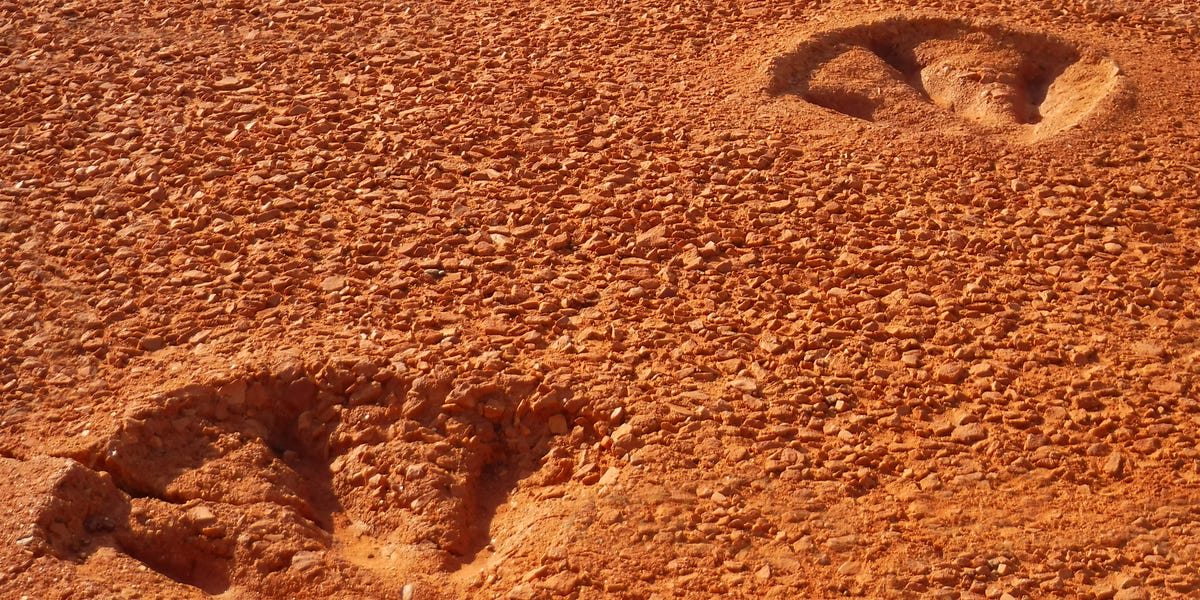
Some discoveries arrive with gold masks, royal tombs, and enough drama to make a documentary narrator whisper for an hour. Others arrive as footprints. Lots of footprints. So many footprints, in fact, that the ground starts looking less like a fossil site and more like the world’s oldest crowded sidewalk.
That is the wonderfully strange case of the nearly 18,000 ancient “ghost tracks” documented at Carreras Pampa in Bolivia’s Torotoro National Park. Strictly speaking, the people behind the research are paleontologists rather than archaeologists, because the stars of the story are dinosaurs, not ancient humans. But the mystery has the same irresistible hook: a landscape full of silent traces, a vanished world, and scientists trying to figure out who passed through, when they moved, and why they left so many marks behind.
The short answer is thrilling: these ghost tracks were made mostly by theropod dinosaurs during the Late Cretaceous, roughly 70 million years ago, when the area was not the dry, rocky surface visitors see today. It was a muddy lakeshore or ancient coastal environment where dinosaurs walked, waded, slipped, turned, dragged their tails, and in some cases may have paddled through shallow water. Over time, those soft impressions were buried, hardened, and preserved in stone. Nature, apparently, has been running the ultimate backup drive since before mammals got ambitious.
What Exactly Did Scientists Find?
The Carreras Pampa tracksite is extraordinary because of both size and detail. Researchers documented 1,321 separate trackways and 289 isolated tracks, adding up to about 16,600 three-toed theropod footprints. They also identified 1,378 swim tracks in 280 swim trackways, along with tail traces and bird-like tracks associated with the dinosaur footprints.
Put simply, this was not one dinosaur taking a very long walk because it forgot where it parked. The variety of track shapes, sizes, directions, and preservation styles suggests that many different animals crossed the area at different moments. Some tracks are small, possibly made by juvenile dinosaurs or smaller theropod species. Others are larger, likely left by mid-sized predators. Together, they create a frozen traffic report from the end of the dinosaur age.
The site is now considered one of the richest dinosaur tracksites ever documented. It is especially important because it preserves not just footprints, but behavior. Bones can tell us what an animal looked like. Tracks can tell us what it was doing. That difference matters. A femur is impressive, sure, but it will never casually announce, “This dinosaur turned sharply here,” or “This one dragged its tail,” or “This one may have been awkwardly swimming like a prehistoric dog learning the backstroke.”
Why Are They Called “Ghost Tracks”?
The phrase “ghost tracks” sounds like something from a haunted railroad, but in this case it refers to faint, incomplete, or unusual fossilized impressions that can look mysterious at first glance. Many of the marks at Carreras Pampa are not perfect textbook footprints with every toe, claw, heel, and pressure point neatly outlined. Some are partial. Some lack heel impressions. Others appear as elongated grooves or scratches instead of full prints.
That ghostly quality is part of what makes the site so scientifically valuable. A footprint is not just the shape of a foot; it is the result of an animal, a surface, water, pressure, sediment depth, speed, and time all having a messy little meeting. If a dinosaur stepped into firm mud, the print might be crisp. If it moved through water, only the toes or claws might scrape the bottom. If the sediment was soft, the foot could sink and distort the final shape. If later layers pressed down from above, the track could become even stranger.
In other words, ghost tracks are not evidence of ghost dinosaurs. They are evidence that fossilization is complicated, and that dinosaurs did not politely step into laboratory-grade mud for the convenience of future scientists.
The Origins of the Tracks: Mud, Water, Dinosaurs, and Time
The origins of the Carreras Pampa ghost tracks begin in a Late Cretaceous environment that was wetter and more dynamic than the modern landscape. The dinosaurs moved across muddy ground near ancient water bodies. Some walked along the shoreline. Others may have entered shallow water and pushed against the bottom with their toes, leaving swim traces rather than full footprints.
For a track to survive for millions of years, several things must go right. First, the ground needs to be soft enough to record the impression but not so watery that the mark instantly collapses. Second, the track must be covered quickly by new sediment before wind, waves, rain, or other animals destroy it. Third, the layers must eventually harden into rock. Finally, erosion has to expose the surface again without erasing the evidence. That is not a simple recipe. It is more like baking a cake during an earthquake and still getting clean frosting.
At Carreras Pampa, those conditions came together in spectacular fashion. The muddy surfaces captured the movement of theropods and other animals. Sediment later sealed the marks. Geological pressure and time turned the layers into rock. Much later, erosion revealed the track-bearing surfaces, allowing researchers to map and study them.
Who Made the 18,000 Ancient Tracks?
Most of the walking tracks are attributed to theropods, the group of mostly bipedal dinosaurs that includes famous predators such as Tyrannosaurus rex and Allosaurus, as well as the evolutionary line that eventually led to modern birds. That does not mean T. rex itself was stomping through Bolivia like a celebrity cameo. The tracks are theropod-style footprints, not signed autographs.
Theropod tracks are often three-toed, which is why many of the Carreras Pampa footprints have a classic bird-like shape. Some trackways show stable bipedal walking. Others suggest turning, changes in speed, or movement through uneven ground. The range of print sizes may point to different species, different ages, or both.
The swim tracks are especially fascinating. These marks appear as grooves, scratches, or elongated impressions that may have been made when dinosaurs moved through water and scraped the soft bottom with their toes. Some swim traces are arranged in alternating left-right patterns, which gives researchers rare insight into how dinosaurs moved when partly buoyed by water.
The site also includes bird tracks, which adds another layer of interest. Birds are living dinosaurs, and their presence near theropod tracks is a reminder that the Cretaceous world was not simply a parade of giant monsters. It was an ecosystem filled with animals of different sizes, habits, and survival strategies.
Why Carreras Pampa Matters So Much
Fossil footprints are known as ichnites, and they belong to a category called trace fossils. Unlike body fossils, such as bones or teeth, trace fossils preserve activity. They are records of behavior. Carreras Pampa matters because it captures a huge amount of behavior in one place.
The trackways suggest that dinosaurs repeatedly used this area, possibly as a shoreline route or “dinosaur highway.” Some trackways appear parallel, which may indicate animals moving in similar directions, perhaps following the edge of water, searching for food, or traveling through a familiar corridor. Other tracks show sharp turns and tail traces, preserving moments that feel almost cinematic.
This is the magic of tracksites: they make deep time feel less abstract. A skeleton in a museum can look majestic, but a footprint feels immediate. Something living stood there. It had weight. It moved with purpose, or maybe with panic, or maybe with the ordinary confidence of an animal that had walked that path many times before.
Bolivia’s Reputation as a Dinosaur Track Hotspot
Bolivia is already famous among paleontologists for dinosaur footprints. The country’s geology includes remarkable Late Cretaceous tracksites, including the well-known Cal Orck’o site near Sucre, where thousands of tracks appear on a steep rock wall. Carreras Pampa adds another major chapter to that story.
What makes Carreras Pampa stand out is not only the number of tracks, but the diversity of movement preserved there. Walking, wading, swimming, turning, and tail-dragging behaviors appear across the site. That combination allows scientists to study not only which animals were present, but how they interacted with the landscape.
Imagine trying to understand a modern beach only by studying bones. You might learn that birds, crabs, dogs, and people exist. But footprints would tell you much more. They would show where the birds gathered, where a dog sprinted, where someone dragged a cooler, and where a child changed direction to chase a wave. Carreras Pampa works the same way, except the beachgoers had claws, tails, and a 70-million-year head start.
What the Ghost Tracks Reveal About Dinosaur Behavior
The tracks at Carreras Pampa help scientists explore several big questions about dinosaur behavior. Did theropods travel alone or in groups? How did they move near water? Were some individuals young? Did different animals use the same shoreline repeatedly? How did water depth and mud texture affect the marks they left?
Some tracks show steady walking. Others suggest running or faster movement. Swim traces hint that certain theropods entered water deep enough to reduce full foot contact with the ground, leaving only claw or toe marks. Tail traces may show moments when animals moved through soft sediment or changed posture. These details are valuable because they reveal action, not just anatomy.
Even incomplete tracks can be useful. A missing heel impression may indicate that the animal was moving through shallow water or that only part of the foot pressed into the sediment. A distorted print may reveal soft mud. A repeated pattern of marks can show rhythm, stride, and direction.
That is why paleontologists get excited about what casual observers might dismiss as “weird scratches in rock.” To trained eyes, those scratches are clues. And at Carreras Pampa, the clues are piled up like nature forgot to clear its browser history.
Why Footprints Can Be More Revealing Than Bones
Bones are essential for understanding anatomy, evolution, and classification. But bones usually represent death. Footprints represent life. They capture animals in motion, which makes them uniquely powerful.
A trackway can help estimate speed, stride length, body size, and gait. It can show whether an animal was walking steadily or shifting direction. Multiple trackways can reveal how animals used a landscape. When tracks from different species occur together, scientists can reconstruct parts of an ancient ecosystem.
At Carreras Pampa, the lack of abundant dinosaur bones does not make the site less important. In fact, it highlights the value of trace fossils. Dinosaur bodies may not have fossilized well in this environment, but their movements did. The result is a place where the animals are gone, yet their behavior remains written across the stone.
The Challenge of Studying a Massive Tracksite
Documenting thousands of fossil tracks is slow, careful work. Researchers must clean surfaces, identify individual impressions, distinguish true tracks from natural cracks or erosion marks, map trackways, measure prints, and interpret patterns. At a site as large and dense as Carreras Pampa, that process can take years.
Scientists also have to be cautious. A single track may be misleading if studied alone. Sediment conditions can distort prints. Water can erase parts of a footprint. Later geological changes can alter the surface. That is why researchers look at many tracks together. Patterns matter more than one dramatic mark.
This is also why the discovery is not just “Wow, big number.” The nearly 18,000 tracks matter because they form a large dataset. With enough tracks, scientists can compare sizes, directions, spacing, preservation styles, and behavior types. The more evidence there is, the better the story becomes.
Preserving the World’s Oldest Traffic Jam
Fossil tracksites can be fragile. Even though the tracks are preserved in rock, they are still vulnerable to weathering, erosion, foot traffic, construction, quarrying, and other human activity. Once a track surface is damaged, it cannot simply be replaced. There is no dinosaur available to come back and step in the mud again. Very rude of extinction, but there we are.
That makes documentation and protection essential. High-resolution mapping, photography, 3D modeling, and careful site management can help preserve the scientific value of Carreras Pampa. Public interest can also support conservation when handled responsibly. A famous fossil site can become a source of education and local pride, but only if tourism and preservation are balanced.
The best fossil sites are not just attractions. They are archives. Carreras Pampa is an archive of movement, climate, sediment, water, animal behavior, and ancient ecology. Protecting it means protecting a chapter of Earth’s biography.
Experience Section: Walking Mentally Beside the Ghost Tracks
To appreciate the Carreras Pampa ghost tracks, imagine arriving at a wide, rocky surface under a bright sky. At first, the ground might not shout for attention. It may look like ordinary stone, dusty and uneven, the kind of place where your eyes need a minute to adjust. Then one three-toed print appears. Then another. Then a line of them. Suddenly, the landscape changes. You are no longer looking at rock. You are looking at movement.
That is the emotional power of fossil tracks. They do not require you to picture a complete skeleton or memorize the difference between every dinosaur group. They give you something simpler and more direct: a step. A footprint is one of the most familiar marks in the world. We leave them on beaches, in snow, in wet concrete if we are either sentimental or badly supervised. Seeing an ancient footprint creates an instant connection across time.
The Carreras Pampa tracks invite that kind of imagination. One trackway may suggest a dinosaur walking steadily along the edge of water. Another may hint at a turn, as if the animal reacted to something nearby. Swim traces suggest a creature moving through shallow water, scraping the bottom with its toes. Tail marks add even more personality to the scene, like punctuation in a sentence written by a dinosaur with very poor penmanship.
For students, travelers, or curious readers, this discovery offers a useful lesson in how science works. Big discoveries are rarely just about one spectacular object. They are about patterns. One footprint is interesting. Thousands of footprints become a map of behavior. Scientists ask where the tracks go, how far apart they are, how deep they are, whether they overlap, and what kind of sediment preserved them. The excitement comes from turning silent stone into evidence.
There is also a humbling side to the experience. The dinosaurs at Carreras Pampa were not posing for history. They were simply living. They crossed mud, followed water, moved through their environment, and disappeared. Millions of years later, their ordinary actions became extraordinary evidence. That should make any of us think twice the next time we complain that our daily routine is boring. Given enough time, even a walk to the edge of a lake can become front-page science.
The best way to relate to the ghost tracks is not to imagine them as spooky mysteries, but as reminders that life is active, temporary, and constantly leaving traces. Some traces vanish in seconds. Others wait in stone for 70 million years. Carreras Pampa is special because it preserves not just where dinosaurs were, but what they were doing. It turns ancient animals from museum shapes into moving creatures, and it turns a rocky surface in Bolivia into one of the most remarkable prehistoric storyboards ever found.
Conclusion
The discovery of nearly 18,000 ancient ghost tracks at Carreras Pampa is more than a numbers story. It is a rare look at dinosaur behavior near the end of the Cretaceous Period. The tracks reveal theropods walking, wading, turning, dragging tails, and possibly swimming through a muddy shoreline environment that later hardened into stone.
What makes the site unforgettable is its sense of motion. These are not just marks in rock; they are fossilized actions. They show that ancient landscapes were busy, messy, and alive. Carreras Pampa reminds us that sometimes the best way to understand the past is not by asking what died there, but by asking who walked through.












