
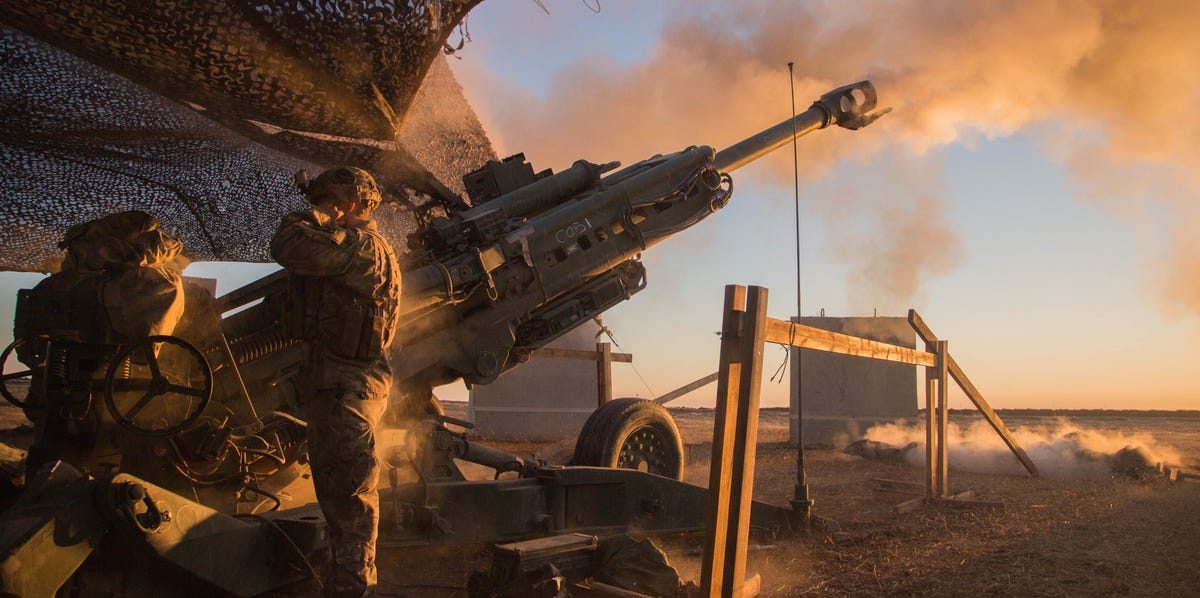
When the U.S. M777 howitzer entered the Russia-Ukraine War, it did not arrive like a flashy sci-fi weapon with lasers, dramatic music, and a cape. It arrived as something far more practical: a lightweight, 155mm towed artillery system that could be moved quickly, fired accurately, repaired under pressure, and fed with NATO-standard ammunition. In a war where artillery has often decided who advances, who holds, and who spends the night digging deeper trenches, the M777 became one of the most recognizable Western weapons on the Ukrainian battlefield.
The Russia-Ukraine War has been described many ways: a drone war, a trench war, an intelligence war, and a logistics war. But from the forests of Kharkiv to the fields of Donbas, it has also been an old-fashioned artillery duel wearing very modern boots. Russia brought huge stockpiles of Soviet-era guns and shells. Ukraine, after exhausting and stretching its own Soviet-caliber systems, needed Western artillery that could hit farther, integrate with modern targeting, and keep firing in a grinding war of attrition. That is where the U.S.-supplied M777 howitzer entered the story.
What Is the M777 Howitzer?
The M777 is a 155mm, 39-caliber, lightweight towed howitzer manufactured by BAE Systems and used by the U.S. Army, U.S. Marine Corps, and several allied militaries. Its biggest selling point is not that it is the biggest gun on the block. It is that it delivers heavy artillery firepower while weighing far less than older systems in its class. Thanks to extensive use of titanium and aluminum alloys, the M777 weighs roughly 9,300 pounds, making it dramatically lighter than the older M198 howitzer it replaced.
That lighter weight matters. On paper, “lighter artillery” sounds about as exciting as “slightly improved office stapler.” On the battlefield, it can mean the difference between firing and surviving. A lighter gun can be moved by truck, loaded into transport aircraft, and repositioned faster after firing. In modern combat, where drones and counter-battery radars can spot artillery positions quickly, the ability to shoot and move is not a luxury. It is survival with mud on its boots.
Key M777 Features
- Caliber: 155mm NATO-standard artillery
- Type: Towed howitzer
- Weight: About 9,300 pounds
- Mobility: Transportable by tactical vehicles and airlift platforms
- Role: Long-range indirect fire support
- Strength: High mobility, precision potential, and compatibility with Western ammunition
Why Ukraine Needed Western Heavy Artillery
Before the full-scale Russian invasion in February 2022, Ukraine relied heavily on Soviet-designed artillery systems, including 122mm and 152mm guns. Those systems were familiar to Ukrainian crews and effective when supplied. The problem was ammunition. A gun without shells is basically an expensive metal sculpture with an attitude problem.
As the war intensified, Ukraine burned through enormous quantities of Soviet-caliber ammunition. Russia, meanwhile, had inherited massive Soviet stockpiles and maintained a large artillery force. Ukraine’s allies understood that Kyiv needed not only more guns, but a transition toward NATO-standard 155mm artillery. The M777 was one of the first major Western systems to support that shift.
The arrival of U.S. M777 howitzers in spring 2022 was strategically important because it helped Ukraine fight at longer ranges, reduce dependence on Soviet ammunition, and connect its battlefield needs with Western supply chains. It also signaled a turning point in U.S. military aid: Washington was moving beyond short-range defensive weapons and into heavier battlefield systems.
The M777 Arrives in Ukraine
In April 2022, the United States began shipping M777 155mm howitzers to Ukraine as part of a larger military assistance package. Early U.S. defense updates said dozens of the planned 90 howitzers were already in Ukraine within weeks, along with 155mm ammunition. By mid-May 2022, U.S. officials reported that most of those guns were forward in the fight, including in the Kharkiv area and the Donbas.
This was not a ceremonial transfer where equipment sits in a warehouse while officials shake hands and cameras click. The M777s were pushed quickly toward the front because Ukraine needed immediate firepower. The Donbas campaign, in particular, was artillery-heavy. Russian forces relied on massed shelling to grind forward, flatten defenses, and turn villages into map labels. Ukraine needed weapons that could answer back with accuracy and mobility.
How the M777 Changed Ukraine’s Firepower
The M777 did not magically solve every battlefield problem. War, unfortunately, does not come with a “skip difficult level” button. But it gave Ukrainian forces several important advantages.
1. NATO-Standard Ammunition
The M777 fires 155mm shells, the standard artillery caliber used by many NATO countries. That opened a much larger pool of Western ammunition support. Over time, the United States and allies supplied millions of 155mm rounds, including conventional shells, precision-guided rounds, and specialized munitions. This helped Ukraine move away from dependence on dwindling Soviet-caliber ammunition.
2. Better Mobility
The M777’s lightweight design made it easier for Ukrainian crews to move the gun after firing. In a battlefield saturated with drones, surveillance, and counter-battery systems, artillery crews cannot linger. Fire too long from one position, and the enemy may send an unpleasant reply package at high speed. Ukrainian units learned to fire, displace, camouflage, and repeat.
3. Precision Potential
When paired with modern targeting data and precision-guided 155mm rounds, the M777 can strike targets with much greater accuracy than traditional unguided artillery. Precision artillery is especially valuable when ammunition is scarce, targets are high-value, or friendly forces and civilians are nearby. Instead of turning the entire grid square into confetti, precision fire aims to put steel where it matters.
4. Training and Western Integration
The M777 also accelerated Ukraine’s transition toward Western military systems. Ukrainian crews had to learn new procedures, maintenance routines, and ammunition handling practices. That training created a bridge to other NATO-standard weapons, including self-propelled howitzers, rocket artillery, and advanced targeting networks.
M777 in the Donbas: Artillery Meets Attrition
The Donbas has been one of the harshest testing grounds for the M777. The terrain is open enough for artillery duels, but cluttered with towns, tree lines, trenches, roads, and industrial areas. Russian forces often relied on massed artillery fire before infantry or armored pushes. Ukrainian forces used M777s to disrupt Russian command posts, ammunition depots, troop concentrations, and artillery positions.
However, the same environment that made the M777 valuable also punished it. Long periods of intense firing wear down barrels, recoil systems, breech mechanisms, and other components. Mud, cold, shrapnel, and emergency repairs do not treat precision machinery kindly. The M777 proved useful, but it also revealed a core truth of modern war: a weapon is only as good as the maintenance network behind it.
The Hidden Battle: Maintenance and Repair
One of the most interesting parts of the M777 story is not the firing line. It is the repair line. Ukrainian troops used the guns heavily, sometimes at rates far beyond peacetime expectations. That created a constant demand for spare parts, technical guidance, barrel replacement, and troubleshooting.
Because NATO troops were not deployed inside Ukraine to maintain the weapons directly, the United States and allies built remote support systems. Reports described encrypted chat rooms, interpreters, contractors, and military specialists helping Ukrainian crews diagnose problems from outside the country. Think of it as tech support, except the “printer problem” is a 155mm howitzer, and nobody is asking whether you tried turning it off and on again.
This remote maintenance system became a symbol of how modern military support works. Sending a weapon is only step one. Keeping it alive requires manuals, spare parts, trained crews, repair depots, digital communication, transportation routes, and industrial capacity. The M777’s battlefield performance depended on all of those pieces working together.
Why 155mm Shells Became a Strategic Issue
The M777 helped Ukraine fire NATO-standard artillery, but it also exposed a major challenge: ammunition consumption. High-intensity war burns through shells at a pace that peacetime planners often underestimate. Ukraine’s need for 155mm ammunition became one of the central defense-industrial questions for the United States and Europe.
By 2025, U.S. security assistance fact sheets showed that Washington had committed more than 200 155mm howitzers and more than 3 million 155mm artillery rounds to Ukraine. Those numbers are enormous, but the war’s appetite has been even larger. When ammunition supplies slowed, Ukrainian gunners had to ration fire. In artillery terms, rationing fire means choosing which threat receives a shell and which threat gets a very stern look.
This is why the M777 cannot be understood simply as a single weapon. It is part of a system that includes shell production, powder, fuzes, barrels, transport vehicles, maintenance depots, and political decisions in Washington and allied capitals. Heavy artillery is never just about the gun. It is about the pipeline behind the gun.
M777 vs. Russian Artillery: Strengths and Limits
Russian forces entered the war with a large artillery inventory, including self-propelled guns, rocket launchers, and older towed systems. Russia’s advantage was quantity: lots of tubes, lots of rockets, and deep stocks of ammunition, though those stocks have also faced strain. Ukraine’s M777 advantage was different: mobility, Western ammunition compatibility, precision potential, and integration with modern intelligence.
The M777 is not armored, which is an obvious limitation. Unlike self-propelled artillery, it cannot drive away under its own power. It needs a towing vehicle and trained crew coordination. That makes concealment, speed, and discipline essential. In drone-heavy combat, even a good gun can become a target if crews stay in one place too long.
Still, the M777’s portability gave Ukraine flexibility. It could be moved to threatened sectors, hidden more easily than some larger systems, and used to support defensive operations. In a war where both sides hunt artillery constantly, the ability to relocate quickly has real value.
Precision Rounds and the Excalibur Factor
One reason the M777 attracted attention was its compatibility with precision-guided 155mm ammunition such as the M982 Excalibur. These rounds are far more expensive than standard shells, but they can strike specific targets with high accuracy when paired with proper targeting data. For Ukraine, precision munitions offered a way to hit command posts, bridges, artillery pieces, vehicles, or ammunition sites while using fewer rounds.
Precision rounds did not replace mass artillery fire. They complemented it. Conventional shells are still essential for suppressing troops, breaking assaults, and defending positions. Precision rounds are the scalpel; standard shells are the hammer. In Ukraine, both tools have been needed, and sometimes the toolbox still looked painfully empty.
The Industrial Wake-Up Call
The M777’s use in Ukraine also forced the United States and allies to confront defense production realities. For decades, many Western countries planned for shorter conflicts, smaller ammunition stockpiles, and just-in-time supply systems. The Russia-Ukraine War reminded everyone that artillery wars are not polite. They do not wait for quarterly procurement cycles.
U.S. and European defense industries began expanding 155mm shell production, refurbishing equipment, and restarting or strengthening supply chains. By 2025, sustainment support for Ukraine’s M777 fleet had become a formal priority, including repair services, training, publications, technical assistance, and logistics support. That development shows how the M777 moved from emergency aid to long-term battlefield infrastructure.
Strategic Meaning of the M777 in the War
The U.S. M777 howitzer matters because it represents more than firepower. It represents Ukraine’s transition toward NATO-standard warfare. It represents the West’s willingness to provide heavier systems after the first shock of the invasion. It represents the return of artillery as a decisive factor in European land warfare. And it represents the uncomfortable truth that modern wars still require old-fashioned industrial muscle.
In 2022, the M777 helped Ukraine stabilize parts of the front and contest Russian artillery dominance. In 2023 and 2024, it remained a workhorse under brutal conditions. By 2025, the focus had shifted heavily toward sustainment, repair, barrel wear, and ammunition production. That timeline tells the larger story of the war itself: the emergency phase became an endurance contest.
Experiences and Lessons from the M777’s Role in Ukraine
Looking at the M777’s experience in Ukraine, one lesson stands out immediately: battlefield success is rarely about one “wonder weapon.” The M777 was important, but it was not magic. Its effectiveness depended on Ukrainian crew skill, Western ammunition, accurate targeting, maintenance support, and the ability to move before Russian counter-fire arrived. In other words, the gun was the star of the show, but the backstage crew deserved applause too.
The first practical experience is that mobility saves lives. Ukrainian artillery crews operating M777s had to master rapid displacement. A crew might fire a small number of rounds, pack up, tow the gun away, and hide before drones or radars could guide return fire. This “shoot-and-scoot” rhythm became central to survival. The M777’s lighter weight made that easier than it would be with heavier legacy systems, but it still demanded discipline and teamwork.
The second lesson is that maintenance is combat power. A howitzer that cannot fire is not a weapon; it is a very expensive lawn ornament. In Ukraine, M777s were used hard, and hard use created mechanical stress. Barrels wore out. Parts broke. Recoil systems needed attention. Crews learned to perform field repairs under pressure, while U.S. and allied specialists provided remote technical support. This experience proved that future military aid packages must include spare parts and repair planning from day one.
The third lesson is that ammunition supply decides tempo. When Ukraine had enough 155mm shells, M777 crews could respond aggressively to Russian attacks. When shells became scarce, they had to prioritize targets carefully. That changed the feel of the battlefield. A gun crew may have the skill, the coordinates, and the will to fire, but without ammunition, all that remains is frustration and a quiet barrel.
The fourth lesson is that precision is valuable, but volume still matters. Precision-guided shells can destroy important targets with fewer rounds, but no army can fight a large land war using only expensive precision munitions. Ukraine needed both high-end rounds and large quantities of standard shells. The M777 experience showed that modern artillery warfare is not a choice between smart weapons and mass fire. It is a demand for both.
The fifth lesson is political: support must be sustained. The M777 entered Ukraine quickly because leaders recognized the urgency of the moment. But the longer the war continued, the more important steady funding, production, logistics, and allied coordination became. Heavy artillery does not fight on announcements. It fights on shells, spare parts, trucks, trained crews, and predictable supply.
Finally, the M777 experience shows that the Russia-Ukraine War has rewritten assumptions about modern combat. Drones did not make artillery obsolete. Satellites did not make trenches disappear. Precision weapons did not eliminate the need for millions of shells. Instead, all of these elements merged into a brutal new battlefield where an old idea still rules: firepower matters, and the side that can deliver it accurately, repeatedly, and sustainably has a better chance of holding the line.
Conclusion
The U.S. M777 howitzer entered the Russia-Ukraine War as an urgent answer to Ukraine’s need for NATO-standard heavy artillery. It became one of the most visible symbols of Western military support, helping Ukrainian forces fight Russian artillery, defend key positions, and transition toward modern 155mm systems. Its strengthsmobility, precision potential, and compatibility with Western ammunitionmade it a valuable battlefield tool. Its challengesbarrel wear, maintenance demands, ammunition shortages, and vulnerability to counter-firemade it a lesson in the realities of high-intensity war.
The M777 did not win the war by itself, and no serious analysis should pretend otherwise. But it changed the artillery equation at a critical moment. It gave Ukrainian crews a lighter, more accurate, NATO-standard weapon when they urgently needed one. More importantly, it reminded the United States and its allies that in a long war, the decisive factor is not only what can be delivered quickly, but what can be sustained over years. In the Russia-Ukraine War, the M777 has been both a weapon and a warning: modern firepower is powerful, but logistics is the engine that keeps it alive.
Note: This article synthesizes information from official U.S. defense releases, U.S. Army materials, State Department and DSCA updates, defense industry data, wire-service reporting, and policy analysis current through 2026. It is written for public educational and SEO publishing purposes and does not provide operational military instructions.













