
Chromium(III) telluride, commonly written as Cr2Te3, is not the kind of material that shows up at a party wearing a glitter jacket. It is quieter than that, darker than that, and far more interesting to physicists who enjoy making electrons behave like tiny acrobats. In the fast-moving world of magnetic materials, chromium telluride has become a serious candidate for next-generation spintronic devices, topological electronics, magnetic sensors, and ultra-thin memory systems.
The excitement comes from a powerful combination: Cr2Te3 can behave as a ferromagnetic material, it can be grown as thin films or two-dimensional layers, and its anomalous Hall effect can be tuned through thickness, strain, interfaces, composition, and temperature. That is a mouthful, but the simple version is this: researchers are learning how to adjust the magnetic and electronic personality of chromium(III) telluride almost like turning knobs on a very expensive scientific stereo.
This matters because future electronics may not rely only on electron charge, as today’s conventional devices do. They may also use electron spin, magnetic texture, Berry curvature, and quantum transport effects. In that future, materials such as Cr2Te3 could help create smaller, faster, more energy-efficient devices that do not faint dramatically every time engineers ask them to work at practical temperatures.
What Is Chromium(III) Telluride?
Chromium(III) telluride is a transition metal chalcogenide made from chromium and tellurium. Its formula, Cr2Te3, indicates a chromium-rich telluride phase where chromium commonly contributes magnetic moments. These moments arise mainly from partially filled 3d orbitals in chromium atoms, while tellurium helps shape the electronic band structure and magnetic exchange interactions.
Chromium tellurides are part of a broader Cr-Te family that includes materials such as CrTe, Cr3Te4, Cr5Te8, and CrTe2. These compounds can show different structures, magnetic ordering temperatures, and transport behavior depending on stoichiometry and growth method. In plain English: move a few chromium atoms around, change the film thickness, or choose a different substrate, and the material may start acting like it read a different job description.
Why Cr2Te3 Is Interesting as a Ferromagnetic Material
Ferromagnetism means that the magnetic moments inside a material tend to align in the same direction, producing a net magnetization. Classic ferromagnets include iron, cobalt, and nickel, but modern research is increasingly focused on thin-film and two-dimensional ferromagnets because they can be integrated into nanoscale devices.
Cr2Te3 is exciting because it can display robust ferromagnetic behavior in thin-film form. Studies have shown that molecular beam epitaxy and chemical vapor deposition can produce chromium telluride films with perpendicular magnetic anisotropy, meaning the preferred direction of magnetization points out of the film plane. That is extremely useful for dense magnetic memory, where vertical magnetic orientation can help pack information more tightly.
Another reason researchers keep circling Cr2Te3 is its tunable Curie temperature. The Curie temperature is the point above which a ferromagnet loses its long-range magnetic order. For real-world devices, higher Curie temperature is usually better because nobody wants a memory device that forgets its identity on a warm afternoon. Cr2Te3 thin films have demonstrated Curie temperatures that can shift depending on thickness, aluminum doping, substrate effects, and structural reconstruction.
Understanding the Hall Effect Without Falling Asleep
To understand the anomalous Hall effect, we should first invite the regular Hall effect into the room. When an electric current flows through a conductor and a magnetic field is applied perpendicular to that current, charge carriers are pushed sideways. This creates a transverse voltage, known as the Hall voltage. It is a classic way to learn whether the main charge carriers are electrons or holes and how densely they populate a material.
The anomalous Hall effect, or AHE, is the more dramatic cousin. In ferromagnetic materials, a sideways voltage can appear not only because of an external magnetic field but also because of the material’s internal magnetization and spin-orbit coupling. In other words, the material’s own magnetic order helps steer electrons sideways. The electron does not merely travel from point A to point B; it takes a scenic route through momentum space, guided by the band structure and Berry curvature.
Berry curvature is often described as a magnetic-field-like quantity in momentum space. That sounds abstract because it absolutely is. But its impact can be measured in real devices. When Berry curvature is strong, it can contribute significantly to anomalous Hall conductivity. This makes AHE a valuable probe of the hidden electronic topology inside magnetic materials.
How Chromium(III) Telluride Produces a Tunable Anomalous Hall Effect
The tunable anomalous Hall effect in Cr2Te3 is not a single trick. It is a collection of linked mechanisms involving magnetization, electronic bands, spin-orbit coupling, strain, thickness, temperature, and domain behavior.
1. Strain Changes the Berry Curvature
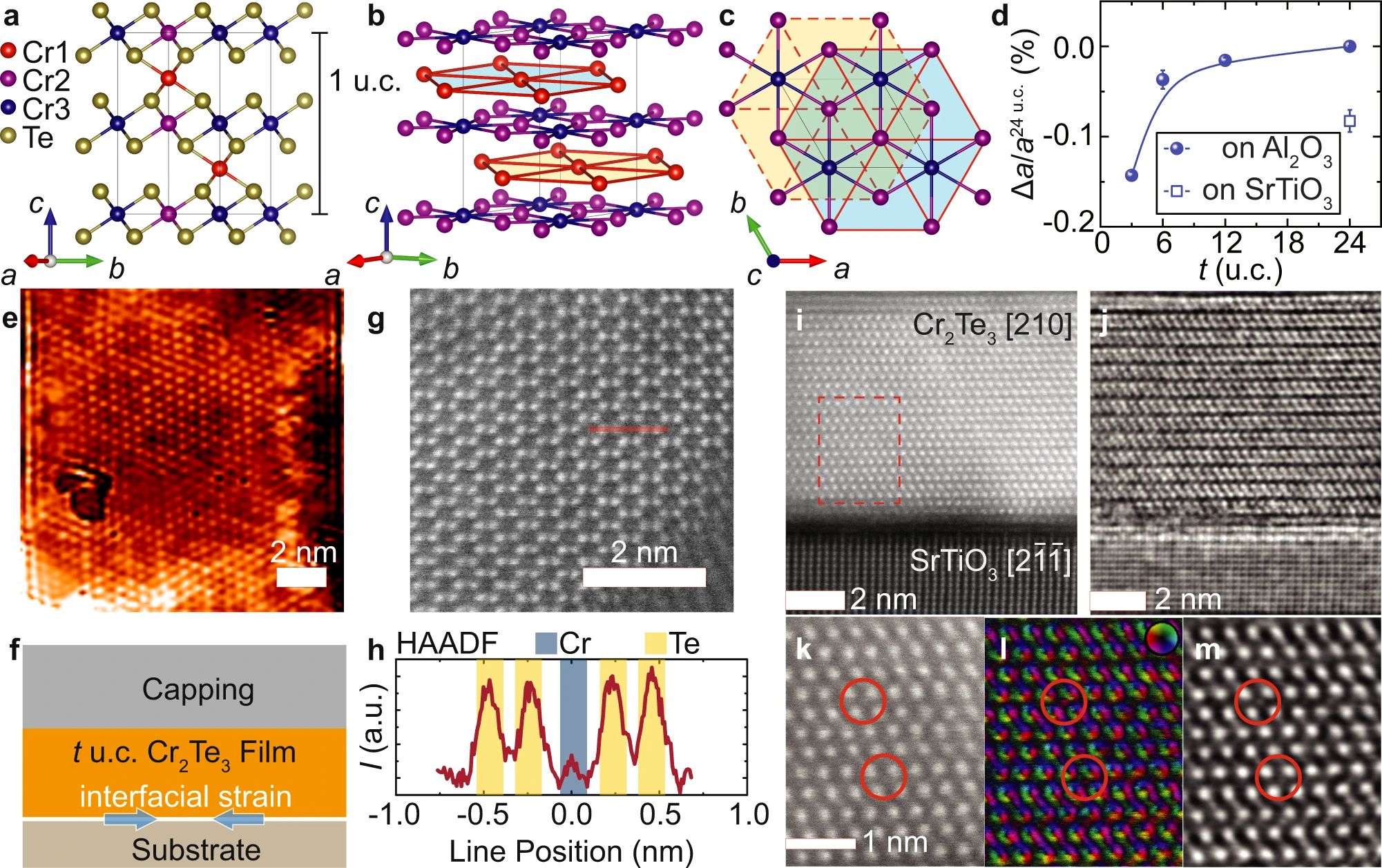
One of the most important findings in recent Cr2Te3 research is that strain can tune Berry curvature. When thin films are grown on a substrate, the lattice of the film may stretch or compress slightly to match the underlying surface. This strain changes atomic spacing, orbital overlap, and band structure. Because Berry curvature depends sensitively on the electronic band structure, even subtle strain can shift the anomalous Hall response.
In quasi-two-dimensional Cr2Te3 thin films, researchers have observed temperature-dependent sign reversal in the anomalous Hall effect while magnetization remains nonzero. That is especially important because it suggests that the Hall signal is not simply following magnetization like an obedient dog. Instead, the electronic structure and Berry curvature are playing a decisive role.
2. Thickness Controls Magnetic Behavior
Thickness is another powerful tuning tool. In ultrathin Cr2Te3, reducing the number of layers can alter the balance between ferromagnetic and antiferromagnetic interactions. Some reports have shown that thin Cr2Te3 layers may maintain strong magnetic behavior near room temperature, which is highly attractive for practical applications.
This thickness dependence is one reason two-dimensional chromium tellurides have become a hot topic in spintronics. A bulk crystal may behave one way, a 30-nanometer film another way, and a few-unit-cell structure yet another way. At the nanoscale, materials are less like bricks and more like moody artists: change the environment and the performance changes.
3. Interfaces Influence Magnetic and Electronic Properties
Interfaces are where the plot thickens. When Cr2Te3 is placed on sapphire, SrTiO3, topological insulators, or other substrates, the interface can introduce strain, charge transfer, symmetry changes, and modified magnetic anisotropy. These interface effects can influence both Curie temperature and anomalous Hall conductivity.
This is particularly relevant for magnetic topological devices. Chromium telluride shares chemical and structural compatibility with some topological insulator systems, making it useful as a magnetic layer in heterostructures. In such devices, the interface is not just a boundary; it is an active engineering zone where new physics can emerge.
4. Composition and Doping Offer Another Control Knob
The Cr-Te system is compositionally flexible. Slight deviations in chromium concentration can produce different chromium telluride phases, each with distinct magnetic properties. Aluminum doping in Cr2Te3 thin films has also been studied as a way to tune Curie temperature and magnetic ordering. This suggests that controlled chemistry can help optimize the material for device conditions.
Why the Sign Reversal of the Anomalous Hall Effect Matters
A sign reversal in the anomalous Hall effect means the transverse Hall signal switches from positive to negative or vice versa. At first glance, that may sound like a lab curiosity. In reality, it is a major clue about the underlying physics.
If the anomalous Hall effect came only from magnetization, the sign would be expected to follow the magnetic moment more directly. But in Cr2Te3, the sign can reverse while magnetization remains present. This points toward competing Berry curvature contributions from different electronic bands. The material may have regions in momentum space that contribute positive Hall conductivity and others that contribute negative Hall conductivity. Temperature, strain, or thickness can shift the balance between them.
For engineers, sign tunability is useful because it suggests a way to encode or control electronic responses without completely changing the material. For scientists, it is a beautiful headache. It forces researchers to think beyond simple magnetization curves and study the full band topology of the material.
Cr2Te3 and Spintronic Devices
Spintronics uses electron spin, rather than only electron charge, to process or store information. A good spintronic material should ideally offer stable magnetism, controllable anisotropy, compatibility with thin-film fabrication, and useful transport effects. Cr2Te3 checks many of these boxes.
Perpendicular magnetic anisotropy makes Cr2Te3 interesting for magnetic tunnel junctions and nonvolatile memory concepts. A tunable anomalous Hall effect makes it useful for Hall sensors, magnetic readout, and topological transport studies. Its compatibility with van der Waals and epitaxial architectures also makes it suitable for layered heterostructures, where each layer contributes a different function.
Potential applications include magnetic random-access memory, low-power logic, spin-orbit torque devices, topological Hall devices, and quantum material platforms. The word “potential” is doing some honest work here. Cr2Te3 is promising, but researchers still need to solve challenges related to large-scale growth, stability, defect control, reproducibility, and integration with standard semiconductor processes.
How Researchers Study Chromium Telluride Films
Cr2Te3 research combines several experimental and theoretical tools. Molecular beam epitaxy allows scientists to grow high-quality thin films layer by layer under controlled conditions. Chemical vapor deposition can produce thin flakes and larger-area films. X-ray diffraction helps determine crystal structure. Transmission electron microscopy reveals atomic-scale interfaces and defects.
Magnetization measurements show whether a film is ferromagnetic and identify its Curie temperature. Hall measurements reveal ordinary and anomalous Hall effects. Magnetoresistance measurements show how electrical resistance changes in response to magnetic fields. First-principles calculations, especially density functional theory, help researchers understand band structures, magnetic interactions, and Berry curvature.
The best studies combine these methods. A Hall curve alone can be seductive, but it may not tell the whole story. The most convincing research connects transport data with magnetization, structural analysis, microscopy, and theory. In quantum materials, one measurement is a clue; several independent measurements are a conversation.
Challenges Before Chromium(III) Telluride Reaches Devices
The road from exciting laboratory data to reliable technology is never short. Cr2Te3 still faces several practical challenges. First, researchers must improve control over stoichiometry. Chromium tellurides can form multiple phases, and small compositional changes may alter magnetic properties.
Second, thin-film growth must become more reproducible. Device manufacturers need materials that behave consistently across wafers, not only in carefully selected samples. Third, long-term stability matters. Telluride materials can be sensitive to surface oxidation or environmental exposure, especially when made very thin. Encapsulation and interface engineering may help, but they add complexity.
Fourth, the microscopic origin of some Hall features still requires deeper study. Hump-shaped Hall signals, sign reversals, and domain-related effects can sometimes be difficult to separate from topological Hall contributions or multi-channel conduction. Careful experiments are essential because the electron transport world enjoys setting traps for overconfident interpretations.
Why This Material Deserves Attention
Chromium(III) telluride stands out because it sits at the intersection of ferromagnetism, two-dimensional materials, spin-orbit physics, and topology. It is not merely another magnetic compound added to a long list. It is a platform where magnetism and electronic structure can be tuned together.
That tunability is the real headline. A material that changes its anomalous Hall response with strain, temperature, thickness, or interface design gives researchers a toolkit. Instead of accepting fixed properties, scientists can engineer responses for specific device goals. In an era where electronics is approaching physical limits, this kind of flexibility is extremely valuable.
Experience-Based Perspective: Working With the Promise and Personality of Cr2Te3
Experience in the broader field of magnetic thin films teaches one very important lesson: the material is never just the material. A Cr2Te3 film on sapphire is not exactly the same as a Cr2Te3 film on SrTiO3. A 5-nanometer sample is not simply a thinner version of a 50-nanometer sample. A film grown under slightly different temperature, flux, or cooling conditions may produce a different magnetic fingerprint. This is why chromium telluride research feels less like reading a cookbook and more like training a very talented but opinionated chef.
In practical analysis, the first experience-related challenge is separating real physics from sample-specific noise. A clean anomalous Hall loop is exciting, but researchers must ask whether the response comes from intrinsic Berry curvature, magnetic domains, strain gradients, mixed phases, or ordinary measurement artifacts. The best approach is patience. Repeating measurements over temperature, checking multiple film thicknesses, comparing substrates, and aligning Hall data with magnetization curves can prevent embarrassing conclusions.
Another useful lesson is that interfaces deserve respect. In older materials thinking, an interface was often treated like a seam. In Cr2Te3, the interface can act more like a control panel. It can impose strain, change symmetry, influence magnetic anisotropy, and shift the electronic structure. For anyone designing a Cr2Te3-based device, ignoring the interface would be like buying a sports car and forgetting the steering wheel.
Thickness control is equally important. In many thin-film magnets, reducing thickness weakens magnetism. Chromium telluride systems are more interesting because reduced dimensionality can sometimes enhance or reshape magnetic order. That does not mean thinner is always better. It means thickness must be treated as a design parameter, not an afterthought.
The anomalous Hall effect is especially helpful as a daily diagnostic tool because it offers an electrical window into magnetic behavior. Instead of relying only on large magnetometers, researchers can pattern devices and measure Hall resistance directly. This makes Cr2Te3 attractive for device-level testing. Still, Hall data should be interpreted with humility. When the Hall signal changes sign or develops humps near coercive fields, the material may be revealing Berry curvature, domain evolution, or multiple transport channels all at once. The data may be telling the truth, but not always in a simple sentence.
From an engineering viewpoint, the most encouraging experience is that Cr2Te3 offers several routes for optimization. If one knob fails, another may work. Strain, doping, substrate selection, thickness, capping layers, and heterostructure design can all be explored. That flexibility makes the material scientifically rich and technologically tempting.
The most realistic outlook is cautious optimism. Cr2Te3 is not ready to replace every magnetic material tomorrow morning. It still needs better wafer-scale uniformity, clearer stability strategies, and stronger integration pathways. But as a ferromagnetic material with a tunable anomalous Hall effect, it has the rare quality researchers love most: it keeps producing useful questions. In science, a material that answers one question and opens five better ones is not being difficult. It is being valuable.
Conclusion
Chromium(III) telluride, or Cr2Te3, has become an important material in the study of two-dimensional ferromagnetism and anomalous Hall transport. Its ferromagnetic behavior, perpendicular magnetic anisotropy, tunable Curie temperature, and strain-sensitive Berry curvature make it a promising platform for spintronic and topological electronic devices.
The most exciting feature is not simply that Cr2Te3 shows an anomalous Hall effect. It is that the effect can be tuned. Temperature, film thickness, strain, interfaces, and composition can all reshape the Hall response. This gives researchers a flexible material system for studying how magnetism, topology, and electron transport work together.
Like many quantum materials, Cr2Te3 is not a finished technology. It is a developing platform. But its combination of measurable ferromagnetism, rich electronic behavior, and practical thin-film growth potential makes it one of the more compelling chromium tellurides for future research. If tomorrow’s electronics need smaller magnets, smarter transport effects, and materials that can be tuned rather than merely tolerated, chromium(III) telluride deserves a seat at the table.
Note: This HTML body is written for web publishing, with no source links inserted in the article body and no unnecessary citation placeholders.













