
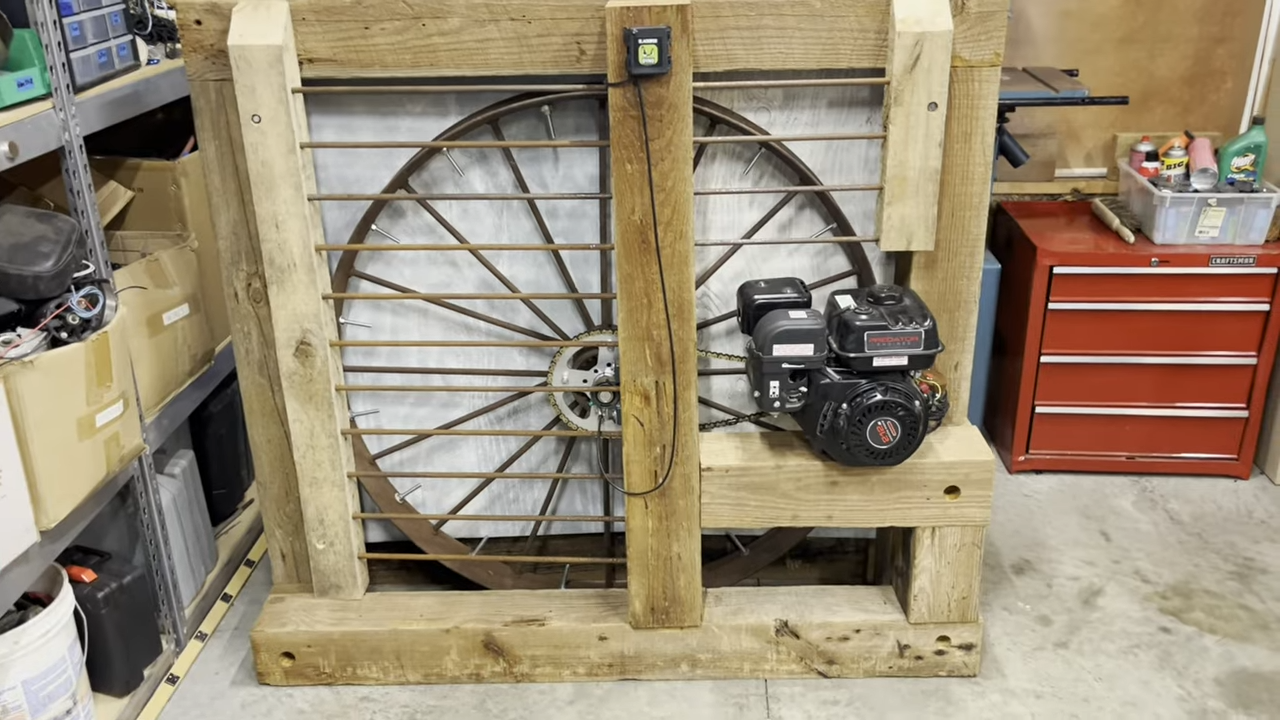
There are two kinds of workshop projects. The first kind begins with a carefully drawn CAD model, a tidy bill of materials, and the gentle hum of precision. The second kind begins when someone looks at a rusty 100-year-old wagon wheel and says, “You know what this needs? Sensors.” The project behind 100-Year Old Wagon Wheel Becomes Dynamometer belongs proudly to the second categoryand that is exactly why it is so fascinating.
At first glance, an antique wagon wheel seems better suited for farmhouse décor, Western movie nostalgia, or holding up a very committed garden gnome. But in the hands of a determined maker, it can become the heart of a small-engine dynamometer, or dyno. A dynamometer measures torque, speed, and power output. In plain English: it helps answer the sacred garage question, “Did that engine modification actually do anything, or did it just make louder noises and flatter your ego?”
This build takes an old wheel that once belonged to the age of horses and dirt roads and repurposes it as a rotating inertial load. Instead of pulling a wagon, the wheel now gets spun by a small engine. By measuring how quickly the wheel accelerates, the system can estimate horsepower and torque. It is part physics lesson, part salvage art, and part backyard engineering comedywith just enough math to make the sawdust nervous.
What Is a Dynamometer, Really?
A dynamometer is a machine used to measure mechanical power. In engine testing, the important pieces of information are rotational speed and torque. Once those are known, horsepower can be calculated. Commercial dynos appear in automotive shops, research labs, emissions facilities, motorsports garages, and manufacturing test cells. They can be large enough to test cars, trucks, motorcycles, generators, industrial motors, or engines that sound like they pay property taxes.
There are several types of dynamometers. A brake dynamometer applies a controllable load and measures how much torque the engine produces while holding or sweeping through specific speeds. A chassis dynamometer uses rollers under a vehicle’s wheels, letting technicians test a vehicle without driving it down the road. An inertia dynamometer, the style most relevant to this wagon wheel project, uses a known rotating mass. The engine accelerates that mass, and the system calculates power from the rate of acceleration.
The wagon wheel dyno is charming because it strips the concept down to its essentials. A heavy rotating object becomes the load. Sensors track speed. Software turns acceleration data into useful numbers. No showroom gloss. No corporate brochure. Just old wood, metal, chain drive, data logging, and the delightful possibility that a farm relic may now know more about torque curves than your average comment section.
How a 100-Year-Old Wagon Wheel Can Act Like a Flywheel
The key to the build is the wagon wheel’s new job as a flywheel. A flywheel stores rotational energy. The more mass it has, and the farther that mass sits from the center, the more it resists changes in speed. That resistance is called moment of inertia. In an inertia dyno, moment of inertia is not an annoying detail; it is the whole personality of the machine.
When a small engine drives the wheel, the engine has to work to spin it faster. If the wheel’s moment of inertia is known, and the wheel’s acceleration can be measured, the system can estimate torque. Then, with torque and RPM, horsepower can be calculated. The idea is elegant: make the engine push against a known rotating load, then let the numbers confess what happened.
Of course, “known rotating load” is doing a lot of work here. A century-old wagon wheel is not a laboratory-grade steel drum. It may be uneven, worn, rusty, slightly warped, or emotionally unavailable. That is why a project like this depends on balancing, calibration, and careful measurement. The original builder reportedly balanced the wheel with added weights and measured its inertia with a falling-weight test. That step is what separates “homemade instrument” from “spinning antique roulette wheel.”
The Cleverness of Using What Already Exists
Modern makers often prove that the best part in the shop is not always the newest one. Sometimes it is the weird old object leaning behind the shed, quietly waiting for a second career. A wagon wheel already has the basic geometry a flywheel wants: diameter, mass, and a structure designed to rotate around a hub. It was originally built to carry loads smoothly over rough ground. Reusing it as an inertia wheel is odd, but not random.
The build also reflects an old engineering truth: machines do not care whether a component looks fashionable. They care whether it can perform a function. If a wheel can rotate, survive the forces involved, and be measured accurately, it can become part of a test system. That does not mean every antique wheel should be bolted into a dyno. It does mean the idea has a certain poetic justice. The wheel once helped move horsepower in the literal horse sense. Now it measures horsepower in the engine sense. Somewhere, a blacksmith is either smiling or asking for a liability waiver.
What Makes This DIY Inertia Dyno Work?
The project uses the wagon wheel as the rotating mass, a simple support frame, chain drive, gearing, and a data logging system. The wheel is driven through a reduction ratio so it does not spin excessively fast. That matters because old wheels were not designed to become high-speed industrial rotors. Keeping rotational speed under control is both an engineering choice and a very good way to avoid turning history into shrapnel.
The data side is just as important as the hardware. A system such as BlackBoxDyno can use RPM sensors to track engine speed and flywheel speed. In many small-engine applications, Hall effect sensors are used because they can detect rotating magnets or ferrous targets and generate pulses. Those pulses become speed data. Speed data over time becomes acceleration. Acceleration, combined with known inertia, becomes torque and horsepower estimates.
That is the magic trick, but it is not magic. It is measurement. The better the sensor placement, calibration, inertia value, and data processing, the better the resulting graph. The worse those things are, the more the dyno becomes a very fancy opinion machine.
Inertia Dyno vs. Brake Dyno: Why the Difference Matters
An inertia dynamometer is excellent for seeing how quickly an engine can accelerate a known mass. It can reveal changes before and after tuning, carburetor adjustments, exhaust changes, gearing changes, or other modifications. For small engines, minibikes, go-karts, lawn equipment, and educational projects, that can be incredibly useful.
But an inertia dyno does not tell the whole story. A brake dynamometer can hold an engine at a chosen RPM and apply different loads. That makes it better for mapping steady-state performance, tuning under controlled conditions, and studying how the engine behaves across load ranges. An inertia dyno gives a dynamic sweep. A brake dyno gives more control. Both have value, but they answer different questions.
This is where expectations matter. If someone uses the wagon wheel dyno to compare one small engine setup against another on the same rig, it can be useful. If someone expects it to produce perfect laboratory numbers that match a professional test cell, the wagon wheel may politely remind them that it used to live in a barn.
The Physics Behind the Fun
The physics behind the project is approachable. Torque is the twisting force that changes rotational motion. Moment of inertia describes how strongly an object resists that change. Angular acceleration tells us how quickly rotational speed is increasing. Put those together, and the basic idea is simple: a known rotating mass accelerating at a known rate requires a calculable amount of torque.
Horsepower then comes from torque and RPM. In the U.S. automotive world, the familiar formula is horsepower equals torque multiplied by RPM, divided by 5,252. That constant exists because of unit conversion between rotational speed and mechanical power. It is one of those formulas that sounds mysterious until you realize it is basically a math translator wearing a shop apron.
The wagon wheel dyno turns these principles into something visible. You can hear the engine work. You can see the wheel spin. You can watch data become a curve. For learners, that physical connection is powerful. A textbook can explain rotational inertia. A spinning antique wheel makes the concept walk into the room wearing boots.
Accuracy: The Hero, the Villain, and the Punchline
Any homemade dynamometer lives or dies by accuracy. With an antique wheel, the biggest issues are balance, true rotation, friction, inertia measurement, chain losses, sensor reliability, and the rotating inertia of the engine itself. If the flywheel’s inertia is not much larger than the engine’s rotating parts, the results can underestimate or distort actual output. If the wheel wobbles, friction changes, or the drive ratio slips, the data gets messy.
That does not make the project useless. It makes it honest. Engineering is often less about building something perfect and more about understanding where the errors live. A DIY dyno can be very valuable as a comparison tool. If the same setup is used consistently, it can show whether one change improved or hurt performance. Maybe the new exhaust gained power. Maybe the carburetor tuning helped. Maybe the “race sticker” added exactly zero horsepower, which is rude but scientifically important.
Professional labs spend serious money controlling variables. A backyard dyno has to be more humble. It should be treated as a practical measuring tool, not a courtroom witness.
Why This Project Catches the Imagination
The reason 100-Year Old Wagon Wheel Becomes Dynamometer is such a clickable, memorable story is not only the machinery. It is the contrast. Old meets new. Wood and iron meet Hall effect sensors. Wagon-era hardware meets digital horsepower graphs. The project feels like time travel, except instead of changing history, it asks history to measure a small engine.
There is also something deeply satisfying about reuse. The wheel was not melted down, thrown away, or turned into wall art with a fake inspirational quote. It became functional again. Not in its original role, but in a role that still honors its design. It rotates. It carries load. It teaches. That is a better retirement plan than most objects get.
Maker culture thrives on this kind of transformation. It rewards curiosity, thrift, experimentation, and the ability to look at junk without seeing junk. The wagon wheel dyno is not just a machine; it is a reminder that engineering often starts with a question: “What can this become?”
Safety Is Not Optional
A serious note belongs here. Any dynamometer involves rotating mass, moving chains, engine vibration, heat, noise, and stored energy. A large wheel spinning under engine power can be dangerous if it fails, comes loose, or is operated without proper guarding. Antique materials add uncertainty because age, cracks, corrosion, and hidden weakness can be difficult to evaluate by eye.
That is why a project like this should be understood as an engineering case study, not a casual weekend recipe. Proper guarding, conservative speeds, remote observation, secure mounting, emergency shutdowns, and professional judgment matter. The funniest shop projects are only funny when everyone still has the same number of fingers afterward.
What Small-Engine Builders Can Learn From It
Small-engine builders often want practical feedback. Did a jetting change improve throttle response? Did a governor adjustment alter the curve? Did a different clutch or torque converter change how the engine loads? A small inertia dyno can help answer those questions more consistently than seat-of-the-pants testing.
The wagon wheel project highlights three lessons. First, repeatability matters more than bragging rights. A dyno that gives consistent comparative data can be useful even if its absolute numbers are imperfect. Second, calibration is not glamorous, but it is everything. The wheel must have a known inertia, and the sensors must record reliable RPM data. Third, physical machines always include losses. Bearings, chains, alignment, vibration, and air drag all nibble at the truth like tiny mechanical raccoons.
For hobbyists, the best use of a dyno like this is controlled comparison. Test a baseline. Change one variable. Test again. Record the conditions. Avoid changing five things at once and then declaring victory because the engine “felt spicy.” Science enjoys enthusiasm, but it prefers notes.
The Charm of Low-Budget Engineering
Low-budget engineering has a beauty that polished commercial equipment sometimes lacks. It shows the thought process. You can see the compromises, the cleverness, and the places where a builder had to solve problems with available materials. A century-old wagon wheel does not hide the project’s personality. It announces it.
That personality is useful for readers because it makes mechanical testing less intimidating. Dynamometers can sound like equipment reserved for race teams and emissions labs. But the underlying ideasload, rotation, acceleration, torque, powerare understandable. The wagon wheel makes them feel less abstract. It says, “Come here, kid, let me explain horsepower using something your great-grandfather might have fixed with a hammer.”
Experience Notes: What This Project Teaches Beyond the Numbers
The most valuable experience connected to a project like 100-Year Old Wagon Wheel Becomes Dynamometer is not simply watching a graph appear on a screen. It is learning how physical measurement behaves in the real world. On paper, an inertia dyno is clean. Measure RPM, calculate acceleration, multiply by moment of inertia, and produce torque and horsepower. In the workshop, every one of those words grows elbows.
The wheel may not be perfectly round. The bearings may add drag. The chain may introduce vibration. The sensor may miss a pulse. The engine may behave differently when cold than when warm. The frame may flex slightly. Even the air around the wheel becomes part of the story because moving objects stir air and waste energy. These are not failures; they are lessons. Real machines are wonderfully rude teachers. They interrupt assumptions immediately.
One experience many builders discover is that balancing is not a finishing touch. It is central to whether the machine feels trustworthy. A balanced wheel spins smoothly, protects bearings, reduces vibration, and gives cleaner data. An unbalanced wheel turns every test into a suspense film. The old wagon wheel adds character, but character must not be allowed to shake the frame across the floor.
Another experience is that data can be seductive. A horsepower number feels official the moment it appears on a screen. But smart builders learn to ask how that number was produced. Was the inertia value measured carefully? Was the engine warmed up? Was the same gear ratio used? Was the test repeated? Was the curve smooth because the engine was smooth, or because the software politely ironed out chaos? Good data is not the same as pretty data.
This kind of project also teaches respect for old materials. A century-old wheel carries history, but history does not guarantee strength. Wood dries, metal corrodes, joints loosen, and previous repairs may be hidden under paint or rust. Before any antique part becomes a working machine component, it deserves inspection and caution. Romantic engineering is still engineering.
Finally, the project offers a useful creative lesson: innovation is not always about buying the latest part. Sometimes it is about understanding principles well enough to repurpose something unexpected. A wagon wheel becomes a flywheel because the builder recognizes function hiding inside form. That mindset transfers everywhereto car repair, robotics, woodworking, electronics, farming equipment, and product design. Once you learn to see objects by what they can do rather than what they were sold as, the workshop gets much bigger.
That may be the real reason this build is so appealing. It is not just a dyno. It is a conversation between generations of technology. The wagon wheel came from an era when horsepower had hooves. The data logger comes from an era when horsepower has charts. Together, they make a machine that is practical, educational, slightly absurd, and very hard not to love.
Conclusion
The story of a 100-year-old wagon wheel becoming a dynamometer is more than a quirky maker headline. It is a compact lesson in mechanical power, rotational inertia, creative reuse, and the stubborn joy of building tools from unlikely parts. By turning an antique wheel into a flywheel for a small-engine inertia dyno, the project shows how old hardware can still serve new ideas when paired with sensors, calibration, and curiosity.
It is not a replacement for a professional dynamometer, and it should not be treated casually. Spinning mass demands respect. But as an educational project and a practical comparison tool, it is wonderfully clever. It reminds us that engineering does not always begin with perfect materials. Sometimes it begins with a rusty wheel, a question, and the confidence to let physics do the talking.













