
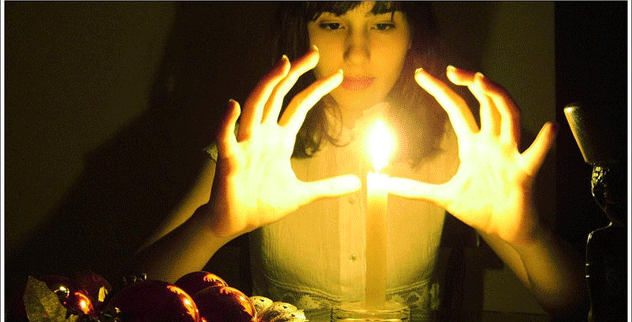
Human beings are excellent pattern-finding machines. Give us a strange shadow, a missing aircraft, an old photograph, or a government building with a fence around it, and our brains will happily sprint into the fog wearing detective sunglasses. That is how bizarre theories are born: part curiosity, part fear, part storytelling, and part “wait, what if?”
Some strange theories are harmless campfire fun. Others can become misinformation when they reject evidence, distrust every expert, or turn ordinary science into a villain wearing a lab coat. The interesting part is that many of these ideas begin with a real mystery: a secret military base, unusual aircraft sightings, an ancient engineering wonder, or the very real fact that memory can be unreliable. The problem starts when imagination parks itself in the driver’s seat and refuses to hand back the keys.
This article explores ten bizarre theories and the facts surrounding them. We will keep the tone fun, but the facts grounded. Think of it as a flashlight tour through the internet’s weird attic: dusty, fascinating, and occasionally full of fake skeletons.
1. The Flat Earth Theory
The theory
The flat Earth theory claims that our planet is not a sphere but a flat disk, usually surrounded by an ice wall. In this version of reality, NASA, governments, pilots, sailors, satellite companies, astronauts, and possibly your geography teacher are all supposedly in on the trick. That is a lot of people to keep a secret, especially considering most offices cannot keep birthday cake hidden until 3 p.m.
The facts
The evidence for a round Earth is overwhelming. Ancient Greek scholars observed Earth’s curved shadow during lunar eclipses. Modern science confirms Earth’s shape through satellite imagery, gravity measurements, circumnavigation, time zones, GPS, space missions, and the way ships disappear hull-first over the horizon. NASA also uses Earth’s roundness in geodesy, the science of measuring Earth’s shape and position, which helps make modern navigation possible.
The flat Earth theory survives not because it explains the world better, but because it offers a dramatic story: hidden truth, corrupt authority, and a heroic believer who “sees through it all.” Unfortunately for the theory, the planet remains stubbornly round.
2. The Moon Landing Hoax
The theory
This famous theory says the Apollo Moon landings were staged, perhaps on a Hollywood set, with NASA allegedly filming astronauts under studio lights. Supporters point to the waving flag, missing stars in photos, and shadows that look “wrong.” Apparently, the most powerful space program in history could land humans on the Moon but forgot to hire a continuity editor.
The facts
The Apollo missions left behind physical and scientific evidence. Astronauts brought back hundreds of pounds of lunar samples. Retroreflectors placed on the Moon are still used for laser-ranging experiments. NASA’s Lunar Reconnaissance Orbiter has photographed Apollo landing sites, including equipment and tracks left on the lunar surface.
The “waving flag” did not wave because of wind. It moved because astronauts twisted the pole while planting it, and with no atmosphere to slow motion quickly, the movement looked unusual. The lack of stars in photos is also easily explained: cameras were set for bright lunar surface conditions, not faint stars. In other words, the Moon landing was not fake. Space photography is just less cooperative than Instagram.
3. Area 51 Is Hiding Aliens
The theory
Area 51 may be the reigning champion of suspicious geography. The theory says the secretive Nevada facility stores crashed alien spacecraft, extraterrestrial bodies, or advanced alien technology. The secrecy surrounding the base has made it a perfect blank canvas for UFO folklore.
The facts
Area 51 is real, and so is its secrecy. But declassified CIA materials identify it as a testing site for classified aircraft programs, including the U-2 spy plane and later advanced reconnaissance projects. That secrecy makes sense in a Cold War context: if you are testing experimental aircraft, you probably do not want enemy intelligence agencies bringing binoculars and a picnic basket.
Unidentified aerial phenomena, or UAPs, are still studied by the U.S. government, but official reports have not confirmed extraterrestrial beings, alien technology, or hidden off-world craft. Some cases remain unresolved because the data is incomplete, not because aliens are borrowing hangar space.
4. The Bermuda Triangle Swallows Ships and Planes
The theory
The Bermuda Triangle is often described as a mysterious zone where ships and aircraft vanish without explanation. Depending on who is telling the story, the cause may be magnetic anomalies, aliens, time portals, sea monsters, or the ocean simply being in a dramatic mood.
The facts
The Bermuda Triangle is a heavily traveled area of the western North Atlantic. NOAA notes that many alleged mysteries can be explained by natural hazards, severe weather, human error, heavy traffic, and the challenges of navigation. The region is prone to sudden storms and strong ocean currents, including the Gulf Stream, which can quickly move debris from an accident site.
There is no strong evidence that ships or planes disappear there at a rate higher than in other busy parts of the ocean. The legend grew because dramatic disappearances make better stories than maintenance problems, bad weather, or navigational mistakes. “Portal to another dimension” sells more paperbacks than “captain misread the forecast.”
5. Ancient Aliens Built the Pyramids
The theory
The ancient alien theory argues that the pyramids of Egypt were too advanced to be built by humans, so extraterrestrials must have helped. The pyramids become less a triumph of human engineering and more a cosmic group project, with aliens apparently specializing in stone masonry.
The facts
Archaeological evidence strongly supports human construction. Discoveries near Giza include worker settlements, tools, administrative records, food remains, and evidence of organized labor. Smithsonian Magazine has covered findings such as ancient papyri and worker housing that help explain how Egyptian logistics, transportation, and labor systems supported pyramid construction.
The alien theory often underestimates ancient people. Egyptians had skilled engineers, architects, surveyors, labor organizers, and craftspeople. They also had time, motivation, religious purpose, and a highly organized state. Calling the pyramids “impossible” says more about modern assumptions than ancient ability.
6. The Mandela Effect Proves Parallel Universes
The theory
The Mandela Effect happens when many people remember something differently from the way it actually occurred. Common examples include misremembered brand spellings, movie lines, logos, or the false belief that Nelson Mandela died in prison in the 1980s. Some people claim these shared false memories prove we have slipped between parallel universes.
The facts
Psychologists explain the Mandela Effect through false memory, suggestion, repetition, and the brain’s habit of filling gaps. University of Chicago News describes false memories as a normal part of how memory works, not proof that reality has been edited like a shared Google Doc.
Memory is not a perfect recording. It is more like a reconstruction, influenced by emotion, context, repetition, and other people’s claims. When many people encounter the same misleading version of a detail, they may remember it the same wrong way. That may feel spooky, but it is more brain chemistry than multiverse travel.
7. Chemtrails Are Secret Chemical Spraying
The theory
The chemtrail theory claims that aircraft trails in the sky are not normal condensation trails but chemicals sprayed for secret purposes such as population control, weather manipulation, or mind control. This theory turns every passing jet into a suspicious sky pencil.
The facts
The white trails behind airplanes are usually contrails, short for condensation trails. The EPA explains that contrails form when hot, humid aircraft exhaust mixes with cold air at high altitudes. Water vapor condenses and freezes into ice crystals, creating visible cloud-like streaks.
Some contrails vanish quickly; others spread and linger depending on humidity, temperature, altitude, and wind conditions. That variation can look suspicious if you do not know the atmospheric science behind it. Real concerns about aviation emissions and climate effects exist, but they are not the same as secret chemical spraying.
8. The Illuminati Secretly Controls the World
The theory
The modern Illuminati theory claims a hidden elite secretly controls governments, banks, entertainment, wars, and world events. Supporters often point to symbols in music videos, currency designs, architecture, or celebrity hand gestures. In this worldview, a triangle is never just a triangle. It is a global management memo.
The facts
The historical Bavarian Illuminati was a real secret society founded in 1776 by Adam Weishaupt. Britannica describes it as an Enlightenment-era group that promoted reason and opposed religious and monarchical control. It was banned in Bavaria in the 1780s and did not become the all-powerful puppet master of modern history.
The modern conspiracy version survives because it simplifies a chaotic world. Economic inequality, political conflict, media influence, and institutional power are real issues. But replacing complex systems with a single secret club creates a neat villain while ignoring evidence, history, and boring but important policy details.
9. Hollow Earth
The theory
The Hollow Earth theory claims our planet contains vast interior worlds, sometimes with hidden civilizations, prehistoric creatures, or entrances near the poles. It sounds like a perfect adventure novel because, historically, it often was. Hollow Earth ideas helped inspire fiction about journeys beneath the planet’s surface.
The facts
Modern geology shows Earth has a layered structure: crust, mantle, outer core, and inner core. USGS explains that scientists understand Earth’s interior through seismic waves, gravity, magnetic fields, heat flow, rocks, minerals, and comparisons with meteorites and other planetary bodies.
Earth is not hollow. Seismic waves from earthquakes travel through the planet in ways that reveal dense internal layers. The planet’s mass, gravity, magnetic field, and volcanic activity also contradict a giant empty interior. A hidden underground kingdom would be fun, but the mantle has other plans.
10. We Live in a Computer Simulation
The theory
The simulation hypothesis suggests that reality might be a highly advanced computer simulation created by a future civilization or intelligence. Unlike many conspiracy theories, this one has been discussed by philosophers, scientists, and technologists. It is bizarre, yes, but it wears a nicer jacket.
The facts
The best-known version comes from philosopher Nick Bostrom’s simulation argument, which proposes a trilemma: advanced civilizations may never reach the stage where they can run ancestor simulations, they may choose not to run them, or we may already be in one. The idea is philosophically interesting, but it is not proven.
Scientific American has explored both the appeal and limits of the simulation hypothesis. The major problem is testability. A claim that cannot be tested or falsified is difficult to treat as science in the usual sense. The theory may inspire fascinating debates about consciousness, computing, and reality, but it should not be confused with established fact. Until further notice, your coffee is probably real enough to spill on your keyboard.
Why Bizarre Theories Feel So Convincing
Bizarre theories often share a few ingredients. First, they begin with uncertainty. A missing plane, a strange light, or an ancient monument creates a gap in understanding. Second, they offer a dramatic explanation that feels more emotionally satisfying than the ordinary one. Third, they usually include a villain: a government, an elite group, a scientific institution, or a mysterious “they.”
These theories also flatter the believer. Accepting the theory can feel like joining a small group of people brave enough to know the “truth.” That feeling is powerful. It turns doubt into identity and skepticism into a badge. The problem is that real critical thinking does not mean rejecting every official explanation. It means asking what the evidence shows, whether the claim can be tested, and whether better explanations exist.
How to Separate Strange Ideas from Strong Evidence
Not every unusual idea is false. Many real discoveries once sounded strange. Germ theory, continental drift, meteorites, and quantum physics all challenged older assumptions. The difference is that genuine discoveries produce evidence that other people can test, repeat, and challenge.
When evaluating a bizarre theory, ask a few practical questions. Does the theory make clear predictions? Does it rely on evidence or only suspicion? Can independent experts verify it? Does it explain all the facts, or does it ignore inconvenient ones? Does it require thousands of people to keep a perfect secret forever? Most importantly, what evidence would change your mind?
If no possible evidence could change a person’s belief, that belief is not really an investigation. It is a locked room with spooky wallpaper.
Real-Life Experiences and Reflections on Bizarre Theories
Almost everyone has encountered a bizarre theory at some point, usually in the wild habitat of late-night conversations, social media comment sections, documentaries with dramatic music, or that one family gathering where someone says, “Okay, hear me out.” The experience can be entertaining, confusing, and occasionally exhausting. One minute you are discussing pizza toppings; the next, someone is explaining why the Moon is a projector. Life comes at you fast.
What makes these conversations interesting is that people rarely believe strange theories because they are foolish. More often, they are trying to make sense of uncertainty. A person who believes in the Bermuda Triangle mystery may be responding to the fear of unexplained disappearance. Someone fascinated by Area 51 may be reacting to real government secrecy. A fan of ancient alien stories may simply be amazed by the pyramids and searching for an explanation big enough to match that wonder.
The best experience when discussing bizarre theories is not to begin with mockery. Humor helps, but humiliation usually closes the door. A better approach is curiosity with boundaries. Ask what evidence convinced the person. Ask where the claim came from. Ask whether there is another explanation that fits the facts with fewer assumptions. This keeps the conversation human instead of turning it into a courtroom drama where everyone objects and nobody listens.
Another useful experience is checking the original source. Many bizarre theories survive through recycled claims. A blurry photo becomes “proof.” A misunderstood scientific term becomes “evidence.” A government report that says “unidentified” becomes “definitely aliens.” When you trace the claim backward, the monster often shrinks. Sometimes it becomes a weather balloon, a camera artifact, a fake quote, a mistranslated document, or a person confidently misreading a chart.
There is also a personal lesson in the Mandela Effect. Most people have felt absolutely certain about a memory that turned out to be wrong. Maybe you remembered a movie quote incorrectly, insisted a brand logo looked different, or swore a childhood snack had another name. That little jolt is humbling. It reminds us that confidence is not the same as accuracy. The brain is brilliant, but it is not a hard drive. It is more like a storyteller with limited storage and a flair for drama.
Bizarre theories can also be gateways into real learning. Flat Earth claims can lead to astronomy, navigation, and physics. Chemtrail claims can lead to atmospheric science. Ancient alien theories can lead to archaeology and engineering. Hollow Earth stories can lead to geology. Even the simulation hypothesis can open serious conversations about consciousness, artificial intelligence, and philosophy. The trick is to let curiosity keep walking toward evidence rather than stopping at the most sensational explanation.
For writers, teachers, parents, and content creators, these theories offer a useful reminder: facts need good storytelling too. If misinformation arrives with mystery, drama, and emotional hooks, plain facts cannot always show up wearing beige pants and expect applause. Good science communication should be accurate, clear, and engaging. It should explain not only what is true, but why the false claim feels tempting in the first place.
In everyday life, the healthiest attitude is balanced skepticism. Do not believe everything instantly, but do not reject everything automatically either. Question claims, check sources, compare evidence, and stay open to correction. The world is already strange enough without inventing extra trapdoors. We live on a spinning planet, orbiting a star, in a universe filled with black holes, dark matter, quantum weirdness, and creatures like the platypus. Reality is not boring. It simply does not need every rumor to be true.
Conclusion
Bizarre theories stick around because they are dramatic, memorable, and emotionally satisfying. They turn confusion into mystery and mystery into a story. But the facts surrounding them are usually more interesting than the myths. The Moon landing shows what human engineering can accomplish. The pyramids reveal ancient organization and skill. The Mandela Effect exposes the strange flexibility of memory. Area 51 reminds us that secrecy can create legends even when the truth is mostly aircraft testing.
Healthy skepticism is not about believing every wild claim or dismissing every strange idea. It is about following evidence with patience, humor, and humility. The next time a bizarre theory appears in your feed, enjoy the weirdness, but bring a flashlight. The truth may be less flashy than the rumor, but it usually has better construction.












