
Nashville has always known how to make an entrance. The city can turn a guitar riff, a porch light, a painted front door, or a plate of hot chicken into a full personality statement. So it makes perfect sense that one of today’s most inspiring Nashville interiors does not whisper politely from the corner. It walks into the room wearing color, carrying original art, and saying, “Yes, the powder room needed drama. Obviously.”
Color, Art and Modern Southern Style Shine in This Nashville Oasis is more than a pretty home tour headline. It captures a larger design movement happening across Nashville and the modern South: homes are becoming more personal, more layered, more culturally expressive, and less afraid of bold choices. The old formula of beige walls plus “one good chair” has been politely thanked for its service and shown to the porch.
Inspired by the work of designer Amber Guyton of Blessed Little Bungalow and broader trends in Southern interiors, this Nashville home shows how new construction can feel soulful, how art can become architecture, and how modern Southern style can honor tradition without dressing like it is headed to a costume party at a historic mansion.
What Makes This Nashville Oasis Feel So Alive?
The strongest interiors do not begin with a shopping list. They begin with a person. In this case, the homeowner was a busy professional with roots in Mississippi, a love of travel, a deep appreciation for Black culture, and a desire for a sanctuary that felt restorative after demanding workdays. That combination matters. It explains why the home is not merely decorated; it is translated.
Many new construction houses come with a familiar problem: they are clean, efficient, and practical, but they can feel as emotionally exciting as a brand-new filing cabinet. Smooth drywall, standard finishes, long hallways, and open layouts are useful, but they do not automatically create intimacy. The designer’s challenge was to add warmth, rhythm, depth, and memory without fighting the bones of the home.
The solution was not to make the house look old. That would have felt forced. Instead, the design brings in the elements that Southern homes do best: meaningful objects, layered texture, hospitality, art, and rooms that invite people to linger. Then it updates those ideas with bold color, graphic wallpaper, sculptural mirrors, modern furniture, and confident contrast.
Modern Southern Style Is Not Your Grandmother’s ParlorUnless Her Parlor Was Fabulous
Modern Southern style has changed. It no longer has to mean stiff rooms, untouchable antiques, or floral wallpaper so intense it appears to be photosynthesizing. Today’s Southern interiors are more flexible. They can mix heirlooms with affordable finds, vintage accents with clean-lined furniture, and dramatic paint colors with easy everyday comfort.
The heart of the style remains the same: a Southern home should tell a story. It should feel collected, not copied. It should make guests feel welcome, but it should also make the homeowner feel seen. That is the difference between a house that looks good in a photograph and a home that feels good at 7:30 p.m. when shoes are off, dinner is warming, and someone is looking for the good candle.
In this Nashville oasis, modern Southern style shows up through balance. The rooms are polished but not precious. They use strong visual moments, yet they remain livable. There are gallery walls, travel souvenirs, cookbooks, warm woods, woven textures, and art that reflects identity. Nothing feels random, even when the design is playful.
The Entryway: A First Impression With a Passport
The entryway sets the tone immediately. Instead of treating a long hallway as a design problem to hide, the space becomes a slow reveal. Neutral geometric wallpaper gives the walls movement without overwhelming them. A gold-framed mirror brings shine and softness. Artwork adds emotion, culture, and personality before visitors even reach the main living area.
This is a smart strategy for narrow spaces. Many homeowners panic when faced with a hallway and assume the only options are white paint or a lonely console table holding one decorative bowl that nobody understands. But a hallway can act like the opening credits of a movie. It can introduce the palette, the mood, and the main character.
Here, pattern does the heavy lifting. The wallpaper gives the entry dimension, while the artwork hints at African cultural influence and the homeowner’s personal interests. The result is not cluttered. It feels intentional, like the house is saying, “Come in. There is more to this story.”
The Living Room: Contrast, Comfort, and a Fireplace With Main Character Energy
The living room demonstrates one of the best tricks in modern interior design: lean into the awkward feature instead of apologizing for it. The home’s tall, narrow proportions could have made the room feel stretched and difficult. Instead, a dark fireplace wall creates a dramatic vertical anchor.
A charcoal shade such as Sherwin-Williams Iron Ore works beautifully in a Southern modern interior because it adds depth without shouting. It is moody, grounded, and sophisticated. Against lighter walls and furniture, the dark feature wall draws the eye upward and gives the living room architectural confidence. Basically, it gives the room a backbone and a better blazer.
Art is essential here, too. Family photos and portraits are arranged as part of the design rather than treated as afterthoughts. That matters because personal photography can easily become visual clutter if it lacks a plan. But when framed consistently and placed thoughtfully, family images become a gallery wall with emotional weight.
The room also proves that great design does not require throwing out everything a homeowner already owns. Existing furniture can stay when the surrounding design gives it context. A sofa, accent chairs, and practical pieces become part of a larger composition through contrast, art, lighting, and layered accessories.
The Kitchen: When Blue Cabinets Learn to Behave
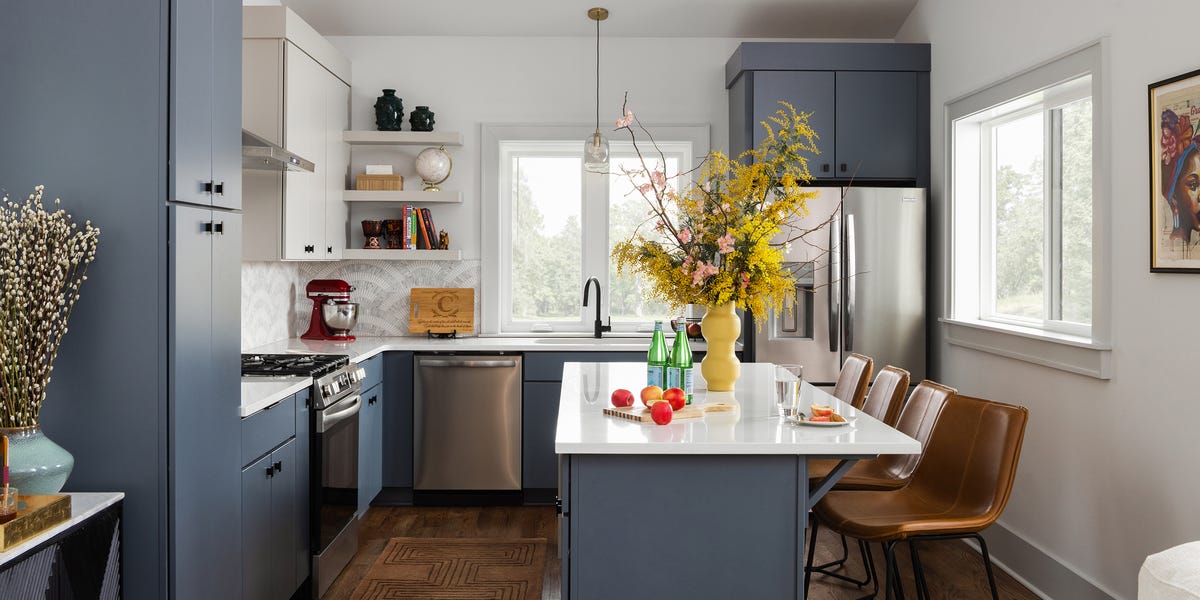
One of the most interesting design lessons in this Nashville home appears in the kitchen. The homeowner was not in love with the existing blue cabinetry, but instead of replacing it, the designer made it work. That is the kind of decision that separates thoughtful design from “let’s demolish everything and emotionally recover later.”
Blue cabinets can feel loud when they are isolated. But when surrounded by the right supporting colors, textures, and objects, blue can become part of a balanced palette. Art, warm woods, books, ceramics, souvenirs, and natural materials help soften the color and make it feel collected rather than accidental.
The floating shelves add function and character. Instead of filling them with generic objects, they display travel memories, cookbooks by Black chefs and creators of color, and pieces that connect to the homeowner’s love of food and culture. This is where the kitchen becomes more than a cooking zone. It becomes a small biography.
For homeowners trying to bring this idea into their own kitchens, the lesson is simple: do not decorate shelves just to decorate shelves. Use them to reveal what you love. A cookbook you actually use, a bowl from a trip, a small framed artwork, or a handmade mug has more power than a row of identical jars pretending everyone decants lentils on a Tuesday.
The Dining Area: Formality Takes Off Its Tie
Modern Southern entertaining is shifting. The traditional formal dining room is not gone, but many younger homeowners prefer dining spaces that feel casual, flexible, and integrated into daily life. In this Nashville home, the dining area sits near the kitchen and living room, making it part of the open flow rather than a room reserved for holidays and tax discussions.
A mix of chairs and bench seating helps the area feel relaxed. This is a smart choice for open-concept homes because it reduces visual stiffness. A bench can tuck in, welcome extra guests, and make the table feel less like a board meeting. Add a bold artwork above the table, and the space becomes a destination rather than a pass-through.
Green dining chairs bring freshness and energy. Green has become a favorite in modern interiors because it connects to nature while still feeling stylish indoors. In a Southern home, green can also bridge traditional and contemporary moods. It works with wood, brass, black, cream, terracotta, blue, and nearly every plant you swear you will remember to water.
The Primary Bedroom: A Warm Hug, But Make It Sherbet
The primary bedroom takes a confident turn with a warm orange wall color. In less careful hands, orange can be risky. It can go from “sunset glow” to “traffic cone with pillows” very quickly. But this room succeeds because the bold wall color is balanced with neutral textiles, natural textures, and a caned or rattan-style bed that adds softness.
This is an important rule for anyone experimenting with saturated color: the stronger the wall, the calmer the supporting cast should be. Linen, cream bedding, woven details, pale woods, and simple shapes allow the color to feel enveloping instead of chaotic.
The bedroom also shows how modern Southern style can be sensual without being overdone. It is warm, tactile, and personal. The palette feels like late afternoon light. The textures keep the room grounded. The result is a retreat that feels designed for rest, not just for applause.
The Powder Room: Tiny Room, Big Nerve
If there is one room where homeowners should be brave, it is the powder room. It is small. It is separate. Guests spend just enough time there to notice something fabulous and not enough time to complain that it is “a lot.” In this Nashville home, graphic wallpaper and a basket-style pendant turn the powder room into a jewel-box moment.
Powder rooms are perfect for dramatic wallpaper, rich paint, unusual mirrors, sculptural lighting, and playful details. They are the design equivalent of earrings: small, but capable of changing the whole outfit.
The key is commitment. A bold powder room should not look like it accidentally wandered away from the rest of the house. It should connect through color, texture, or theme. In this home, the wallpaper relates to the larger story of pattern, culture, and expressive design. The result is surprising, but not random.
Why Art Is the Secret Ingredient
Art is not used as filler in this Nashville oasis. It is the soul of the home. From portraits to family photos to pieces collected through travel, artwork creates emotional architecture. It gives each room a point of view.
This is one of the most valuable lessons for modern homeowners. A room can have expensive furniture and still feel empty if the walls say nothing. Art does not need to be famous, costly, or approved by a committee of people wearing tiny glasses. It needs to matter. It can be a painting by an emerging artist, a photograph from a meaningful trip, a textile, a child’s drawing, a vintage poster, or a framed recipe card from a grandmother.
In Nashville especially, art feels natural at home. The city is built on creative expression, from music and songwriting to galleries, murals, local makers, and neighborhood shops. Bringing art into the home echoes the city’s broader identity: expressive, layered, soulful, and just a little bit dramatic in the best way.
Color Strategy: Bold Does Not Mean Random
The home’s palette works because it uses color with purpose. Charcoal anchors the living room. Blue cabinetry becomes friendlier through styling. Green energizes the dining area. Warm orange turns the bedroom into a cocoon. Neutral wallpaper calms the entry while still creating pattern.
This is how bold color becomes sophisticated: each shade has a job. Some colors ground, some lift, some warm, and some surprise. When every color is screaming for attention, a home feels exhausting. When each color plays a role, the rooms feel layered and alive.
For anyone trying to recreate this approach, start with one anchor color. It might be a dark fireplace wall, a green dining chair, a terracotta bedroom, or a blue island. Then repeat related tones in smaller ways throughout the house. Use art, pillows, rugs, lamps, flowers, and books to connect the palette. The goal is not to match everything. The goal is to make the rooms sound like they belong to the same album.
Texture Keeps the Home From Feeling Flat
Color gets the attention, but texture makes the design livable. Woven lighting, rattan details, linen bedding, wood furniture, framed art, glossy mirrors, and patterned wallpaper all create tactile contrast. Without texture, bold color can feel like stage paint. With texture, it feels warm and dimensional.
Southern interiors have always understood the power of texture. Think cane, wicker, cotton, linen, brass, wood, brick, grasscloth, pottery, and aged finishes. Modern Southern style simply edits these materials into cleaner compositions. The result is familiar but fresh.
This is especially important in new construction. New homes often lack the quirks of older houses: original molding, old floors, imperfect plaster, built-ins, and strange little corners that make people say, “Well, that’s charming,” even when they mean “What happened here?” Texture helps add soul where age has not yet had time to do its job.
How to Bring This Nashville Oasis Look Into Your Own Home
Start With a Personal Story
Before choosing paint or furniture, ask what the home should say about the people who live there. Travel, family, culture, music, food, career, hobbies, and heritage can all become design clues.
Use One Brave Moment Per Room
A dark fireplace wall, a colorful bedroom, a bold powder room, or a statement artwork can transform a space. The trick is to let that brave moment lead while quieter pieces support it.
Mix High and Low
Modern Southern style does not require every piece to be expensive. A meaningful portrait, a vintage side table, a well-framed family photo, or a budget-friendly chair can look elevated when placed with intention.
Let Art Be Personal
Choose pieces because they move you, remind you of somewhere, or start a conversation. A home full of personal art will always feel richer than a home full of objects selected only to match the rug.
Make the Powder Room Mischievous
Small rooms can handle big ideas. Try wallpaper, a saturated paint color, a quirky mirror, or statement lighting. The powder room is where shy design choices go to become legends.
Experience Notes: Living With Color, Art, and Modern Southern Style
One of the best things about a colorful, art-filled Southern home is that it changes how people behave inside it. A beige room can be beautiful, but a room with personal art and confident color often starts conversations before anyone has asked whether they want sparkling water. Guests pause in front of portraits. They ask about the object on the shelf. They notice the wallpaper. They remember the house later, which is the entire point of hospitality.
Living with bold design also teaches patience. At first, a strong wall color may feel like a guest who arrived early and brought a brass band. But after a few days, the eye adjusts. The room begins to feel intentional. The color becomes part of the household rhythm. Morning light softens it. Evening lamps deepen it. Suddenly the “risky” choice feels like the only choice that ever made sense.
Art has a similar effect. The more personal the collection, the more the home feels rooted. A gallery wall does not have to be perfect on day one. In fact, it is better when it grows. Add family photos over time. Frame a postcard from a trip. Buy work from local artists. Hang pieces at eye level, mix sizes, and leave room for the next chapter. A home that evolves is more interesting than one that looks finished forever, like a showroom trapped in amber.
Modern Southern style is also practical when done well. It understands that people gather in kitchens, that dining spaces need to handle weeknight meals and birthday cake, and that living rooms should support both conversation and collapsing onto the sofa. Beauty matters, but comfort is nonnegotiable. A gorgeous chair that nobody wants to sit in is just a sculpture with commitment issues.
For homeowners nervous about color, the best approach is gradual confidence. Begin with art, pillows, lampshades, or a painted piece of furniture. Then move to a small room. Once you survive a dramatic powder roomand you willyou may start seeing the hallway, bedroom, or fireplace wall differently. Color becomes less intimidating when you realize paint can be changed, wallpaper can be replaced, and design should not require a permission slip.
The Nashville oasis is inspiring because it does not chase perfection. It chases personality. It proves that a new home can feel layered, that Southern style can be modern and culturally rich, and that color can be both joyful and refined. Most of all, it reminds us that the best interiors are not designed to impress strangers on the internet, although that is a pleasant bonus. They are designed to welcome real life: the busy workday, the dinner with friends, the quiet morning coffee, the family photo, the souvenir, the song playing in the kitchen, and the little moment when you walk through the door and think, “Yes. This feels like me.”
Conclusion: A Nashville Home With Soul, Style, and a Wink
Color, Art and Modern Southern Style Shine in This Nashville Oasis because every design decision serves a deeper purpose. The home is colorful, but not careless. Modern, but not cold. Southern, but not stuck in the past. Its strongest idea is simple: a beautiful home should reflect the life inside it.
From the patterned entryway to the charcoal fireplace, from the travel-filled kitchen shelves to the warm orange bedroom and playful powder room, this Nashville interior offers a blueprint for anyone craving a home with more courage and character. It shows that art can tell the story, color can set the mood, and modern Southern style can feel as welcoming as a front porch with better lighting.
Note: This article is written as an original, publication-ready SEO feature based on real U.S. home design coverage, Nashville interior trends, and modern Southern decorating principles.













