
Note: This article is based on public mission updates from NASA, NASA Jet Propulsion Laboratory, IEEE Spectrum, Space.com, The Planetary Society, Live Science, Scientific American, and other reputable U.S. science and space-technology publications. It is fully rewritten as original editorial content for web publication.
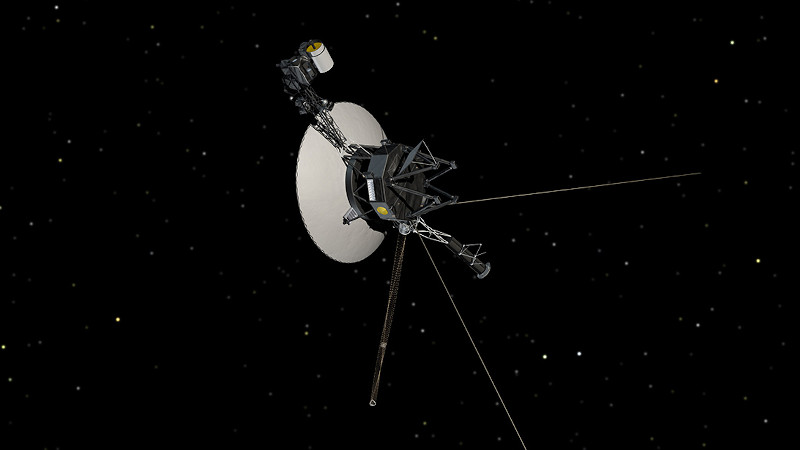
Voyager 1 has survived Jupiter’s radiation belts, Saturn’s gravity games, 15 billion miles of cosmic loneliness, and nearly five decades of deep-space travel. But in late 2023, humanity’s most distant spacecraft ran into a very modern-sounding problem: its computer started talking nonsense.
Not dramatic movie nonsense, unfortunately. No alien poetry. No “send pizza.” Instead, Voyager 1 began transmitting a repeating pattern of binary data that engineers could not use. The spacecraft was still alive, still receiving commands, and still pointing its antenna toward Earth. But the information it sent back from its Flight Data System, or FDS, was unreadable. For a mission that depends entirely on tiny streams of data crossing interstellar space, that was a serious headache with a 45-hour feedback loop.
The issue quickly became one of the most fascinating engineering stories in modern spaceflight: how do you debug a 1977 spacecraft, more than 15 billion miles from Earth, using tiny packets of commands, outdated documentation, and hardware no one can physically touch? The answer, as it turns out, involves patience, detective work, old code, and the kind of technical creativity that makes duct tape look underqualified.
What Happened to Voyager 1?
Voyager 1’s trouble began on November 14, 2023, when the spacecraft stopped sending readable science and engineering data back to Earth. Mission controllers could still tell the probe was receiving and executing commands, which was excellent news. The bad news was that the data pipeline had become effectively useless.
The problem was traced to the Flight Data System, one of Voyager 1’s three onboard computer systems. The FDS has a critical job: it collects science data from instruments, gathers engineering information about the spacecraft’s health, packages that information, and sends it to the Telemetry Modulation Unit. From there, the data is transmitted to Earth through Voyager’s radio system.
Think of the FDS as the spacecraft’s cosmic mailroom. It sorts the letters, labels the envelopes, and hands them to the radio transmitter. When the mailroom fails, the antenna may still shout across space, but Earth receives a stack of envelopes filled with confetti.
Why the Flight Data System Matters
Voyager 1 is not just a vintage machine floating through the dark. It is a working scientific observatory in interstellar space. Its instruments study magnetic fields, plasma waves, and high-energy particles outside the Sun’s protective bubble, known as the heliosphere. That makes Voyager 1 uniquely valuable because no other active spacecraft has traveled as far.
The Flight Data System is essential because it turns raw instrument readings into usable telemetry. Without it, scientists cannot receive fresh measurements of the interstellar environment, and engineers cannot easily check the spacecraft’s condition. It is like trying to monitor a patient whose heartbeat monitor is plugged in but displaying alphabet soup.
NASA’s engineers soon realized the spacecraft itself was not dead. Voyager 1 was still responsive. The issue was narrower and more maddening: a small portion of FDS memory had become corrupted, preventing normal data packaging.
The Culprit: Corrupted Memory in a 46-Year-Old Computer
After weeks of investigation, engineers sent a special command to Voyager 1 that prompted the spacecraft to return a readout of the FDS memory. That memory included software code and variables used by the system. The returned readout helped the team identify the problem: roughly 3% of the FDS memory was corrupted.
The likely cause was a failed chip. Engineers could not say with absolute certainty why it failed. Two leading possibilities were natural aging after more than four decades of operation or damage from an energetic particle in deep space. Both explanations are believable. Voyager 1 is old enough to qualify for a senior discount and is traveling through an environment filled with cosmic radiation. That combination is not exactly gentle on electronics.
There was no way to replace the chip. Nobody was going to send a repair van to interstellar space, and even if they did, the mileage charge would be rude. The only realistic solution was to work around the damaged memory by moving affected code to healthy parts of the FDS.
Debugging From 15 Billion Miles Away
Repairing Voyager 1 was not like updating a laptop. There was no restart button, no screen share, no friendly “install update now?” prompt. Commands sent from Earth took about 22.5 hours to reach Voyager 1, and the response took another 22.5 hours to come back. That meant every test required nearly two days of waiting.
The engineering team at NASA’s Jet Propulsion Laboratory had to proceed with extreme caution. A bad command could make the situation worse. A rushed fix could interfere with other essential systems. Every instruction needed to be reviewed, simulated, checked again, and then transmitted through NASA’s Deep Space Network.
One of the biggest challenges was memory. Voyager’s computers have less than 70 kilobytes of memory each. That is not a typo. A single modern phone photo can be thousands of times larger. Engineers had to find small unused pockets of memory and divide the damaged code into pieces that could be relocated. They also had to update references so the scattered pieces still worked together.
It was less like moving a file from one folder to another and more like relocating a library into several broom closets while keeping the catalog system functional.
The April 2024 Breakthrough
In April 2024, engineers focused first on restoring engineering data. That was the practical priority because engineering data tells the team about the spacecraft’s health, power, temperature, and system status. Once they could see the patient’s vital signs again, they could plan the next steps.
The team relocated the code responsible for packaging engineering data and sent the update to Voyager 1. Then came the waiting. Nearly two days later, the answer came back: it worked. For the first time in about five months, Voyager 1 was sending usable engineering updates again.
That moment mattered. It proved the workaround was possible. It also gave engineers confidence that they could restore science data by relocating additional portions of the damaged FDS code.
Voyager 1 Returns to Science
The recovery continued in stages. By May 2024, Voyager 1 resumed returning science data from two of its instruments. By June 2024, NASA reported that all four then-operating science instruments were returning usable data again. After months of garbled transmissions, the spacecraft was back to conducting normal science operations.
That does not mean Voyager 1 became young again. The spacecraft remains extremely old, extremely distant, and increasingly power-limited. But the FDS repair stands as a remarkable example of remote engineering under almost absurd constraints.
NASA still needed to perform follow-up work after science data returned, including resynchronizing timing software among Voyager’s computers and maintaining systems such as the digital tape recorder used for some plasma wave data. In other words, the spacecraft was back, but the maintenance list was not exactly empty. Spacecraft ownership, apparently, is a lot like owning an old car: fix one thing, celebrate briefly, then listen for the next rattle.
Why Voyager 1 Still Matters
Voyager 1 launched on September 5, 1977, only weeks after Voyager 2. The two spacecraft were originally designed for close flybys of the outer planets. Voyager 1 visited Jupiter and Saturn, revealing astonishing details about giant planets and their moons. Its sibling, Voyager 2, went on to visit Uranus and Neptune as well.
But Voyager 1’s second life may be even more historic than its planetary tour. On August 25, 2012, it became the first human-made object to enter interstellar space. That does not mean it left the solar system in the strictest gravitational sense; the Sun’s influence extends far beyond the planets. But Voyager 1 crossed the heliopause, the boundary where the solar wind gives way to the interstellar medium.
From that region, Voyager 1 provides direct measurements of an environment scientists cannot study up close any other way. Its data helps researchers understand cosmic rays, magnetic fields, plasma waves, and the shape of the Sun’s protective bubble. It is not glamorous in the way a Mars rover selfie is glamorous, but scientifically it is priceless.
Aging Spacecraft, Shrinking Power
The Flight Data System issue was not Voyager 1’s only challenge. The spacecraft is powered by radioisotope thermoelectric generators, which convert heat from decaying plutonium into electricity. That power supply naturally declines over time. Engineers have gradually turned off heaters, instruments, and nonessential systems to conserve energy.
By 2026, Voyager 1 had already lost several instruments to age, degraded performance, or power-saving decisions. NASA shut down the Low-Energy Charged Particles experiment in April 2026 to preserve enough power for the remaining mission. The magnetometer and plasma wave instruments remained especially important because they continue to provide rare measurements from interstellar space.
Every watt matters. The team must balance scientific value against survival. Keeping Voyager alive is now a game of careful trade-offs, where each switch flipped off may buy more time for the instruments still operating.
The Human Side of the Voyager 1 Repair
The most charming part of the Voyager 1 FDS story is not the corrupted chip. It is the people. Engineers had to consult decades-old documentation, reconstruct how the spacecraft’s software worked, and reason through hardware designed before many modern programmers were born.
Some original Voyager engineers have retired or passed away. Documentation exists, but it was written for a different era, when nobody expected the spacecraft to still be operating almost 50 years later. The team had to combine archival knowledge with modern analysis, making the repair both a technical task and a historical excavation.
That is part of what makes the mission so beloved. Voyager 1 is not sleek, new, or shiny. It is a deeply human machine: overbuilt, patched, protected, coaxed along, and still somehow doing the job. It carries the Golden Record, a message from Earth to whoever might someday find it. But every signal it sends back is also a message to us: careful work lasts.
Lessons From the Flight Data System Crisis
1. Redundancy Matters, But It Does Not Last Forever
Voyager was designed with backup systems, but after decades in space, not every backup remains available. The FDS issue showed that redundancy is essential, yet long missions eventually push hardware beyond its original design life. Future spacecraft headed for extreme-duration missions will need even more flexible architectures.
2. Software Can Rescue Hardware
The failed memory chip could not be repaired, but software made a workaround possible. By relocating code and adjusting references, engineers effectively taught Voyager 1 to step around the broken floorboard. That is a powerful reminder that smart software design can extend the life of physical machines.
3. Documentation Is Mission-Critical
Old documents may not be exciting, but they can save a spacecraft. Engineers needed historical records to understand Voyager’s systems. For modern missions, preserving documentation, institutional knowledge, and software history is not administrative clutter. It is survival gear.
4. Patience Is an Engineering Tool
When each command takes almost two days to test, impulsive troubleshooting is impossible. The Voyager team had to think slowly, plan carefully, and respect the consequences of every command. In a world obsessed with instant fixes, Voyager 1 is a 15-billion-mile reminder that patience still works.
What the Voyager 1 Trouble Means for Space Exploration
The Voyager 1 FDS issue is more than a dramatic repair story. It is a preview of the future. As space agencies plan missions to icy moons, distant asteroids, outer planets, and perhaps one day interstellar precursors, long-term maintainability will become increasingly important.
Spacecraft that travel far from Earth must be able to handle unknown problems. Engineers cannot rely on quick repairs, high-bandwidth diagnostics, or physical access. Future probes will need resilient software, fault-tolerant hardware, modular systems, and perhaps more onboard autonomy.
Voyager 1 also demonstrates the value of designing with margins. The spacecraft exceeded its original mission by decades because it was built with care, protected from harsh environments, and supported by teams willing to keep learning from it. That kind of engineering discipline is not flashy, but it is exactly why a probe launched during the Carter administration is still whispering from interstellar space.
Experiences and Reflections: What Voyager 1 Teaches Us About Fixing the Impossible
There is something oddly relatable about Voyager 1’s Flight Data System problem. Most of us have experienced a computer that suddenly stops cooperating. A file will not open. A screen freezes. A printer decides it has entered a spiritual retreat and no longer believes in paper. The difference is that our troublesome devices are usually within arm’s reach. Voyager 1 is farther away than any other human-made object, and its “customer support appointment” takes almost two days per question.
The experience of following this repair feels like watching a master class in calm problem-solving. The engineers did not panic when the spacecraft began returning unreadable data. They narrowed the problem. They tested assumptions. They ruled out possibilities. They found a way to make the spacecraft reveal its own memory contents. Then they studied the evidence until a workable explanation emerged. That sequence is useful far beyond space exploration. It is how good troubleshooting works in software, business, medicine, aviation, and even daily life.
One practical lesson is that a confusing symptom is not the same as a total failure. Voyager 1 was sending gibberish, but it was still powered, still listening, and still responding. In human terms, it was not gone; it was misunderstood. Many problems look catastrophic at first because the output is messy. The smartest response is often to ask, “What is still working?” That question gives you a foothold.
Another lesson is the importance of working with constraints instead of complaining about them. Voyager’s memory is tiny. Its hardware is ancient. Its distance is ridiculous. Its original designers did not expect engineers in the 2020s to be rearranging code inside it. Yet those constraints did not end the mission. They shaped the solution. The team found unused memory, divided code into pieces, updated references, and restored function. Creativity often appears when comfort disappears.
There is also a deeper emotional experience in this story. Voyager 1 feels less like a machine and more like a shared human heirloom. It carries greetings, music, images, and sounds from Earth on the Golden Record. It also carries the labor of thousands of people: machinists, programmers, scientists, navigators, mission planners, antenna operators, archivists, and engineers who inherited a spacecraft older than many of them. When they repaired the FDS, they were not merely fixing data flow. They were extending a conversation between Earth and the edge of the unknown.
For writers, builders, engineers, and curious readers, Voyager 1 offers a final experience worth keeping: meaningful work can outlive its original deadline. The mission was not supposed to last this long. Yet because it was built well and cared for patiently, it continues to deliver value. That is an inspiring standard. Whether someone is designing software, writing an article, building a house, teaching a class, or repairing an old engine, the Voyager lesson is clear: build carefully, document generously, maintain patiently, and never underestimate an old system with a good team behind it.
Conclusion
Voyager 1’s Flight Data System trouble was a serious threat to one of NASA’s most iconic missions. For months, the spacecraft could not return usable science or engineering data, leaving engineers with a mystery unfolding across interstellar distance. The culprit turned out to be corrupted memory in the FDS, likely tied to a failed chip. Since the hardware could not be repaired, NASA’s team created a software workaround, relocated critical code, and gradually restored engineering and science data.
The result was not just a technical win. It was a reminder of why Voyager 1 remains one of humanity’s greatest machines. It is old, distant, power-limited, and fragile, yet still scientifically valuable. Its survival depends on brilliant engineering, careful patience, and a willingness to solve problems that no manual fully anticipated.
Voyager 1 may be in trouble from time to time, but trouble has become part of its legend. Each fix adds another chapter to a mission that refuses to stop making history. Somewhere beyond the planets, a 1977 spacecraft is still listening, still speaking, and still proving that human curiosity has excellent long-distance coverage.











