
Note: This publish-ready article is written in standard American English, formatted as an HTML body, and intentionally excludes visible source links for clean web publication.
Introduction: A Piano, A Radio, And A Tiny Identity Crisis
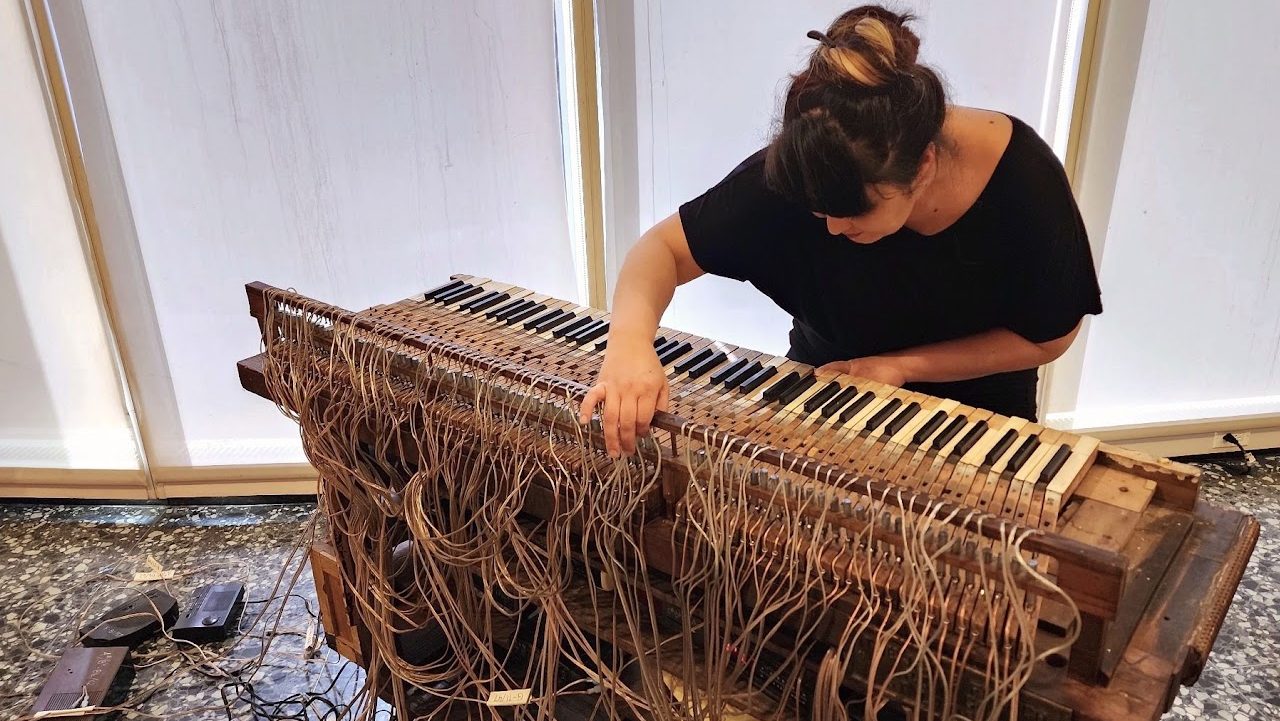
The Trans-Harmonium is not the kind of instrument you casually bring to a campfire unless your idea of “campfire music” includes FM static, overlapping talk-show voices, and a deconstructed antique piano behaving like it just discovered public broadcasting. Created by Washington, D.C.-based artist Emily Francisco, the Trans-Harmonium is a strange, charming, and slightly mischievous radio-musical instrument that turns local airwaves into playable sound.
At first glance, it looks like an instrument. It has keys. It has the posture of a keyboard. It seems to invite the familiar logic of melody, harmony, and “please do not spill coffee on the electronics.” But the moment it is played, the Trans-Harmonium reveals that it is less interested in traditional music than in listening itself. Each key activates a clock radio tuned to a specific frequency. Instead of producing a predictable note, the instrument releases whatever that radio is receiving at that moment: classical music, pop songs, commercials, sports commentary, weather reports, static, emergency tones, half-sentences, or the ghostly shimmer between stations.
That is what makes the Trans-Harmonium such a fascinating piece of sound art. It is a keyboard instrument, a radio receiver, a city portrait, a DIY sculpture, and a small philosophical prank wearing piano clothes. It asks a simple but surprisingly deep question: what happens when the musician does not fully control the music?
What Is The Trans-Harmonium?
The Trans-Harmonium is a deconstructed antique piano wired to play a collection of radios. According to the artist’s own project description, the instrument uses twelve radio frequencies, one for each chromatic key. The white keys are tuned to local stations when possible, while the black keys are tuned between stations, where static and fragments of sound overlap. In practical terms, pressing a key does not strike a string or trigger a digital sample. It completes a speaker connection and allows one radio’s sound to pass through.
This is why the instrument feels both mechanical and magical. There is no secret artificial intelligence hiding inside. No grand synthesizer brain is calculating waveforms. The magic comes from rerouting simple consumer technology: clock radios, speaker wires, a keyboard mechanism, and the invisible electromagnetic soup that already surrounds us every day.
The word “Trans-Harmonium” is clever because it nods toward the harmonium, a keyboard reed organ that traditionally produces sound through air and vibrating reeds. But this instrument crosses that old idea with transmission. The prefix “trans” suggests movement across, through, or beyond. Instead of air passing through reeds, broadcast signals pass through radios. Instead of bellows, there is the FM band. Instead of a church parlor, there is a living map of a city’s soundscape.
How The Trans-Harmonium Works
A Keyboard That Opens Radio Gates
The Trans-Harmonium’s technical principle is refreshingly simple. The clock radios remain functional receivers. Their speaker lines are interrupted and routed through the keyboard. When a player presses a key, the connection for that radio is completed, and the sound becomes audible. Release the key, and that radio falls silent again.
In other words, the keyboard does not generate sound. It behaves more like a set of gates. Each key opens a different window in the wall of radio noise. Some windows look out onto clear stations. Others look into fog. A traditional piano gives you a C when you press C. The Trans-Harmonium might give you classical music, an announcer saying “traffic is backed up,” or the tail end of an advertisement for discount tires. It is performance with a side order of uncertainty.
Why The Sharps And Flats Are So Weird
The instrument’s tuning system is part musical logic, part local archaeology. The C key is generally reserved for a classical station when available. Other natural notes are assigned to local stations in order of frequency. The sharps and flats are placed between stations, where static, bleed, and partial reception become part of the sound.
That detail matters. In conventional Western music, sharps and flats sharpen or flatten pitch. In the Trans-Harmonium, they destabilize reception. They are not “wrong notes” in the usual sense. They are unstable listening zones. They expose the messy edges between clean broadcasts, proving that radio is not a tidy menu of stations but a crowded neighborhood of signals constantly bumping elbows.
A Radio-Musical Instrument, Not Just A Gadget
It would be easy to dismiss the Trans-Harmonium as a quirky DIY project: antique piano plus radios equals weird internet headline. But that misses the point. The instrument is not strange merely because it is made from unexpected parts. It is strange because it changes the role of the performer.
On a normal keyboard, the player chooses pitch, rhythm, dynamics, and harmony. On the Trans-Harmonium, the performer chooses timing and combination, but the content comes from elsewhere. The city, the broadcasters, the weather, the geography of reception, and the moment itself all become collaborators. The player is not a musical dictator. The player is more like a traffic cop at an intersection where every car is a radio station and half the drivers are yelling about pledge drives.
This creates a wonderful tension. You can press multiple keys and create chords, but those chords may be made from news, static, jingles, and fragments of music in unrelated keys. You can attempt rhythm, but a station’s content may change mid-gesture. You can try to compose, but the instrument answers back with whatever is currently floating through the air.
The Trans-Harmonium As A Portrait Of A City
One of the most poetic ideas behind the Trans-Harmonium is that it can create audible portraits of different places. Because the instrument depends on local radio frequencies, it changes from city to city. The same key layout can produce different voices, languages, genres, signal strengths, and cultural textures depending on where the piece is installed.
A Trans-Harmonium in Washington, D.C. may sound like public radio, classical programming, political chatter, gospel, sports talk, college stations, and the soft hiss of urban interference. In another city, it might reveal country stations, Spanish-language programming, local ads, religious broadcasts, underground music, or weather alerts. The sculpture travels, but the content is site-specific. It is like a postcard that plays itself, though admittedly one that occasionally interrupts with mattress commercials.
This makes the instrument part of a larger tradition of sound art and field recording. Instead of recording the city with a handheld microphone, it samples the broadcast environment in real time. It does not ask, “What does this place look like?” It asks, “What is this place transmitting?”
Why It Belongs In The History Of Electronic Music
The Trans-Harmonium sits comfortably among the odd cousins of electronic music history. It is not a commercial synthesizer like a Moog. It is not a touchless instrument like the theremin. It is not a giant early electronic ancestor like the Telharmonium, the massive tone-wheel instrument associated with Thaddeus Cahill in the early 20th century. But it shares a family resemblance with all of them because it treats electricity as a musical medium.
The Telharmonium attempted to generate musical tones electrically and distribute them through telephone lines. The theremin turned electromagnetic fields into eerie continuous tones controlled by hand movement. Later synthesizers made electronic sound programmable, portable, and eventually mainstream. The Trans-Harmonium takes a different route. It does not generate a clean electronic tone. It captures existing radio signals and turns them into playable material.
That distinction is important. Many electronic instruments promise control. The Trans-Harmonium promises encounter. It is less about “making the perfect sound” and more about revealing the sounds already present but usually ignored. In an age of polished playlists and algorithmic recommendations, that feels almost rebellious. It says: here is the messy, live, unpredictable air around you. Press a key and deal with it.
Why The Instrument Feels Funny, And Why That Matters
Part of the Trans-Harmonium’s charm is that it has a sense of humor built into its structure. A piano is a symbol of discipline. It suggests lessons, scales, recitals, and someone’s aunt whispering, “Play something nice.” Clock radios, on the other hand, suggest cheap motel rooms, sleepy mornings, and alarms that have ruined more dreams than any villain in literature.
By combining the two, Francisco creates a delightful mismatch. The instrument has the seriousness of sculpture and the personality of a junk drawer. It looks like it should perform Bach, but it may instead perform a breakfast show host laughing at his own joke. That collision is not accidental. It reminds viewers that sound is not automatically noble just because it comes from an instrument, and everyday technology is not automatically boring just because it was mass-produced.
The humor also makes the concept more approachable. Some sound art can feel like homework with speakers. The Trans-Harmonium avoids that trap. It invites curiosity first. People want to press the keys. They want to hear what happens. Only after the initial fun does the deeper idea appear: every place is already full of invisible performance.
The Beauty Of Obsolete Technology
The Trans-Harmonium also belongs to the growing artistic interest in obsolete and discarded devices. Old radios, cassette decks, televisions, projectors, and other analog machines carry physical memory. They have knobs, dust, labels, scratches, and habits. They do not feel like anonymous software. They feel like objects with past lives.
Francisco’s broader practice often uses disrupted signal flow, inexpensive consumer technologies, and discarded instruments. The Trans-Harmonium fits that approach beautifully. A clock radio is not glamorous technology. It is the sort of object people donate, forget, or trap forever in a basement box labeled “miscellaneous.” Yet in this artwork, the humble clock radio becomes a performer. It is promoted from nightstand servant to sonic oracle.
This repurposing gives the work emotional texture. The instrument does not simply recycle old electronics. It asks what kinds of time are stored in them. Clock radios are already obsessed with time: waking time, sleeping time, alarm time, broadcast schedules, hourly news updates. When several of them are wired into a keyboard, they become a chorus of time fragments.
Collecting Fragments Of Time
The Trans-Harmonium is connected to Francisco’s larger project, “Collecting Fragments of Time,” which involves recordings made from instruments that pull live radio frequencies from the air. That phrasefragments of timeis a perfect description of what the instrument does.
A radio broadcast is always temporary. A sentence passes, and it is gone. A song fades. A station changes programming. Static appears and disappears. The Trans-Harmonium turns these passing moments into playable events, but it cannot freeze them completely. Even if someone records a performance, the next performance will be different. The archive grows because the instrument keeps encountering new versions of the present.
This makes the Trans-Harmonium especially relevant now, when so much digital culture pretends to be permanent while actually disappearing behind platforms, updates, and broken links. Radio feels old-fashioned, but it is still live in a way that matters. It exists in time. The Trans-Harmonium makes that liveness audible.
What It Is Like To Experience The Trans-Harmonium
Imagine walking into a gallery and seeing what appears to be a wounded piano attached to a cluster of radios. You press one key. A classical station floats out. You press another. Someone is giving the weather. You try a third and get static with a faint voice underneath. Then you press several keys together and suddenly the room becomes a messy civic choir: violins, traffic, advertisements, talk radio, pop hooks, and electromagnetic fuzz.
The experience can be funny, confusing, beautiful, or mildly chaotic. It can also be oddly intimate. Radio voices are designed to enter private spaces: kitchens, cars, bedrooms, workshops, lonely night shifts. Hearing them through a sculptural instrument in a public gallery changes their meaning. They become material. They become texture. A news anchor becomes a note. A commercial becomes rhythm. Static becomes atmosphere.
That shift is the heart of the work. The Trans-Harmonium does not ask us to admire radio from a distance. It lets us touch radio indirectly, through keys. It gives the invisible a body.
Why The Trans-Harmonium Matters For Modern Listeners
The Trans-Harmonium matters because it challenges the way we think about music, technology, and attention. Most modern listening is customized. Streaming platforms try to predict taste. Playlists reduce friction. Noise-canceling headphones seal the listener into a private bubble. The Trans-Harmonium does the opposite. It makes listening public, local, unstable, and shared.
That instability is not a flaw. It is the artwork’s personality. The instrument reminds us that not all valuable sound is smooth. Not all music has to be composed in advance. Not every instrument needs perfect pitch, and not every performance needs to flatter the performer. Sometimes the most interesting music is the kind that refuses to behave.
For musicians, the piece offers a lesson in humility. For technologists, it is a reminder that simple circuits can produce complex experiences. For artists, it shows how familiar objects can become strange again when their signals are rerouted. For everyone else, it is proof that even a clock radio can have a second act if someone with enough imagination and speaker wire gets involved.
Experiences Related To The Trans-Harmonium
Experiencing the Trans-Harmonium is less like attending a concert and more like discovering that the city has been humming behind your back all along. The first instinct is usually playful. People press one key, smile, press another, then quickly realize the instrument is not going to reward them with a neat melody. It behaves like a piano that went to art school, took a radio engineering elective, and came back with opinions.
One of the most memorable experiences with an instrument like this is the feeling of losing control in a safe and creative way. A player may begin with a musical plan: perhaps a slow pattern, a chord, or a rhythmic pulse. But the radios do not care about the plan. A station might shift from music to a host speaking. Static might swallow a frequency. A commercial might suddenly become the loudest voice in the room. The player has to adapt. That adaptation becomes the performance.
This can be surprisingly freeing. Many people feel nervous around musical instruments because they believe they must play correctly. The Trans-Harmonium weakens that fear. There is no traditional “correct” version of the piece. A wrong note is almost impossible because the instrument is already built from glorious wrongness: mismatched broadcasts, unstable signals, and local accidents. The performer becomes a listener with hands.
For gallery visitors, the instrument can also change how they hear ordinary radio afterward. A person who spends time with the Trans-Harmonium may get into a car later and notice the space between stations, the rhythm of announcer voices, the emotional tone of traffic reports, or the strange musicality of advertisements. The artwork trains attention. It says, “Listen again. The boring stuff is not as boring as you thought.”
There is also a nostalgic layer. Clock radios belong to a particular domestic history. Many people remember waking up to them, fumbling for snooze buttons, or hearing distant stations late at night. The Trans-Harmonium gathers that private nostalgia and places it in a shared public setting. Suddenly, an object associated with bedrooms and bedside tables becomes part of a communal performance.
For artists and makers, the piece is inspiring because it proves that innovation does not always require futuristic materials. The Trans-Harmonium is not impressive because it uses the newest technology. It is impressive because it listens carefully to old technology. It finds unused potential in devices that might otherwise be ignored. That is an important creative lesson: sometimes the next strange idea is not hiding in a laboratory. Sometimes it is sitting in a thrift store, blinking 12:00 forever.
Finally, the Trans-Harmonium offers a rare kind of experience in a world full of repeatable media. You cannot fully replay it. You can document it, but the live event remains tied to location, reception, timing, and chance. Every performance is a small weather system of signals. That makes it fragile, funny, and alive.
Conclusion: The Strange Instrument That Teaches Us How To Listen
The Trans-Harmonium is strange in the best possible way. It is a radio-musical instrument that refuses to separate sculpture, performance, technology, and local culture. By wiring clock radios into a deconstructed antique piano, Emily Francisco created an artwork that turns broadcast signals into playable fragments of time.
It may not behave like a traditional instrument, and that is precisely why it matters. It does not offer perfect control, polished tone, or predictable melody. Instead, it offers surprise, place, accident, and attention. It invites players and listeners to hear the invisible architecture of radio that surrounds everyday life.
In a world where music is increasingly filtered, optimized, and delivered on demand, the Trans-Harmonium gives us something refreshingly unruly. It lets the city play itself. It makes static meaningful. It turns the air into an orchestra. And yes, it proves that a pile of clock radios can be more interesting than half the expensive gadgets currently charging on our desks.













