
Note: This article is written for web publication and synthesizes real information from reputable U.S. science and space sources, including NASA, NASA Goddard, STScI, mission documentation, and astronomy education resources.
Introduction: Space Has Parking Spots, But No Valet
If space feels like a cosmic freeway with no lanes, no brakes, and absolutely no helpful road signs, you are not alone. Yet hidden inside all that orbital chaos are a few surprisingly convenient “parking spots” called Lagrange points. These are locations where gravity and motion work together so well that spacecraft can remain in a useful position with relatively little fuel. Think of them as gravitational sweet spotsexcept instead of a painted line and a parking meter, you get the Sun, Earth, orbital mechanics, and a math problem with attitude.
The James Webb Space Telescope, often called JWST or simply Webb, uses one of these spots: the Sun-Earth L2 Lagrange point. Webb does not sit perfectly still, and it is not nailed to a cosmic hook. Instead, it follows a large halo orbit around L2, about 1.5 million kilometers, or roughly 1 million miles, from Earth. That location helps Webb keep its giant sunshield pointed toward the Sun, Earth, and Moon while its cold instruments stare into deep space like the universe owes them answers.
So, what are Lagrange points? Why does Webb use L2? And how does a telescope the size of a tennis court “stay put” in a place where there is no planet, no moon, and definitely no driveway? Let’s unpack the science without turning the article into a physics textbook wearing a lab coat.
What Are Lagrange Points?
Lagrange points are special positions in space where the gravitational pull of two large bodiessuch as the Sun and Earthcombines with the motion of a smaller object so that the smaller object can maintain a stable or semi-stable position relative to those two bodies. In simple terms, a spacecraft placed near one of these points can travel around the Sun while staying in nearly the same arrangement with Earth and the Sun.
They are named after Joseph-Louis Lagrange, the mathematician who helped solve parts of the famous three-body problem in the 18th century. The three-body problem asks what happens when three objects influence one another through gravity. The answer, generally, is “things get complicated very quickly.” Lagrange found special cases where the geometry stays predictable. Space agencies have been grateful ever since.
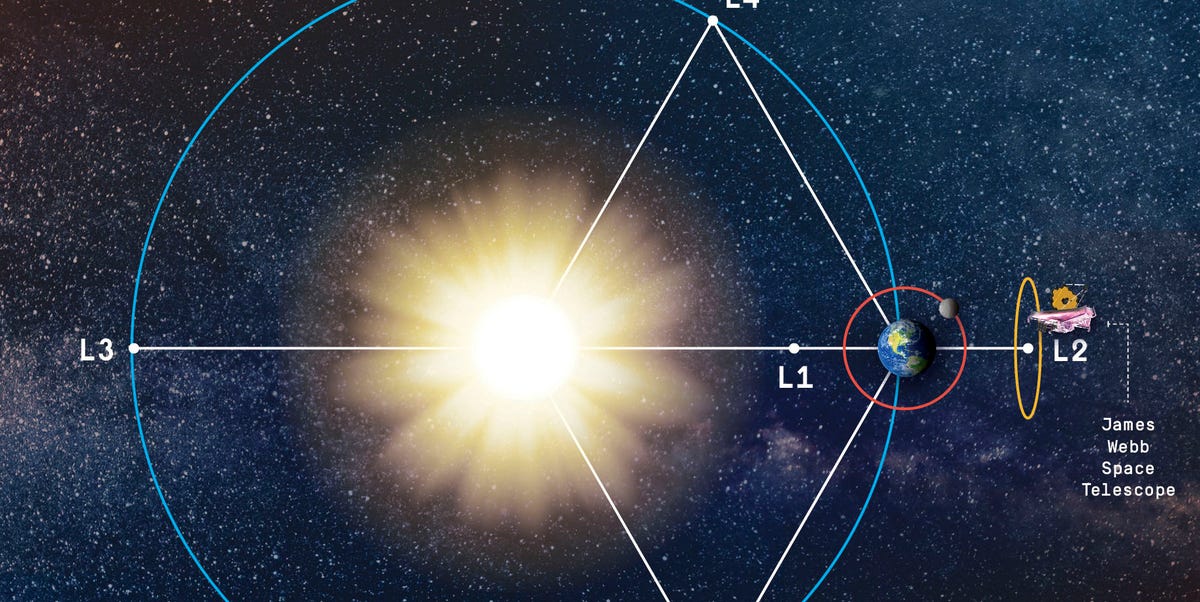
For any two large orbiting bodies, there are five Lagrange points: L1, L2, L3, L4, and L5. Each has a different location and personality. Yes, orbital mechanics has personalities now. We do what we must.
The Five Lagrange Points Explained
L1 sits between two massive bodies. In the Sun-Earth system, L1 is between Earth and the Sun. It is useful for solar-observing spacecraft because it provides a constant view of the Sun before solar wind and space weather reach Earth.
L2 is located on the far side of Earth from the Sun. This is Webb’s neighborhood. It is ideal for deep-space observatories because the Sun, Earth, and Moon remain in roughly the same direction from the spacecraft’s perspective. That means a telescope can use one shield to block heat and light from all three.
L3 lies on the opposite side of the Sun from Earth. It sounds mysterious and dramatic, which is why science fiction loves it. In real mission planning, it is less practical for communication because the Sun gets in the way.
L4 and L5 sit ahead of and behind the smaller body in its orbit, forming equilateral triangles with the two larger bodies. These two points are more stable than L1, L2, and L3. In fact, Trojan asteroids naturally gather near L4 and L5 in some planet-Sun systems, especially around Jupiter.
Why Lagrange Points Matter for Space Missions
Lagrange points matter because they let spacecraft do difficult jobs with less fuel, better geometry, and more consistent conditions. A spacecraft near a Lagrange point does not have to constantly fight gravity like a shopping cart with one bad wheel. Instead, it can use small corrections to remain in a useful region of space.
Different missions use different Lagrange points depending on their goals. Solar monitoring spacecraft often use L1. Deep-space observatories prefer L2. Future missions may use L4 and L5 for solar studies, asteroid research, or navigation experiments. These points are not magic, but they are among the closest things mission designers have to cosmic convenience stores.
For astronomy, L2 is especially attractive. A telescope there can avoid passing in and out of Earth’s shadow every 90 minutes, which is what low-Earth-orbit spacecraft experience. It can also avoid much of the scattered light, thermal cycling, and Earth-blocked viewing that complicate observations closer to home. Space is still harsh, of course. It is not a spa. But L2 is a much calmer office for a sensitive infrared observatory.
Where Is the James Webb Space Telescope?
The James Webb Space Telescope operates near the Sun-Earth L2 point, about 1.5 million kilometers from Earth in the direction opposite the Sun. That is about four times farther away than the Moon. Unlike the Hubble Space Telescope, which orbits Earth, Webb orbits the Sun while staying near Earth’s night-side direction.
This distinction is important: Webb is not orbiting Earth in the usual sense. It is also not sitting directly on L2 like a bird on a branch. Instead, it follows a wide, looping halo orbit around L2. From Earth’s moving point of view, Webb appears to circle around that invisible gravitational region. From a broader solar-system view, Webb is orbiting the Sun alongside Earth, with a carefully managed rhythm.
NASA describes Webb’s halo orbit as large and complex. The telescope completes one loop around L2 in roughly 168 days, and its distance from the exact L2 point varies by hundreds of thousands of kilometers. That sounds wildly imprecise until you remember that in space, “nearby” often means “please pack snacks.”
How Does JWST Stay Put at L2?
When people say Webb “stays put,” they usually mean it stays in a stable relationship with Earth and the Sun, not that it remains frozen in one place. Everything is moving. Earth is orbiting the Sun. The Moon is orbiting Earth. The Sun is moving through the galaxy. Webb is moving too. Space is less like a parking lot and more like a synchronized dance where everyone is wearing roller skates.
At L2, gravity and orbital motion nearly balance in a way that lets Webb keep pace with Earth around the Sun. Normally, an object farther from the Sun than Earth would orbit more slowly. But near L2, Earth’s gravity adds just enough extra pull to help the telescope maintain an orbital period close to Earth’s one-year trip around the Sun. This lets Webb stay roughly aligned with Earth as both travel around the Sun.
However, L2 is not perfectly stable. The collinear Lagrange pointsL1, L2, and L3are dynamically unstable. If a spacecraft drifts too far, it will not automatically return like a marble rolling back into a bowl. It may wander away. That is why Webb performs station-keeping maneuvers: small thruster burns that gently correct its path.
Station Keeping: Tiny Pushes, Huge Consequences
Station keeping is the art of giving a spacecraft small, carefully timed nudges so it remains on its planned orbit. Webb uses onboard propulsion for orbit maintenance, attitude control, and momentum management. These burns are short, but they matter. Without them, Webb would eventually drift away from its desired halo orbit.
The telescope does not fire its thrusters constantly. Instead, mission teams monitor its trajectory and schedule corrections when needed, often on the order of every few weeks. These burns conserve fuel while keeping the observatory in a safe, productive orbital path. It is like correcting your bike’s direction with tiny handlebar movements instead of waiting until you are halfway into a hedge.
Fuel is one of Webb’s key consumables. The telescope does not carry cryogenic coolant for its main cooling system; it relies heavily on passive cooling through its sunshield and design. But it does need propellant for station keeping and spacecraft control. Efficient launch and orbit insertion helped extend Webb’s expected operational life beyond the original minimum mission requirement, giving scientists more years to explore the universe.
Why JWST Uses L2 Instead of Low Earth Orbit
The Hubble Space Telescope orbits Earth at a relatively low altitude and has produced legendary science. So why not put Webb there too? The answer comes down to temperature, light, and mission design.
Webb observes mainly in infrared light. Infrared astronomy is all about heat. Warm objects glow in infrared, including telescopes themselves. If Webb were too warm, its own heat would interfere with the faint infrared signals it is trying to detect from distant galaxies, newborn stars, and exoplanet atmospheres. That would be like trying to hear a whisper while standing next to a leaf blower.
At L2, Webb can keep the Sun, Earth, and Moon on the same side of the observatory. Its enormous five-layer sunshield blocks their heat and light, allowing the telescope and instruments to remain extremely cold. The cold side of Webb faces deep space, while the hot side faces the Sun. This elegant arrangement is one of the biggest reasons L2 is perfect for Webb.
Low Earth orbit would expose Webb to repeated sunrises, sunsets, Earth glow, shadow transitions, and changing thermal conditions. For an infrared telescope that demands stability, that would be a nightmare with solar panels.
The Sunshield: Webb’s Cosmic Beach Umbrella
Webb’s sunshield is one of the most recognizable parts of the telescope. It is roughly the size of a tennis court and made of five thin layers. Its job is to separate the hot, Sun-facing side of the observatory from the cold, space-facing side. Calling it a “shade” feels almost rude, like calling a cathedral “a building with a roof.”
The L2 location makes the sunshield practical. Because the Sun, Earth, and Moon stay in roughly the same direction, the shield can protect Webb’s mirrors and instruments without constant flipping or complicated gymnastics. The telescope can point at many regions of the sky while keeping the shield oriented safely.
This thermal stability is essential for Webb’s science. Its infrared instruments can detect ancient light stretched by the expansion of the universe, peer through dust clouds where stars are forming, and analyze molecules in exoplanet atmospheres. None of that works well if the telescope is basking in heat like a lizard on a driveway.
Does Webb Orbit Nothing?
This is one of the most common questions about JWST’s L2 orbit, and it is a good one. How can something orbit a point where there is no physical object?
The short answer: Webb is not orbiting “nothing” in the same way the Moon orbits Earth. It is following a path shaped by the combined gravity of the Sun and Earth while viewed in a rotating reference frame. In that frame, the L2 region acts like a mathematical landmark. Webb’s halo orbit loops around that landmark, but gravity still comes from real objects: the Sun and Earth.
A useful analogy is a surfer riding a wave. The surfer is not orbiting a painted dot on the ocean. The motion comes from water, balance, speed, and timing. L2 is similar: it is not a thing, but a dynamic location created by gravity and orbital motion.
Why the Halo Orbit Helps
Webb’s halo orbit is not just a decorative loop. It solves several practical problems.
First, it helps Webb avoid Earth’s shadow. The telescope needs sunlight on its solar panels for power. Sitting exactly behind Earth could create eclipse issues, but the halo orbit keeps Webb offset enough to maintain solar energy.
Second, the halo orbit supports communication. Webb sends data back to Earth through NASA’s Deep Space Network. Staying near L2 gives the telescope a consistent line of sight to Earth, making mission operations much more manageable.
Third, the orbit supports thermal stability. Webb can maintain its sunshield orientation while observing large portions of the sky over time. It cannot look anywhere at any moment, because it must keep the sunshield properly angled, but over months it can access a huge range of targets.
Finally, the halo orbit is fuel-efficient. It still requires station keeping, but far less fuel than many alternative mission designs would require. In spaceflight, saving fuel is not just economical. It can directly extend a mission’s life.
What Webb Gains From Staying Near L2
Webb’s position near L2 gives it several major advantages for astronomy:
1. A Cold Environment for Infrared Science
Webb studies infrared light, which is strongly affected by heat. Its L2 orbit and sunshield allow the telescope to stay cold enough to detect faint signals from the early universe and dusty cosmic regions.
2. A Stable Viewing Platform
Because Webb is not zooming around Earth every 90 minutes, it avoids frequent day-night transitions. That makes long observations easier and improves scheduling efficiency.
3. Efficient Communication With Earth
L2 keeps Webb relatively aligned with Earth, allowing regular communication and data downlinks. This matters because Webb produces enormous scientific datasets, and scientists would very much like to receive them instead of imagining them wistfully.
4. Better Protection From Bright Nearby Objects
With the Sun, Earth, and Moon on one side, Webb can use its sunshield to block the brightest local heat and light sources. That gives its instruments the dark, cold conditions needed for deep observations.
Common Misconceptions About Lagrange Points and Webb
Misconception 1: Webb Is Motionless
Webb is always moving. It orbits the Sun, travels with Earth, and loops around L2 in a halo orbit. “Stays put” means it remains in a useful relative position, not that it has achieved cosmic laziness.
Misconception 2: L2 Is Completely Stable
L2 is useful but unstable. Webb needs occasional station-keeping burns to remain on course. Without those corrections, it would drift away over time.
Misconception 3: Webb Is in Earth’s Shadow
Webb is not parked directly in Earth’s shadow. Its halo orbit keeps it offset, helping it receive sunlight for power while maintaining the proper thermal geometry.
Misconception 4: Lagrange Points Are Rare
Every two-body orbital system has five Lagrange points. The Sun-Earth system has them. The Earth-Moon system has them. Other planets and moons have them too. The trick is choosing the right point for the right mission.
Real Examples of Spacecraft Using Lagrange Points
Webb is famous, but it is not the only mission to benefit from Lagrange points. Solar observatories have used the Sun-Earth L1 region to monitor the Sun and solar wind. Other space observatories have operated near L2 because it offers a dark, stable environment for astronomy. The upcoming Nancy Grace Roman Space Telescope is also designed to operate near Sun-Earth L2, continuing the trend of placing powerful observatories in this valuable region.
Lagrange points are also important for asteroid science. Trojan asteroids near stable L4 and L5 points preserve clues about the formation of the solar system. NASA’s Lucy mission, for example, is studying Jupiter Trojan asteroids to learn more about the early solar system. In other words, Lagrange points are not just places to park spacecraft. They are natural laboratories.
Why L2 Is Perfect for Seeing the Early Universe
One of Webb’s biggest jobs is looking far back in cosmic time. Because light takes time to travel, observing extremely distant galaxies means seeing them as they were billions of years ago. The most distant light has been stretched into infrared wavelengths by the expansion of the universe. Webb was built to detect that faint infrared glow.
L2 gives Webb the calm, cold environment needed for this work. Its mirrors collect ancient light. Its instruments split, measure, and analyze that light. Its orbit keeps the observatory thermally stable enough to make those measurements meaningful. Without L2, Webb’s job would be much harder. With L2, it can turn the universe’s baby pictures into data.
That is the real genius of Webb’s location. L2 is not just a convenient address. It is part of the telescope’s scientific instrument. The orbit, the sunshield, the mirrors, the detectors, the communications system, and the mission plan all work together. Webb does not merely live at L2; it uses L2 as part of how it sees.
Experience Section: Understanding Lagrange Points Through Everyday Imagination
The easiest way to understand Lagrange points is not to begin with equations. Equations are wonderful, but they can sometimes enter a room wearing steel-toed boots. A better starting point is experience: balance, timing, and motion.
Imagine walking through a crowded airport while pulling a suitcase. You are not standing still, but you can stay beside a friend if both of you walk at the same pace. You may drift a little left or right, adjust your steps, dodge someone with an oversized coffee, and keep going. From above, you and your friend form a moving pattern. That is closer to Webb’s situation than a parked car analogy. Webb is moving with Earth around the Sun while maintaining a useful relationship with both Earth and the Sun.
Another helpful experience is riding in a car around a curve. You feel the turn because your motion and the forces acting on you are connected. In orbital mechanics, gravity provides the curve. At a Lagrange point, the gravitational pulls and the orbital motion line up in a special way. A spacecraft there can keep pace with the larger bodies. It is not escaping physics; it is cooperating with physics, which is usually the cheaper option.
You can also picture a marble near a saddle-shaped surface. Some directions feel stable, while others are unstable. L1, L2, and L3 are somewhat like that. A small drift in the wrong direction can grow unless corrected. Webb’s station-keeping burns are like a careful fingertip nudge that keeps the marble from rolling away. The spacecraft does not need a giant shove. It needs precision, patience, and a mission team that knows exactly when to say, “Tiny push now, please.”
For readers who enjoy skywatching, Webb’s L2 location adds another layer of appreciation. When you look up at night, Webb is far beyond the Moon, quietly working in a region humans cannot visit casually. It is not visible to the naked eye, and it does not sweep across the sky like the International Space Station. Yet it is there, sending back observations that reshape astronomy: galaxies from the early universe, star-forming regions wrapped in dust, and exoplanet atmospheres that may contain chemical fingerprints.
The experience of learning about Lagrange points also changes how you think about space exploration. It shows that great missions are not only about powerful rockets or shiny mirrors. They are about choosing the right environment. A spacecraft’s location can be as important as its hardware. Webb’s success depends not just on being big and advanced, but on being placed where the universe becomes easier to observe.
That is the quiet beauty of L2. It is invisible, but useful. Empty, but mathematically rich. Far away, yet linked to Earth by radio signals, careful navigation, and human curiosity. Webb “stays put” because scientists and engineers learned how to borrow balance from the solar system itself. Not bad for a parking spot with no pavement.
Conclusion: Lagrange Points Are Space’s Smart Geometry
Lagrange points are among the most elegant ideas in orbital mechanics. They show that gravity is not merely a force pulling things together; it can also create structure, opportunity, and surprisingly useful locations in empty space. For the James Webb Space Telescope, the Sun-Earth L2 point is the perfect operating zone: far enough from Earth to avoid many thermal and observational problems, close enough for communication, and positioned so the telescope’s sunshield can do its job beautifully.
Webb does not sit still at L2. It orbits the Sun while tracing a wide halo orbit around the L2 region. It stays on track through careful station-keeping maneuvers, using small amounts of fuel to maintain a mission-critical path. This is how the telescope “stays put”: not by stopping, but by moving in exactly the right way.
In the end, Lagrange points remind us that space exploration is a partnership between engineering and nature. NASA and its partners built Webb, launched it, unfolded it, cooled it, aimed it, and operate it. But the solar system itself provides the gravitational stage. Webb’s discoveries begin with mirrors and instruments, yesbut also with a brilliant piece of celestial geometry that lets a telescope hover near an invisible point and look almost all the way back to the beginning of time.













