
Student debt in America has a special talent: it can turn a diploma into a receipt, a dream job into a budgeting puzzle, and a quiet Sunday morning into a spreadsheet with emotional damage. Across social media, forums, comment sections, and personal blogs, borrowers keep sharing stories that sound almost unbelievableuntil you realize millions of people are living some version of the same financial sitcom, except nobody is laughing at the monthly payment.
The U.S. student debt system affects people’s lives far beyond the obvious number on a loan portal. It shapes where people live, when they move out, whether they buy homes, whether they start families, what jobs they take, and how long they stay in careers they never loved. For many borrowers, the problem is not simply that college costs money. The problem is that the system often feels confusing, unforgiving, and designed like a haunted corn maze with interest rates.
This article looks at 30 alarming post-style stories and themes that show how student loan debt changes ordinary lives. Some examples are composite scenarios based on common borrower experiences, public reporting, and real patterns in the U.S. student loan system. The point is not to mock borrowers. The point is to ask why so many responsible people did what they were toldgo to school, work hard, invest in yourselfand still ended up feeling financially trapped.
Why Student Debt Feels So Personal
Student debt is not like buying a luxury boat named “Bad Decisions III.” Most borrowers took out loans because higher education was presented as the responsible path to a better future. Students were told that a degree would open doors, boost income, and help them build stable lives. For many people, college still does exactly that. The problem is that the bill has grown so large, and the repayment system so complicated, that the door opens directly into another door labeled “Please Hold For Your Loan Servicer.”
College costs have continued to pressure families. Average undergraduate budgets for 2025–26 range from public two-year college costs to much higher private nonprofit four-year college budgets. Even at public institutions, tuition, fees, housing, transportation, books, and basic living costs can require borrowing. Students from families without generational wealth often face a brutal choice: borrow now or give up opportunities that society keeps saying are necessary.
Then repayment arrives. A borrower may have several loans, multiple interest rates, shifting payment plans, confusing servicer messages, and life events that do not politely wait for a billing cycle. Job loss, medical bills, rent spikes, family obligations, and childcare can make a manageable payment feel like a tiny financial anvil dropped every month.
30 Alarming Posts That Reveal The Real Impact Of Student Loans
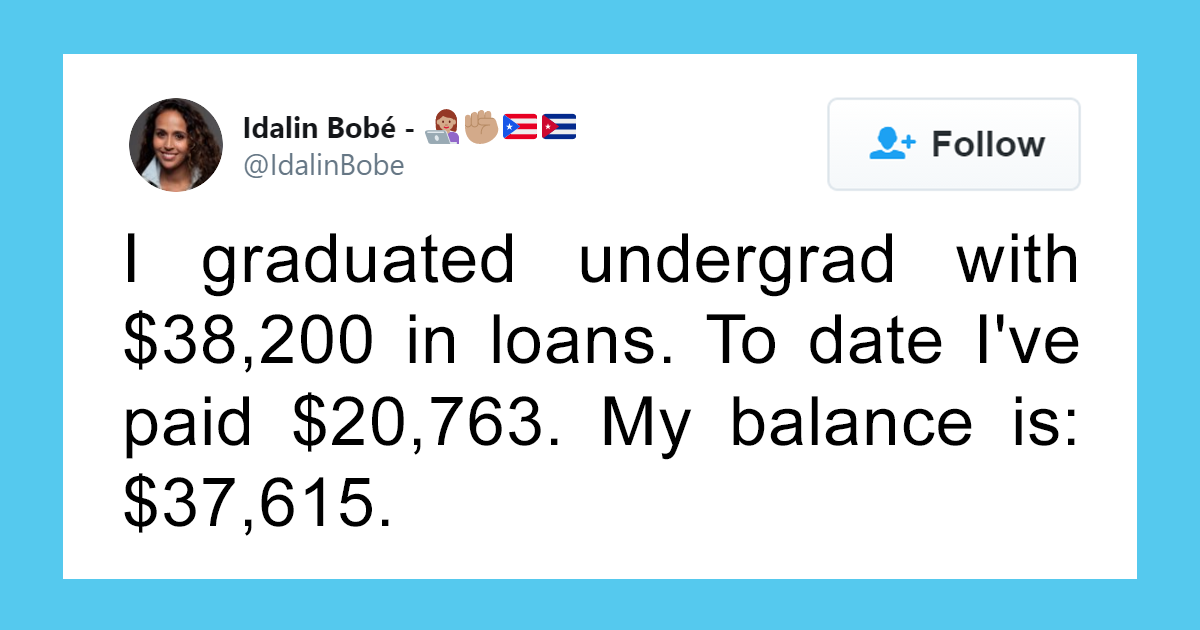
1. “I paid for five years and owe more than I borrowed.”
This is one of the most common and most rage-inducing student debt posts. Borrowers make payments, do the adulting thing, skip vacations, and still watch the balance grow because interest quietly eats the progress. It feels like trying to mop the floor while the sink is still running.
2. “My student loan payment is higher than my car payment.”
Many borrowers compare student loan bills with car notes, rent, groceries, or insurance. The result is usually depressing math. A degree was supposed to increase stability, but for some people the monthly payment competes with basic necessities.
3. “I cannot qualify for a mortgage because of my debt-to-income ratio.”
Student loans can delay homeownership by making borrowers look riskier on paper. Even people with steady jobs may struggle to qualify for a mortgage because their monthly obligations are already too high. The American dream apparently comes with underwriting footnotes.
4. “I chose the higher-paying job over the meaningful one.”
Debt can influence career choices. A graduate who wanted to teach, work in public service, join a nonprofit, or start a small business may choose a higher-paying role simply to keep up with payments. That is not freedom; that is a loan balance doing career counseling.
5. “I moved back in with my parents after college.”
For many young adults, moving home is not a failure. It is survival math. Rent, food, transportation, phone bills, and student loan payments can make independent living unrealistic, especially in expensive cities.
6. “My parents co-signed, and now they are stuck too.”
Private student loans can pull families into shared financial risk. A missed payment may affect a parent’s credit. A borrower’s crisis becomes a household crisis, which is exactly the kind of family bonding nobody requests.
7. “I did not finish my degree, but I still have the loans.”
This may be the harshest category. Borrowers who leave school without graduating often carry debt without the full earning benefit of a completed credential. They get the bill without the career boost. It is like buying concert tickets and only receiving the parking fee.
8. “My servicer gave me different answers every time I called.”
Borrowers frequently describe confusion around payment plans, forgiveness rules, recertification, and processing delays. When the system is hard to understand, a single wrong answer can cost money, time, and trust.
9. “I stayed in a job I hated for Public Service Loan Forgiveness.”
Public service forgiveness can be valuable, but it also affects life choices. Some borrowers remain in qualifying jobs because leaving could disrupt their path to relief. Golden handcuffs are still handcuffs, even if they come with a government form.
10. “My balance went into default before I understood my options.”
Default is not just a scary word. It can damage credit, trigger collection costs, and make future financial moves harder. Many borrowers fall behind not because they are irresponsible, but because the repayment system is difficult to navigate during real-life emergencies.
11. “I have a master’s degree and still live paycheck to paycheck.”
Advanced degrees can lead to better earnings, but they can also mean larger balances. Some graduates discover that a higher credential does not automatically protect them from high housing costs, inflation, underemployment, or low starting salaries.
12. “I delayed having kids because of student loans.”
Family planning is deeply personal, but money matters. Borrowers often say student debt delayed marriage, children, or childcare decisions. A loan statement should not be invited into family planning conversations, yet there it is, sitting at the table with a calculator.
13. “I cannot save for retirement.”
Every dollar going to past education is a dollar not going to future security. This is especially concerning for borrowers in their 30s, 40s, 50s, and beyond. Student debt is not only a young adult issue; it follows people into middle age and even retirement years.
14. “My credit score dropped after repayment restarted.”
When delinquent loans are reported to credit bureaus, borrowers can see real damage. A lower credit score can increase the cost of borrowing, affect housing applications, and make life more expensive in ways that pile onto the original problem.
15. “I skipped medical appointments to make payments.”
When student loans compete with healthcare, the system has officially entered villain territory. Borrowers may delay dental care, therapy, prescriptions, or preventive care because the monthly budget has no slack.
16. “My payment plan changed, and I do not know what happens next.”
Policy changes, court rulings, and repayment plan revisions can leave borrowers confused. Even when changes are meant to simplify the system, the transition can feel chaotic for people who just want one clear answer and maybe a website that does not require emotional support.
17. “I borrowed because everyone said college was the only way.”
For decades, students heard that college was the safest path upward. That message was not completely wrong, but it often ignored price, completion risk, local job markets, school quality, and whether a teenager should be expected to understand compound interest.
18. “I feel punished for being first-generation.”
First-generation students often have less family experience navigating financial aid, choosing institutions, comparing loan types, and evaluating long-term debt. They may also have fewer family resources to absorb mistakes. The result is a system that rewards insider knowledge.
19. “My degree helped me earn more, but the debt swallowed the raise.”
A better salary does not always translate into a better life if student loan payments, rent, taxes, insurance, and childcare rise at the same time. Some borrowers feel like their diploma increased income on paper while the loan system confiscated the upgrade.
20. “I cannot afford to go back to school, but I need more training.”
Some workers need additional credentials to advance, switch careers, or remain competitive. But existing student debt can make further education feel impossible. The ladder is there, but it is covered in invoices.
21. “My loan was transferred, and everything got messy.”
Borrowers often report frustration when loans move between servicers. Payment histories, account details, and forgiveness counts can become confusing. Even when records are correct, the borrower may spend hours proving what should already be obvious.
22. “I am scared to open my loan account.”
Debt avoidance is real. When balances feel overwhelming, people may stop checking. That fear can make problems worse, but it is understandable. Nobody enjoys logging into a website that looks like a ransom note written by interest.
23. “My private loan has fewer protections.”
Private student loans often lack the same income-driven repayment options, forgiveness paths, and flexible protections available for federal loans. Borrowers may discover this only after hardship hits.
24. “I pay, but I cannot build wealth.”
Student debt affects more than monthly cash flow. It can slow savings, emergency funds, investments, homeownership, and business formation. Wealth is built over time, and student debt often steals the early years when compounding could matter most.
25. “My loan balance affects my relationships.”
Debt can add tension to dating, marriage, and family life. Couples may delay plans or argue over budgets. Nobody dreams of whispering, “What is your income-driven repayment status?” over a romantic dinner.
26. “I owe money for a school that did not deliver.”
Some borrowers attended programs that promised career outcomes but offered poor value. When schools close, mislead students, or fail to provide meaningful credentials, borrowers can be left with debt and disappointment.
27. “I am a public servant and still drowning.”
Teachers, nurses, social workers, government employees, and nonprofit workers often serve communities while struggling with their own debt. Public service should not require private financial panic.
28. “I cannot help my own kids because I am still paying for my degree.”
Student debt can become intergenerational. Parents who are still repaying their loans may be unable to save for their children’s education, increasing the chance that the next generation borrows too.
29. “The system is so confusing that I paid for advice.”
Borrowers sometimes pay consultants or third-party companies simply to understand repayment options. A public loan system should be navigable without hiring a translator fluent in bureaucracy.
30. “I did everything right and still feel stuck.”
This is the post that sums up the whole crisis. Many borrowers worked, graduated, paid, called, recertified, budgeted, and sacrificed. Yet they still feel trapped by balances that barely move. That is why student debt is not just a financial issue. It is a trust issue.
What These Posts Reveal About The Student Debt System
The 30 posts above point to a bigger reality: student debt is not one problem. It is a stack of problems wearing one trench coat. There is the cost problem, where college prices and living expenses force students to borrow. There is the information problem, where young people make huge financial decisions before they have the tools to evaluate them. There is the servicing problem, where borrowers depend on accurate guidance from companies and systems that have repeatedly drawn complaints. There is the labor market problem, where wages do not always match the cost of credentials. And there is the fairness problem, where first-generation students, Black borrowers, lower-income families, and borrowers without family wealth often carry heavier risks.
One major reason student debt feels so brutal is that it turns education into a long-term financial bet. If the borrower graduates, finds stable employment, avoids major emergencies, and enters a solid repayment plan, the bet may pay off. But if any part goes wrongschool closure, illness, job loss, confusing paperwork, family crisisthe borrower can face years of consequences.
Supporters of the current system often argue that borrowers agreed to the terms. Technically, yes. But the average 18-year-old signing loan documents is not usually thinking about retirement savings, mortgage underwriting, income-driven repayment recertification, or how interest capitalization might behave like a raccoon in a pantry. A signature is not the same as informed power.
Why Student Debt Hits Some Borrowers Harder
Student loan debt does not land evenly. Borrowers from wealthy families may borrow less, receive help during repayment, or avoid loans entirely. Borrowers from low-wealth families often have fewer cushions. One missed paycheck can turn into delinquency. One confusing notice can become a credit problem. One semester short of graduation can become years of payments without the degree.
First-generation college students can face additional barriers because they may not have family members who understand financial aid forms, school selection, or repayment plans. Black borrowers and other borrowers of color also face broader wealth gaps that can make repayment harder. When families have less inherited wealth, students may need to borrow more, and graduates may have less backup when life becomes expensive.
This is where student debt becomes more than an individual finance issue. It becomes a structural problem. The system can amplify existing inequality by asking people with the least family wealth to take the biggest educational risks.
The Emotional Cost Of Always Owing
The emotional side of student debt is harder to measure but easy to recognize. Borrowers describe embarrassment, frustration, anxiety, resentment, and exhaustion. They may feel guilty for borrowing, angry at rising costs, confused by policy changes, or ashamed that a degree did not produce instant stability.
That shame is misplaced. A borrower struggling with student loans is not automatically irresponsible. In many cases, they are responding to a system that made borrowing feel necessary, repayment confusing, and relief difficult to access. Personal responsibility matters, but so does system design. If millions of people keep hitting the same wall, maybe the wall deserves a performance review.
What Would A Better System Look Like?
A better student debt system would start before the loan is signed. Students need clear, plain-language comparisons of program costs, completion rates, expected earnings, borrowing limits, and repayment scenarios. Financial aid letters should not read like puzzle boxes. Schools should be accountable for outcomes, especially when programs leave students with debt but weak career value.
Repayment should also be simpler. Borrowers should not have to become amateur policy analysts to choose a plan. Monthly payments should be affordable, interest should not endlessly punish people making good-faith payments, and loan servicers should be held to high standards for accuracy and customer support.
Finally, relief programs should work as promised. If public servants qualify for forgiveness after years of payments, the system should track that progress clearly. If borrowers are eligible for income-driven repayment, they should not spend months waiting in limbo. If a school misled students, debt relief should not require a heroic paperwork quest.
Experience Section: What Living With Student Debt Actually Feels Like
Living with student debt is often less dramatic than people imagine, which is exactly why it becomes so heavy. It is not always one giant crisis. Sometimes it is a thousand tiny compromises. It is ordering water instead of a drink because your loan payment came out yesterday. It is keeping your old laptop alive with hope, tape, and suspicious fan noises because replacing it would wreck the budget. It is celebrating a raise and then realizing the extra income may change your repayment calculation. Congratulations, your reward is paperwork.
For many borrowers, student loans become part of the background noise of adulthood. They check apartments with the loan payment already subtracted in their head. They compare job offers not only by passion or growth, but by whether the salary can survive rent, groceries, insurance, transportation, and the monthly student loan bill. They watch friends without debt save for houses, take career risks, or start businesses sooner. The comparison is not always jealousy. Sometimes it is grief for a timeline that feels delayed.
There is also the strange social pressure around student debt. Borrowers may feel they cannot complain because college is still considered a privilege. And yes, education is valuable. But value does not erase burden. A person can be grateful for their education and still angry that the financing system feels like it was assembled by a committee of confused calculators.
Student debt also changes how people think about the future. Instead of asking, “What kind of life do I want?” they ask, “What can I afford after the payment clears?” Vacations become rare. Emergency funds grow slowly. Retirement contributions get postponed. Weddings get smaller. Medical appointments get delayed. Career dreams get negotiated down into whatever keeps the account current.
One of the most frustrating experiences borrowers describe is the feeling of invisibility. The system sees balances, interest rates, due dates, and account numbers. It does not see the teacher buying classroom supplies, the nurse working night shifts, the parent paying both childcare and loans, or the first-generation graduate trying to help younger siblings avoid the same mistakes. Behind every loan is a life, and behind every life is a set of choices shaped by pressure.
The most alarming thing about these student debt posts is not that they are shocking. It is that they are familiar. Millions of people read them and think, “That sounds like me.” That familiarity should bother us. A higher education system should help people build lives, not leave them feeling like they signed a decades-long subscription to financial stress with no unsubscribe button.
Conclusion
The student debt system affects people’s lives in ways that are practical, emotional, and generational. It delays homeownership, redirects careers, strains families, damages credit, and turns the promise of education into a long repayment journey. The 30 alarming posts above capture what statistics alone cannot: the daily frustration of borrowers trying to move forward while dragging a financial anchor behind them.
Student loans may be normal in America, but normal does not automatically mean healthy. A better system would make college prices clearer, borrowing safer, repayment simpler, and relief programs more reliable. Until then, borrowers will keep posting their stories onlinenot because they enjoy public budgeting sadness, but because they want someone to admit that the system is not working the way it should.














