
Growing up does not necessarily mean becoming mature. Sometimes it simply means gaining a salary, a driver’s license, and enough graphic-design knowledge to replace the family portrait with Obi-Wan Kenobi.
Adult children occupy a uniquely dangerous position in the family ecosystem. They know where their parents keep the spare key, which decorations are considered sacred, what Dad says every time somebody asks for the time, and exactly how long Mom can stare at a suspicious photograph before realizing something is terribly, hilariously wrong.
The funniest pranks on parents are rarely the loudest or most expensive. They are personal, reversible, and just believable enough to survive the first inspection. A fake emergency may create panic, but a mysteriously altered photo frame can quietly produce comedy for three months. That is professional-level patience with absolutely no practical benefit, which is precisely why we respect it.
From stealthy home-decor changes to gloriously inappropriate greeting cards, these 50 examples prove that becoming an adult does not end the parent-child comedy routine. It merely gives the child a larger budget.
Why Adults Still Love Pranking Their Parents
Family humor operates on familiarity. An adult child knows which joke will earn an eye roll, which one will make a parent laugh until they wheeze, and which one might result in being removed from the will. This knowledge allows for highly customized mischief.
Shared laughter can also reinforce closeness. A good family prank creates a brief moment of confusion followed by relief and recognition. Everyone realizes that no real harm occurred, the target joins the laughter, and the story becomes permanent family folklore.
The key word is shared. Laughing with a parent can strengthen a relationship. Laughing at a frightened, embarrassed, or genuinely distressed parent is something else entirely. The best pranksters understand that distinction before touching the Photoshop toolbar.
50 Epic Pranks Adults Played on Their Parents
Photo Frames, Portraits, and Decorative Infiltration
- The Obi-Wan replacement: One adult child swapped a traditional portrait in the parents’ home for Ewan McGregor as Obi-Wan Kenobi. Months passed without detection. Either the disguise was flawless or the parents had quietly accepted Jedi Jesus.
- The mystery family member: A stranger’s face was inserted into a framed family photograph, then left in plain sight to see how long the household would tolerate its newest relative.
- The empty-frame opportunity: When parents left a photo frame unused for too long, their child filled it with an image that was technically a photograph but spiritually an act of vandalism.
- The hidden-dad campaign: Tiny pictures of Dad were placed throughout the house, turning cabinets, shelves, and storage spaces into a low-budget surveillance network.
- The awkward family card: One prankster digitally portrayed every member of an uncomfortable family portrait. Every face belonged to the same person, including the deeply disappointed father.
- The digital-frame ambush: A mother-in-law who checked her digital photo frame every morning received a surprise image that made the device feel considerably less wholesome.
- The reunion Photoshop: The person taking the family reunion photo edited themselves into the final picture with all the subtlety of a floating cardboard cutout.
- The celebrity takeover: Every family photo was temporarily replaced with pictures of a television personality. The family took hours to notice that they had apparently been adopted by Steve Harvey.
- The childhood-photo recreation: Adult siblings recreated an old family photograph, preserving the poses while completely ignoring the fact that they were now several feet taller.
- The extra childhood memory: Dad requested old photos of his children, so the family included one fabricated image that suggested a deeply confusing chapter of their upbringing.
Gifts That Were Not What Parents Expected
- The ceiling-tile souvenir: After Dad accidentally fell through a ceiling, the damaged tile was transformed into a framed Christmas present. Home repairs are temporary; family mockery is forever.
- The misleading television package: Parents received a new TV hidden inside packaging that suggested a much less exciting gift. Emotional whiplash became part of the unboxing experience.
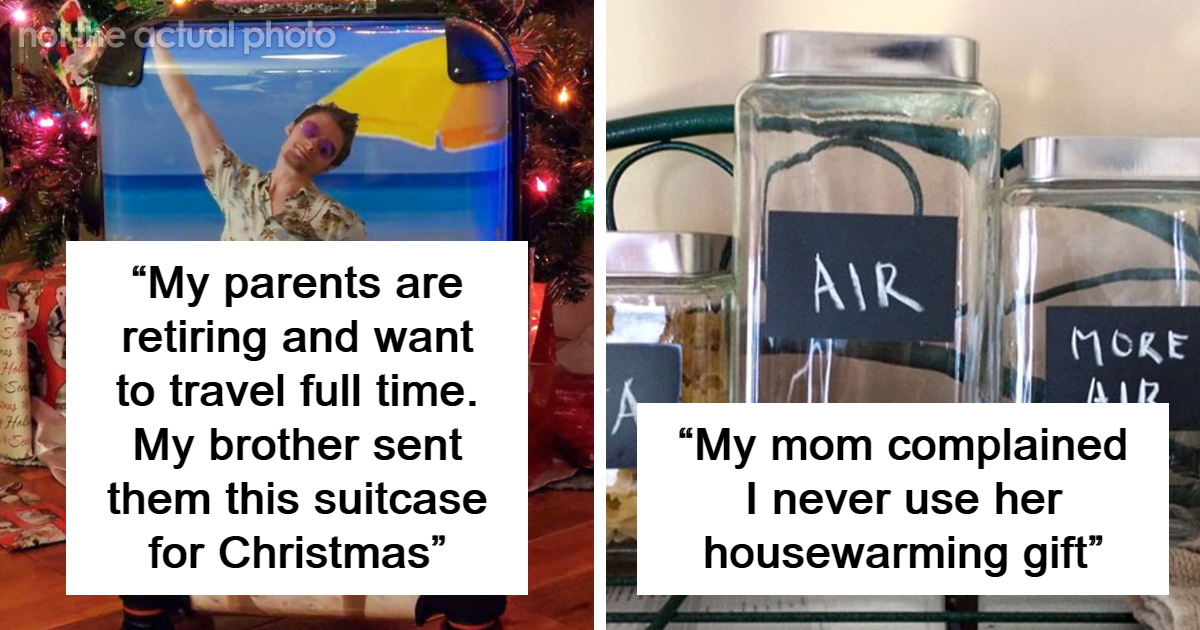
- The retirement suitcase: Parents planning full-time travel received luggage customized with an image so embarrassing that airport baggage claim would become a public performance.
- The divorce-survival gift: A recently divorced mom received a present designed to celebrate her return to independence with the gentle subtlety of a marching band.
- The tomato birthday cake: Dad insisted that he did not want cake but loved tomatoes, so his children built him a tomato-based birthday centerpiece. Technically, every instruction was followed.
- The dish-sponge cake: A father who complained about washing dishes received a realistic sponge-shaped cake for Father’s Day. Fortunately, it contained cake rather than industrial detergent.
- The suspicious housewarming gift: After Mom complained that her gift was never used, her adult child staged a photograph demonstrating an extremely imaginative alternative purpose.
- The bouquet Dad always wanted: A Father’s Day arrangement replaced ordinary flowers with snacks, tools, or other dad-approved objects. Roses are romantic; beef jerky is useful.
- The outrageous apron: Grandma opened a seemingly innocent birthday gift and discovered that the apron carried a message considerably less innocent than expected.
- The personalized clock: A father who always answered time-related questions with the same predictable joke received a clock permanently dedicated to that joke.
Technology Gave the Children Too Much Power
- The remote printer scare: Dad’s new printer could receive documents by email, allowing his child to make mysterious messages appear without warning. Suddenly, office equipment had become haunted.
- The fake house disaster: While house-sitting, an adult child sent the parents an edited photo suggesting that something catastrophic had happened to the property.
- The second fake house disaster: Another child was told to watch the family home and responded with photographic “evidence” that the assignment was going very badly.
- The television upgrade: Mom’s entertainment system was carefully configured with confusing labels, joke settings, or a personalized interface that only the installer found intuitive.
- The wastewater Christmas portrait: Parents requested a professional photo for their holiday card. Their child, who worked in wastewater treatment, chose a location reflecting the family business with troubling honesty.
- The traveling cardboard child: A student living abroad sent Mom a life-size cutout. Mom then photographed the cardboard version attending dinners, celebrations, and household activities.
- The suspicious vacation update: A worried parent received a carefully staged travel photo designed to confirm every fear they had expressed before the trip.
- The deliberately terrible senior photos: One sibling offered to save the family money by photographing another sibling’s senior portraits. The results explained why professionals charge money.
- The sports-rivalry makeover: After Dad’s favorite team lost, the house was decorated in the winning team’s colors before he woke up.
- The edited trophy photograph: Tired of Dad posing proudly with hunting trophies, an adult child created a ridiculous alternative trophy shot and presented it as serious competition.
Holiday Mischief and Greeting-Card Crimes
- The brutally honest Mother’s Day card: Instead of sentimental poetry, Mom received a card congratulating her on raising a child capable of purchasing a card.
- The heartfelt Father’s Day message: Dad opened a touching card whose emotional opening led directly to an insulting punchline.
- The age-candle improvisation: When the correct birthday numbers were unavailable, the family used creative arithmetic to display Dad’s age. Mathematics has never looked so disrespectful.
- The 69th-birthday masterpiece: A strategically selected card ensured that Dad’s milestone birthday would not pass with maturity or dignity.
- The last Mother’s Day signature: One sibling waited until everyone else had signed the card, then added a message designed to claim favorite-child status.
- The Thanksgiving outfit: Mom requested something nice for dinner. Her adult child arrived dressed as a Thanksgiving food item, interpreting “nice” through an aggressively seasonal lens.
- The questionable centerpiece: A child trusted with Thanksgiving decorations produced a table display that was memorable, technically festive, and unlikely to be requested again.
- The improper Christmas tree: After Mom complained that the family never decorated correctly, the children gave the tree a theme she could not possibly ignore.
- The stocking-hanger rearrangement: Holiday letters were repeatedly reordered into mischievous words whenever Mom looked away.
- The adult remake of a childhood pose: Grown siblings squeezed into old outfits and positions for a Mother’s Day photo that was equal parts affectionate and alarming.
Long-Game Pranks That Required Unreasonable Commitment
- The 17-year ceramic-pig battle: A child repeatedly arranged Mom’s decorative pigs in naughty poses. Mom silently restored them. Neither participant acknowledged the conflict for nearly two decades.
- The unnoticed decor change: A tiny alteration was introduced into the parents’ home and monitored for weeks, proving that people stop examining decorations shortly after buying them.
- The fake formal photograph: A ridiculous image replaced a respectable family portrait, creating an ongoing contest between the prankster’s patience and Mom’s powers of observation.
- The escalating family tradition: What began as one altered card or photograph returned each holiday with greater complexity and worse taste.
- The endlessly relocated object: A figurine was moved to a new location during every visit, slowly convincing the parents that either someone was joking or the house was alive.
- The hidden miniature faces: Dozens of tiny celebrity or family photographs were concealed around the home, transforming ordinary cleaning into a scavenger hunt.
- The wall-quote remix: Decorative letters were rearranged to give an inspirational family message a surprisingly hostile new meaning.
- The silent household conspiracy: Several siblings cooperated on an environmental prank while acting completely normal whenever a parent entered the room.
- The absurd airport sign: Mom arrived expecting a warm welcome and instead found her adult child holding a sign announcing an embarrassing fictional identity.
- The prank nobody noticed: The ultimate long game involved changing something obvious, waiting months, and gradually wondering whether the prank had failed or the parents simply did not care.
What Separates a Great Prank From a Cruel One?
A successful prank creates what humor researchers often describe as a harmless violation. Something appears wrong, strange, or socially inappropriate, but the target quickly realizes that the situation is safe.
Replacing a picture, rearranging decorations, or giving Dad a sponge-shaped cake can produce surprise without creating lasting damage. Faking a medical crisis, destroying property, exploiting a phobia, interfering with medication, or convincing someone that a loved one has died does not belong in the same category.
Use the Five-Minute Recovery Test
Ask whether the target will be physically safe, emotionally settled, and able to resume the day normally within five minutes of the reveal. If the answer is no, the prank needs revision.
Never Make the Audience More Important Than the Target
Social media rewards large reactions, but a parent is not unpaid content. Recording someone secretly and publishing the footage can turn private family humor into public humiliation. Obtain permission before sharing identifiable photos or videos.
Know the Person, Not Just the Punchline
A startling joke may amuse one parent and seriously distress another. Age, health, previous trauma, mobility, hearing, and comfort with surprises all matter. The prank should be tailored to the person receiving it, not copied blindly from a viral video.
Be Prepared to Apologize Without Defending Yourself
Good intentions do not automatically create a good experience. When a prank lands badly, skip the phrase “You are too sensitive.” Restore what was changed, apologize, and accept that the target determines whether the joke was enjoyable.
Experiences and Lessons From Family Pranking
The most memorable prank experiences usually begin with a tiny observation. Perhaps Mom walks past the same framed photograph every morning without looking closely. Maybe Dad repeats one joke so often that the family can predict the punchline before he opens his mouth. These habits provide the perfect raw material because they are familiar, affectionate, and specific to the household.
Consider the portrait-switching prank. The physical work might take ten minutes: print a photograph, trim it, and slide it into an existing frame. The real experience unfolds afterward. Every family visit becomes an inspection. Has anyone noticed? Did Dad glance at it? Did Mom dust the frame without recognizing that a famous actor is now posing as a spiritual figure? The waiting becomes funnier than the initial act.
Long-running pranks also reveal how families communicate without speaking. The 17-year battle involving rearranged ceramic pigs is funny because both participants clearly understand the game. The child moves them. The mother restores them. Neither announces victory. Their silent ritual functions like an inside joke expressed through home decor.
Gift pranks create a different experience because they combine suspense with affection. A television disguised as a disappointing package or a cake designed to resemble a cleaning sponge initially disrupts expectations. Once the truth is revealed, the parent still receives something thoughtful. The prank adds a story to the gift rather than replacing the gift with disappointment.
Photo recreations are especially effective because they mix comedy with nostalgia. Adult siblings repeating childhood poses may look ridiculous, but the final image also shows the passage of time. Parents can laugh at the tight clothing, exaggerated expressions, and collapsing furniture while recognizing the same relationships captured decades earlier. The joke works because genuine sentiment is hiding underneath it.
Technology-based pranks require greater caution. Remote printers, digital frames, image editors, and smart televisions make it easy to create believable surprises. They also make it easier to cross boundaries. A strange document appearing from a printer can be funny; a fake bank warning or medical notice can cause genuine fear. An edited house photo can work when the destruction is obviously absurd, but a realistic image of fire or burglary may send parents racing home or calling emergency services.
Many adults who prank their parents eventually discover that retaliation is inevitable. Parents possess decades of embarrassing photographs, childhood stories, and personal knowledge. They remember the haircut from seventh grade. They know the nickname you hoped had died in 2009. They may appear slow to notice the modified portrait, but they are gathering evidence.
That possibility of revenge keeps the relationship balanced. Pranks are most enjoyable when everyone can participate, refuse, or strike back. A playful family culture does not assign one permanent victim. It creates a rotating cast of volunteers who understand that today’s prankster may become tomorrow’s airport-sign recipient.
Ultimately, these experiences are less about fooling parents than showing that the relationship still contains play. Adult life often reduces family conversations to work updates, bills, health appointments, and travel logistics. A harmless prank interrupts that routine. It says, in an unusually inconvenient language, “I know you well, I was thinking about you, and I believed we could laugh together.”
Conclusion
The best adult-child pranks do not require fake disasters, destroyed kitchens, or a production budget. They need familiarity, restraint, creativity, and a parent who will eventually appreciate the joke.
A swapped portrait can outlive an expensive stunt. A ridiculous birthday card can become family legend. A ceramic-pig feud can continue for 17 years without either side admitting that a competition exists. These jokes succeed because they are personal and reversible, and because affection remains visible beneath the mischief.
So proceed carefully. Change the photograph, customize the cake, or rearrange the holiday decorations. Just remember that your parents raised you, know all your weaknesses, and probably still have access to your baby pictures. Revenge is not merely possible. It is already organized in an album.
Note: Keep practical jokes safe, reversible, private, and appropriate for the target. Avoid fabricated emergencies, health or pregnancy announcements, property damage, dangerous scares, financial deception, and public sharing without consent.














