
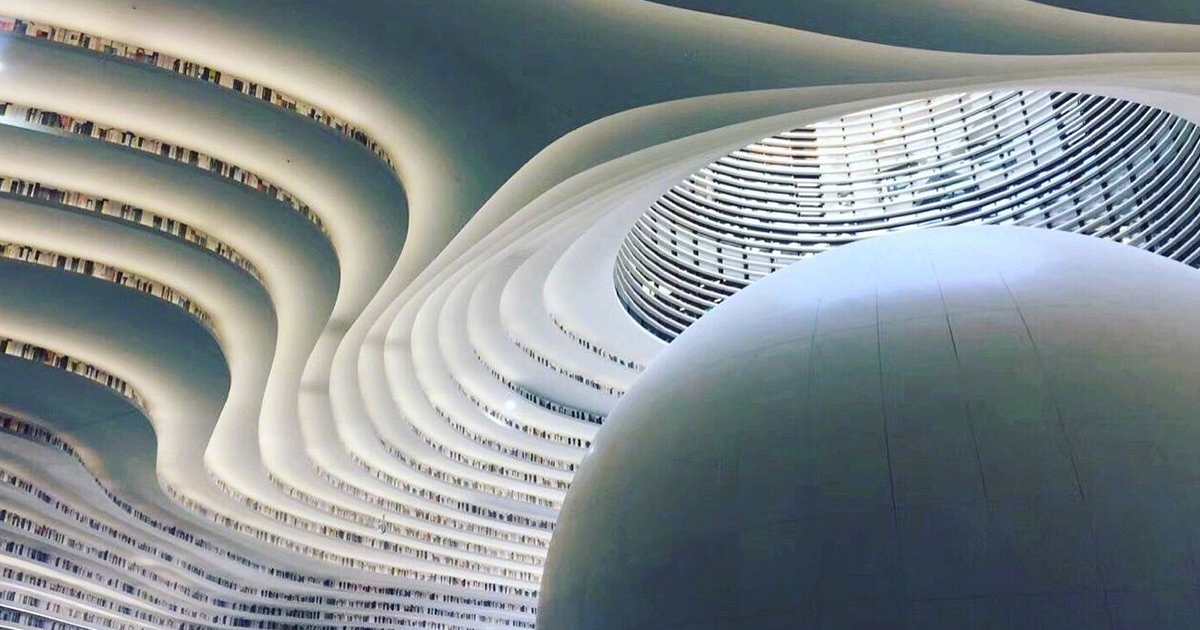
Some buildings politely ask for your attention. The Tianjin Binhai Library kicks the door open, strikes a pose, and says, “Look at me, I am architecture now.” Located in Tianjin, China, this futuristic cultural landmark became instantly famous for its glowing white interior, rolling terraced shelves, and giant spherical centerpiece that looks like a sci-fi moon landed in the middle of a reading room. It is dramatic, a little surreal, wildly photogenic, and somehow still about books.
That combination is exactly why people around the world fell for it. The library was designed by Dutch firm MVRDV in collaboration with the Tianjin Urban Planning and Design Institute, and it was built as part of a larger cultural district meant to give the city a bold public identity. On paper, it offers shelf capacity for roughly 1.2 million books. In photos, it looks like the kind of place where even your to-do list would suddenly seem literary.
But the real story is even more interesting than the viral images. The Tianjin Binhai Library is not just a beautiful room with shelves that curl like ocean waves. It is a case study in how architecture can turn a library into a destination, how design can pull people back toward physical public spaces, and how one breathtaking interior can spark both admiration and debate at the same time.
The Library That Looks Like It Was Beamed Down From the Future
The first thing people notice is the enormous glowing sphere at the center of the atrium. This orb contains an auditorium and gives the library its nickname: The Eye. From many angles, the terraced shelves curve toward it like ripples around a pupil, creating the unmistakable illusion that visitors are standing inside a giant eye made of books, light, and pure ambition.
That visual trick is not accidental. The library was designed to feel fluid rather than boxy. Instead of relying on stiff rows and predictable corridors, the shelves sweep upward and outward, blending reading, seating, stair-like movement, and visual drama into one continuous landscape. The result feels less like a traditional library and more like a topography of knowledge. Yes, that phrase sounds dramatic, but so does the room, so everybody wins.
The building spans five levels and includes reading rooms, lounge areas, meeting spaces, offices, computer rooms, audio rooms, and rooftop patios. In other words, it is not only an architectural stunt. It is a multi-use public building designed to support learning, gathering, browsing, and lingering. It also functions as a connector within the larger cultural district, linking the nearby park and surrounding institutions into a more cohesive civic destination.
That matters because the Tianjin Binhai Library was never meant to be just a pretty shell. It was part of a broader effort to strengthen Tianjin’s cultural profile and create a public space people would actually want to visit. Judging by the crowds and the endless stream of photos, that mission worked with almost suspicious efficiency.
Why the Interior Feels So Unforgettable
Plenty of libraries are beautiful. This one is memorable because it manipulates scale, light, and repetition in a way that almost overwhelms the senses. The shelves are not merely storage units; they are the architecture. They shape the walls, define the contours of the room, and even appear to spill onto the ceiling. The white palette amplifies the effect, bouncing light across the space so the whole interior seems to glow from within.
There is also a cathedral-like quality to the space. Not in the stained-glass, hush-your-voice sense, but in the emotional one. You walk in and instinctively look up. The room creates awe by stretching the eye vertically and wrapping it in repetition. Shelf after shelf, curve after curve, line after line. It is visual rhythm turned into architecture.
That is one reason the library became such a sensation online. Even people who had never heard of Tianjin suddenly recognized the building from a single image. In a digital culture crowded with forgettable spaces, the Tianjin Binhai Library did the architectural equivalent of showing up in a silver suit at a black-tie dinner. It stood out immediately.
Still, the building is more than an Instagram darling. Its design makes a broader point about what public libraries can be in the 21st century. They are no longer just storage systems for print collections. They are community anchors, cultural stages, study zones, social spaces, and symbols of civic identity. The Tianjin Binhai Library understands that modern libraries must compete with screens, convenience, and shrinking attention spans. So it does the obvious thing: it becomes impossible to ignore.
The 1.2 Million-Book Claim: Gorgeous, Complicated, and Worth Explaining
Now for the plot twist, because every iconic building needs one.
The library was widely described as having capacity for 1.2 million books, and that number helped fuel its reputation. But the viral photos also triggered a wave of scrutiny. Observers soon noticed that many of the highest shelves in the atrium were not actually stocked with accessible books. Instead, some of those upper areas were filled with printed aluminum panels designed to look like book spines.
That revelation led to a predictable internet reaction: admiration, confusion, disappointment, hot takes, more admiration, and approximately 4.7 million variations of “Wait, are those books fake?”
Here is the more useful interpretation. The fake-book issue did not mean the library was fake. It meant the building’s fast-track construction altered part of the original concept. According to project explanations and later reporting, access to the upper shelves behind the atrium was dropped during the rushed delivery process, leaving the highest tiers visually complete but functionally limited. The accessible collections and reading spaces still exist elsewhere in the building, and the library remains an active public institution.
In fact, the controversy reveals something important about contemporary design culture. We often want public buildings to do two jobs at once: be highly functional and also visually extraordinary. When a project leans heavily toward spectacle, critics understandably ask hard questions. But when a project attracts huge public interest and gets people talking about libraries again, supporters argue that the spectacle itself has value.
The Tianjin Binhai Library sits right at that intersection. It is both a real civic space and a symbol. Both a library and a statement. Both a place to read and a place that reminds cities what public architecture can still do when it stops being shy.
Why This Library Matters in the Age of Phones, E-Books, and Doomscrolling
One of the most interesting things about the Tianjin Binhai Library is the timing. It opened in an era when people constantly predict the decline of physical books, the decline of public attention, and the decline of just about everything that is not being delivered by algorithm. Yet this library became popular precisely because it made the physical experience feel irresistible.
That is not a small achievement. Public libraries everywhere are rethinking how to stay relevant. Quiet stacks alone are no longer enough. People want flexibility, visual appeal, digital tools, community programming, and places that feel alive. The Tianjin Binhai Library may be more theatrical than most, but it expresses a global truth: if you want people to show up in person, give them a place worth showing up for.
And it worked. Reports noted massive visitor interest around the opening, and later coverage continued to describe the library as one of Tianjin’s biggest attractions. That popularity says something powerful about human behavior. For all our love of convenience, we still crave physical places that surprise us. We still respond to rooms that make us feel small in a good way. We still like being around other people who are also looking up and whispering, “Okay, wow.”
Libraries have always been about access to knowledge, but they are also about atmosphere. The smell of paper. The hush before concentration. The sense that thought matters here. Tianjin Binhai pushes that atmosphere into the realm of spectacle, but the core instinct is ancient: people learn better, linger longer, and care more deeply in places that make meaning visible.
A New Kind of Cultural Landmark for Tianjin
The library’s impact is not limited to architecture fans. It has helped define Tianjin’s identity for international audiences. For many travelers and online readers, the building became a shorthand introduction to the city itself: modern, ambitious, culturally invested, and unafraid of scale.
That branding effect matters more than it may seem. Cities increasingly compete through images as much as infrastructure. A single landmark can reshape how a place is imagined around the world. The Eiffel Tower did it. The Sydney Opera House did it. The Seattle Central Library did it in a different, nerdier, excellent way. Tianjin Binhai Library belongs in that conversation as a contemporary landmark that turned civic architecture into global visual currency.
It also proves that libraries can still be central to urban imagination. For decades, flashy investment often flowed toward stadiums, malls, and towers, while libraries were expected to be worthy but modest. Tianjin flipped that formula. It treated a public library not as a background utility, but as a headline attraction. That choice sends a surprisingly hopeful message: books, learning, and public culture are still worthy of architectural drama.
Of course, not every city needs a giant glowing eyeball at the center of its reading room. Some towns just need better lighting and chairs that do not squeak like haunted accordions. But the lesson remains useful. Design influences participation. Beautiful public space invites public life. And when cities invest boldly in places of knowledge, people notice.
What It Feels Like to Experience Tianjin Binhai Library in Person
Photos of the Tianjin Binhai Library are impressive, but they flatten the experience in one important way: they cannot fully capture what happens when your body enters the space and your eyes start adjusting to the scale of it. The room does not feel like a normal interior. It feels like stepping into a sculpted landscape where books have somehow melted into architecture and architecture has decided to become theater.
You walk through the entrance, and for a second your brain does that little buffering thing. The glowing white surfaces bounce light everywhere. The shelves rise in curves that do not behave the way shelves are supposed to behave. The sphere in the center seems both massive and strangely weightless. People become tiny moving punctuation marks inside a giant visual sentence.
Then the emotional shift kicks in. It is not just “This looks cool.” It is more like, “I should probably speak softer because the room has opinions.” That is the power of good public architecture. It changes your behavior without needing to post a sign.
One of the most striking experiences is movement. As you walk, the view keeps changing. A shelf line that looked flat from one angle suddenly becomes a wave. The Eye appears calm from a distance, then intensely reflective up close. The steps and terraces make the room feel active, almost performative, as if reading, walking, meeting, and looking are all part of one choreographed civic ritual. Even people who are clearly there for the photos end up participating in something larger than tourism. They are inhabiting an idea about culture.
There is also a strange and wonderful tension between intimacy and scale. Libraries are usually personal spaces. You read quietly, think privately, disappear into a page. Tianjin Binhai does not erase that feeling, but it places it inside a grand public frame. You can imagine sitting with a book while surrounded by this huge architectural gesture, as if private thought and public ambition have decided to share the same room.
And yes, there is an undeniable cinematic quality to the place. It feels like the set of a futuristic film where civilization survived because someone remembered to fund libraries. Yet despite the sci-fi energy, the emotional effect is very human. The building invites curiosity. It makes people wander. It encourages lingering. It creates the kind of memory that stays unusually crisp afterward: the white light, the curved shelves, the upward glance, the odd feeling that a library just stole the spotlight from every museum in town.
That is why the Tianjin Binhai Library continues to fascinate people years after its opening. It is not perfect, and the debate over its inaccessible upper shelves is part of its story. But perfection was never really the point. The point is that this place makes people feel something immediate and rare. Wonder. In a library. In public. In an age that too often confuses convenience with experience. That alone makes it unforgettable.
Final Thoughts
The Tianjin Binhai Library became famous because it is visually spectacular, but it remains important because it asks a bigger question: what should a public library be today? The answer, at least in Tianjin, is not modest. It should be useful, social, symbolic, memorable, and bold enough to make the world stop scrolling for a minute.
Yes, the library’s most famous images come with caveats. Yes, some of the shelves that looked infinitely stocked were part illusion. But even that wrinkle has become part of the building’s appeal, because it forces a richer conversation about function, symbolism, civic investment, and the role of design in public life.
In the end, China did not just open a library that looks cool in photos. It opened a building that made millions of people think about libraries again. And in a century full of noise, distraction, and disposable spaces, that is no small thing. A place that can inspire awe, curiosity, debate, and actual desire to visit a library? That deserves a standing ovation, or at the very least, a very respectful whisper.











