
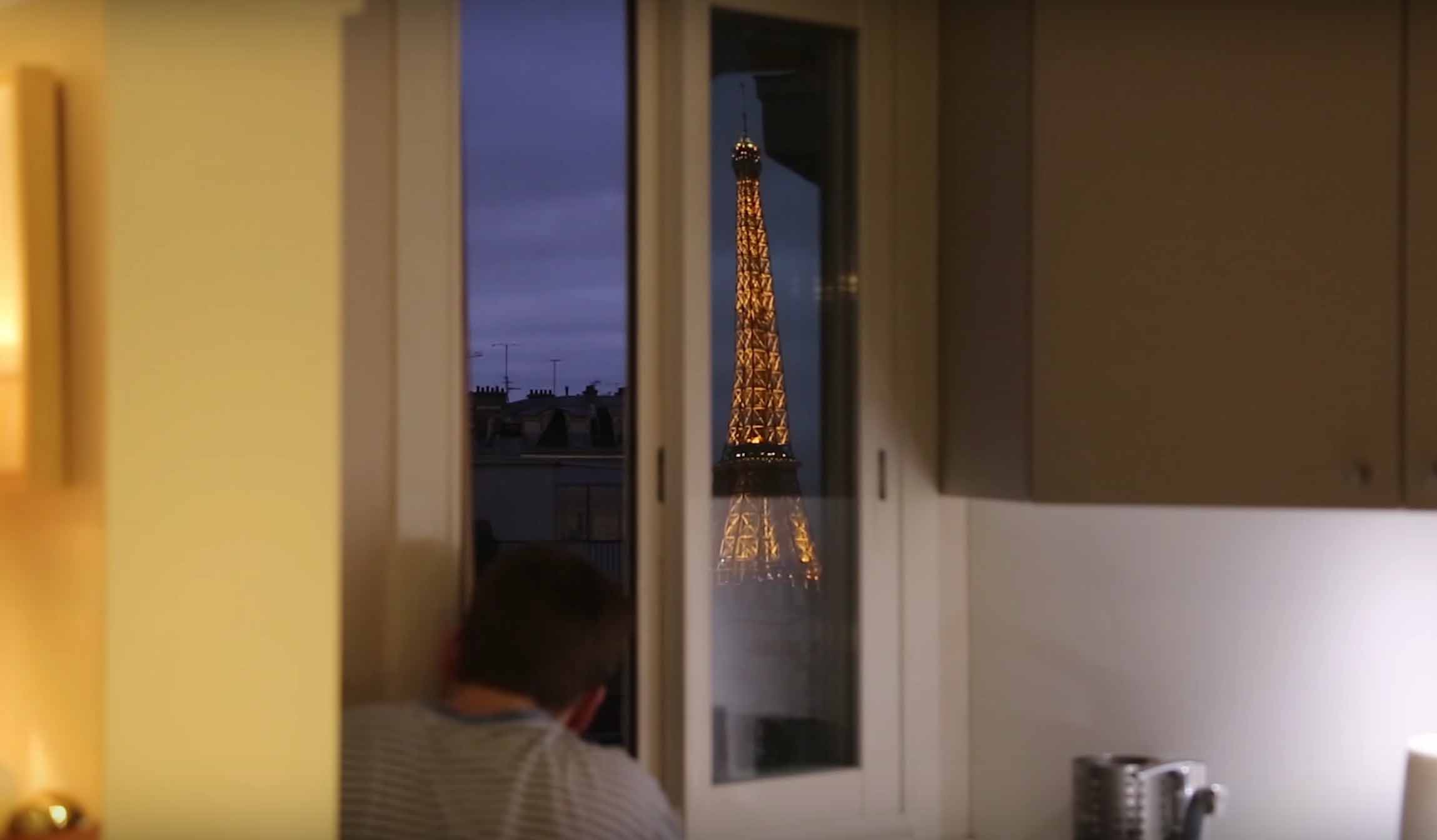
Some people dream of waking up to a direct view of the Eiffel Tower. Others check hotel prices, faint politely, and return to browsing “Paris view wallpaper” on their phones. But every so often, a clever maker looks at an ordinary apartment window, a pair of mirrors, and the most photographed iron tower on Earth and thinks, “What if the room had a better seat?” That is the delightful idea behind a spectacular view of the Eiffel Tower created entirely with mirrors.
The concept sounds like a magic trick, but it is really a compact lesson in optics, design, and urban imagination. By arranging two large mirrors like a horizontal periscope, a distant view of the Eiffel Tower can be bounced from outside a window into the interior of a room. The result is not a fake poster, not a digital screen, and not a suspiciously perfect travel influencer backdrop. It is real light from the real Eiffel Tower, redirected by real mirrors into a real living space. In other words, science dressed up as Parisian romance.
This article explores how the mirror view works, why the Eiffel Tower remains such a powerful subject, what makes mirror-based perspectives so visually satisfying, and how a simple optical idea can transform the way we experience architecture. Along the way, we will talk about reflection, periscopes, Trocadéro views, photography, interior design, and the strangely charming human urge to improve a window by arguing with physics until it cooperates.
The Clever Idea: Bring the Eiffel Tower Indoors
The famous mirror-based Eiffel Tower view was built around a wonderfully simple principle: if you cannot move the apartment, move the light. A standard window might face the right general direction but not frame the tower comfortably from where a person sits, works, or rests. Instead of accepting defeat, the creator used two full-length mirrors mounted with backing and swivels to redirect the view. One mirror catches the outside scene; the second mirror sends that image inside.
This is basically a horizontal periscope. Most people imagine a periscope as a tube rising from a submarine, because apparently submarines have excellent branding departments. But the same concept works on land, in apartments, and anywhere light can be guided from one line of sight to another. The mirrors do not create the Eiffel Tower image from nothing. They simply change the path that light takes before it reaches the viewer’s eyes.
That is why the result feels more alive than a photograph. A photograph freezes one moment. A mirror system delivers a current view. The light changes with the weather. The sky shifts. The tower may look sharp in bright daylight, softened by haze, or theatrical at dusk. With the room lights turned down, the reflected view becomes even more dramatic, almost like a private cinema where the star is 1,083 feet of iron lattice and Paris refuses to stop being photogenic.
How Mirrors Create a Real View, Not an Illusion
Mirrors work because of the law of reflection: light reflects away from a smooth surface at the same angle at which it arrives. That sentence may sound like something a physics teacher writes before a pop quiz, but it explains the entire trick. If a mirror is positioned correctly, light from the Eiffel Tower can bounce off it and travel in a new direction. Add a second mirror, and the direction can be changed again.
The Periscope Principle
A basic periscope uses two mirrors, often placed at 45-degree angles, to let someone see over a wall, around an obstacle, or from a hidden position. In the Eiffel Tower mirror setup, the mirrors perform a similar job, except the goal is not secrecy. The goal is a better view from inside a room. Light from the tower hits the first mirror, reflects toward the second mirror, then reflects toward the viewer.
The beauty of this setup is that it does not require advanced electronics, an expensive lens system, or a tiny team of Parisian wizards in striped shirts. It requires alignment. When the mirrors are aimed correctly, the image lines up with the interior space. The window becomes a frame, the room becomes a viewing chamber, and the Eiffel Tower appears exactly where the viewer wants it.
Why the Image Feels So Cinematic
Mirror views often feel theatrical because they separate the act of seeing from the obvious source of the view. When you look out a window, your brain says, “Window. Outside. View. Fine.” When the scene appears through a reflected angle, your brain pauses for a second. The view is real, but the route is unexpected. That tiny moment of surprise makes the experience memorable.
There is also a framing effect. A mirror can crop the world more intentionally than a window does. Instead of seeing wires, walls, roof edges, or the neighbor’s laundry having its main-character moment, the mirror can isolate the Eiffel Tower. The result feels composed, almost like a photograph, while still being live. It is not just a view; it is a view with editing privileges.
Why the Eiffel Tower Is the Perfect Subject
The Eiffel Tower is unusually well suited for this kind of optical experiment. It has a strong silhouette, a recognizable shape, and enough height to remain visible from many points across Paris. Built between 1887 and 1889 for the Exposition Universelle, the tower began as a bold engineering project and eventually became one of the world’s most recognizable landmarks. It was controversial at first, because every great icon apparently needs a few early critics to look silly later.
Today, the tower stands at about 1,083 feet including antennas. Its iron frame, enormous scale, and open-lattice structure make it visually readable even from a distance. That matters for a mirror setup. A small, visually cluttered subject would be harder to recognize after reflections, distance, and indoor lighting all have their say. The Eiffel Tower, however, announces itself immediately. Even a partial view can be enough.
Its location also helps. The tower rises from the Champ de Mars near the Seine, and classic viewpoints from the Trocadéro area offer especially open perspectives. The Trocadéro Gardens, with their broad sightline across the river, remain one of the most famous places to admire the tower. A mirror project borrows from that same idea: the power of a clean line of sight. Whether you are standing in a public garden or redirecting light into a bedroom, the essential ingredient is visual access.
The Design Lesson: Small Tools, Big Transformation
What makes this mirror-based Eiffel Tower view so appealing is not only the cleverness of the optics. It is the modesty of the tools. Two mirrors, plywood backing, adjustable hardware, and patience can transform an everyday interior into a room with a landmark view. No construction crew. No luxury penthouse. No dramatic real-estate agent whispering, “This view adds seven figures.”
Mirrors as Architectural Tools
Interior designers have used mirrors for centuries to make rooms feel brighter, larger, and more elegant. A mirror can reflect daylight into a dark corner, visually expand a narrow hallway, or turn a plain wall into something more dynamic. In this Eiffel Tower setup, the mirror becomes even more ambitious. It does not merely reflect the room; it imports a piece of the city.
That shift is important. A mirror usually doubles what is already there. Here, it redirects what is nearby but not conveniently visible. It edits the relationship between interior and exterior space. It lets a room borrow a view from another angle. In design terms, that is a delightful cheat code.
The Role of Adjustment
The system works only if the mirrors are carefully adjusted. A tiny change in angle can move the reflected image dramatically. Anyone who has tried to angle a bathroom mirror while half-awake understands this principle on a deeply personal level. With a distant landmark, the precision matters even more. The farther away the subject is, the more sensitive the reflection becomes to small movements.
That is why swivels or adjustable mounts are so useful. They let the maker fine-tune the image until the tower is framed properly. The best setups are not merely built; they are tuned. It is part carpentry, part optics, and part “please stop slipping, I almost had it.”
Photography, Reflections, and the Paris Effect
Paris is a city that rewards framing. Doorways, bridges, balconies, cafés, and narrow streets often create postcard-like compositions without asking permission. The Eiffel Tower is especially good at appearing between buildings, above rooftops, or at the end of a street. Official visitor guides often mention viewpoints such as the Trocadéro, Champ de Mars, Rue Saint-Dominique, and smaller streets in the 16th arrondissement for memorable tower photos.
A mirror view plays with the same photographic instincts. It creates a frame within a frame. The viewer sees not just the tower, but the tower as selected by the mirror. That makes the experience feel curated. It also makes the room itself part of the image. A bed, desk, wall, or window ledge becomes a foreground element. Suddenly, the Eiffel Tower is not just “out there.” It is part of the living space.
Daylight Versus Night Views
During the day, a mirror system can capture the tower’s structure clearly, especially when the sky is bright and visibility is good. At sunset, the reflection may become warmer and moodier. At night, the tower can look spectacular, but there is an important publishing note: the Eiffel Tower’s nighttime lighting and sparkling display are treated separately from the daytime structure for professional image use. Tourists can enjoy personal photos, but commercial use of night images may require authorization.
For web publishers, that means it is safer to describe the night experience in original writing rather than casually using someone else’s night photograph. The daytime tower is broadly familiar and legally simpler to discuss, while nighttime imagery should be handled with care if used commercially. The mirror story itself, however, remains a wonderful example of optical creativity regardless of the hour.
Why This Story Works So Well Online
The phrase “Spectacular View Of The Eiffel Tower Is All Done With Mirrors” has a built-in hook. It combines a famous landmark, an unexpected method, and a hint of magic. Readers want to know whether the view is real, how the mirrors are arranged, and whether they could do something similar. That is strong web storytelling because it creates curiosity immediately.
It also belongs to several popular content categories at once. Travel lovers see Paris. DIY fans see a build. Science readers see optics. Design enthusiasts see a clever interior solution. Photography fans see composition. People who enjoy unusual home hacks see proof that someone, somewhere, is using mirrors more creatively than the rest of us use refrigerator magnets.
The Emotional Appeal
At the heart of the project is a simple emotional idea: people want beauty closer to daily life. Not everyone can own a balcony facing the Eiffel Tower. Not everyone can book a luxury hotel suite with a perfect view. But creativity can close some of that gap. The mirror setup says, “Maybe the view already exists. Maybe it just needs a better route.”
That is why the idea feels charming rather than merely technical. It turns a limitation into a feature. It does not complain about the window angle; it negotiates with it. It is practical, playful, and just a little bit theatrical, which is exactly the right personality for a project involving Paris.
Could You Recreate a Similar Mirror View?
In theory, yes. In practice, it depends on what you can already see from your location. Mirrors cannot reveal a landmark that has no line of sight at all. They can redirect, crop, and improve a view, but they cannot bend light through buildings like a superhero with zoning approval. The outside mirror still needs access to the subject, even if the viewer inside does not have a comfortable direct angle.
For a safe and practical version, the key considerations are mirror size, mounting stability, weather exposure, and reflection angle. Outdoor or window-mounted mirrors must be secured properly. Large mirrors can be heavy, fragile, and vulnerable to wind. A small experimental setup can be fun, but anything installed near a window or exterior ledge should be treated seriously. Spectacular views are great; falling glass is not a lifestyle brand.
Best Uses for Mirror-Based Views
A mirror-based view can work well in apartments, studios, cafés, galleries, photography sets, and small rooms with awkward windows. It can reflect a skyline, garden, sculpture, mountain, water view, or street scene. The subject does not need to be the Eiffel Tower, although the Eiffel Tower does make everything feel more elegant, including the sentence “I adjusted plywood today.”
The best subjects have strong shapes, good contrast, and enough distance to feel scenic. Tall buildings, trees, bridges, and monuments often work well. The best interiors have controlled lighting, because bright indoor lights can create glare and reduce the clarity of the reflected outdoor image. Turning down interior lights can make the outside reflection feel richer and more immersive.
What the Mirror View Teaches About Seeing
This project is a reminder that seeing is not passive. We often assume a view is something a building either has or does not have. But views can be shaped. They can be framed, redirected, emphasized, softened, or staged. Architecture gives us openings; design decides what to do with them.
The Eiffel Tower mirror setup turns optics into storytelling. It says that the experience of a place is not only about location. It is also about perspective. A small change in angle can change the emotional value of a room. A pair of mirrors can turn a partial opportunity into a daily ritual. That is not just a neat trick. It is a miniature philosophy of design.
Experiences Inspired by “Spectacular View Of The Eiffel Tower Is All Done With Mirrors”
Imagine stepping into a quiet Paris apartment after a long day of walking along the Seine. Your feet are tired, your phone battery is hanging on with heroic determination, and your camera roll contains seventeen versions of the same pastry because it looked “important.” Then the room lights dim, and there it is: the Eiffel Tower, perfectly framed inside the room, not through the obvious window but through a mirrored path that feels almost secret. The moment would be part travel memory, part science demonstration, and part private joke between you and the laws of physics.
The most interesting experience would not be seeing the tower once. It would be watching how the reflected view changes throughout the day. In the morning, the mirror might catch a pale sky and a calmer, quieter tower. The iron structure could look crisp and architectural, less like a tourist icon and more like an enormous drawing made with metal lines. By afternoon, the view might become brighter and busier, with sunlight changing the contrast. At sunset, the reflection could soften into warmer tones, turning the room into a small observation lounge without velvet ropes or overpriced bottled water.
There is also something personal about a reflected landmark. Seeing the Eiffel Tower from a public viewpoint is exciting, but you share that moment with crowds, tripods, tour groups, and at least one person attempting an ambitious jump photo. Seeing it through a mirror inside a room feels more intimate. The city is still outside, but the view belongs to the space for a moment. It becomes part of breakfast, reading, writing, or lying in bed pretending you are in a French film with excellent natural lighting.
For travelers, the idea also changes how one looks at hotels and apartments. Instead of asking only, “Does this room have a view?” you start asking, “What views could this room borrow?” A side window, a reflective wall, a polished cabinet, or a carefully placed mirror can create unexpected compositions. Even outside Paris, the lesson applies. A beach cottage might reflect the ocean into a dining corner. A city apartment might pull a skyline into a hallway. A cabin might bounce a mountain view toward a desk. The Eiffel Tower example is famous because the subject is famous, but the experience is really about noticing hidden angles.
As a photography exercise, the mirror view is equally rewarding. It encourages patience. You have to move slowly, adjust the angle, watch for glare, and think about what appears inside the frame. A slight tilt can remove a distracting rooftop or bring the tower into balance with the room. The mirror becomes both tool and collaborator. It does not simply show what is there; it asks you to compose the scene. That makes the final view feel earned.
The experience also has a playful emotional effect. There is a little thrill in knowing the view is “done with mirrors,” because the phrase usually suggests deception. Here, though, the mirrors are not lying. They are telling the truth creatively. The Eiffel Tower is really there. The light is really traveling. The room is really receiving the image. The trick is honest, which may be the best kind of trick. It reminds us that wonder does not always require advanced technology. Sometimes it requires two mirrors, a good angle, and a willingness to look at a window as a question instead of an answer.
Conclusion
A spectacular view of the Eiffel Tower made with mirrors is more than a clever home project. It is a beautiful collision of travel, science, design, and everyday creativity. By using the law of reflection and the basic periscope principle, a maker can redirect a real outdoor view into an interior space, turning an ordinary room into a private Paris lookout. The result feels magical because it is both simple and surprising.
The Eiffel Tower itself adds emotional weight to the idea. Built as an engineering achievement in the late 19th century, it remains a symbol of innovation, romance, and bold visual identity. When mirrors bring that landmark indoors, they do more than move an image. They change the relationship between viewer and city. They prove that perspective can be designed, adjusted, and rediscovered.
For readers, designers, travelers, and DIY enthusiasts, the lesson is wonderfully practical: sometimes the view you want is not missing. It is just waiting for a better angle. And if that angle involves mirrors, Paris, and a little bit of optical mischief, so much the better.












