Calvin and Hobbes looks simple at first glance: one energetic six-year-old, one tiger, one cardboard box, and approximately zero respect for household order. Yet Bill Watterson’s newspaper comic became a rare cultural objectfunny enough for children, thoughtful enough for adults, and beautifully drawn enough to make other cartoonists stare at the Sunday page with professional envy.
Behind the sled rides, mutant snowmen, school-day escapes, and philosophical debates is a surprisingly rich history. These Calvin and Hobbes trivia tidbits explore how the strip began, why it never became a merchandising empire, what inspired its famous names, and how Watterson quietly changed the possibilities of newspaper comics.
Fascinating Calvin and Hobbes Facts Every Fan Should Know
1. The Comic Ran for Just Over 10 Years
Calvin and Hobbes debuted on November 18, 1985, and ended on December 31, 1995. That is a relatively compact run compared with newspaper strips that continued for several decades. Still, Watterson packed those years with elaborate fantasy sequences, recurring jokes, seasonal traditions, and unusually ambitious Sunday artwork.
By the end, the strip appeared in more than 2,400 newspapers. Its enormous reach makes its short lifespan even more striking. Watterson walked away while the feature was still widely loved, rather than allowing it to become a routine he no longer found creatively satisfying.
2. Calvin and Hobbes Were Named After Serious Thinkers
The title sounds playful, but the names carry intellectual baggage. Calvin was named after John Calvin, the Protestant theologian associated with predestination. Hobbes was named after Thomas Hobbes, the English political philosopher known for his bleak assessment of human nature.
The joke fits the characters beautifully. Calvin charges through life as if destiny has personally guaranteed him dessert, while Hobbes often observes human behavior with amused suspicion. Watterson studied political science at Kenyon College, so the names were also an academic winkone disguised beneath tiger pounces and arguments about bedtime.
3. Calvin Is Always Six Years Old
Calvin experiences changing seasons, repeated Christmas mornings, many school days, and enough dangerous sled rides to alarm an insurance company. Nevertheless, he remains six throughout the strip.
That fixed age gives the comic its timeless quality. Calvin is old enough to form elaborate theories about art, ethics, consumerism, education, and parental incompetence, but young enough to turn a cardboard box into a transmogrifier without worrying about permits. His advanced vocabulary is part of the comedy: he can discuss existential despair and then refuse to eat a vegetable because it looks suspicious.
4. Hobbes Is Both a Stuffed Animal and a Living Tiger
To Calvin, Hobbes is alive: he talks, tackles, schemes, plays Calvinball, and occasionally offers better advice than every adult in the strip. To everyone else, he appears to be a stuffed tiger. Watterson never turns this into a puzzle with a single official answer.
The contrast is not presented as a trick. It shows two ways of seeing the same relationship. Adult reality says “toy.” Calvin’s reality says “best friend.” The strip gives both views visual authority, which is why Hobbes can feel emotionally real without requiring a scientific explanation, a magical origin story, or a cinematic universe with twelve prequels.
5. The Pair Grew Out of a Rejected Comic Idea
Before success, Watterson developed several comic-strip concepts that syndicates rejected. One proposed strip included a minor charactera younger brother with a stuffed tiger. An editor recognized that the boy-and-tiger relationship was the strongest part and encouraged Watterson to develop it.
The revised project was not accepted by that same syndicate, but Universal Press Syndicate eventually signed it. The lesson is delightfully inconvenient for anyone seeking a clean success story: the idea that worked was discovered inside work that did not. Calvin would probably call this proof that failure builds character, provided someone else was doing the failing.
6. Spaceman Spiff Existed Before the Final Strip Concept
Spaceman Spiff, Calvin’s square-jawed interplanetary alter ego, feels inseparable from the comic. Yet Watterson had experimented with the character in earlier science-fiction cartoon ideas before Calvin and Hobbes took its final form.
Inside the published strip, Spiff lets Watterson transform ordinary frustrations into pulpy cosmic danger. A classroom becomes an alien prison. A teacher becomes a hostile creature. A simple assignment becomes an emergency transmission from a doomed sector of space. These sequences also gave Watterson room to shift drawing styles, use dramatic shadows, and parody adventure storytelling.
7. Calvinball Has Rules, but Stability Is Not One of Them
Calvinball is the anti-organized sport. Players wear masks, move through improvised zones, invent scoring systems, sing songs, carry flags, and announce new rules whenever convenient. Its most consistent principle is that no two games should be played the same way.
The game captures Calvin’s resistance to structure, but it also reflects the way children actually play. Rules emerge through negotiation, argument, inspiration, and shameless attempts to avoid losing. Calvinball is chaos with ceremonial confidencethe same basic formula used by many committee meetings, only with better equipment.
8. The Cardboard Box Was the Strip’s Cheapest Special Effect
Calvin’s cardboard box becomes a transmogrifier, time machine, duplicator, and other devices depending on the label written on its side. Watterson could create an entire science-fiction premise with one ordinary household object and Calvin’s total belief in its powers.
This recurring prop demonstrates the strip’s central creative engine: imagination does not need expensive machinery. The box is funny because adults see trash while Calvin sees technology capable of rewriting biology and time. It is also an elegant storytelling shortcut. One hand-lettered sign, and suddenly the backyard is a research laboratory with very questionable ethics.
9. Watterson Refused to Turn the Characters Into a Product Empire
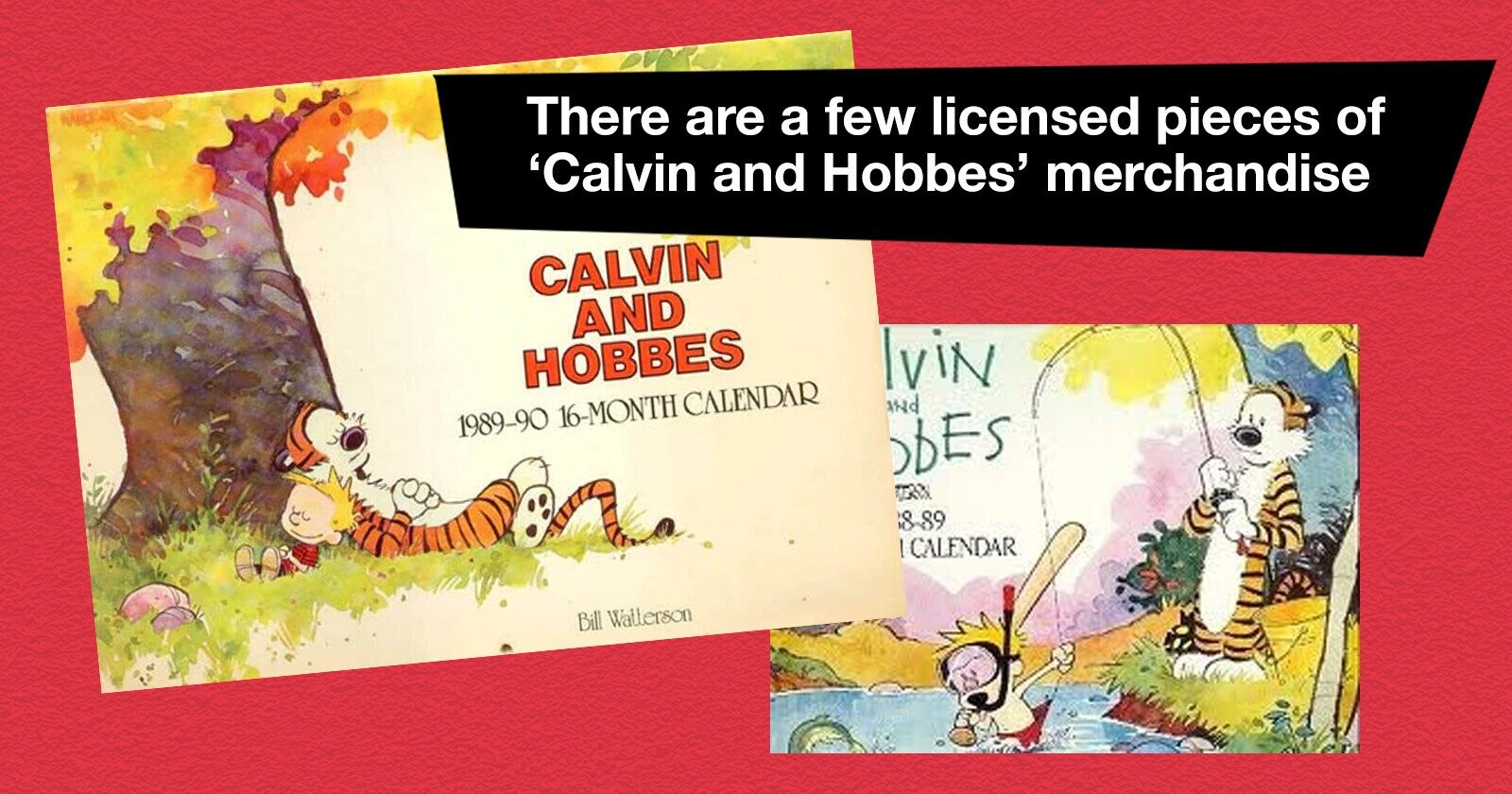
Despite the strip’s popularity, Watterson strongly resisted licensing Calvin and Hobbes for toys, clothing, lunchboxes, animated commercials, and other mass-market merchandise. He believed excessive commercialization would flatten the characters and interfere with the private imaginative relationship readers had with them.
That is why official character merchandise has always been deliberately scarce and why the familiar decals showing Calvin urinating on a logo are unauthorized. The irony is difficult to miss: one of the most recognizable images associated with Calvin was never drawn or approved by his creator. Watterson declined an enormous revenue stream to protect the work’s identityan unusual decision in an era built on turning popular characters into aisle seven.
10. There Has Never Been an Official Animated Series
Watterson also rejected animation proposals. He appreciated what animation could do visually, but adapting the strip would require fixed voices, production teams, commercial negotiations, and many creative decisions shared with other people.
The newspaper comic was a one-person operation in a meaningful sense: Watterson wrote the dialogue, designed the timing, drew the expressions, and controlled the world. Readers supplied voices in their own heads. An animated version might have been popular, but it would also have replaced millions of private Calvins with one officially sanctioned performance.
11. Watterson Fought for Bigger, More Flexible Sunday Comics
Newspapers traditionally preferred Sunday strips that could be rearranged or trimmed to fit standardized spaces. Watterson disliked the artistic restrictions this created. After gaining greater control, he pushed for a larger format that allowed him to design the Sunday page as a complete composition.
The result was a burst of inventive layouts: wide landscapes, unusual panel shapes, silent sequences, giant establishing images, and scenes that used color as part of the storytelling. These pages were not merely longer jokes. They treated the newspaper page like a canvas and drew inspiration from ambitious earlier comics such as Krazy Kat and Little Nemo in Slumberland.
12. Calvin’s Parents Do Not Have First Names
Throughout the strip, Calvin’s parents are simply Mom and Dad. Their lack of first names keeps the story rooted in Calvin’s point of view. To a six-year-old, parents do not necessarily arrive with independent biographies; they are the mysterious authorities who control transportation, bedtime, food, money, and access to television.
Yet Watterson gives them distinct personalities. Dad enjoys long explanations, outdoor hardship, and the claim that unpleasant experiences build character. Mom is often more practical and quicker to recognize an approaching disaster. Neither is perfect, but both feel more human than generic sitcom parents.
13. The Strip Could Shift From Absurd Comedy to Real Grief
One memorable sequence begins when Calvin finds an injured baby raccoon. The animal dies despite the family’s attempt to help it, leaving Calvin confused and heartbroken. The story does not erase the sadness with a final gag.
This sequence revealed how much emotional range the comic could carry. Watterson could move from grotesque snowmen and dinner-table battles to mortality, vulnerability, and friendship without making the change feel manipulative. The seriousness worked because the strip had already established Calvin as more than a troublemaker. Beneath the noise was a child confronting a world that could be wondrous and unfair at the same time.
14. Watterson Won the Reuben Award Twice
The National Cartoonists Society awarded Watterson its Reuben Award for Outstanding Cartoonist of the Year in 1986 and again in 1988. Winning so early in the strip’s run reflected how quickly fellow cartoonists recognized his combination of expressive drawing, sharp writing, and formal experimentation.
The honors are especially notable because Watterson often criticized the shrinking space and commercial pressures affecting newspaper comics. He was not simply successful within the form; he argued publicly that the form deserved more artistic freedom. His work then demonstrated exactly what cartoonists could do when given that freedom.
15. The Final Strip Ended With Possibility, Not Closure
The last Calvin and Hobbes strip appeared on a snowy Sunday at the end of 1995. Familiar landmarks had vanished beneath fresh snow, making the world appear new. Calvin and Hobbes set off together with a sled, ending on the invitation: “Let’s go exploring!”
Watterson did not age Calvin, explain Hobbes, or flash forward to an adult reunion. The ending preserved the characters in motion. It also summarized the philosophy underneath the comic: the world is strange, temporary, frustrating, beautiful, and worth investigating. For a strip famous for high-speed crashes, it achieved a remarkably graceful landing.
Why Calvin and Hobbes Still Feels Fresh
Many comic strips are tied closely to the technology, slang, celebrities, and political arguments of their original decade. Calvin and Hobbes certainly comments on television, advertising, environmental damage, education, consumerism, and adult hypocrisy, but its emotional center is broader. Children still resent bedtime. Parents still improvise answers. Friends still invent games. Snow remains irresistible until it enters a boot.
The artwork also rewards rereading. Watterson used body language with exceptional precision: Hobbes can communicate smugness through the angle of a whisker, while Calvin can move from confidence to panic in a single panel. Quiet forest scenes provide breathing room between jokes, reminding readers that childhood is not only noisy rebellion. It also includes boredom, solitude, curiosity, and the feeling that an afternoon might last forever.
The Reader Experience: Growing Up With a Boy and His Tiger
Reading Calvin and Hobbes at different ages can feel like reading different books. As a child, the immediate pleasure is recognition. Calvin sees school as imprisonment, vegetables as biological threats, baths as naval warfare, and bedtime as an unreasonable government policy. His victories are exhilarating because children rarely control the schedule. His failures are funny because they usually arrive at high speed.
A young reader may also understand Hobbes without needing the reality question explained. Of course the tiger is alive when Calvin is alone with him. Of course he becomes stuffed when another person enters. Imaginative play already works this way. A toy can have a voice, history, mood, and moral opinion, then become an ordinary object when placed on a shelf. The strip respects that experience instead of treating it as confusion that adulthood must correct.
Returning to the comic as an adult produces a gentle shock: Calvin’s parents suddenly become relatable. Dad’s lectures are still ridiculous, but his tired expressions begin to make sense. Mom’s ability to detect trouble from another room seems less like parental magic and more like survival training. Scenes that once looked like adults crushing fun now reveal two people trying to raise an intelligent tornado who owns scissors.
The philosophical jokes change too. A child may laugh because Calvin uses huge words to excuse bad behavior. An adult notices how accurately he imitates public debate, advertising language, cultural criticism, and self-serving logic. Calvin wants moral principles when they protect him and flexible interpretation when they do not. In other words, he is sixand also an alarmingly effective miniature spokesperson for civilization.
The books create a physical experience that digital reading cannot entirely duplicate. Collections are often reread out of order, opened to favorite snowman pages, carried on trips, or handed from an older sibling to a younger one. Corners bend. Covers loosen. Certain punch lines become family vocabulary. The object ages while Calvin does not, which makes each return feel both familiar and slightly bittersweet.
There is also comfort in the strip’s refusal to over-explain. No official sequel tells us what career Calvin chooses. No adaptation assigns him a permanent voice. No merchandise aisle defines Hobbes as a particular type of plush toy. Readers keep room to imagine what happens beyond the panel. That creative space is part of the experience Watterson protected so fiercely.
Most of all, Calvin and Hobbes reminds readers how intensely the ordinary can be experienced. A patch of woods becomes unexplored territory. A snowfall resets the planet. A wagon becomes a philosophical vehicle with terrible brakes. The comic does not ask adults to pretend childhood was perfect. Calvin is often lonely, frustrated, frightened, or misunderstood. Instead, it remembers that childhood could make the world feel enormous.
That may be the strip’s lasting gift. It encourages readers to recover curiosity without surrendering intelligence. Look closely. Ask inconvenient questions. Make something from a cardboard box. Go outside before the clean snow is covered in footprints. The grown-up world will still be waiting, probably holding a bill and asking who broke the lamp.
Conclusion
These 15 trivia tidbits about Calvin and Hobbes reveal a comic built with unusual care. Bill Watterson combined childhood imagination, philosophical humor, visual experimentation, and emotional honesty while resisting the commercial machinery that usually surrounds a global hit. The result is a strip that still feels personal decades after its final newspaper appearance.
Calvin and Hobbes never needed to grow older because readers do that for them. Each rereading changes as our sympathies shift from the rebellious child to the exhausted parents and back again. Meanwhile, Hobbes waits with a wise remark, the sled points downhill, and the world remains ready to explore.