Some country stays promise “rustic charm” and then hand you a decorative wooden roord printed in Comic Sans. Upcott Farm takes a more convincing route. Hidden in a green valley near Braunton on the North Devon coast, this centuries-old farm pairs orchards, stone paths, livestock buildings, and quiet rural scenery with two beautifully restrained barn conversions: the Calfshed and the Lambshed.
The result feels wonderfully storybook-like without becoming theatrical. Wild rabbits may appear near the garden, sheep can be heard across the valley, and a wood-burning stove waits for the inevitable English drizzle. Yet the interiors are not a museum of floral curtains and porcelain ducks. They are calm, contemporary spaces shaped by white walls, oak beams, polished concrete, linen upholstery, farmhouse kitchens, and carefully chosen antiques.
That balance explains why Upcott Farm is often described as lodging fit for Beatrix Potter. The celebrated author never lived here, and the property is in Devon rather than Potter’s Lake District. The connection is one of atmosphere: an old working landscape, domestic gardens, practical farm buildings, small animals behaving as though they own the place, and a sense that rural life can be both ordinary and magical.
Research basis: official Upcott Farm property information and Remodelista’s original design feature. 2>A Storybook Farm With Real History
Upcott Farm’s appeal begins long before anyone discusses paint colors or mattress brands. Parts of the farmhouse are believed to date to the mid-1600s, when the building functioned as a traditional Devon longhouse. In that early arrangement, people lived above while animals occupied the ground floora housing plan that presumably made winter mornings warmer and breakfast conversations louder.
Major changes came in the 1830s. The house was extended westward, its upper floor was raised, and a new roof was built. The front was also reoriented toward the south to capture more sunlight, helping create the Georgian-style farmhouse seen today. A dated plaque records the construction of a threshing barn in 1833, while the property also retains an old apple press and other agricultural outbuildings that reveal how the place evolved over generations.
Ben and Sarah Lambert moved to Upcott Farm with their young family in 2005 and began restoring the dilapidated property. The main farmhouse renovation unfolded over several years, followed by work on the former livestock sheds. The Calfshed and Lambshed opened to guests in 2012, transformed from utilitarian farm buildings into refined self-catering cottages while preserving the shapes, beams, and material character that made them worth saving.
Historical details synthesized from Upcott Farm’s official history and property pages. 2>Why the Beatrix Potter Comparison Works
It Is About Mood, Not a Historical Claim
Beatrix Potter bought Hill Top Farm in England’s Lake District in 1905 using proceeds from her early illustrated books, including The Tale of Peter Rabbit. Hill Top became a sanctuary, working farm, and source of visual inspiration for later stories. Upcott Farm has no documented personal connection to Potter, but it taps into the same emotional territory: a farmhouse embedded in its landscape rather than placed on top of it like an oversized wedding cake.
At both places, domestic life and nature seem to overlap. Gardens are productive as well as pretty. Paths, walls, gates, barns, and fields contribute to the experience. Animals are not decorative branding opportunities; they are part of the setting. This is the countryside as a lived environment, which is exactly why it feels more enchanting than a hotel that has simply purchased three vintage watering cans.
Beatrix Potter and Hill Top background verified through the National Trust and Smithsonian Magazine. 3>The Landscape Feels Illustrated
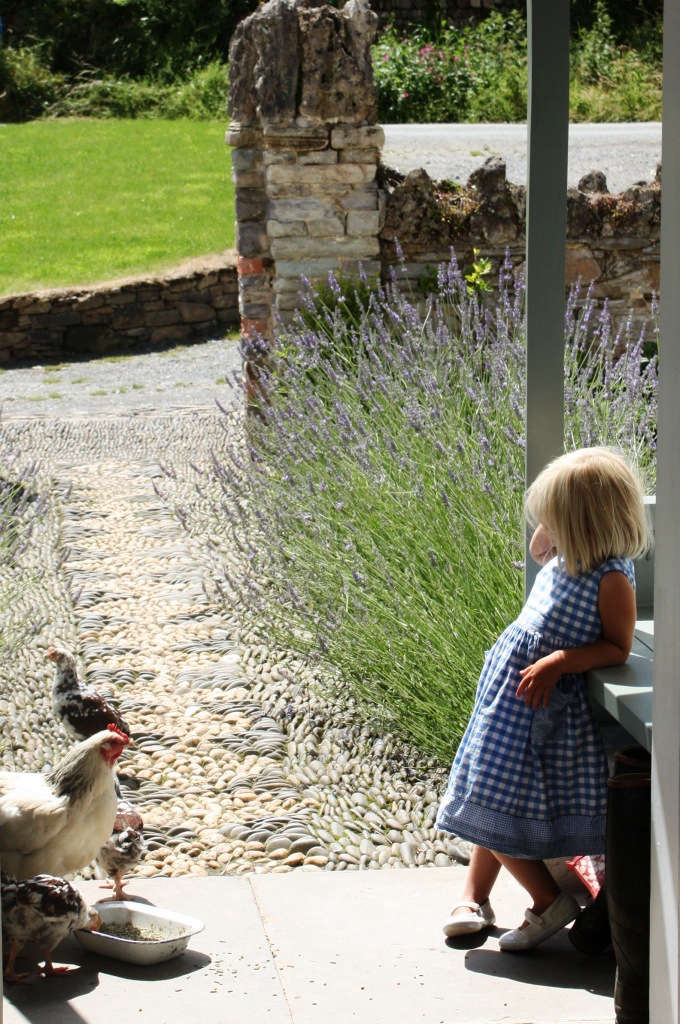
Upcott Farm sits in a secluded valley surrounded by fields and orchards. Its cottages open toward courtyards, while guests can also enjoy lawn and orchard areas with a pond and stream. The combination creates a sequence of small scenes: breakfast beside French doors, boots drying after a wet walk, herbs near the path, children investigating the garden, and evening light settling over the pasture.
The farm’s intimacy matters. Grand estates impress through scale; Upcott charms through detail. A rabbit crossing a path can become the day’s headline. A bowl of local strawberries can feel like a major culinary event. The countryside slows attention down until things normally dismissed as background scenery become the main attraction.
Inside the Calfshed
The Calfshed sleeps four guests plus infants and is well suited to couples, small families, or friends. Four original arched openings have been fitted with tall glazed doors, bringing daylight into a spacious open-plan kitchen, dining, and living area. Large oak beams establish the building’s history, while polished concrete floors and underfloor heating add a clean, modern layer.
The living space avoids the familiar barn-conversion trap of becoming either too rugged or too glossy. A linen corner sofa, antique furniture, and a wood-burning stove add softness and warmth. The farmhouse-style kitchen includes oak work surfaces, a deep butler sink, and the practical appliances needed for proper self-catering. This is a kitchen where guests can cook a roast, not merely unwrap one beside a miniature refrigerator.
Upstairs are two en suite bedrooms with super-king beds, one of which can be arranged as a twin. A muted gray-and-white palette, linen window treatments, quality bedding, and roof lights support the cottage’s restful mood. Blackout blinds are available, an important detail for anyone who enjoys skylights aesthetically but does not wish to be personally awakened by sunrise at an unreasonable hour.
Calfshed layout, amenities, capacity, and design details are based on the official cottage description. 2>Inside the Lambshed
The Lambshed sleeps six guests plus infants and offers three en suite bedrooms, including one on the ground floor. Its L-shaped open-plan living area combines kitchen, dining space, and lounge, with generous glazed doors facing an enclosed courtyard. Like the Calfshed, it retains heavy oak beams and polished concrete flooring, softened by linen seating, antique pieces, and a wood stove.
The dining table can accommodate a larger group when both cottages are rented together, making the Lambshed especially useful for extended families or friends traveling as a party. Each bedroom has a super-king bed, with one available as a twin configuration. The ground-floor bedroom adds flexibility for multigenerational groups, although travelers with specific mobility needs should always confirm exact access details before booking.
The two cottages can function independently, preserving privacy, or work together as a larger rural base. Their courtyards may be shared by one group, creating an easy flow between accommodations without sacrificing the sense that everyone has room to retreat when the family board game becomes a constitutional crisis.
Lambshed capacity, room arrangement, amenities, and shared-group features are based on the official property description. 2>Design Lessons From Upcott Farm
Let Old Features Carry the Drama
The strongest visual elements at Upcott Farm are structural: original arches, thick beams, tall ceilings, and the barn-like proportions of the rooms. The interiors do not compete with those features through excessive pattern or ornament. Instead, a limited palette allows age, texture, and light to become the decoration.
Use Contrast Instead of Imitation
The cottages do not pretend that every surface is centuries old. Contemporary concrete floors sit comfortably beneath antique furniture. Crisp white walls sharpen the silhouette of dark timber. Modern glazing fills old openings. This contrast makes the historic fabric easier to read and prevents the spaces from feeling like stage sets.
Make Comfort Practical
Underfloor heating, well-equipped kitchens, laundry facilities, en suite bathrooms, large beds, and wood stoves are not glamorous in isolation, but together they determine whether a rural stay feels relaxing. Upcott’s style succeeds because the beauty is supported by function. Guests can come back muddy, wash clothes, cook dinner, light the stove, and settle in without treating the cottage like a fragile showroom.
Design analysis informed by Remodelista, i-escape, and Architectural Digest’s coverage of successful barn conversions. 2>What to Do Around Braunton and North Devon
Upcott Farm’s rural seclusion does not mean guests are stranded with nothing but a teapot and their thoughts. Braunton serves as a gateway to some of North Devon’s best-known beaches and outdoor landscapes. Saunton Sands offers a broad sweep of sand and conditions popular with families and surfers, while Croyde Bay is famous for stronger surf culture, coastal scenery, and a village filled with places to eat and drink.
Nearby Braunton Burrows forms the core of the North Devon UNESCO Biosphere and is recognized as England’s largest sand-dune system. Its dunes support a rich variety of plants and animals, making it rewarding for walkers, photographers, and anyone whose vacation priorities include identifying an orchid while pretending not to be lost.
Walkers can explore coastal routes near Baggy Point and elsewhere along the North Devon coast. Cyclists have access to routes in the broader region, while golfers, riders, paddleboarders, and surfers have multiple options within driving distance. Longer outings may include Exmoor National Park or a boat trip to Lundy Island, where dramatic scenery and seabird life provide a wilder contrast to Upcott’s sheltered valley.
Regional information synthesized from Visit Devon, UNESCO, the North Devon Biosphere, and North Devon Coast National Landscape. 2>Who Will Love Upcott Farm?
Design-minded travelers are the obvious audience. Anyone who saves images of converted barns, limewashed walls, farmhouse sinks, and “quiet luxury” interiors will find plenty to admire. Families should also appreciate the cottages’ space, kitchens, toy-friendly atmosphere, outdoor areas, and proximity to beaches. Couples can use the Calfshed as a spacious escape, while groups can reserve both properties for a sociable but flexible gathering.
Upcott also suits travelers who prefer self-catering to scheduled hotel dining. Shopping in Braunton, choosing local ingredients, and cooking in a generous farmhouse kitchen can become part of the vacation rather than an obligation. The trade-off is that meals are not provided, so guests seeking room service and a breakfast buffet large enough to require architectural planning should look elsewhere.
Practical Considerations Before Booking
A car is effectively essential. The farm is reached through rural lanes, some of which are narrow enough to make first-time visitors reconsider the emotional value of their side mirrors. Arriving during daylight is sensible, especially for drivers unfamiliar with the area.
Internet service is available but is not promoted as superfast. That may be a drawback for remote work, though it is arguably excellent news for a vacation. The open design and roof lights can allow sound and early daylight to travel, so light sleepers may want to use the provided blackout blinds and pack earplugs. Minimum-stay rules, prices, pet policies, and availability can vary by season, making direct confirmation important before arranging transportation.
Practical advantages and limitations are based on official property information and i-escape’s independent review. 2>A 500-Word Upcott Farm Experience: From Arrival to Sunday Morning
The ideal Upcott Farm stay begins before check-in, when the road narrows, hedges rise on both sides, and the landscape starts editing unnecessary thoughts from your brain. The final approach feels less like arriving at commercial lodging and more like discovering a place that has been quietly waiting behind the trees. Stone, timber, orchard greenery, and old farm buildings come into view without a neon sign announcing that relaxation is now compulsory.
Inside the cottage, the first impression is space and light. The glazed arches pull the courtyard into the room, while the oak beams immediately remind you that the building had a life before vacation photos. Bags are dropped, the kettle is located, and everyone spends ten minutes saying variations of, “Look at this sink.” This is normal behavior in a good farmhouse kitchen.
The first afternoon is best kept simple. Open the doors, walk through the orchard, listen for sheep, and investigate the stream without attempting to optimize the experience. Children can explore the outdoor space; adults can sit at the courtyard table and rediscover the astonishing fact that a cup of coffee stays hot when nobody is rushing to a meeting. If a rabbit appears, it will receive more attention than most celebrities.
Dinner should be cooked in the cottage at least once. Local bread, cheese, vegetables, and something slow enough to justify the wood stove create the right rhythm. The large table encourages a long meal, especially when phones have poor reasons to be present. Afterward, the sofa becomes headquarters. Rain against the roof is not a disappointment here; it is free sound design.
The next morning calls for the coast. Saunton Sands offers room to walk until the group naturally spreads into pairs and solitary wanderers. More active guests can arrange a surf lesson, while determined spectators can hold towels and provide expert commentary from dry land. Lunch in Braunton or Croyde adds a livelier note before the return to Upcott’s quiet valley.
Back at the farm, the luxury is not extravagance but ease. Wet clothes can be washed. Sandy shoes can be left near the utility area. Dinner can be elaborate or consist of bread, soup, and the heroic finishing of yesterday’s cake. The interior’s pale colors and natural materials look beautiful in evening light, but they never demand formal behavior. This is a stylish space in which people can actually live.
On the final morning, the cottage often feels more appealing than the planned itinerary. Breakfast stretches. Someone walks outside “for five minutes” and returns half an hour later. Packing becomes strangely inefficient because every room invites one last pause. That reluctance to leave is the clearest measure of the experience. Upcott Farm does not manufacture fantasy with costumes or themed décor. It simply offers an old rural setting, thoughtful design, and enough quiet for the imagination to start working again.
Conclusion: A Modern Farm Stay With Storybook Soul
Upcott Farm succeeds because it respects both halves of its identity. It is genuinely old, with a layered agricultural history and buildings shaped by centuries of practical use. It is also thoroughly comfortable, offering warm floors, generous beds, modern bathrooms, capable kitchens, and interiors that feel edited rather than decorated.
The Beatrix Potter comparison should be understood as an invitation, not a biography. Upcott is not Hill Top, and Devon is not the Lake District. Yet the farm captures something Potter understood particularly well: small landscapes can hold enormous imaginative power. A courtyard, an orchard, a kitchen garden, a sheep field, or a rabbit near the path may be modest subjects, but in the right setting they make everyday life feel newly interesting.
For travelers seeking a North Devon farm stay with design credibility, family-friendly space, coastal access, and a strong sense of place, the Calfshed and Lambshed offer a persuasive escape. Bring practical shoes, groceries, and a willingness to slow down. The rabbits will handle the rest.
Note: Upcott Farm is a real accommodation property, but rates, availability, amenities, minimum stays, and policies may change. Confirm current details directly with the property before booking.