
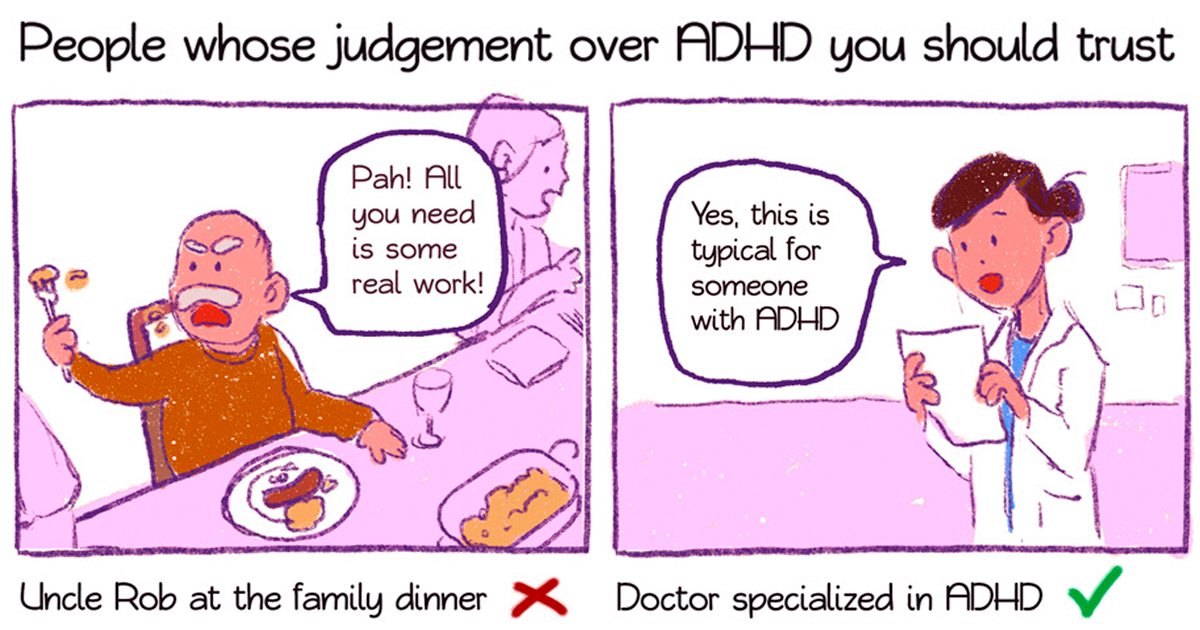
Imagine opening a comic and discovering that someone has drawn the exact argument you had with your brain five minutes ago. The forgotten appointment, the unfinished coffee, the mysterious disappearance of your keys, and the sudden urge to research medieval spoons instead of answering one emailit is all there, wearing a tiny alien costume.
That sense of recognition helped make Pina’s ADHD Alien comics popular among adults who live with attention-deficit/hyperactivity disorder. When the original collection was published in 2019, Pina was introduced as a 29-year-old German illustrator and visual development artist who had received an ADHD diagnosis at 28. She explained that the demands of freelance work made long-standing difficulties with organization, anxiety, and daily functioning impossible to ignore.
The resulting comics are playful, brightly drawn, and often funny enough to produce the dangerous thought, “Ha! That is me,” followed immediately by, “Oh. That really is me.” More importantly, they translate invisible struggles into scenes that friends, families, coworkers, and people questioning their own experiences can understand.
Meet the Artist Behind ADHD Alien
Pina’s path to diagnosis did not follow a tidy three-panel story. She described struggling at university, developing anxiety, trying therapy, and being dismissed because she appeared too quiet or academically capable to have ADHD. After documenting her behavior, researching the condition, speaking with doctors, and participating in group support, she finally found an explanation that made her history look less like a collection of personal failures.
That background matters because adult ADHD is frequently misunderstood. It is a neurodevelopmental condition, not a synonym for being energetic, occasionally distracted, or allergic to spreadsheets. Symptoms commonly involve persistent difficulties with attention regulation, impulse control, organization, and, for some people, restlessness. They begin in childhood, although many individuals are not identified until adulthood.
Pina created the alien character partly because she wanted other people with ADHD to feel less isolated. Her stated goal was not to tell readers whether they had the condition. Instead, she hoped that relatable art might help people understand their struggles and feel comfortable seeking professional guidance.
Why These ADHD Comics Feel So Accurate
They Make Invisible Effort Visible
A person may appear to be sitting quietly while internally attempting to remember six instructions, resist three distractions, estimate the passage of time, regulate frustration, and persuade the brain to begin a task it has already agreed to complete. From the outside, nothing dramatic is happening. Inside, the control room is on fire and one intern is searching for the instruction manual.
Executive functions help people plan, prioritize, begin tasks, regulate behavior, and work toward goals. When these processes are unreliable, an apparently simple chore can require an exhausting amount of mental negotiation.
They Use Humor Without Dismissing the Problem
The jokes work because they recognize the absurdity of everyday situations without suggesting that ADHD itself is trivial. Forgetting why you entered a room can be funny. Repeatedly missing deadlines, damaging relationships, or believing you are lazy because you cannot perform consistently is not.
Humor creates enough emotional distance for readers to examine uncomfortable experiences. A colorful alien panicking over an ordinary task feels safer than a lecture about executive dysfunction, yet the message may remain with the reader much longer.
They Replace Shame With Recognition
Many adults reach diagnosis after years of being labeled careless, irresponsible, overly sensitive, or unmotivated. Reliable medical resources emphasize that ADHD is not caused by laziness, low intelligence, or a lack of discipline.
Seeing a familiar struggle in a comic can produce a powerful shift: “This is not evidence that I am a terrible person. It may be a pattern worth understanding.” That change does not erase consequences, but it creates a healthier starting point for addressing them.
21 Relatable ADHD Experiences Reflected in the Comics
-
1. Wanting to Begin but Feeling Physically Stuck
The task is open. The instructions are clear. The deadline exists. Yet starting feels like attempting to launch a refrigerator into orbit with a rubber band. This task-initiation barrier is one of the most misunderstood executive-function difficulties because observers may see refusal where the individual experiences paralysis.
-
2. Turning One Chore Into Twelve Side Quests
Cleaning the desk leads to finding an old receipt, which leads to checking a bank statement, reorganizing a drawer, sharpening every pencil, and wondering whether octopuses dream. Two hours later, the desk is technically less clean, but the pencil situation is magnificent.
-
3. Losing Objects That Were in Your Hand
Keys, phones, glasses, identification cards, and drinks seem to enter temporary witness protection. Working-memory difficulties can make an object disappear from awareness almost immediately after it is set down, producing an apartment-wide investigation featuring one increasingly offended couch.
-
4. Experiencing Time as “Now” and “Not Now”
Many people with ADHD use the informal term time blindness to describe difficulty sensing, estimating, or planning around time. Five minutes may feel enormous until it suddenly becomes forty-five. Time blindness is not a separate diagnosis, but the experience can affect punctuality, deadlines, and daily routines.
-
5. Hyperfocusing on the Most Interesting Thing
ADHD does not always mean an inability to focus. It often involves difficulty controlling where attention goes. An engaging project can absorb hours while hunger, messages, and the setting sun quietly file missing-person reports. Cleveland Clinic describes this as an ability to become intensely “in the zone” with highly interesting activities.
-
6. Needing Interest, Urgency, or Novelty
A routine report may feel impossible for days, but the same person can complete it at astonishing speed when the deadline begins breathing directly onto the back of their neck. The result may look like procrastination followed by magic, although the emotional cost is rarely magical.
-
7. Remembering the Wrong Detail Perfectly
The brain may forget an appointment scheduled yesterday but preserve the exact theme song from a cartoon watched in 2003. Memory is not simply “good” or “bad.” Retrieval can depend heavily on context, emotion, novelty, repetition, and whether the information was successfully encoded in the first place.
-
8. Interrupting Before a Thought Escapes
An idea arrives with the urgency of breaking news. Waiting for the other person to finish creates the fear that the thought will disappear, so it bursts into the conversation early. The interruption can seem rude even when it comes from excitement, impulsivity, or an effort to hold onto working memory.
-
9. Feeling Restless Without Running Around
Adult hyperactivity may appear as internal restlessness, constant fidgeting, rapid speech, difficulty relaxing, or a powerful need to stay busy. The stereotype of a child sprinting around a classroom misses adults whose bodies are seated while their thoughts are hosting a trampoline tournament.
-
10. Reacting Strongly to Criticism
Some adults with ADHD describe criticism or perceived rejection as unusually painful. “Rejection sensitive dysphoria” is a popular term associated with this experience, although it is not a formal diagnostic category. Emotional reactions should be considered individually rather than treated as proof of ADHD.
-
11. Replaying a Social Mistake for Hours
A slightly awkward sentence can become the evening’s main attraction. The brain reopens the scene, adds dramatic lighting, invites an imaginary jury, and asks why a normal human would ever pronounce “you too” after a waiter says, “Enjoy your meal.”
-
12. Masking Symptoms to Look Organized
Some people compensate by arriving excessively early, checking their work repeatedly, copying social behavior, or using anxiety as a productivity engine. These strategies may hide difficulties from others while creating exhaustion. Women and people with primarily inattentive symptoms have historically been especially vulnerable to being overlooked.
-
13. Being Called “Too Smart” to Have ADHD
Intelligence and ADHD are not opposites. A capable student may earn good grades while sacrificing sleep, relying on last-minute panic, or putting several times more effort into organization than classmates do. Achievement can conceal impairment; it does not automatically disprove it.
-
14. Collecting Exciting New Projects
A new hobby arrives carrying possibility, novelty, and approximately $87 worth of supplies. The early learning stage is thrilling. Once repetition replaces discovery, motivation may fade, leaving a closet full of evidence that the person was briefly destined to become a potter, guitarist, baker, and beekeeper.
-
15. Overcommitting During a Burst of Optimism
Future-you appears to have unlimited energy, flawless planning skills, and no existing responsibilities. Present-you therefore agrees to three projects, two social events, and a favor involving a truck. When the future arrives, it is shocked to learn that it is still you.
-
16. Struggling With Multi-Step Instructions
“Open the document, update the figures, rename the file, attach it, and copy the team” sounds simple until step three pushes step one out of working memory. Written instructions, checklists, and visible reminders can reduce the cognitive burden without treating the person like a malfunctioning appliance.
-
17. Becoming Overwhelmed by Ordinary Clutter
Clutter creates visual reminders of unfinished decisions. Unfortunately, the overwhelm caused by the clutter can make organizing it even harder. The result is a feedback loop in which every object silently requests attention while the person responds by sitting on the floor and eating crackers.
-
18. Having Trouble Switching Tasks
Moving from an interesting activity to a necessary one can feel more difficult than either task alone. The brain must stop, disengage, remember the next goal, tolerate the loss of stimulation, and rebuild momentum. Transition warnings and small closing rituals can make the handoff less abrupt.
-
19. Depending on Other People’s Presence
Some people find it easier to begin or finish work when another person is quietly present, a strategy often called body doubling. The companion does not need to supervise. Their presence can provide structure, accountability, and a gentle anchor for attention.
-
20. Mistaking Inconsistency for a Character Flaw
Completing something brilliantly once can lead others to ask why it cannot happen every time. ADHD performance may vary with sleep, environment, emotional state, urgency, interest, and available structure. Inconsistency is frustrating, but it is not necessarily evidence that someone does not care.
-
21. Feeling Relief After a Late Diagnosis
A diagnosis does not rewrite the past, but it can provide a new interpretation. Old report cards, abandoned plans, missed appointments, and emotional struggles may finally form a recognizable pattern. For many adults, the first feeling is not sadness but relief: there is a name, a community, and a path forward.
What the Comics Get Rightand What They Cannot Do
The strongest message in Pina’s work is that ADHD affects more than the ability to concentrate during boring meetings. It can influence time management, relationships, emotional responses, household routines, finances, work performance, and self-esteem. Adults may struggle to meet deadlines, manage money, maintain routines, or complete long tasks unless those tasks are especially engaging.
However, relatable content is not a clinical assessment. Sleep deprivation, anxiety, depression, trauma, medical conditions, substance use, and other factors can produce overlapping symptoms. A proper evaluation reviews current difficulties, childhood history, impairment in different settings, medical information, and possible coexisting conditions.
Treatment is also not one-size-fits-all. Depending on the person, professional care may include medication, psychotherapy, skills training, environmental adjustments, coaching, or a combination. Cognitive-behavioral approaches may help adults develop practical systems for planning, organization, emotional regulation, stress management, and breaking complex tasks into manageable steps.
A Composite Experience: One Very ADHD Tuesday
The following narrative is a fictional composite based on commonly reported adult ADHD experiences. It is not presented as Pina’s personal story or as a universal description of ADHD.
Maya wakes at 7:00 a.m. and immediately remembers that she needs to send an important document. She picks up her phone to email it, notices a weather alert, checks whether she needs an umbrella, and somehow ends up watching a video about a dog that recognizes 200 toys.
At 7:24, she realizes she has not sent the document. She opens her laptop, but the battery is nearly dead. While searching for the charger, she finds yesterday’s coffee mug, carries it toward the kitchen, sees a package by the door, opens the package, and discovers the planner she ordered to become a completely different person.
The planner is beautiful. It has sections for priorities, habits, gratitude, water intake, and possibly diplomatic negotiations. Maya spends ten minutes selecting the correct pen. Then she remembers the document.
She sends it at 7:51. The task itself takes forty seconds.
During work, Maya struggles to begin a routine spreadsheet. She knows how to do it. She has done it many times. Still, the first cell seems protected by an invisible force field. She checks messages, rearranges two folders, and feels increasingly guilty. A coworker joins a silent virtual work session, and the spreadsheet suddenly becomes approachable. With another person quietly present, Maya finishes the first section in twenty minutes.
At lunch, she decides to research one detail for a creative project. The topic is interesting, so her attention locks on. She follows references, makes connections, and produces an excellent concept. When she finally looks up, it is 3:47 p.m., lunch is untouched, and six messages are waiting.
One message says, “Can we revise this?” Maya’s stomach drops. For several minutes, the sentence feels less like a routine request and more like a declaration that she has disappointed everyone she has ever met. She starts drafting an apology worthy of an international scandal. Then she pauses, drinks water, rereads the message, and notices that the requested change is tiny.
In the evening, Maya intends to clean the apartment. She puts on music, gathers dishes, and discovers a library book that is due tomorrow. She places it by the door. Knowing she may forget it anyway, she puts her keys on top of it and sets a phone reminder labeled, “THE BOOK IS UNDER YOUR KEYS.”
Not every strategy works. The new planner may be abandoned by Thursday. The reminder may ring while she is already holding the book. But Maya is learning that support systems do not need to look elegant; they need to make the next action easier.
Before bed, she writes down three things she completed. This feels strange because her attention naturally gravitates toward everything unfinished. The list is short but real: she sent the document, completed the spreadsheet, and created a strong project concept.
For years, Maya interpreted days like this as proof that she was careless. Now she sees a more complicated picture. Her brain can be creative, fast, observant, and intensely focused. It can also struggle with transitions, routine tasks, working memory, and emotional regulation. Understanding both sides helps her replace punishment with practical problem-solving.
Tomorrow will not be perfectly organized. There will probably be another missing mug. But there will also be reminders, smaller steps, scheduled breaks, supportive people, and a little less shame. Progress, she has learned, is not becoming someone who never struggles. It is becoming someone who knows what to do when the struggle arrives.
Conclusion: Comics Can Open a Door
Pina’s 21 ADHD comics succeed because they turn complicated internal experiences into simple visual moments. A tiny alien can show the difference between knowing what to do and being able to begin, between hearing criticism and feeling emotionally flattened by it, or between losing focus and having attention captured by the wrong target.
The artwork does not portray every person with ADHD, and it should never be treated as a diagnostic checklist. Its real value is translation. Readers who recognize themselves may gain language for a professional conversation. Friends and relatives may become more patient. Adults who spent years calling themselves lazy may finally consider a more compassionate explanation.
That is a substantial achievement for a comic character who looks as though it might forget why it walked into the final panel.
Editorial note: This article provides general educational information and is not medical advice. Anyone experiencing persistent attention, impulsivity, organizational, or emotional difficulties that interfere with daily life should consult a qualified healthcare professional.













