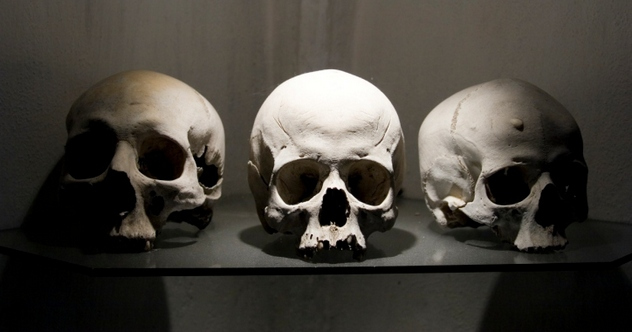
Modern detectives have fingerprints, phone records, surveillance cameras, and suspects who cannot resist posting suspiciously specific details online. Investigators of ancient murder mysteries have considerably less to work with: a damaged skeleton, a half-trustworthy chronicler, perhaps a rope preserved in a bog, and several thousand years of missing paperwork.
Yet forensic archaeology can still reconstruct astonishing details. CT scans reveal hidden stab wounds. Chemical analysis identifies a victim’s last meal. Radiocarbon dating narrows the time of death, while pollen, isotopes, and ancient DNA can suggest where someone lived or traveled. The problem is that evidence can explain how a person died without telling us who killed them or why.
The ten unsolved ancient crimes below range from prehistoric ambushes to palace assassinations. In several cases, deliberate killing is certain. In others, murder remains only one interpretation among disease, accident, execution, sacrifice, and political rumor. That uncertainty is not a flaw in the story. It is the story.
1. Who Shot Ötzi the Iceman?
When hikers discovered Ötzi in the Alps in 1991, authorities initially treated him like a recently dead mountaineer. He was actually a Copper Age man who died more than 5,000 years ago. An arrowhead lodged in his left shoulder, a deep cut on his hand, and other trauma point toward a violent final encounter. The arrow likely damaged a major blood vessel, making blood loss a leading explanation for his death.
Ötzi had eaten shortly before dying and carried valuable equipment, including a copper axe. Because those possessions remained with him, simple robbery looks unlikely. Was he attacked during a feud? Pursued after a political dispute? Ambushed by someone he knew? The mountain preserved his body with almost insulting efficiency, but it did not preserve the attacker’s name. Ötzi may be archaeology’s best-documented murder victim and its least cooperative witness.
2. Who Stabbed Gebelein Man in the Back?
Gebelein Man was buried in Upper Egypt around 3500 B.C., long before the pyramids reached the skyline. Hot, dry sand naturally preserved his body. For more than a century, museum visitors could see him without knowing that a fatal wound was hidden beneath his skin.
A high-resolution CT scan revealed damage to his shoulder blade and rib consistent with a single deep stab from behind. He was probably only 18 to 21 years old. The wound’s angle suggests an attacker struck with force, likely using a stone or copper blade.
That answers the most basic forensic question, but almost nothing else survives. There is no weapon, written accusation, or social context that identifies the killer. It could have been personal violence, conflict between communities, punishment, or something ceremonial. The oldest cold cases are particularly rude: they provide a cause of death and then leave before questioning begins.
3. Why Was Tollund Man Hanged?
Tollund Man’s peaceful expression is deeply misleading. Found in a Danish peat bog in 1950, he looked so fresh that his discoverers feared they had uncovered a modern homicide. Radiocarbon dating placed his death in the Iron Age, roughly between 405 and 380 B.C. A braided hide cord remained around his neck, and examination showed that he died by hanging.
The mystery is motive. His body was carefully positioned, with closed eyes and mouth, rather than casually discarded. His final meal included porridge made from barley, flax, and wild seeds, along with fish. Some researchers see signs of ritual preparation and human sacrifice. Others allow for execution, revenge, or suicide.
Since the people of his community left no written explanation, a tidy burial and a complicated bowl of porridge must carry far more interpretive weight than any breakfast deserves.
4. What Happened to Lindow Man?
Lindow Man, discovered in an English bog in 1984, suffered a spectacularly violent death around the turn of the first millennium. Investigators identified blows to the head, a cord around the neck, and a cut throat. The apparent sequence inspired the phrase “triple death,” which some scholars connected to ritual sacrifice.
That interpretation is dramatic, memorable, and not universally accepted. Bog pressure, decomposition, ancient injury, and damage after discovery can complicate forensic reconstruction. Even when the wounds are genuine, ritual is not the only explanation.
Lindow Man might have been sacrificed, executed, murdered, or subjected to a combination of punishment and ceremony that does not fit modern categories. His carefully groomed nails and relatively healthy body suggest he was not an anonymous outcast, but status only adds suspects; it does not identify one.
5. Who Killed the Yde Girl?
The Yde Girl was about 16 when she died near the beginning of the Common Era. Her preserved remains were found in a Dutch bog in 1897. A woolen band around her neck indicates strangulation, and a wound near her collarbone may have been inflicted with a knife. Part of her hair had been cut or shaved, while the rest remained long.
CT imaging showed that she had scoliosis, which would have affected her posture and gait. Earlier interpretations suggested that physical difference may have made her a target for sacrifice, but that idea risks projecting modern prejudice onto people who left no testimony.
She could have been selected for a ritual, punished for an offense, killed during a personal conflict, or murdered for a reason completely invisible to archaeology. We know more about the curve of her spine than about the society that decided her fate.
6. Who Delivered the Fatal Blows to Pharaoh Seqenenre-Taa II?
Seqenenre-Taa II ruled southern Egypt during conflict with the Hyksos in the 16th century B.C. His mummy preserves devastating wounds to the face and skull. Modern CT analysis suggests multiple weapons were used and that his hands may have been restrained behind him. One reconstruction proposes that enemy fighters captured and executed him.
That is more specific than most ancient homicide theories, but the final scene remains uncertain. Did he fall in battle, die during a ceremonial execution, or become a prisoner after a failed campaign? Were the killers ordinary soldiers, officers, or a royal execution team? Earlier theories even placed the crime inside a palace.
Science has narrowed the possibilities, yet it cannot recover the identities or commands behind the attack. The likely murder weapon types survive in bone; the chain of command does not.
7. Was Tutankhamun Murdered at All?
Tutankhamun died around age 19 in the 14th century B.C., creating a perfect environment for conspiracy theories. A young king, no surviving heir, ambitious courtiers, and a hurried burial are basically an engraved invitation for historical gossip. For years, damage at the back of his skull was cited as evidence of a fatal blow.
Later imaging weakened that murder theory. Studies have instead highlighted malaria, bone disease, a leg injury, possible infection, and other health problems. Severe damage to the mummy also makes reconstruction difficult because ancient embalming, tomb conditions, and modern handling all left marks.
Tut may have died from illness or trauma rather than assassination. Still, no single explanation has ended the debate. His case belongs here because it demonstrates an important rule of ancient crime writing: sometimes the biggest mystery is whether there was a crime.
8. Who Were the Shackled Men of Phaleron?
Excavations near ancient Athens uncovered a mass grave containing dozens of men, many still wearing iron shackles. The burial dates to the seventh century B.C. One tempting theory links them to followers of Cylon, an aristocrat and Olympic victor who attempted to seize power in Athens around 632 B.C. After the coup failed, some of his supporters were reportedly killed despite seeking sanctuary.
The dates fit, but not tightly enough to close the case. The men could have been rebels, prisoners of war, criminals, enslaved people, or victims of another political purge. Their orderly placement suggests controlled execution rather than chaotic battle.
Yet their names, alleged offenses, and executioners remain unknown. Archaeology found the victims exactly where history becomes vague, which is excellent for debate and terrible for issuing indictments.
9. Who Ordered the Assassination of Philip II of Macedon?
Unlike many cases on this list, the man who stabbed Philip II in 336 B.C. is known. Pausanias, one of the king’s bodyguards, attacked during a public celebration and tried to escape toward waiting horses. He was killed almost immediately, conveniently preventing a confession, interrogation, or ancient Macedonian courtroom drama.
Pausanias had a plausible personal motive rooted in abuse and Philip’s failure to provide justice. Nevertheless, the assassination also benefited powerful people. Suspicion later touched Philip’s estranged wife Olympias, his son Alexander, rival Macedonian factions, and foreign enemies.
No surviving evidence proves that Pausanias acted for anyone else. The direct killer is certain; the possibility of a larger conspiracy is not. In modern terms, police caught the gunman and lost the group chat.
10. Did Agrippina Poison Emperor Claudius?
Roman emperor Claudius died in A.D. 54 after a meal, and ancient writers blamed his wife, Agrippina the Younger. The famous version says she arranged for poisoned mushrooms so her son Nero could inherit the throne. Other accounts add a food taster, a professional poisoner, or a doctor using a poisoned feather when the first dose failed.
The details vary because the sources were written within a political culture that adored scandal and often portrayed powerful imperial women as dangerous schemers. Claudius was in his sixties and could have died naturally, while later authors had reasons to make Nero’s rise appear criminal from the first bite.
Agrippina had motive and opportunity, but a dramatic story is not toxicology. With no body suitable for modern testing and no neutral eyewitness report, the mushroom murder will remain one of Rome’s most deliciously suspicious tales.
Why These Ancient Murder Mysteries Resist a Final Verdict
Forensic archaeology is powerful, but it works with incomplete and altered evidence. Bone can preserve blunt-force trauma while losing soft-tissue injuries. Bog chemistry can save skin but dissolve much of a skeleton. Mummification may protect a body while also cutting, filling, drying, and rearranging it. Excavation itself can introduce damage, and early discoveries were not always documented according to modern standards.
Written sources create a different problem. Ancient chroniclers often wrote decades later, repeated rumors, shaped moral lessons, or served political agendas. A palace poisoning described by three historians is not automatically three independent confirmations; it may be one irresistible story copied and decorated over time.
That is why responsible analysis separates evidence from interpretation. An arrowhead is evidence. “Political revenge” is an interpretation. A ligature is evidence. “Human sacrifice” is an interpretation. The difference may sound less exciting, but it is what keeps historical mystery from becoming historical fan fiction wearing a respectable hat.
The Experience of Following a 2,000-Year-Old Cold Case
Exploring ancient murder mysteries creates a strange kind of closeness to the past. Dates such as “3500 B.C.” can feel abstract, like numbers printed on a museum label by someone determined to ruin the fun. A wound changes that. The moment a scan reveals an arrow, a crushed skull, or a blade path through a rib, the victim stops being a timeline entry. This was a person who ate, worried, traveled, argued, trusted someone, and then experienced a final event that modern researchers are trying to reconstruct from fragments.
The most rewarding approach is to begin with the body rather than the legend. Read what the examination actually found. Was there a wound inflicted before death? Is the injury definitely fatal? Could pressure, embalming, excavation, or decay explain it? Then move outward to clothing, food, weapons, burial position, and location. Only after that should political motives and ritual theories enter the room. Otherwise, a dramatic theory can become the answer before the evidence has even removed its coat.
Museums also change the experience. A photograph of Tollund Man is unsettling; seeing the preserved face at human scale would make the distance of twenty-four centuries feel remarkably thin. Reconstructed faces can create empathy, although they should not be mistaken for perfect portraits. Even a careful reconstruction contains choices about skin tone, hair, expression, and age. It is an informed bridge to the past, not a time-travel selfie.
Another useful experience is comparing older explanations with newer research. King Tut was once a favorite “blow to the head” case. Better imaging made that confident solution much less secure. Seqenenre’s injuries, by contrast, became more interpretable when CT scans revealed wounds hidden by embalmers.
These reversals teach intellectual humility. Technology does not simply solve mysteries; sometimes it proves that the previous solution was built on sand, which is awkward when the subject is ancient Egypt.
Readers can also build a small evidence table for each case with four columns: confirmed fact, likely inference, competing explanation, and missing evidence. For Ötzi, the embedded arrowhead is confirmed; homicide is highly likely; the exact sequence of the attack is debated; the killer’s identity is missing. This method makes sensational claims easier to evaluate and reveals why certain mysteries endure.
Finally, ancient cold cases encourage respect for uncertainty. “We do not know” is not an empty conclusion. It can mean researchers have eliminated several weak ideas, identified the limits of the surviving material, and refused to convert possibility into fact.
That restraint is part of the experience. The past is not obligated to provide a satisfying ending, a named villain, or a final courtroom reveal. Sometimes all it leaves is a body, a wound, and a question sturdy enough to survive an empire.
Conclusion
The best ancient murder mysteries are not fascinating merely because they are gruesome. They show what archaeology can recover and where evidence finally runs out. Ötzi’s arrow, Gebelein Man’s hidden stab wound, the cords around bog bodies, and the damaged skull of Seqenenre preserve moments of violence with extraordinary clarity. Motive and responsibility remain far harder to reconstruct.
Future DNA work, imaging, chemical analysis, and fresh excavations may sharpen these stories. A few cases might even be partly solved. But certainty requires more than a clever theory. Until a new inscription, burial, or biological clue appears, these unsolved ancient crimes will remain open files in humanity’s oldest evidence room.