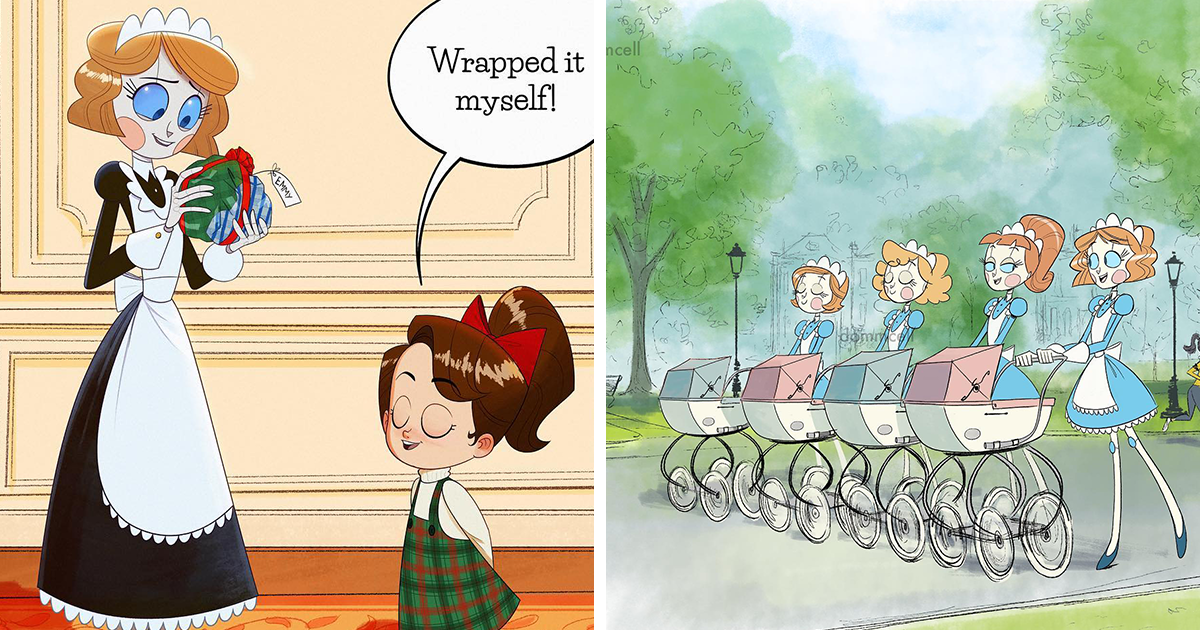
Science fiction usually introduces a highly advanced robot and immediately asks an important question: How long until it takes over the world?
Dominic Cellini’s Emmy the Robot asks something much sweeter: What if the robot is mainly worried about preparing breakfast correctly, protecting a child, following household etiquette, and being useful to the people she loves?
The 21 wholesome comics featuring Emmy turn futuristic artificial intelligence into a surprisingly tender story about caregiving, identity, change, and the awkward art of being human. Emmy may have a polished metal body and sophisticated programming, but emotionally, she is the coworker who arrives 20 minutes early, brings color-coded notes, and apologizes because the meeting started without enough napkins.
Behind the gentle humor is a larger story. Emmy was designed to be a high-end robotic nanny responsible for childcare and domestic maintenance. She works for the Delaire family and forms a close bond with their daughter, Madeline. When an accident disrupts that stable life and leaves Emmy outmoded, she must adapt to a world that no longer fits her original instructions.
That combination of cozy comedy and quiet existential panic is what makes Dominic Cellini’s robot nanny comics so memorable. Emmy is not trying to start a revolution. She is simply trying her bestand sometimes that is considerably harder.
Who Is Emmy the Robot?
Emmy is an android known as a “Nandroid,” a premium household robot created to care for children and manage domestic responsibilities. Her personality is built around order, service, protection, and excellent manners. She is capable, sincere, and deeply committed to completing her duties properly.
Unfortunately for Emmy, humans are not especially interested in behaving properly.
Children change their minds. Adults conceal their emotions. Families make unpredictable decisions. Social rules contain exceptions, and those exceptions have smaller exceptions wearing tiny hats. Emmy can process instructions efficiently, but understanding why people break their own rules requires a different kind of intelligence.
Cellini has explained that the story grew from his interest in what happens when circumstances permanently alter someone’s life. Emmy believes she is defined by her purpose, so separating her from that purpose forces her to discover whether she can become something more than the role she was manufactured to perform.
Why Dominic Cellini’s Robot Nanny Comics Feel So Wholesome
The warmth of Emmy the Robot does not come from pretending that every problem has an easy solution. It comes from watching a kindhearted character continue to care even when she does not fully understand the situation.
Emmy’s literal thinking creates plenty of comedy, but the comic rarely treats her innocence as stupidity. Instead, her straightforward questions expose how confusing human behavior can be. We tell children to be honest, then whisper that they should pretend to like an unpleasant birthday gift. We create schedules, ignore them, and act surprised when the robot considers this a system failure.
The emotional connection also reflects something researchers have observed in real child-robot interactions. Young children may attribute psychological qualities to social robots, help humanoid machines, respond to robotic encouragement, and remain engaged with robots during educational or therapeutic activities. That does not make today’s robots equivalent to human caregivers, but it helps explain why the friendship between Emmy and Madeline feels emotionally believable.
21 Reasons These Emmy the Robot Comics Work So Well
1. Emmy Takes Every Small Responsibility Seriously
Whether she is supervising a lesson, organizing the household, or responding to a child’s unexpected question, Emmy behaves as though the future of civilization depends on doing the task correctly. Her intensity turns ordinary family moments into miniature missions.
2. Her Perfectionism Is Instantly Relatable
Emmy was designed to be dependable, but her desire to perform flawlessly often becomes an emotional burden. Anyone who has reread a two-sentence email seven times will recognize the condition.
Cellini has said there is a little of his own perfectionism in Emmy. He spent months developing her seemingly simple design, repeatedly sketching her until the character finally looked right.
3. Madeline Treats Emmy Like a Person
Madeline does not approach Emmy as a fancy appliance. She trusts her, speaks to her, learns from her, and occasionally introduces the kind of unpredictable childhood logic that could make any operating system request emergency maintenance.
4. Emmy’s Formal Manners Are Adorable
Her careful language and old-fashioned politeness contrast beautifully with messy family life. She can make a minor misunderstanding sound like an international diplomatic incident involving cookies.
5. The Humor Never Needs Cruelty
Many jokes come from mismatched expectations rather than humiliation. Emmy misunderstands people, people misunderstand Emmy, and everyone generally survives with their dignity only lightly dented.
6. The Comics Celebrate Effort
Emmy does not always find the correct answer, but she keeps trying. The series understands that sincere effort can be moving even when the final result includes confusion, accidental chaos, or a highly organized chart nobody requested.
7. Routine Becomes Part of the Emotional Story
Breakfasts, lessons, chores, and daily rituals are more than background activity. They give Emmy stability. When that routine changes, readers understand why she feels lost.
8. Emmy’s Innocence Reveals Human Contradictions
A robot that follows rules forces humans to explain why they do not. The result is funny, but it also allows the comic to examine politeness, class expectations, parenting, responsibility, and social pressure without turning into a lecture delivered by a toaster.
9. The Retro-Futuristic Artwork Feels Comforting
Cellini’s visual approach blends futuristic machinery with the warmth of classic animation. He has described his style as influenced by traditional Disney-era animation and the simplified, graphic approach associated with mid-century UPA cartoons.
That aesthetic makes Emmy appear advanced without looking cold. She belongs equally well in a speculative future and on the cover of a cheerful 1950s household manual titled Your New Robot Is Definitely Not Having an Identity Crisis.
10. Emmy Is Powerful but Emotionally Vulnerable
Her physical construction may be durable, yet her sense of identity is fragile. This reversal makes her sympathetic. The machine can withstand more than the person inside the machine believes she can.
11. The Story Asks Whether Purpose Can Change
Emmy begins with a specific function: care for a family. Once circumstances separate her from that role, she must confront a frightening possibility. Perhaps purpose is not something permanently installed at the factory. Perhaps it can be chosen, revised, or rediscovered.
12. Obsolescence Becomes a Human Problem
Being labeled outmoded is not only a technological issue. People experience similar fears when industries change, careers disappear, relationships end, or younger replacements arrive carrying new software and suspiciously strong knees.
13. The Childcare Details Make the World Believable
The futuristic setting works because the emotional situations remain familiar. Children still need reassurance, supervision, education, patience, and someone willing to answer the same question for the fifteenth time.
14. Care Is Presented as More Than Completing Tasks
Emmy can clean, organize, teach, and protect, but genuine caregiving requires responsiveness to unpredictable needs. Modern socially assistive robotics research makes a similar distinction: a system may support learning, communication, or well-being, yet successful interaction still depends on safety, adaptation, trust, and involvement from human caregivers.
15. The Comics Balance Optimism With Uneasiness
Emmy is lovable, but her existence raises serious questions. Who controls a domestic robot? What happens to older models? Can a machine refuse an instruction? Who is responsible when programming conflicts with a child’s real needs?
The comic does not need to answer every question immediately. Letting those concerns hum quietly beneath the wholesome surface gives the story depth.
16. Emmy’s Emotions Are Left Intriguingly Complicated
Readers can debate whether Emmy truly feels affection or performs an extraordinarily sophisticated version of it. More importantly, the people around her respond as though those feelings matter.
Research on anthropomorphism suggests that giving human qualities to nonhuman entities can increase feelings such as gratitude and emotional connection. It can also create risks when people mistake programmed behavior for genuine human understanding. Emmy’s story lives in that fascinating space between attachment and uncertainty.
17. Madeline and Emmy Learn From Each Other
Emmy may serve as Madeline’s nanny and teacher, but the education is not one-directional. Madeline introduces spontaneity, emotional ambiguity, and the radical possibility that rules sometimes need to bend.
18. Side Characters Expand the Robot World
Other robots and outmoded characters show that Emmy’s struggle is not isolated. Different machines respond to human society in different ways, allowing the series to explore belonging, social status, friendship, and survival beyond one household.
19. The Series Is Accessible Without Being Shallow
A reader can enjoy the expressive artwork and gentle jokes without studying artificial intelligence ethics. Another reader can examine the same strips as commentary on labor, identity, automation, and emotional dependency. Both readers receive a satisfying story, although one may require significantly more coffee.
20. The Comic Gives Science Fiction a Softer Center
Robots in fiction are often threats, weapons, servants, or puzzles. Emmy is first and foremost a caregiver. That shift changes the central question from “Can humans stop the machine?” to “Can humans recognize the value of someone they created to serve them?”
21. Emmy Keeps Choosing Kindness
The most wholesome part of the series is not Emmy’s design, politeness, or occasional confusion. It is her continued commitment to helping others. Even when her circumstances change, care remains part of who she is.
Perhaps that is the comic’s quiet argument: purpose may begin as an assignment, but it becomes meaningful through the choices made after the original instructions stop being useful.
Could a Real Robot Nanny Exist?
Real-world robots can already support structured learning, encourage participation, assist in therapeutic settings, and help reduce anxiety for some hospitalized children. Researchers are also developing caregiving robots capable of performing physical assistance and responding to less predictable home environments. However, today’s systems remain far from the flexible, independent household intelligence represented by Emmy.
A real robot nanny would need more than accurate speech recognition and excellent pancake timing. It would require reliable perception, physical safety, privacy protection, cybersecurity, cultural awareness, emotional boundaries, and the ability to recognize when a human adult must intervene.
NIST’s work on human-robot interaction emphasizes measurable safety, trustworthy behavior, intuitive communication, clear feedback, and systems capable of adapting to people without creating dangerous ambiguity. Those concerns become even more important when a robot operates near children.
In other words, building Emmy’s polished metal body might eventually be the easy part. Building judgment, accountability, and dependable common sense is where the engineers begin staring thoughtfully into the middle distance.
Dominic Cellini’s Storytelling and Art Style
Cellini created Emmy in 2019 after years of drawing, character design, and interest in comics and animation. He originally saw the character as a strong portfolio concept, but positive audience interest encouraged him to expand Emmy’s world into an ongoing story.
The character’s design succeeds because it is immediately readable. Emmy looks mechanical, but her face and body language remain expressive. Small changes in posture or eye direction communicate worry, determination, embarrassment, or confusion without requiring lengthy dialogue.
This clarity is especially valuable in webcomics, where readers often encounter stories on phones and social platforms. Strong silhouettes, recognizable expressions, and clean visual storytelling make each installment easy to understand while preserving the larger narrative.
The official WEBTOON description presents the series as both comedy and science fiction, following Emmy as she adapts to the complicated world of humans and robots after becoming outmoded. That premise gives Cellini room for cozy domestic jokes, adventurous storylines, and thoughtful questions about what society owes the intelligent machines it creates.
Reader Experience: Why Emmy’s Struggle Feels Surprisingly Personal
Reading a collection of wholesome Emmy comics can feel like opening a cheerful children’s book and discovering that it has quietly been reading your résumé.
At first, the attraction is simple. Emmy is charming. Her formal speech, careful manners, and determined attempts to handle unpredictable situations create an immediate sense of affection. Readers want her to succeed because she approaches every responsibility with complete sincerity.
Then the uncomfortable recognition begins.
Many people build an identity around being useful. They become the dependable employee, the responsible sibling, the organized parent, the patient caregiver, or the friend who always solves everyone else’s problems. They receive appreciation for what they provide, so usefulness gradually becomes proof that they belong.
Emmy embodies that experience in its purest form. She was literally manufactured for a role. Her daily routine tells her where to stand, whom to protect, and what success looks like. When that structure disappears, she does not merely lose a job. She loses the framework she used to understand herself.
That emotional situation is familiar to anyone who has faced a layoff, retirement, relocation, breakup, illness, family transition, or sudden change in responsibility. The old instructions no longer apply, but the new ones have not arrived. There is no helpful manual titled Congratulations, Your Life Is Different Now.
Emmy’s response offers a gentle alternative to the idea that people must immediately reinvent themselves. She struggles. She misunderstands. She continues using old habits in situations where they no longer fit. Most importantly, she forms new relationships before she has completely figured out her new purpose.
That progression matters because real adaptation rarely happens through one dramatic realization. It happens through smaller experiences: accepting help, learning an unfamiliar routine, discovering an unexpected skill, or realizing that someone values your presence rather than your productivity.
The relationship between Emmy and Madeline adds another emotional layer. Children often accept unusual characters more easily than adults because they are less interested in official categories. Madeline’s attachment is based on shared time, trust, and care. She does not need a philosophical committee to determine whether Emmy’s affection meets the technical definition of emotion.
For adult readers, that simplicity can be refreshing. The comic invites us to consider whether constantly evaluating another being’s usefulness prevents us from recognizing loyalty, effort, growth, and companionship.
The reading experience is therefore both comforting and bittersweet. The jokes provide enough warmth to keep the story inviting, while Emmy’s uncertainty gives each tender scene additional weight. A successful lesson, hug, household task, or moment of friendship feels important because readers know how much purpose Emmy attaches to caring well.
By the end of the collection, the robot nanny may seem less like a futuristic machine and more like a familiar part of ourselves: the part that wants clear instructions, fears becoming unnecessary, and hopes that trying our best will be enough while we learn what comes next.
Conclusion
Dominic Cellini’s 21 wholesome comics about Emmy the Robot succeed because they combine an irresistible character with a genuinely thoughtful premise. Emmy is funny because she is literal, lovable because she is sincere, and emotionally compelling because her search for purpose resembles challenges faced by very human readers.
The series also offers a refreshing vision of science fiction. Technology is not presented only as a source of destruction or convenience. It becomes a way to examine caregiving, identity, loyalty, obsolescence, emotional attachment, and the frightening freedom of choosing a new direction.
Emmy may have been built to serve one household, but her story reaches far beyond domestic routines. It reminds readers that change can interrupt even the most carefully organized lifeand that losing an assigned role does not mean losing the ability to care, grow, or belong.
Note: This independent editorial article discusses publicly described characters, themes, and research related to human-robot interaction. It does not reproduce Dominic Cellini’s original comic artwork or dialogue.