
When Elon Musk finally took over Twitter in October 2022, the internet did what the internet does best: it panicked, joked, argued, screenshotted everything, and then argued about the screenshots. The $44 billion deal ended months of will-he-or-won’t-he drama, but the takeover itself was only the opening scene. Within days, top executives were out, policy changes were being floated in public, advertisers were nervous, and Twitter users were watching the platform like a raccoon staring at a vending machine: confused, suspicious, and weirdly invested.
The main keyword here is simple: Elon Musk taking over Twitter. But the real story is bigger than one billionaire buying one social network. It became a cultural stress test. Celebrities, journalists, comedians, politicians, activists, and everyday users had to decide what Twitter meant to them. Was it a public square? A professional networking tool? A breaking-news machine? A group chat with too many strangers? Or was it, as many users joked, a flaming bird app with push notifications?
Some celebrities announced they were leaving Twitter. Others said leaving would hand the platform to the loudest voices. Some mocked Musk’s “free speech” branding. Others celebrated the idea of fewer restrictions. And many regular users reacted with memes, sarcasm, and the classic online survival strategy: refreshing the timeline while saying they were definitely logging off.
Why Elon Musk’s Twitter Takeover Became Such A Big Deal
Twitter was never the biggest social media platform by user count, but it punched above its weight. News broke there. Celebrities apologized there. Brands tried to be funny there, sometimes against medical advice. Politicians used it to shape headlines, and journalists used it to find both sources and migraines.
So when Musk completed the purchase and tweeted that “the bird” was free, people heard different things. Supporters heard a promise of open debate. Critics heard a warning that moderation rules could loosen. Advertisers heard the sound of a brand-safety meeting being scheduled before lunch. Former Twitter employees heard something even louder: uncertainty.
That uncertainty explains why reactions came so fast. Twitter users were not merely responding to a business acquisition. They were reacting to a possible change in the emotional weather of the internet. And for many public figures, the question became personal: do you keep posting in a digital town square if you no longer trust the person holding the keys?
30 Public Reactions That Captured The Mood
Not every person below left the platform. Some did. Some considered it. Some stayed and urged others to fight for the space. Some cracked jokes because humor is the internet’s emergency exit. Together, these 30 reactions show how divided users were after Elon Musk took over Twitter.
1. Elon Musk: The Owner Who Set The Tone
Musk’s own reaction was brief but symbolic. He framed the takeover as liberation, presenting himself as a free-speech reformer. That message thrilled supporters who believed Twitter had been too restrictive. It also alarmed critics who worried that “free speech” would become a polite umbrella for harassment, misinformation, and abuse.
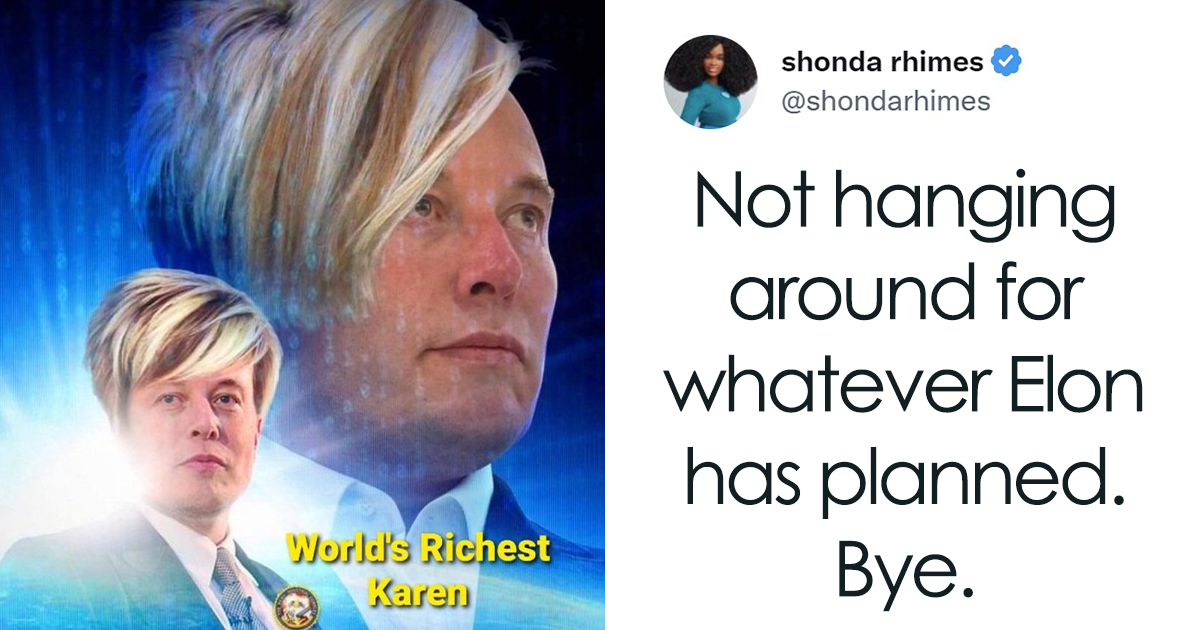
2. Shonda Rhimes: A Clean Exit
Shonda Rhimes, the powerhouse behind shows like Grey’s Anatomy and Scandal, became one of the most visible celebrities to say goodbye early. Her short exit message carried the tone of someone leaving a chaotic party before the karaoke machine gets involved.
3. Sara Bareilles: “This One’s Just Not For Me” Energy
Singer-songwriter Sara Bareilles also announced she was leaving. Her reaction felt less like a dramatic door slam and more like a calm decision to step away from a platform that no longer felt aligned with how she wanted to communicate.
4. Ken Olin: Leaving With A Civic Message
Producer and actor Ken Olin’s departure was framed around kindness, democracy, generosity, and protecting the planet. In other words, he did not simply say “bye.” He left Twitter with a mini graduation speech for humanity.
5. Toni Braxton: Concern Over Hate Speech
Toni Braxton expressed alarm over hateful language she saw after the takeover. Her reaction represented a major concern among Black users and other marginalized communities: that a weaker moderation approach could make the platform feel less safe.
6. Whoopi Goldberg: “I’m Out”
Whoopi Goldberg announced on The View that she was getting off Twitter, at least for the time being. Her reasoning was simple: the place felt messy, and she did not want to keep participating while the dust storm was still in progress.
7. Gigi Hadid: Calling It A “Cesspool”
Model Gigi Hadid reportedly left Twitter and criticized the platform’s direction. Her reaction became part of a broader celebrity migration conversation, as public figures reassessed whether Twitter was worth the emotional toll.
8. Jameela Jamil: The Early Warning
Jameela Jamil had already raised concerns when Musk’s acquisition bid first became public. Her on-and-off relationship with the platform reflected what many users felt: Twitter could be useful, funny, and addictive, but also exhausting enough to require a digital hazmat suit.
9. Rob Reiner: Stay And Fight
Rob Reiner took a different view. Instead of urging people to leave, he suggested that users concerned about democracy should remain active, especially during election season. For him, Twitter was still a battlefield worth occupying.
10. LeBron James: Alarm Over Slur Reports
LeBron James reacted to reports of rising hate speech and racial slurs after the takeover. His concern was not about who owned Twitter as much as what the platform would tolerate under new leadership.
11. Kathy Griffin: The Parody Protest
Kathy Griffin became central to one of the takeover’s earliest controversies after changing her display name to Elon Musk as a parody. Her account was suspended, igniting debate over impersonation, comedy, and whether “free speech” had footnotes.
12. Valerie Bertinelli: A Point Made With A Name Change
Valerie Bertinelli also used display-name parody to make a point about verification and identity. Her reaction highlighted a practical concern: if blue checks could be purchased, how would users know who was real?
13. Elton John: Leaving Over Misinformation
Elton John later announced he was stepping away, citing misinformation concerns. His exit showed that the unease was not just about rudeness or drama. For many, it was about the spread of harmful falsehoods.
14. Jim Carrey: Art, Farewell, And A Digital Curtain Call
Jim Carrey also became part of the celebrity departure wave. In true Jim Carrey fashion, his exit was not bland. It arrived with creative flair, because apparently even quitting Twitter can have stage lighting.
15. Trent Reznor: Rejecting The Vibe
Nine Inch Nails frontman Trent Reznor criticized the platform’s direction and joined the list of artists who no longer wanted to participate. His reaction reflected a broader creative-class fatigue with social media toxicity.
16. Jack White: Criticism From A Musician’s Corner
Jack White sharply criticized Musk and the reinstatement of controversial accounts. His reaction showed how the Twitter takeover quickly became a debate not only about moderation but also about accountability.
17. Adam McKay: A Political Exit
Writer and filmmaker Adam McKay was among the public figures who said they were leaving. His reaction fit the mood of politically engaged users who believed the platform’s new direction could make public discourse worse.
18. Meek Mill: Another Celebrity Departure
Rapper Meek Mill was also reported among notable users stepping away. His move showed that the exodus was not limited to one corner of Hollywood or one political lane.
19. Mia Farrow: Considering The Door
Mia Farrow was among those who weighed whether to leave. That hesitation was important. Many users did not want to abandon communities they had built, even while feeling increasingly uncomfortable.
20. Josh Gad: The “Should I Stay?” Mood
Actor Josh Gad represented another group: users who were disturbed by the takeover’s implications but uncertain whether quitting was the right move. That ambivalence may have been the most relatable reaction of all.
21. Molly Jong-Fast: Staying Because Twitter Was Home Base
Writer Molly Jong-Fast captured the perspective of people whose professional and social lives were deeply tied to Twitter. For journalists, authors, commentators, and internet-native personalities, leaving was not as simple as deleting an app. It was like moving out of an apartment where all your contacts, archives, jokes, and enemies lived.
22. Alyssa Farah Griffin: Watching For Trump’s Return
Alyssa Farah Griffin, a former Trump aide and television commentator, focused on whether Donald Trump would return to Twitter. Her reaction reflected one of the central political questions of the takeover: who would be reinstated, and what would that mean for public debate?
23. Wajahat Ali: Concerned Commentary
Writer Wajahat Ali was among the public voices reacting critically to the takeover. His perspective fit a wider concern that Twitter could become more hostile toward journalists, minorities, and politically outspoken users.
24. Tressie McMillan Cottom: Academic Twitter Anxiety
Academic and writer Tressie McMillan Cottom represented another essential Twitter community: scholars who used the platform for public analysis, professional visibility, and rapid commentary. For academics, the takeover threatened not just entertainment but a valuable communication network.
25. Chris Hayes: Media-Watcher Mode
MSNBC host Chris Hayes was among media figures reacting to the unfolding chaos. Journalists had a special stake in the platform because Twitter had long functioned as a news wire, tip line, argument factory, and public correction machine all at once.
26. Naomi Klein: The Broader Power Question
Author Naomi Klein’s reaction fit a larger critique of billionaire control over public communication spaces. The issue was not only Musk’s personality. It was whether one extremely wealthy person should have so much influence over a platform used for politics, activism, journalism, and crisis updates.
27. Tom Coates: Tech-Savvy Skepticism
Technology commentator Tom Coates appeared in reaction roundups as one of many users scrutinizing Musk’s promises. Tech users were not only asking what would change; they were asking whether the new owner understood the platform’s fragile social mechanics.
28. Dan Crenshaw: A Conservative Reaction
Representative Dan Crenshaw was part of the broader political response. Many conservative users welcomed Musk’s takeover as a correction to what they saw as unfair moderation. Their enthusiasm was a reminder that the reaction was never one-sided.
29. Tomi Lahren: Applause From The Right
Conservative commentator Tomi Lahren also represented the users who saw the acquisition as good news. For this camp, Musk’s arrival suggested a platform that might be friendlier to voices they believed had been suppressed.
30. Everyday Twitter Users: The Meme Department Reported For Duty
Beyond famous names, ordinary Twitter users supplied the jokes, doubts, and doomscrolling commentary. Some predicted advertisers would flee. Others joked about the bird logo having a nervous breakdown. Some cheered. Some sighed. Some announced they were leaving and then returned three hours later, because Twitter was always a little like a refrigerator: people kept opening it even when they knew nothing good was inside.
The Verification Meltdown Made Everything Worse
One of the biggest flashpoints after Musk’s takeover was verification. Before the acquisition, blue check marks generally signaled that an account had been verified as authentic. The system was imperfect and occasionally elitist, but users broadly understood what it meant. Then came the idea of charging for a blue check through Twitter Blue.
The concept sounded simple: users could pay for verification-style status. The consequences were less simple. Fake accounts posing as brands and public figures appeared, some with blue checks. This created confusion and reputational headaches for companies. Suddenly, a tiny symbol that once meant “this is probably the real account” looked more like “someone has eight dollars and ambition.”
For celebrities, the verification shift mattered because public figures are constant targets for impersonation. For journalists, it threatened source trust. For brands, it threatened customer confusion. For comedians, it created a brief golden age of parody chaos, quickly followed by suspensions and rule changes. The whole episode made users wonder whether Twitter’s new leadership was moving fast or simply shaking the vending machine until snacks and wires fell out together.
Why Some Celebrities Left Twitter
Celebrity departures were driven by several overlapping concerns. First, many worried that looser moderation would increase hate speech. Second, some disliked Musk’s management style and public behavior. Third, others were uneasy about misinformation, especially on a platform where false claims can travel faster than a celebrity apology after a Notes app scandal.
There was also a personal-brand calculation. Celebrities use social media to promote projects, talk to fans, support causes, and occasionally remind everyone that they, too, have opinions about airline boarding. But when a platform becomes associated with hostility or instability, the value of staying changes. The audience may still be there, but the room feels different.
For some stars, leaving Twitter was a statement. For others, it was self-care. And for a few, it was probably a practical decision made after looking at the timeline and whispering, “Absolutely not.”
Why Others Refused To Leave
Leaving sounded clean, but staying had its own argument. Twitter remained a powerful platform for activism, journalism, emergency information, and political organizing. Users like Rob Reiner argued that abandoning the space could give more influence to the loudest and most extreme voices.
This created a genuine dilemma. If a platform feels harmful, leaving protects your peace. But if a platform shapes public conversation, leaving may reduce your ability to influence that conversation. Many users were stuck between two bad options: stay in a messy room or leave the messy room to the people making the mess.
What The Takeover Revealed About Social Media Culture
The reaction to Elon Musk taking over Twitter revealed that people do not experience social media as a neutral tool. They experience it as a place. Twitter had neighborhoods: Black Twitter, Weird Twitter, Academic Twitter, Film Twitter, NBA Twitter, Politics Twitter, Brand Twitter, and countless micro-communities held together by jokes, arguments, and shared references.
When ownership changed, users reacted as if their neighborhood had been sold to a developer who immediately announced plans through memes. Some were excited about renovations. Others feared eviction. Many just wanted to know whether the plumbing still worked.
The takeover also showed how dependent public discourse had become on privately owned platforms. A single business deal changed the mood of journalism, politics, entertainment, and online activism. That is a lot of cultural weight for an app where people also debate pizza toppings and post photos of dogs wearing sunglasses.
Experience-Based Reflection: What Users Can Learn From The Twitter Exit Debate
The reactions to Musk’s Twitter takeover offer a useful lesson for anyone who spends time online: your relationship with a platform should be intentional, not automatic. Many people stayed on Twitter for years because everyone else was there. Their friends were there, their favorite writers were there, their breaking news was there, and their best jokes had nowhere else to go. Then the takeover forced a question that users often avoid: do I actually like being here?
That question matters beyond Twitter. Social platforms change all the time. Ownership changes. Algorithms change. Moderation rules change. Verification systems change. Your feed can go from lively to unbearable without asking permission. The best experience strategy is to treat platforms as rented space, not permanent homes. Build your audience, but do not build your entire identity on land you do not own.
For creators, journalists, business owners, and public figures, the practical takeaway is diversification. Keep an email list. Maintain a website. Use multiple platforms. Save your archives. If one app changes direction overnight, you should not feel as if your entire community has been locked in a birdcage and shipped to another billionaire’s garage.
For casual users, the lesson is emotional. Social media can be informative, funny, and genuinely connective. It can also be a slot machine that pays out in outrage. After the Musk takeover, many users realized that they were not only reacting to policy changes; they were reacting to how Twitter made them feel. Tense. Defensive. Addicted. Entertained. Informed. Annoyed. Sometimes all before breakfast.
Leaving a platform does not have to be dramatic. You do not need a farewell thread with twelve parts and a black-and-white profile picture. You can simply log off, delete the app, reduce notifications, or decide to use it only for specific purposes. On the other hand, staying does not mean endorsing everything about the platform. Some users stayed because their communities remained valuable. Others stayed to monitor news, fight misinformation, or keep professional connections alive.
The healthiest approach is to define your own rules. Decide what you use the platform for. Decide what crosses the line. Decide how much time it deserves. If your feed constantly makes you feel worse, that is data. If your community still brings value, that is data too. The mistake is letting the platform decide for you.
In the end, the celebrity reactions were entertaining, but the deeper story was about control. Musk bought Twitter, but users still had to decide whether Twitter owned their attention. That is the real social media question of the era. Not “Who owns the app?” but “How much of my day, mood, work, and voice am I giving to it?”
Conclusion
Elon Musk taking over Twitter was more than a tech-business headline. It was a cultural earthquake with memes for aftershocks. Celebrities left, activists debated, journalists worried, conservatives celebrated, brands hesitated, and ordinary users turned the whole thing into a global group chat with better jokes than stability.
The takeover exposed the fragile bargain behind social media: users create the culture, but owners control the infrastructure. That tension is why the reactions were so intense. Twitter was not just an app; it was a stage, newsroom, comedy club, complaint desk, protest sign, and digital town square squeezed into one endlessly scrolling feed.
Some people decided the new version was not for them. Others stayed because the conversation still mattered. Both choices made sense. The important thing is that users began asking better questions about where they spend their attention, who controls their communities, and whether any platform deserves permanent loyalty. The bird may have been “freed,” but the users had to decide whether they wanted to keep flying with it.













