
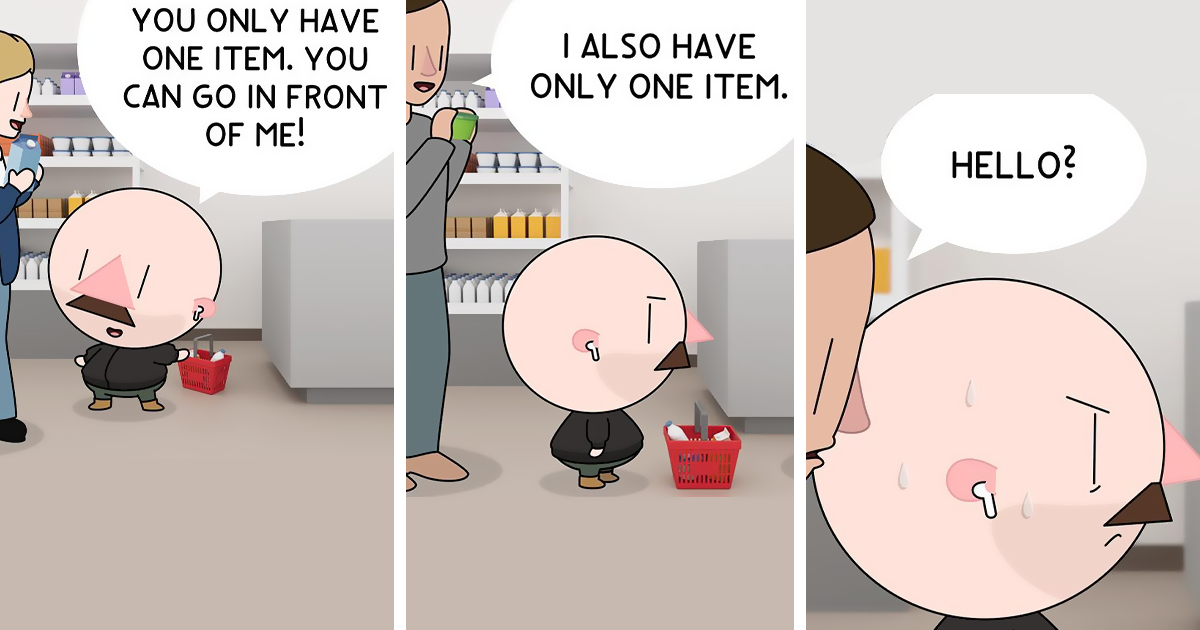
Some artists need explosions, dragons, capes, glowing swords, and a suspiciously dramatic thunderstorm to make a story memorable. Mesut Kaya needs a bald little guy, a pointy nose, a heroic mustache, and one painfully familiar human moment. That is the charm behind 30 New Comics By Mesut Kaya Illustrating Funny And Sometimes Awkward Life Situations: the humor does not arrive wearing a tuxedo. It sneaks in wearing sweatpants, trips over the coffee table, and says, “I meant to do that.”
Kaya’s comics are built around tiny disastersthe kind that make us laugh because we have either lived them, caused them, or watched someone else suffer through them while pretending not to notice. His protagonist, often described as an exaggerated version of the artist himself, moves through the world like a walking magnet for awkwardness. Supermarket encounters become emotional obstacle courses. Social situations turn into slapstick puzzles. Everyday confidence walks into a room, immediately slips on a banana peel, and files for early retirement.
What makes these Mesut Kaya comics so enjoyable is not only the punchline. It is the timing, the softness of the character design, and the way a simple four-panel setup can capture a whole emotional spiral. In a few drawings, Kaya turns embarrassment, confusion, kindness, insecurity, family life, and absurd logic into compact visual jokes that feel instantly shareable.
Who Is Mesut Kaya?
Mesut Kaya is a German artist and digital designer known online for creating short, funny webcomics about a small bald character with a large mustache. The character is not a strict self-portrait, but Kaya has explained in interviews that the little guy is an exaggerated version of himself. That detail matters because the comics feel personal without becoming heavy. They are not diary entries with punchlines stapled on. They are more like emotional cartoons: real feelings dressed up in round shapes and tiny shoes.
Kaya has said that he grew up loving cartoons, comics, anime, manga, and visual storytelling. His childhood interest in Japanese media, especially gag-driven stories, helped shape the kind of humor he enjoys today. Rather than relying on giant battles or grand action scenes, he prefers human interactions, odd turns, and compact comic rhythm. His work shows the influence of gag manga, internet comics, and modern social media storytelling, but the voice is very much his own.
His comics often appear in a four-panel structure. That limitation is not a cage; it is part of the game. Four panels give Kaya just enough space to set up a situation, twist it, and land the joke before the reader’s thumb scrolls away. In a world where attention spans are treated like endangered wildlife, that compactness is a superpower.
Why These Funny Life Situation Comics Work So Well
At first glance, Kaya’s comics may look simple. A cute character enters a scene, something unexpected happens, and the reader smiles. But the simplicity is carefully engineered. The best short comics do not waste motion. Every face, pause, object, and panel transition has a job. Kaya’s work understands this beautifully.
1. The Character Design Is Instantly Recognizable
The bald head, pointed nose, small body, and oversized mustache make the protagonist easy to identify in any scene. That kind of visual consistency is powerful in webcomics. Readers do not need a fresh introduction every time. The moment the little guy appears, we understand the emotional contract: something funny, weird, awkward, or oddly wholesome is probably about to happen.
2. The Humor Is Relatable Without Being Predictable
Relatable comedy can become lazy when it simply points at normal life and says, “This, right?” Kaya goes further. His comics often begin with something recognizablea social interaction, a small insecurity, a daily inconveniencebut then push it into a strange or exaggerated direction. That tiny leap from ordinary to absurd is where the joke lives.
3. The Awkwardness Feels Gentle
Some comedy laughs at people. Kaya’s comics usually laugh with them. Even when the little mustached hero is embarrassed, the tone rarely feels cruel. The awkwardness is familiar and forgiving, like remembering a moment when you waved back at someone who was actually waving to the person behind you. Painful? Yes. Fatal? Only socially, for about four seconds.
The Beauty Of The Four-Panel Comic Format
The four-panel format is perfect for internet humor because it feels complete but never exhausting. It works almost like a tiny stage play. Panel one introduces the situation. Panel two adds tension. Panel three shifts expectations. Panel four delivers the punchline, reveal, or emotional button.
Kaya has mentioned that he enjoys the challenge of telling stories in four panels. That challenge gives his comics discipline. There is no room for rambling. A joke either works or it politely packs its bag and leaves. This is why his strips often reward rereading. A facial expression, background detail, or tiny visual clue can make the punchline funnier the second time around.
Modern webcomics thrive on this kind of efficiency. A clean four-panel strip fits neatly into Instagram, Facebook, Reddit-style sharing, and mobile screens. It can be read during a coffee break, in a waiting room, or during that mysterious three-minute period when you opened your phone to check the weather and somehow ended up watching raccoons steal cat food.
Funny, Awkward, And Sometimes Too Real
The title 30 New Comics By Mesut Kaya Illustrating Funny And Sometimes Awkward Life Situations says exactly what readers can expect: life, but slightly more cartoonish and much better timed. Kaya’s humor often lands in that strange middle ground between “Ha, that is ridiculous” and “Please delete the surveillance footage of my entire personality.”
His comics may touch on public embarrassment, relationship moments, self-image, work situations, parenthood, random misunderstandings, or the strange logic people use to survive daily life. One strip might turn a small inconvenience into a full dramatic crisis. Another might make a quiet emotional point while still ending with a visual gag. That range keeps the collection from feeling repetitive.
Awkward Encounters
Awkward encounters are one of Kaya’s strongest playgrounds. The little guy is often placed in situations where normal human behavior suddenly becomes impossible. Standing in line, talking to a stranger, entering a room, or trying to appear cool can all become Olympic-level challenges. Anyone who has rehearsed a simple sentence in their head and then produced a sound like a haunted printer will understand.
Everyday Absurdity
Kaya also understands that daily life is already absurd. We pretend it is normal to spend years learning how to behave at supermarkets, birthdays, offices, gyms, and group chats. Then one tiny unexpected thing happens, and all our social software crashes. His comics exaggerate that crash in a way that feels oddly comforting.
Wholesome Chaos
Not every gag is built on embarrassment. Some strips lean into sweetness, especially when family or relationships enter the scene. Kaya has shared that fatherhood changed his routine and gave him a new life chapter to draw from. That experience brings a warmer layer to his newer comics. The chaos remains, but now it sometimes carries a diaper bag.
Why Readers Connect With Mesut Kaya’s Comics
Readers connect with Kaya’s work because the comics feel emotionally honest. They are not trying to be the loudest thing on the internet. They are trying to catch a small truth before it escapes. That truth might be insecurity, impatience, tenderness, jealousy, confusion, or the universal experience of making something worse while trying very hard to make it better.
There is also a lovely humility in the art style. The characters are expressive but not overcomplicated. The settings are clear but not cluttered. The color palettes tend to support the joke rather than distract from it. This gives the reader a smooth experience: look, understand, laugh, maybe feel personally attacked, continue scrolling.
His best comics often rely on what happens between panels. The reader fills in the missing beat, which makes the joke more participatory. Instead of explaining everything, Kaya trusts the audience to connect the dots. That trust is one reason the strips feel smarter than their small size might suggest.
The Role Of Facial Expressions In Kaya’s Humor
Facial expressions are one of Kaya’s secret weapons. A raised eyebrow, tiny mouth, blank stare, or panicked side-eye can carry half the joke. In short comics, expressions are not decorative; they are dialogue. Sometimes the funniest part of a strip is not what the character says, but the exact moment his face realizes life has betrayed him again.
The mustache also deserves credit. It is not just facial hair. It is a mood indicator, a visual anchor, and possibly the hardest-working supporting actor in the series. On a small cartoon face, a large mustache becomes comic punctuation. It makes embarrassment funnier, confusion bigger, and confidence more fragile.
What Makes These Comics SEO-Friendly And Shareable?
From a content perspective, funny comics about life perform well because they satisfy several reader needs at once. They are quick to consume, easy to share, visually appealing, and emotionally accessible. Search users looking for awkward life comics, relatable webcomics, or funny illustrations about everyday situations are usually not seeking a textbook. They want a small break from reality, preferably one that confirms reality is weird for everyone.
Kaya’s work fits naturally into that demand. His comics are specific enough to feel original but broad enough to cross language and culture barriers. A joke about embarrassment, misunderstanding, or tiny personal failure does not need much translation. Humanity has been socially awkward in every known language.
Examples Of Themes In The 30 New Comics
Although each strip stands on its own, the collection can be understood through a few recurring themes. These themes help explain why Kaya’s comic style feels cohesive even when the situations vary wildly.
Social Pressure
The little protagonist often tries to behave correctly in public, which is exactly when public life becomes a trap. The comedy comes from the gap between what he intends and what actually happens. That gap is where most real embarrassment lives.
Modern Life Problems
Technology, work, shopping, online habits, and everyday routines can all become joke machines. Kaya is especially good at finding the strange emotional weight inside small modern problems. A phone notification, a checkout line, or a casual comment can become the beginning of a tiny identity crisis.
Relationships And Family
Some of Kaya’s most charming comics involve couples, domestic life, and parenthood. These strips work because they observe affection without making it sugary. Love, in Kaya’s universe, is sweetbut it is also tired, weird, occasionally confused, and probably trying to assemble furniture without reading the instructions.
Physical Comedy
Because Kaya’s protagonist has such a distinct shape, physical comedy lands quickly. The little body, large head, and expressive features make movement readable and funny. A fall, jump, dance, or sudden pose can deliver a punchline before a word bubble appears.
Why Awkward Comedy Feels So Comforting
Awkward comedy works because it gives us permission to laugh at the parts of life we usually hide. Everyone has moments when they feel too small, too loud, too late, too confused, or too aware of their own hands. Kaya turns those moments into cartoons, which makes them less threatening. Once embarrassment becomes a drawing, it loses some of its power.
There is also a social benefit to this kind of humor. When people share a comic about an awkward moment, they are often saying, “This is me,” or “This happened to us,” or “Please enjoy this accurate documentary about my nervous system.” The comic becomes a tiny emotional postcard.
Experience: Reading Mesut Kaya’s Comics Feels Like Seeing Your Inner Monologue In A Tiny Mustache
The best way to describe the experience of reading Mesut Kaya’s comics is this: it feels like someone has quietly followed your inner monologue around with a sketchbook. Not the impressive inner monologuethe one that makes deep decisions and remembers passwords. The other one. The one that panics when a cashier says, “You too,” after you say, “Have a nice day.”
There is a special pleasure in seeing small humiliations transformed into art. In real life, awkward situations feel enormous while they are happening. A wrong word, a clumsy entrance, a failed attempt to be coolthese moments can expand until they fill the entire room. Kaya shrinks them back down. He turns the disaster into four panels, gives it a mustache, and suddenly it becomes survivable.
Reading a collection like this also reminds you how much comedy lives in timing. A pause can be funnier than a speech. A blank stare can be louder than a scream. Kaya’s comics often make you slow down for a second because the punchline is not always shouted. Sometimes it waits patiently in the final image, letting your brain walk into the joke on its own. That delayed reaction is one of the joys of visual humor.
Another enjoyable part is the feeling of recognition. You may not have been in the exact situation shown in a comic, but you know the emotional category. You know the panic of being perceived. You know the strange confidence that appears right before a mistake. You know the tiny betrayal of your own body language when you are trying to act casual and instead look like a malfunctioning garden gnome.
Kaya’s work also makes everyday life feel less lonely. That sounds dramatic for comics about a little bald man with a mustache, but it is true. Relatable humor tells readers that their private weirdness may not be private at all. Maybe everyone is improvising. Maybe everyone is pretending to understand the rules. Maybe the most human thing in the world is quietly hoping nobody noticed the awkward thing you just did, while absolutely everyone noticed and kindly chose peace.
The parenthood-related comics add another layer to that experience. They carry the tired warmth of real life: the strange mixture of love, exhaustion, and surprise that comes with caring for someone small. Kaya does not need to turn family life into a perfect greeting card. He can let it be messy, funny, tender, and slightly chaotic. That honesty makes the sweetness stronger.
There is also something refreshing about the scale of the stories. These are not world-ending conflicts. No villain is trying to destroy the galaxy. No ancient prophecy depends on a chosen one finding a magic sword. Instead, the stakes are beautifully tiny: a social misunderstanding, a bad decision, a weird reaction, a small act of kindness, a personal insecurity. Yet those little stakes matter because that is where most of us actually live.
In the end, the experience of reading 30 New Comics By Mesut Kaya Illustrating Funny And Sometimes Awkward Life Situations is like taking a guided tour through the funny museum of being human. Each comic is a small exhibit: here is embarrassment, here is love, here is confusion, here is overthinking, here is a man with a mustache somehow representing all of us. You leave the collection amused, slightly exposed, and grateful that someone else can turn the strange little glitches of daily life into something this charming.
Conclusion
Mesut Kaya’s comics prove that funny storytelling does not need to be loud, complicated, or overloaded with dialogue. A simple character, a clean setup, and a perfectly timed awkward twist can say plenty. His bald, mustached protagonist has become a lovable guide through the comedy of everyday life, from embarrassing social moments to sweet domestic chaos.
What makes these comics memorable is their balance. They are silly without being empty, relatable without being stale, and awkward without becoming mean. Kaya understands that life is already full of punchlines; the artist’s job is to catch them before they run away. In these 30 new comics, he does exactly that, turning ordinary situations into tiny, funny reminders that being human is weirdand honestly, thank goodness.
Note: This article is based on publicly available information about Mesut Kaya’s comics, artist interviews, public creator profiles, and broader research into modern webcomic storytelling, four-panel humor, visual narrative, and social media comic culture.













