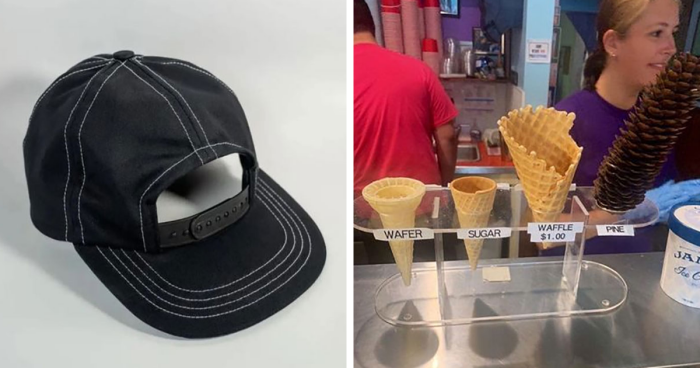
There is a special kind of confusion that occurs when your brain sees an ordinary object in a wildly inappropriate location. A toothbrush in a bathroom? Fine. A toothbrush growing out of a flowerpot? Questions. An ice cream cone filled with meatballs? Suddenly, lunch has become an investigation.
Things in places they shouldn’t be are internet comedy at its purest because the joke needs almost no explanation. The brain recognizes the object, recognizes the location, and immediately files a complaint with management. Psychologists have long connected humor with incongruitythe collision between what we expect and what actually appearswhile another influential explanation suggests that something can feel funny when it violates expectations without becoming overwhelmingly threatening. In other words, a harmlessly wrong object can function like a visual punchline.
Of course, the line between hilarious and concerning can be thinner than a gas-station napkin. A mannequin forgotten in a vehicle is funny. A propane tank forgotten there deserves considerably less giggling. Airport authorities even have a formal term for misplaced objects capable of creating hazards: foreign object debris. Meanwhile, environmental agencies document everything from small consumer trash to enormous tangles of abandoned fishing gear appearing where nature definitely did not order them.
Inspired by viral collections of bizarre object-location combinations and real reports from transportation agencies, lost-property systems, parks, airports, and unclaimed luggage facilities, here are 50 examples that make you ask the most important question in modern civilization: How did that get there?
50 Hilarious and Concerning Things Found Where They Absolutely Did Not Belong
Food Crimes and Household Confusion
- Meatballs in an ice cream cone. The cone says dessert. The meatballs say dinner. Together, they say someone has rejected the basic principles of menu organization.
- A compact disc being used to cut pizza. Somewhere, a pizza wheel is unemployed while an old music collection is being forced into kitchen service.
- A tambourine among bathroom supplies. Shampoo, soap, conditioner, percussion instrument. Perhaps the morning routine was simply more theatrical than most.
- Twenty pounds of duck sausage in a rideshare. Forgetting your phone is understandable. Forgetting enough sausage to cater a suspiciously specific festival is a different achievement.
- A fish loin intended for a restaurant left in a car. The concerning part is not that somebody forgot it. The concerning part is the driver discovering it several hours later.
- Hundreds of donuts abandoned after a ride. A single forgotten donut is a tragedy. Hundreds of them constitute a carbohydrate emergency requiring immediate investigation.
- A massive bag of blue raspberry candy. The owner lost enough artificial blue flavoring to permanently alter the color balance of a small town.
- An entire wedding cake left behind. There are wedding-day mistakes, and then there is arriving at the reception without the architectural centerpiece made of frosting.
- A full Thanksgiving meal in transit. Somewhere, a family was setting the table while one seat remained reserved for the person explaining where the turkey went.
- A live lobster in the back of a vehicle. Of all possible passengers to be accidentally abandoned, the one with claws seems especially motivated to file a complaint.
Objects That Turned a Vehicle Into a Storage Unit
Lost-and-found reports demonstrate that people do not merely forget keys and phones. Recent U.S. rideshare data has included appliances, medical equipment, live animals, unusual foods, wedding clothing, industrial equipment, and objects so large that forgetting them seems to require a philosophical commitment to not looking backward.
- A brand-new mini refrigerator. It is difficult to imagine exiting a car and failing to notice that your refrigerator is no longer participating in the journey.
- A 75-gallon fish tank. This is not an item that slips between seat cushions. It is practically a transparent studio apartment.
- A dishwasher. Anyone who can forget a household appliance weighing more than many adult humans may be operating at an advanced level of distraction.
- A double-door oven. At some point, a vehicle apparently stopped being transportation and became an extremely ambitious home-delivery service.
- A coffee table. Perhaps the passenger became so comfortable in the back seat that they briefly attempted to furnish it.
- A kitchen faucet. Technically, somebody came surprisingly close to leaving the kitchen sink.
- A shower pole. One can only hope the rest of the bathroom arrived safely at its destination.
- Two actual trees. Most passengers check for phones, wallets, and keys before leaving. Someone apparently needed to add “forest” to the checklist.
- A patch or bundle of grass. The passenger may have been transporting landscaping materialor quietly attempting to introduce a lawn to the automotive industry.
- A meat slicer. One moment, you are taking a ride. The next, your driver is wondering why the back seat looks prepared to open a delicatessen.
Medical and Personal Items That Create Immediate Questions
- Dentures with only two teeth. Losing your teeth is unfortunate. Losing the device containing your remaining replacement teeth feels like the universe adding unnecessary paperwork.
- A child’s prosthetic eye. The humorous surprise disappears quickly here. Some misplaced objects are deeply important to their owners and deserve an especially urgent return.
- Pelvis implants. Most people expect medical hardware to be either in a hospital or performing its assigned dutiesnot waiting alone in a vehicle.
- An oxygen tank. A reminder that an unusual lost object can be more than an inconvenience; it may be essential medical equipment.
- A sleep apnea machine. The owner probably discovered the mistake at exactly the worst possible time: when trying to go to sleep.
- A stethoscope. Somewhere, a medical professional may have arrived at work and experienced the world’s most literal “I knew I was forgetting something” moment.
- A respirator and hard hat. Safety equipment left behind before work is the occupational equivalent of bringing a sandwich but forgetting lunch.
- Human hair. Not a few strands. A transportable quantity significant enough to be reported as a lost item. The backstory remains gloriously unavailable.
- Breast milk. This may sound unusual in a lost-property report, but for its owner it can represent valuable time and effort, making recovery genuinely important.
- An ankle monitor. There are objects you forget accidentally and objects that immediately make everyone wonder whether “accidentally” is doing some heavy lifting.
Airport Finds That Stop Being Funny Very Quickly
Airport security officers regularly encounter objects packed in places or bags where they do not belong. Recent unusual-find reports have included replica explosive materials, weapons concealed or packed in unexpected ways, knives, ammunition, and firearms. The FAA separately warns that even ordinary debris in the wrong part of an airport can damage aircraft or injure people.
- A replica pipe bomb at an airport checkpoint. Even when an object is not a functioning explosive, choosing airport security as its travel companion is a spectacularly poor decision.
- Replica blocks resembling C4. There are jokes that work at parties. Looking like military explosives while passing through security is not among them.
- A firearm packed in a golf bag. Golf already has clubs, balls, tees, and deeply complicated opinions about pants. It does not need this accessory.
- A knife hidden in a child’s car seat. Few combinations trigger the words “please explain immediately” faster than that one.
- Knives and ammunition wrapped in foil. Aluminum foil may preserve leftovers, but it does not magically transform prohibited or dangerous objects into sandwiches.
- Electric cattle prods inside a guitar case. A guitar case traditionally promises music. Opening one to discover livestock-control equipment dramatically changes the genre.
Nature, Parks, and the Great Outdoors
Not every strange object outdoors is harmless litter. NOAA has documented marine debris ranging from tiny discarded consumer items to enormous masses of abandoned fishing gear, while the National Park Service warns visitors that unfamiliar objects may sometimes be hazardous debris or historically important artifacts that should remain untouched.
- A 4,000-pound tangle of fishing nets on a coral reef. This is less “somebody littered” and more “the ocean has been forced to store an industrial nightmare.”
- A cracked bowling ball recovered from water. Nobody expects to go looking for aquatic debris and discover evidence of an underwater bowling league.
- Missile-test debris buried in sand dunes. At White Sands, unfamiliar objects can be serious enough that visitors are instructed not to touch them and to alert a ranger.
- A rusty can that may actually be history. In protected areas, yesterday’s garbage can become today’s archaeological evidence, making “cleaning up” surprisingly complicated.
The Lost-Luggage Hall of Fame
Unclaimed luggage facilities and major lost-property systems offer another window into human forgetfulness. Reports have described valuable jewelry, historic objects, unusual machinery, weapons, medical devices, artificial bones, and even mysterious technology. Transit systems often require detailed descriptions before returning property, which seems wise when the lost item is considerably stranger than a black umbrella.
- A samurai sword inside unclaimed luggage. Most forgotten suitcases contain socks. Discovering a sword turns routine baggage processing into the beginning of an adventure movie.
- A fragment of a meteorite. Imagine successfully transporting something that traveled through space for millions of years, only to lose it at baggage claim.
- A fully assembled robot with an unclear purpose. The only responsible response is to avoid pressing mysterious buttons and hope it does not know your name.
- A suitcase containing carefully packed rat poison. The neat organization somehow makes the situation more unsettling rather than less.
- Fake human bones. They may be artificial, but nobody sorting luggage wants to discover that fact only after several emotionally complicated seconds.
- A missile guidance system. This is an excellent example of an object for which “Please describe your lost property” becomes a very memorable conversation.
- An engraved headstone. Reports of one turning up in unclaimed baggage prove that even objects designed for permanent placement can apparently go on unexpected vacations.
- A prosthetic leg in lost property. Forgetting something this personal sounds impossible until the history of lost-and-found departments demonstrates that humans can, in fact, forget nearly anything.
- A human skull discovered as lost property. At this point, the standard claim form probably requires a few additional questions.
- A wedding dress left without its owner. Few abandoned objects contain as much implied drama. The dress is silent; everyone else immediately writes an entire movie.
Why These Wrong-Place Objects Are So Satisfying to Look At
The magic lies in expectation. Our minds constantly predict what belongs in a scene. A freezer should contain food. A guitar case should contain a guitar. A car seat should contain a child or perhaps several crushed crackers of mysterious origin. When the expected object is replaced by something wildly different, the brain performs a tiny mental double take.
That mismatch is why visual oddities can be funnier than carefully written jokes. There is no setup to memorize. The setting provides the setup, and the misplaced object delivers the punchline. A dishwasher in a rideshare is funny because it is technically possible yet socially absurd. Two trees left in a car are funny because the object is familiar, but the act of forgetting them feels almost impossible.
Context also controls whether we laugh or become concerned. A wizard wand under a seat is delightful. A propane tank requires caution. A strange chunk of metal on a beach might be harmless trash, valuable historical material, or something dangerous. That uncertainty is why real-world judgment matters more than the urge to create the perfect viral photograph.
The Experience of Finding Something Where It Absolutely Shouldn’t Be
Encountering a truly misplaced object in real life usually follows a predictable emotional sequence. First comes recognition: I know what that is. Then comes location awareness: I know where I am. Finally comes the collision: Those two facts should not be happening together.
Imagine walking into an office break room and finding a single formal shoe inside the refrigerator. The first reaction is rarely to move it. You stare. You check whether anyone else is seeing this. You may open the refrigerator door a second time, because apparently the brain believes footwear can disappear if properly challenged. Then the theories begin. Was someone trying to cool a swollen foot? Was it a prank? Is the matching shoe in the microwave? The object becomes interesting precisely because the explanation is missing.
Public transportation creates an even stranger version of the experience. A forgotten phone tells a simple story: someone was distracted. A coffee table does not. Large or unusual abandoned objects make observers mentally reconstruct an invisible sequence of events. Someone acquired the object, carried it outside, loaded it into transportation, traveled with it, unloaded themselvesand somehow completed that final step without the object that was presumably the reason for the journey.
There is also an important difference between weird and unsafe. Finding a rubber duck in a tree is a photograph. Finding an unidentified metal cylinder near an active range, a weapon in a public place, or suspicious debris near transportation infrastructure is a situation for professionals. The best experience is sometimes the one in which curiosity loses the argument and nobody touches anything.
Another lesson is that context can completely change an object’s meaning. A rusty bottle in a modern parking lot may be litter. A similar bottle at an archaeological site may provide information about people who lived or worked there decades ago. A net in a fishing boat is equipment; the same net abandoned on a reef can become destructive marine debris. A propane tank beside a grill is ordinary; one forgotten in a passenger vehicle deserves attention. “Belonging” is often less about the object itself than its relationship with the environment around it.
Then there is the social experience. Strange discoveries are nearly impossible to keep to ourselves. People photograph them, send them to friends, post them online, and invite thousands of strangers to supply captions. A mysterious image becomes collaborative comedy. One person notices the absurdity; another invents the backstory; a third makes a pun so terrible that it somehow improves the situation.
Perhaps that is the real appeal of things in places they shouldn’t be. Everyday life is usually organized enough to become invisible. Cups live in cupboards. Cars stay on roads. Appliances remain in houses. Then a dishwasher appears in a rideshare, a meteorite turns up in forgotten luggage, or an ice cream cone arrives carrying meatballs, and the ordinary world briefly stops following its own rules.
For a moment, everyone becomes a detective. Nobody has enough evidence. The theories become increasingly ridiculous. And unless the object is actually dangerous, the mystery may be better than the answer.
Conclusion: Sometimes the Wrong Place Is the Perfect Punchline
The funniest misplaced objects are ordinary things that somehow escaped the rules governing ordinary life. They make us laugh because we instantly recognize the mismatch. They make us curious because we want the missing story. And occasionally, they make us step backward slowly because a strange object can be a genuine safety problem rather than an invitation to take a selfie.
From meatballs in ice cream cones and lobsters in cars to enormous appliances, medical devices, dangerous airport discoveries, marine debris, and mysterious objects hiding inside lost luggage, the world clearly has no shortage of things refusing to stay where logic assigned them.
So the next time you see something that clearly does not belong, take a moment before moving it. It might be a joke, a forgotten possession, an environmental problem, a historical artifact, or an object best handled by someone wearing gloves and carrying official identification.