
Note: This article is for general fitness education. Choose a medicine ball weight that allows clean form, stop if you feel sharp pain, and ask a qualified fitness professional or healthcare provider for guidance if you are new to exercise, recovering from injury, pregnant, or managing a medical condition.
A medicine ball looks innocent enough. It sits in the corner of the gym like a polite, slightly heavier cousin of a playground ball. Then you pick it up, squat with it, slam it, twist it, press it overhead, and suddenly your core sends a formal complaint to management. That is the beauty of medicine ball exercises: they make simple movements more powerful, more athletic, and much more interesting than counting ceiling tiles during another set of crunches.
If you want a full-body workout that trains strength, coordination, balance, power, and conditioning without needing a garage full of equipment, a medicine ball is a smart choice. It can add resistance to classic bodyweight moves, encourage your core to stabilize through rotation, and help you practice explosive movement in a controlled way. In other words, it is small, round, and extremely good at making your entire body join the meeting.
This guide breaks down six medicine ball exercise moves that work your legs, glutes, core, shoulders, arms, back, and cardiovascular system. You will also learn how to choose the right weight, how to structure the workout, and how to modify each move so it fits your fitness level.
Why Medicine Ball Workouts Are So Effective
Medicine ball training is often described as functional training because the movements resemble things your body does in real life: lifting, reaching, rotating, bracing, carrying, squatting, and throwing. Unlike many gym machines that isolate one muscle group, a medicine ball usually asks multiple muscles to cooperate. Your legs create force, your core transfers it, and your upper body finishes the movement. When everything works together, exercise starts feeling less like “leg day versus arm day” and more like “human body day.”
Another major benefit is versatility. You can use a medicine ball for slow strength work, fast power drills, core exercises, balance challenges, partner workouts, and low-equipment circuits. A lighter ball can turn a movement into cardio conditioning. A heavier ball can make squats, lunges, and carries feel more demanding. A soft slam ball can absorb impact during slams, while a firmer medicine ball can be useful for tosses and controlled strength exercises.
How to Choose the Right Medicine Ball Weight
The best medicine ball is not the heaviest one you can wrestle off the rack while making dramatic movie-trailer noises. It is the one you can control through the entire movement. For beginners, a 4- to 8-pound ball is often enough for learning technique. Intermediate exercisers may use 8 to 12 pounds for many full-body moves. Advanced athletes may go heavier, especially for slams, wall balls, or strength-focused circuits.
Use this simple rule: if the ball makes your form collapse, it is too heavy. Your spine should stay neutral during hinges and squats, your knees should track in line with your toes, and your shoulders should not feel pinched when the ball goes overhead. You should finish a set challenged, not confused about why your lower back is now the main character.
Before You Start: Warm Up Like You Mean It
A good warm-up prepares your joints, muscles, and nervous system for movement. Spend five to eight minutes gradually increasing your body temperature. Try marching or jogging in place, arm circles, hip circles, bodyweight squats, reverse lunges, inchworms, and light medicine ball halos. For the first round of the workout, move slower and use a lighter ball if available.
Focus on breathing, posture, and control. Exhale during the hardest part of each exercise, such as standing up from a squat, pressing the ball overhead, or slamming it down. Avoid holding your breath, especially during high-effort moves.
The Full-Body Medicine Ball Workout Plan
Perform the following six medicine ball exercise moves as a circuit. Beginners can do 2 rounds. Intermediate exercisers can do 3 rounds. Advanced exercisers can do 4 rounds or add a timed interval format.
- Reps: 8 to 12 per exercise, or 30 to 45 seconds per move
- Rest: 20 to 45 seconds between exercises
- Rounds: 2 to 4 total rounds
- Frequency: 2 to 3 times per week, with recovery days between hard sessions
1. Medicine Ball Squat to Overhead Press
Muscles worked: Quads, glutes, hamstrings, shoulders, triceps, core
The squat to overhead press is a full-body classic because it combines lower-body strength with upper-body pressing. It also teaches your body to transfer power from the ground up. Your legs do the heavy lifting, your core keeps your torso stable, and your shoulders finish the move.
How to do it
- Stand with your feet about shoulder-width apart and hold the medicine ball at chest height.
- Brace your core and sit your hips back into a squat.
- Keep your chest lifted and knees tracking in line with your toes.
- Drive through your feet to stand, pressing the ball overhead as you rise.
- Lower the ball back to your chest and repeat.
Form tip
Do not let the ball pull your ribs forward when you press overhead. Keep your ribs stacked over your hips, as if your torso is a strong column rather than a bendy straw.
Make it easier
Use a lighter ball and press only to forehead height instead of fully overhead.
Make it harder
Add tempo: lower into the squat for three seconds, then stand and press with power.
2. Medicine Ball Slam
Muscles worked: Core, lats, shoulders, triceps, glutes, legs
The medicine ball slam is the exercise version of deleting 47 unnecessary browser tabs. It is explosive, satisfying, and surprisingly effective. This move trains power, coordination, and conditioning. It also teaches you to use your whole body instead of just your arms.
How to do it
- Stand with your feet hip- to shoulder-width apart and hold a slam-safe medicine ball with both hands.
- Raise the ball overhead while keeping your ribs down and core braced.
- Rise slightly onto your toes if comfortable.
- Use your hips, core, and arms to slam the ball down in front of you.
- Squat or hinge to pick it up safely, then repeat.
Form tip
Choose a ball designed for slams. Some medicine balls bounce aggressively, and nobody wants a surprise uppercut from fitness equipment.
Make it easier
Perform slow overhead reaches and controlled downward chops without releasing the ball.
Make it harder
Do timed intervals: 20 seconds of powerful slams followed by 40 seconds of rest.
3. Medicine Ball Russian Twist
Muscles worked: Obliques, deep core, hip flexors, shoulders
The Russian twist is a popular core exercise, but the goal is not to fling the ball from side to side like you are trying to win a carnival game. The goal is controlled rotation. Your core should guide the movement while your spine stays long and your chest stays open.
How to do it
- Sit on the floor with your knees bent and feet flat.
- Hold the medicine ball close to your chest.
- Lean back slightly until your core engages.
- Rotate your torso to the right, then to the left.
- Move slowly and keep the ball close to your body.
Form tip
Turn your ribs and shoulders together. Avoid just waving the ball with your arms while your torso stays frozen.
Make it easier
Keep your feet on the floor and use a light ball or no ball.
Make it harder
Lift your feet slightly, but only if you can maintain a tall spine and steady control.
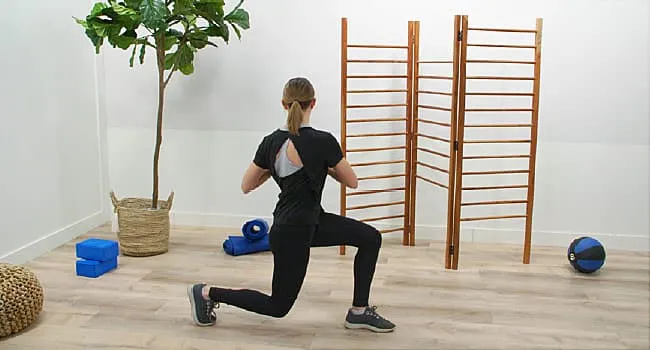
4. Medicine Ball Reverse Lunge With Rotation
Muscles worked: Glutes, quads, hamstrings, calves, obliques, core
This move trains balance, lower-body strength, and rotational control. It is especially useful because life rarely happens in perfectly straight lines. You turn to grab groceries, pivot during sports, reach across the car, and twist to find out why the dog is suspiciously quiet. A reverse lunge with rotation helps prepare your body for those everyday movements.
How to do it
- Stand tall and hold the medicine ball at chest height.
- Step your right foot back into a reverse lunge.
- As you lower, rotate your torso gently toward your front leg.
- Return the ball to center and push through your front foot to stand.
- Alternate sides with control.
Form tip
Rotate from your upper back and core, not by yanking your lower back. Keep the front knee aligned over the middle toes.
Make it easier
Remove the rotation and practice reverse lunges while holding the ball at your chest.
Make it harder
Pause at the bottom of the lunge for one second before standing.
5. Medicine Ball Push-Up Tap
Muscles worked: Chest, shoulders, triceps, core, serratus anterior
This exercise adds a stability challenge to a classic push-up pattern. You place one hand on the medicine ball, perform a push-up, then tap or roll the ball to the other side. The uneven surface forces your core and shoulders to work harder to keep your body stable.
How to do it
- Start in a high plank with one hand on the floor and the other hand on the medicine ball.
- Keep your feet slightly wider than usual for stability.
- Lower into a push-up while keeping your body in a straight line.
- Press back up, then move the ball to the other hand.
- Repeat, alternating sides.
Form tip
Your hips should not sway like a hammock in a thunderstorm. Brace your core and squeeze your glutes to stay steady.
Make it easier
Perform the move from your knees or skip the push-up and do alternating medicine ball shoulder taps from a plank.
Make it harder
Use a slower lowering phase or add a full hand-to-hand ball roll between reps.
6. Medicine Ball Wall Ball
Muscles worked: Glutes, quads, hamstrings, core, shoulders, arms, cardiovascular system
The wall ball is a squat plus an explosive throw. It is one of the best medicine ball exercises for a full-body workout because it trains strength, power, timing, and endurance in one move. It is also humbling. After a few rounds, even confident gym-goers start negotiating with the wall.
How to do it
- Stand facing a sturdy wall, holding the medicine ball at chest height.
- Keep your feet shoulder-width apart.
- Squat down with your chest lifted.
- Drive upward and throw the ball to a safe target height on the wall.
- Catch the ball close to your chest and smoothly lower into the next squat.
Form tip
Do not let the ball crash into your hands far away from your body. Catch it close, absorb the impact with your legs, and keep your chest proud.
Make it easier
Use a lighter ball, reduce the throw height, or perform a squat to chest pass without a high target.
Make it harder
Try 3 sets of 10 to 15 reps with short rest, or use intervals such as 30 seconds of work and 30 seconds of rest.
Sample 20-Minute Medicine Ball Workout
Here is a simple routine using the six moves above. It is efficient, balanced, and spicy enough to remind you that “quick workout” does not always mean “easy workout.”
Warm-up: 5 minutes
- 30 seconds marching or light jogging
- 30 seconds arm circles
- 30 seconds bodyweight squats
- 30 seconds reverse lunges
- 30 seconds hip hinges
- 30 seconds medicine ball halos
- Repeat once
Main circuit: 12 to 15 minutes
- Medicine Ball Squat to Overhead Press: 10 reps
- Medicine Ball Slam: 10 reps
- Medicine Ball Russian Twist: 12 reps per side
- Medicine Ball Reverse Lunge With Rotation: 8 reps per side
- Medicine Ball Push-Up Tap: 6 to 10 reps per side
- Medicine Ball Wall Ball: 10 to 15 reps
Rest 30 to 60 seconds after each round. Complete 2 to 4 rounds depending on your fitness level, schedule, and how dramatically your legs are negotiating.
Cool-down: 3 to 5 minutes
Finish with slow breathing, gentle shoulder stretches, hip flexor stretches, hamstring stretches, and a relaxed child’s pose. Cooling down gives your heart rate time to settle and helps your body transition out of workout mode.
Common Mistakes to Avoid
Going too heavy too soon
A medicine ball should challenge you without stealing your technique. If your back rounds, your knees cave inward, or your shoulders shrug toward your ears, reduce the weight.
Using only your arms
Many medicine ball moves are full-body exercises. In slams, wall balls, and squat presses, your legs and hips should create much of the power. Your arms guide and finish the movement.
Rushing rotational exercises
Rotation should be controlled. Fast twisting with poor form can irritate the lower back. Keep your core engaged and move with intention.
Skipping recovery
Medicine ball workouts can feel playful, but they still count as training. Give your muscles time to recover, especially after high-intensity slams and wall balls.
Who Should Try Medicine Ball Training?
Medicine ball workouts can work for beginners, athletes, busy parents, desk workers, and anyone who wants a compact tool for strength and conditioning. Beginners should start with basic movements and lighter loads. Athletes can use medicine balls for power, agility, and rotational strength. People training at home can use one ball for a surprisingly complete workout without needing a large space.
That said, not every move is right for every body. If overhead exercises bother your shoulders, modify the press and slam variations. If jumping or fast movement irritates your joints, choose slower strength-based moves. If you are managing pain, injury, or a medical condition, get personalized guidance before pushing intensity.
Experience Section: What It Feels Like to Train With These 6 Medicine Ball Moves
The first time someone tries a medicine ball workout, they often underestimate it. The ball does not look intimidating. It has no shiny plates, no complicated cables, and no digital screen demanding your birth year before letting you sweat. But once the circuit begins, the experience changes quickly. The squat to overhead press feels smooth at first, almost friendly. Then the shoulders wake up, the legs start working, and the core quietly realizes it has been assigned a full-time job.
The medicine ball slam is usually the crowd favorite because it feels athletic and oddly therapeutic. There is something satisfying about raising the ball overhead and driving it into the floor with control. It is not random aggression; it is coordinated power. After eight or ten reps, breathing picks up, the heart rate climbs, and you understand why this move appears in so many conditioning workouts. It turns the entire body into one strong, organized system.
The Russian twist brings a different lesson. It teaches patience. People often want to move fast, but the exercise works best when the rotation is controlled and deliberate. When done well, the obliques light up, the posture improves, and the movement feels less like “abs punishment” and more like training your body to rotate safely. The reverse lunge with rotation adds another layer. Balance becomes part of the challenge, especially when stepping backward while holding weight. It feels practical, like training for real-life movement rather than posing for a fitness poster.
The medicine ball push-up tap can be humbling. Even strong people may notice one side feels more stable than the other. That is useful feedback, not failure. The ball exposes small differences in shoulder stability and core control. Modifying the move from the knees or widening the feet can make it much more manageable while still building strength.
Then come wall balls, the grand finale with a personality. They combine a squat, throw, catch, and rhythm. When the timing clicks, the move feels powerful and almost meditative. When the timing does not click, the wall politely returns the ball as if to say, “Try again, friend.” After a few sessions, most people notice better coordination, stronger legs, and improved conditioning. They also learn to respect the value of choosing the right ball weight. Too light can feel pointless; too heavy turns the workout into a wrestling match with a round object.
One practical experience-based tip is to keep the first round conservative. Use it as a rehearsal. Check your squat depth, breathing, grip, and posture. By round two, increase effort. By round three, focus on quality under fatigue. That is where the workout becomes powerful: not just doing reps, but doing good reps when your body wants to get sloppy. The medicine ball teaches strength, but it also teaches awareness. And occasionally, it teaches you that your living room floor is not as soundproof as you hoped.
Conclusion
A medicine ball is one of the simplest tools for building a stronger, more coordinated, and more athletic body. With just six movesthe squat to overhead press, slam, Russian twist, reverse lunge with rotation, push-up tap, and wall ballyou can train nearly every major muscle group while improving core stability and conditioning. Keep the weight manageable, prioritize form, and progress gradually. Your workout does not need to be complicated to be effective. Sometimes, all you need is one ball, a little space, and the willingness to discover that “simple” and “easy” are definitely not the same thing.














