
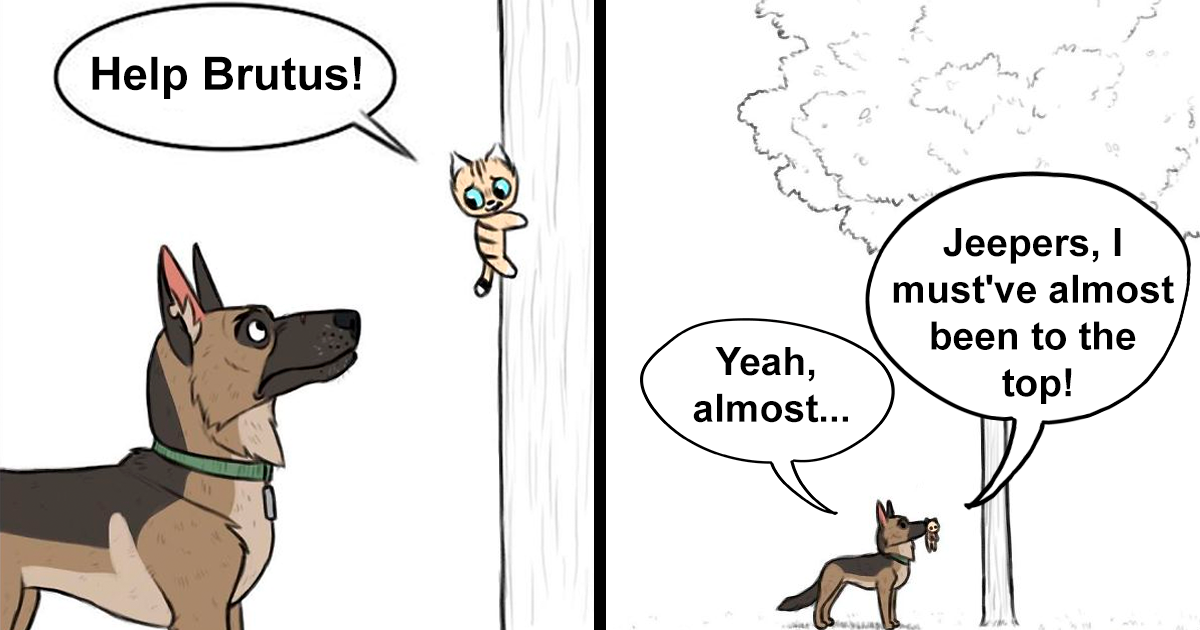
Some internet friendships arrive quietly. Others burst through the door like a German Shepherd with a military résumé and a tiny kitten who believes danger is just spicy furniture. That, in one sentence, is the irresistible charm of Pixie and Brutus, the beloved animal webcomic created by illustrator Ben Hed of Pet Foolery.
The series follows Pixie, a cheerful kitten with the survival instincts of a marshmallow, and Brutus, a scar-faced retired military dog whose hobbies include tactical vigilance, emotional restraint, and quietly preventing Pixie from becoming a cautionary tale. Together, they form one of the internet’s most adored comic duos: one soft, sunny, and completely unaware of consequences; the other massive, serious, and secretly softer than a blanket fresh out of the dryer.
This article takes a fresh look at 7 new comics from the adorable duo Pixie and Brutus, using the most recent publicly listed episodes and the broader history of the series as context. Whether you are already a fan of Pet Foolery comics or you are meeting these two for the first time, prepare for wholesome chaos, tiny paws, giant feelings, and at least one moment where Brutus looks like he needs a vacation from being emotionally responsible.
Why Pixie and Brutus Still Own the Internet’s Soft Spot
Pixie and Brutus works because the premise is simple but endlessly flexible: put innocence next to experience, then let the comedy wobble between them like a cat on a windowsill. Pixie sees the world as a playground. Brutus sees it as a threat map with fur. That contrast gives each comic a built-in engine for humor, suspense, and tenderness.
Ben Hed originally imagined the idea as a funny contrast between a small kitten and a large war dog, not necessarily as a long-running series. Fans, however, had other plans. Once readers met Pixie and Brutus, they wanted more: more protective grumbling, more kitten logic, more big-dog patience, and more of that rare webcomic feeling where a punchline can make you laugh and then sneakily reorganize your emotions.
The duo’s popularity also reflects a bigger trend in online comics: readers love characters who are easy to understand quickly but rewarding to revisit. Pixie and Brutus are visually distinct, emotionally clear, and instantly meme-friendly. Yet beneath the cute animal comic format, the series often plays with themes of trust, trauma, friendship, courage, and chosen family. That is a lot of depth for a comic where a kitten may also be concerned about a moth.
Meet the Duo: Pixie, Brutus, and the Magic of Opposites
Pixie: Tiny, Joyful, and Dangerously Optimistic
Pixie is the kind of kitten who would look at a bear trap and ask whether it wants to be friends. She is bright, affectionate, curious, and wonderfully unaware of how alarming the world can be. Her innocence is not stupidity; it is trust in its purest, fluffiest form. Pixie believes first, asks questions later, and usually requires Brutus to stand nearby like a furry emergency response team.
Brutus: Big, Scarred, and Secretly a Softie
Brutus is a retired military working dog, typically presented as a serious German Shepherd with a scarred face and a protective nature. He has seen enough to understand danger immediately, which makes Pixie’s optimism both terrifying and healing to him. He may look intimidating, but around Pixie, he becomes a reluctant guardian, emotional translator, and sometimes full-time babysitter.
Why Their Chemistry Works
The secret sauce is contrast. Pixie turns ordinary things into wonder. Brutus turns ordinary things into threat assessments. Together, they create a rhythm that readers recognize from real relationships: the dreamer and the realist, the chaos gremlin and the responsible friend, the person who says “What could go wrong?” and the person already holding a first-aid kit.
7 New Comics From The Adorable Duo Pixie And Brutus
The newest publicly listed WEBTOON episodes include titles such as Mouse Trap, Moth, Wonder, Learning, Watch, Invincibility Part 3, and Pumpkin Patch. Rather than retelling each comic panel by panel, which would spoil the fun and flatten the visual humor, let’s explore what these recent entries suggest about the series’ continuing strengths.
1. “Mouse Trap”: Classic Pixie Curiosity Meets Brutus-Level Alarm
A title like “Mouse Trap” already sounds like a Pixie disaster wearing a tiny hat. The brilliance of this setup is obvious: Pixie is naturally curious, and Brutus is naturally suspicious of anything that can snap, bite, fall, explode, or mildly inconvenience a kitten. This is the exact type of premise that lets the comic balance slapstick with affection.
What makes a Pixie and Brutus gag land is not just the danger itself, but the difference in how each character reads it. Pixie may see a mysterious object. Brutus sees a hazard. Pixie sees an adventure. Brutus sees paperwork. The result is a comic dynamic that feels familiar to anyone who has ever owned a pet, watched a toddler, or tried to stop a friend from texting their ex at 1:00 a.m.
2. “Moth”: Small Creature, Big Emotional Potential
“Moth” sounds tiny, but Pixie and Brutus has always been good at making tiny things feel enormous. A moth can be a flying mystery, a snack-shaped temptation, a spiritual crisis, or a full tactical event depending on who is looking at it. Pixie would likely treat it as a magical visitor. Brutus, naturally, would wonder whether the winged intruder has clearance.
This kind of comic reminds readers that Pet Foolery does not need complicated plots to work. The humor often grows from everyday pet behavior: chasing bugs, staring at walls, misjudging distances, and turning ordinary household life into a National Geographic special narrated by panic. Pixie gives these moments wonder; Brutus gives them consequences.
3. “Wonder”: The Heart of Pixie’s Worldview
“Wonder” is a perfect Pixie word. It captures the soft emotional center of the series: the ability to see ordinary things as amazing. Pixie’s innocence is funny because it creates misunderstandings, but it is also moving because it gives Brutus a reason to look at the world differently.
In many Pixie and Brutus comics, Brutus is not merely protecting Pixie from the world. Pixie is also protecting Brutus from becoming completely hardened by it. She reminds him that not every unknown is a threat, not every noise is a warning, and not every small creature is helpless just because it is small. That emotional give-and-take is why the series has lasted beyond a single joke.
4. “Learning”: The Comedy of Teaching a Tiny Optimist
Few setups are funnier than Brutus trying to teach Pixie something serious. Imagine a battle-tested dog attempting to explain practical survival to a kitten who might interrupt with a question about butterflies. The humor is built into the classroom itself: Brutus teaches like a drill instructor; Pixie learns like a glitter cannon.
“Learning” fits one of the series’ best recurring patterns. Brutus attempts to prepare Pixie for real-world risks. Pixie absorbs the lesson in the most charmingly wrong way possible. The result is often a comic that starts with instruction and ends with Brutus questioning every life decision that led him to this moment.
5. “Watch”: Protection, Patience, and Big-Dog Responsibility
The title “Watch” feels made for Brutus. He watches over Pixie, watches for danger, watches suspicious squirrels, and probably watches the doorway with the intensity of a security camera that has unresolved feelings. His protective instinct is one of the reasons fans love him so much.
But the best Brutus moments happen when protection becomes emotional, not just physical. He is not simply guarding a kitten from harm; he is learning to care openly. That matters because Brutus is not written as a one-note tough guy. His seriousness is funny, but his tenderness gives the comic weight. He may grumble, but he shows up. In the Pixie and Brutus universe, that is practically a love language.
6. “Invincibility Part 3”: When Confidence Meets Reality
A title like “Invincibility Part 3” suggests a bigger gag arc, and it fits beautifully with Pixie’s fearless personality. Pixie often behaves as if the world is safe because she is loved. In a way, that is both hilarious and painfully sweet. Her confidence is not based on experience; it is based on trust.
Brutus, on the other hand, knows that nobody is truly invincible. That tension gives the comic room to play with courage, overconfidence, and the strange power of having someone nearby who will catch you when your confidence outruns your coordination. Readers return to Pixie and Brutus because the series understands this: sometimes bravery is adorable, sometimes bravery is reckless, and sometimes bravery is a kitten standing next to a very tired German Shepherd.
7. “Pumpkin Patch”: Seasonal Cuteness with Built-In Chaos
“Pumpkin Patch” brings the kind of seasonal charm that webcomic readers love. Put Pixie in a pumpkin patch and you already have visual comedy: round orange objects, tiny paws, hay, leaves, possible costumes, and Brutus trying to maintain dignity in an environment clearly designed to destroy it.
Seasonal episodes are especially effective for this series because they let the characters interact with familiar traditions through their contrasting personalities. Pixie experiences autumn as magic. Brutus experiences autumn as low visibility, unstable terrain, and suspicious gourds. Somewhere between those interpretations, the comic finds its warmth.
What Makes These New Pixie and Brutus Comics So Readable?
They Are Short, Visual, and Emotionally Clear
Great webcomics respect the reader’s time. Pixie and Brutus comics are easy to enter quickly because the characters communicate so much through posture, expression, and contrast. Pixie’s wide-eyed sweetness and Brutus’s battle-worn seriousness create a visual joke before the dialogue even begins.
They Blend Wholesome Humor with Real Stakes
The comics are cute, yes, but they are not empty sugar. Brutus’s background gives the humor a shadow, and Pixie’s innocence gives that shadow a lamp. This balance helps the series avoid becoming just another cute animal strip. It can be silly in one panel and surprisingly touching in the next.
They Understand Pet Logic
Anyone who has lived with animals recognizes the truth in these comics. Pets do not experience the world like humans. A cardboard box can become a fortress. A bug can become a destiny. A loud noise can become a national emergency. Pixie and Brutus exaggerates these behaviors, but the exaggeration feels honest.
Pixie and Brutus as a Modern Webcomic Success Story
Part of the appeal of Pixie and Brutus is how naturally it fits the internet. The characters are instantly recognizable, the jokes are highly shareable, and the emotional beats travel well across platforms. In an online culture that moves fast, Pixie and Brutus offers a small pause: a few panels where danger is softened by loyalty and silliness is treated like a valid survival strategy.
The series has also grown beyond simple social media posts. It has appeared on WEBTOON, gained a large fan community, inspired collections and discussions, and expanded into longer-form adventures such as Pixie and Brutus: Gnome Sweet Gnome. Ben Hed’s later work with DC also shows how strongly his animal-focused humor and expressive character storytelling resonate beyond the original webcomic audience.
Why Fans Keep Coming Back
Fans return because Pixie and Brutus feels comforting without being boring. The formula is familiar, but the situations remain flexible. One day Pixie is misunderstanding danger. Another day Brutus is misunderstanding innocence. Sometimes the joke is visual. Sometimes it is character-based. Sometimes it sneaks up and gently punches your feelings in the ribs.
There is also a strong found-family element. Brutus and Pixie are not alike, but they choose each other again and again. Their friendship suggests that care does not always look soft from the outside. Sometimes it looks like a giant dog standing between a kitten and a questionable object. Sometimes it looks like patience. Sometimes it looks like letting someone teach you how to see the world with less fear.
Experience Section: Reading Pixie and Brutus in Real Life
Reading Pixie and Brutus feels a lot like watching a tiny optimistic friend drag a deeply responsible friend into emotional community service. You start with a smile because Pixie is cute. Then Brutus appears, looking like he has personally survived three wars and one very disappointing bath, and the joke suddenly has structure. Their chemistry is not just “cat and dog.” It is innocence and experience sharing the same couch.
The best way to enjoy these comics is slowly. That might sound strange because webcomics are usually consumed quickly, especially on social media. But Pixie and Brutus rewards a second look. The first read gives you the punchline. The second read gives you the expressions. The third read makes you notice how often Brutus’s body language tells a story before he says anything at all. His ears, eyes, and posture often do half the emotional lifting.
For pet owners, the comics hit even harder. Pixie’s behavior feels like every kitten who has ever decided that gravity is optional. Brutus feels like every older dog who has had enough nonsense but still follows the nonsense into the next room because love apparently requires supervision. If you have ever watched a pet become fascinated with a bug, a box, a shadow, or absolutely nothing visible to human eyes, these comics feel less like fiction and more like documentary footage with better timing.
There is also something unexpectedly calming about the series. The internet can be loud, argumentative, and full of people typing as if their keyboards owe them money. Pixie and Brutus offers a different rhythm. The stakes are small enough to be funny but meaningful enough to matter. A moth, a pumpkin patch, a lesson, a watchful momentthese are tiny events, yet they become memorable because the characters care about them.
Another enjoyable experience is sharing the comics with someone who has never seen them before. Pixie usually wins people over instantly, because tiny animals with huge eyes are basically emotional cheat codes. Brutus takes about three panels longer, and then he becomes the favorite. People love characters who look tough but act tender when it counts. He is not sentimental in a loud way. He is sentimental in the “I will stand here all day to make sure you do not accidentally befriend a lawn mower” way.
The newer episodes continue that pleasure because they show the formula still has life. A comic like “Mouse Trap” promises classic protective chaos. “Moth” suggests tiny-scale wonder. “Learning” hints at mismatched education. “Pumpkin Patch” brings seasonal charm. Each title alone reminds readers of why the series works: Pixie can turn anything into an adventure, and Brutus can turn any adventure into a security operation.
For writers, artists, and content creators, Pixie and Brutus is also a useful lesson in character design. The series proves that a strong contrast can carry many stories. You do not always need a complicated universe. Sometimes you need two characters who see the same event in completely different ways. When those perspectives collide, comedy happens. When those perspectives begin to soften each other, heart happens.
That is why Pixie and Brutus remains more than a cute animal comic. It is a small, funny reminder that friendship often means translating the world for someone else. Pixie teaches Brutus that not everything unknown is dangerous. Brutus teaches Pixie that not everything interesting should be touched with your face. Honestly, both lessons are valuable.
Conclusion
7 New Comics From The Adorable Duo Pixie And Brutus reminds us why Ben Hed’s webcomic continues to charm readers years after its first viral rise. The newest episodes keep the heart of the series intact: Pixie’s bright curiosity, Brutus’s protective seriousness, and the wonderful comedy that happens when a tiny kitten treats the world like a toy box while a retired military dog treats it like a tactical briefing.
The magic of Pixie and Brutus is not only in the jokes. It is in the relationship. Their friendship is funny because they are opposites, but it is moving because they make room for each other. Pixie brings lightness. Brutus brings safety. Together, they create the kind of wholesome webcomic readers want to revisit whenever the internet gets too noisy and the real world could use a little more fluffy emotional support.













