The Oval Office is only about 816 square feet, yet every lamp, portrait, rug, and carefully positioned bust can generate an astonishing amount of political analysis. It is part workplace, part television studio, part national museum, and part extremely exclusive interior-design project where the client may receive nuclear briefings between furniture decisions.
Joe Biden and Donald Trump both used the historic Resolute Desk, gold curtains, cream-colored sofas, and many objects drawn from the White House Collection. Nevertheless, their versions of the Oval Office communicated noticeably different messages. Biden emphasized civil rights, organized labor, scientific achievement, family, and cooperation among political rivals. Trump’s first-term office leaned toward military symbolism, traditional presidential portraits, populist history, and a brighter cream-and-gold presentation. After returning to the presidency on January 20, 2025, Trump restored many familiar elements and gradually added considerably more gold-toned decoration.
Editorial note: This article primarily compares Biden’s 2021–2025 Oval Office with Trump’s first-term design, while also explaining how Trump changed the room again after beginning his second term in 2025.
Why Oval Office Décor Matters
Presidents do not simply order a random sofa online and hope it arrives before the next state visit. They generally choose furniture, paintings, rugs, sculptures, and historic objects from the White House Collection, museums, government institutions, or approved private loans. The room can be rearranged quickly during the presidential transition, although preserving and maintaining its museum-quality contents requires professional curators and residence staff.
These choices create a visual summary of an administration. A president can honor military leadership, scientific exploration, civil rights, economic populism, national unity, or personal heroes without delivering a speech. The artwork quietly does the talking while reporters, foreign leaders, and television cameras record every angle.
Biden vs. Trump Oval Office: The Main Differences
| Design Element | Joe Biden | Donald Trump |
|---|---|---|
| Rug | Deep blue Clinton-era rug | Beige patterned Reagan-era rug |
| Main fireplace portrait | Franklin D. Roosevelt | George Washington |
| Historical emphasis | Civil rights, labor, science, cooperation | Founders, presidents, military power, populism |
| Prominent sculptures | César Chávez, Rosa Parks, Martin Luther King Jr., Eleanor Roosevelt, Robert F. Kennedy | Winston Churchill, Martin Luther King Jr., Western bronzes and presidential figures |
| Flags | U.S. flag and presidential flag | U.S. and presidential flags plus military service flags during much of his first term |
| Personal details | Numerous family photographs and a lunar sample | Family photographs and the famous beverage call button |
| Overall mood | Calm, historical, inclusive, institutional | Formal, theatrical, patriotic, increasingly gilded |
Despite their differences, the two offices shared more furniture than quick before-and-after photographs might suggest. Biden retained the gold-colored curtains used by Trump, which had previously appeared during Bill Clinton’s presidency. Both men also chose the Resolute Desk, demonstrating that even intense political rivals can agree on an impressive piece of Victorian oak.
The Rugs Created Two Very Different Moods
Biden’s Deep Blue Foundation
Biden replaced Trump’s light-colored carpet with a dark blue rug that had been used during the Clinton administration. Its floral border and saturated color gave the room a cooler, quieter appearance. The blue also provided a strong visual background for the cream sofas, gold curtains, and dark wooden furniture.
The effect was traditional without feeling overly ceremonial. In photographs, the room appeared grounded and calm, almost as though it were politely asking everyone to lower their voices and read the briefing memo.
Trump’s Beige and Gold Palette
Trump used a beige-patterned rug associated with the Reagan era, pairing it with gold curtains and light floral wall covering. The warmer palette made the Oval Office appear brighter and more formal. It also complemented Trump’s preference for gold-colored frames, decorative objects, and traditional furnishings.
During Trump’s second term, the gold theme became far more pronounced. Additional gilded objects and decorative accents turned the office from understated presidential elegance toward a denser, more theatrical form of luxury. Admirers saw grandeur and confidence; critics saw a room in danger of developing its own jewelry collection.
The Portraits Told Two Different American Stories
Biden Centered Franklin D. Roosevelt
The largest visual change in Biden’s Oval Office was the prominent portrait of Franklin D. Roosevelt. Biden entered office amid the COVID-19 pandemic, economic disruption, and severe political division. Choosing Roosevelt, who led the country through the Great Depression and most of World War II, created an obvious connection between crisis leadership and Biden’s own ambitions.
Roosevelt’s portrait formed the center of a five-painting arrangement that included George Washington, Abraham Lincoln, Thomas Jefferson, and Alexander Hamilton. Jefferson and Hamilton were intentionally displayed near each other. The two founders disagreed constantly, sometimes with enough intensity to make modern cable-news arguments seem like a quiet book club, but they still served in the same early government. Biden’s staff presented their pairing as a symbol of productive disagreement.
A portrait of Benjamin Franklin appeared near the Resolute Desk. Close by was a lunar sample loaned by NASA, linking Franklin’s scientific curiosity with the ambition of the American space program. Together, the objects emphasized evidence, experimentation, discovery, and the idea that government should occasionally listen to people carrying laboratory equipment.
Trump Favored Washington, Jackson, and Traditional Power
Trump’s first-term arrangement placed George Washington above the fireplace and included portraits of Thomas Jefferson, Alexander Hamilton, Benjamin Franklin, Abraham Lincoln, and Andrew Jackson. The overall presentation emphasized founders, presidents, executive authority, and familiar national heroes.
Andrew Jackson held particular symbolic importance. Trump often compared his political movement with Jackson’s populist image as an outsider challenging an entrenched political establishment. The portrait was also controversial because Jackson signed the Indian Removal Act, and his administration’s policies led to the forced relocation and deaths of thousands of Native Americans.
Biden removed the Jackson portrait when he entered office in 2021. Trump restored Jackson to the room after returning in 2025, while a portrait of George Washington once again replaced Biden’s large image of Franklin Roosevelt above the fireplace.
Biden’s Busts Expanded the Room’s Cast of Characters
Biden surrounded himself with sculptures of leaders associated with civil rights, workers’ rights, social reform, and national service. His office included representations of Martin Luther King Jr., Rosa Parks, César Chávez, Eleanor Roosevelt, Robert F. Kennedy, Abraham Lincoln, and statesman Daniel Webster.
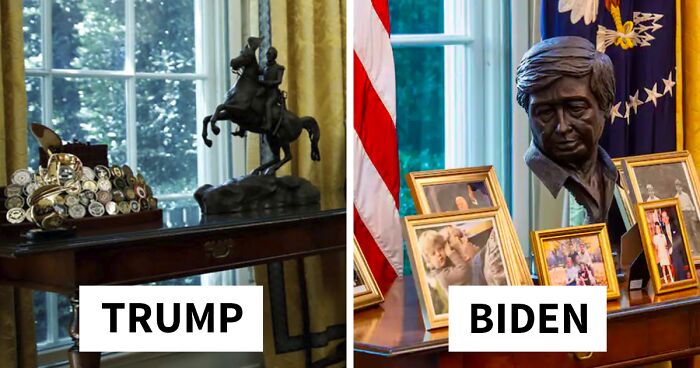
The César Chávez bust occupied one of the most visible positions in the room: on the table directly behind the Resolute Desk, among Biden family photographs. Whenever Biden signed legislation or delivered remarks from his desk, the labor organizer often appeared in the camera frame. It was a clear tribute to farmworkers, Latino Americans, organized labor, and immigrant communities.
Trump’s first-term office included busts of both Martin Luther King Jr. and Winston Churchill near the fireplace. Churchill’s return received substantial attention because the British leader represented wartime resolve, Western alliances, and unapologetically forceful leadership. Trump also displayed Western-themed bronze sculptures, connecting his office with a long presidential tradition of using frontier imagery to suggest motion, risk, and strength.
The contrast was not simply “Biden honored activists while Trump honored statesmen.” Both displayed figures from multiple traditions. The more meaningful difference was emphasis: Biden built a broad visual coalition, while Trump favored a more conventional gallery of presidents, founders, military leadership, and forceful national personalities.
The Flags Changed the Camera Frame
During much of Trump’s first term, military service flags stood behind the Resolute Desk alongside the American and presidential flags. The arrangement created a dense, highly patriotic backdrop that visually connected the commander in chief with the armed forces.
Biden returned to the simpler arrangement of an American flag and a flag bearing the presidential seal. With fewer flags, the family photographs and Chávez bust behind his desk became more noticeable. The change did not alter the president’s constitutional military role, of course; upholstery and flag placement have not yet been added to Article II. It did, however, shift the visual emphasis from military institutions toward family and civilian leadership.
The Resolute Desk Stayed, but Its Personality Changed
Both presidents used the Resolute Desk, which was made from timbers of the British exploration ship HMS Resolute and presented by Queen Victoria to President Rutherford B. Hayes in 1880. It has become the most recognizable presidential desk and has been used in the Oval Office by nearly every modern president.
Under Biden, the desk was frequently surrounded by family photographs, briefing materials, folders, and the visible symbols of his civil-rights-focused décor. It looked like the working center of a political family album.
Trump treated the desk as both a workspace and a stage for public negotiation. He frequently received visitors and reporters while seated behind it, using the physical setting to reinforce presidential authority. One small object became unexpectedly famous: a wooden call box with a red button that summoned an attendant, often carrying a Diet Coke. It looked dramatic enough to launch a satellite, although its mission was significantly more carbonated.
Biden removed the button in 2021. Trump brought it back after returning to office in 2025, restoring one of the most recognizable personal details of his presidential workspace.
Personal Photographs Humanized Both Offices
Political analysis often focuses on portraits of historical leaders, but both presidents displayed family photographs behind the desk. Biden’s collection included images of his children and grandchildren, with photographs of his late son Beau carrying particular emotional meaning.
Trump also displayed personal family photographs, including images connected with his parents and immediate family. These collections softened a room designed to project institutional power. Behind the speeches, flags, and executive orders was a reminder that the person occupying the office also had a private history.
That may be one reason family photographs survive dramatic political transitions. Washington, Roosevelt, and Jackson can argue symbolically from the walls, but grandchildren usually maintain a strong bipartisan lead on the side tables.
Trump’s Second-Term Oval Office Became More Elaborate
When Trump returned to the White House on January 20, 2025, the Oval Office was rapidly converted from Biden’s design. The beige Reagan-era rug returned, Washington again occupied the space over the fireplace, Andrew Jackson came back, and Winston Churchill’s bust was restored to a prominent position.
Trump then continued modifying the office. Gold-toned objects, ornate frames, decorative urns, sculptures, and additional artwork gradually filled more of the available surfaces and walls. The result differed not only from Biden’s room but also from Trump’s comparatively restrained first-term office.
This evolving design makes simple Biden-versus-Trump comparisons slightly tricky. There is no single permanent “Trump Oval Office.” His January 2017 office, renovated first-term office, January 2025 restoration, and later gold-heavy version represent stages of the same aesthetic project.
What the Décor Revealed About Their Leadership Brands
Biden’s Visual Message
Biden’s room presented the presidency as a coalition of historical experiences. Founders shared the walls with reformers, civil rights leaders, scientists, labor organizers, and family members. The deep blue rug and balanced portrait grouping created an institutional mood. Its message was that national progress comes from cooperation, historical memory, scientific knowledge, and the inclusion of people who were not traditionally centered in presidential spaces.
Trump’s Visual Message
Trump’s office presented power more directly. Washington, Jackson, Churchill, military flags, strong gold accents, and Western bronzes created a story about command, national confidence, conflict, and decisive leadership. During his second term, the increasingly ornate décor also reinforced Trump’s long-standing preference for visual luxury and personal branding.
These interpretations should not be mistaken for policy analysis. A president can display a civil rights leader without fulfilling every civil rights promise, just as a portrait of Washington does not automatically produce Washingtonian restraint. Décor is political communication, not a legislative scorecard. Still, it helps explain how each administration wanted presidential power to look.
A Visitor’s-Eye Experience of the Two Oval Offices
Most Americans will never enter the working Oval Office, but photographs, televised addresses, press events, museum exhibits, and full-scale replicas make it possible to experience its visual language from a distance. The White House Historical Association has even maintained a detailed replica that changes with presidential administrations, allowing visitors to observe the furniture and artwork without accidentally wandering into a national security meeting.
Experiencing Biden’s Oval Office
Imagine first seeing Biden’s version through the doorway. The blue rug immediately defines the room. It absorbs some of the brightness from the windows and gold curtains, producing a calmer, more formal atmosphere. The large Roosevelt portrait draws attention toward the fireplace, but the surrounding images prevent one historical figure from dominating the entire story.
As the eye moves around the room, the experience becomes more layered. Jefferson and Hamilton represent disagreement within government. Lincoln and Roosevelt suggest national survival during periods of enormous strain. Franklin and the Moon rock add intellectual curiosity. Rosa Parks, Martin Luther King Jr., César Chávez, Eleanor Roosevelt, and Robert F. Kennedy bring social movements and reform into a room once dominated almost entirely by presidents and military heroes.
The photographs behind Biden’s desk alter the emotional temperature again. They make the office appear less like a sealed museum and more like a place where a grandfather happens to work beside priceless national artifacts. The Chávez bust positioned among those photographs gives labor history an unusually personal presence.
For viewers watching Biden sign an executive order, the room’s symbols tended to work collectively. No single decorative element shouted for attention. The experience was cumulative: blue carpet, family photographs, reformers, rival founders, scientific achievement, and crisis leadership. The room communicated through a committeewhich, appropriately enough, is a very Biden-like method of communication.
Experiencing Trump’s Oval Office
Trump’s first-term room created a warmer and more immediate impression. The pale rug reflected light, while the gold curtains and cream furniture made the space appear brighter. Portraits of Washington, Jackson, Jefferson, Hamilton, Franklin, and Lincoln formed a traditional account of American political power.
The military flags behind the desk changed the balance of televised images. They created vertical lines around the president and gave even routine meetings a commander-in-chief atmosphere. Churchill’s bust added wartime determination, while Western bronzes introduced movement and frontier mythology.
The experience became more theatrical during Trump’s second term. Added gold surfaces caught the light from almost every camera angle. More artwork and decorative objects reduced empty space, making the room feel fuller, busier, and more personalized. Supporters could experience that density as confidence, success, and national grandeur. Viewers who preferred restraint could find it excessive. Either way, the décor refused to become background scenery.
The beverage button offered a final, distinctly human detail. After contemplating executive authority, historic leaders, and military symbolism, visitors encountered a device associated with ordering Diet Coke. It reduced the distance between the enormous power of the presidency and the wonderfully ordinary desire to have someone bring a cold drink.
What These Experiences Teach Us About Design
The comparison demonstrates that a room can change its political meaning without changing its basic architecture. The same desk, curtains, windows, sofas, and fireplace can support completely different stories. Color influences mood. Portrait placement establishes a hierarchy. Sculptures expand the historical narrative. Flags define authority, while family photographs provide intimacy.
It also shows why supposedly minor decorative changes attract so much attention. The Oval Office is rarely viewed as an ordinary workplace. Every object may appear behind a major announcement, diplomatic meeting, national tragedy, or ceremonial signing. In that setting, moving a portrait several feet can become a statement about whose history deserves the most visible position.
Perhaps the most interesting experience is recognizing how carefully constructed the apparent naturalness of the room really is. It may look as though a president casually placed a few favorite objects around the office. In reality, curators, designers, museum lenders, residence workers, communications staff, historians, and security personnel help create a space that must be functional, photogenic, historically appropriate, and ready for global scrutiny.
In other words, redecorating the Oval Office is rather more complicated than shifting the sofa and announcing that it “opens up the room.”
Conclusion
The differences between Biden’s and Trump’s Oval Office were not limited to partisan shades of blue and gold. Biden used portraits, busts, family photographs, and scientific objects to create a broad story about civil rights, organized labor, public service, cooperation, and American achievement. Trump favored founders, presidents, military imagery, Churchill, Andrew Jackson, warm colors, and increasingly ornate decoration to project command, patriotism, tradition, and personal confidence.
Yet continuity remained beneath the changes. Both presidents worked at the Resolute Desk, used historic White House furnishings, displayed family photographs, and selected objects from a shared national collection. The room changed dramatically without ceasing to be recognizable.
That is the peculiar magic of the Oval Office. It belongs temporarily to one president but permanently to the country. Every administration rearranges the furniture, changes the historical guest list, and adjusts the lighting. Then history enters, takes a seat on the cream sofa, and judges the results.