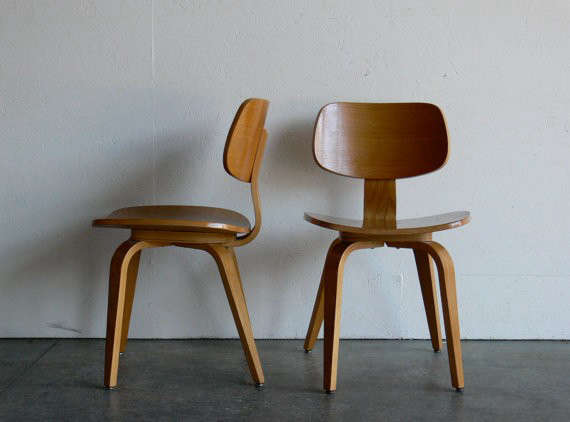
A vintage mid century modern Thonet plywood chair can look surprisingly simple: a few graceful curves, an exposed wood grain, and perhaps a modest upholstered seat. Look closer, however, and that quiet chair begins telling a much bigger story about industrial production, postwar optimism, American modernism, and humanity’s long campaign to make sitting down look sophisticated.
Collectors prize these chairs for their sculptural frames, efficient construction, and ability to complement interiors without demanding a spotlight and a velvet rope. Yet identification is not always straightforward. “Thonet plywood chair” describes several designs and variations rather than one universal model. Labels disappear, online attributions get copied from one listing to another, and bentwood is frequently confused with molded plywood. This guide explains what buyers should actually examine before bringing one home.
Why the Thonet Name Matters
Michael Thonet Helped Industrialize the Modern Chair
Michael Thonet opened his first cabinetmaking workshop in Boppard, Germany, in 1819. His experiments with bent wood eventually transformed furniture production. Instead of carving heavy components individually, Thonet developed repeatable processes that allowed wood to be shaped into lightweight, strong curves.
The famous Chair No. 14, introduced in 1859 and now known as Model 214, demonstrated the brilliance of the system. The chair used six major bentwood components, ten screws, and two nuts. According to the Philadelphia Museum of Art, 36 disassembled examples could be packed into a specially designed shipping crate. It was flat-pack furniture long before an Allen wrench became an essential household survival tool.
Thonet’s nineteenth-century furniture was primarily associated with steam-bent solid beech. Wood was softened using heat and moisture, bent along its grain, and dried in a form. This manufacturing history matters because it established the company’s lasting philosophy: use technology to reduce material, simplify construction, and create elegant furniture for everyday life.
From Bentwood to Molded Plywood
Bentwood and molded plywood are related, but they are not interchangeable terms. Bentwood is generally a solid piece of wood shaped with steam or heat. Molded plywood consists of thin veneers bonded in layers and pressed into a curved form. The laminated construction lets designers create broad shells and tight compound curves that would be difficult to achieve with an ordinary board.
After World War II, molded plywood became a defining material of modern furniture. Designers appreciated its light weight, strength, warm appearance, and compatibility with mass production. Thonet embraced the technology through collections such as Bent Ply. The company’s official history of Thonet and molded plywood highlights Günter Eberle’s Model 661, whose seat and back were formed as a flowing shell with a characteristic opening between them. Introduced in the early 1950s, the chair received a silver medal at the 1954 Milan Triennale.
The American Mid-Century Thonet Plywood Chair
During the postwar period, American Thonet Industries expanded the company’s modern furniture vocabulary. A 1953 Museum of Modern Art exhibition catalog specifically discussed American Thonet’s knock-down plywood-and-leather seating by Ilmari Tapiovaara and molded plywood chairs by a designer identified in the catalog as Joe Adkinson.
Today, vintage dealers commonly attribute sculptural 1950s Thonet plywood armchairs to “Joe Atkinson.” That spelling appears throughout major resale platforms, while the contemporary MoMA catalog uses “Adkinson.” Because original documentation should outweigh repeated marketplace descriptions, careful sellers should acknowledge the discrepancy instead of pretending the furniture gods personally handed them an unquestionable attribution.
The chairs associated with this designer typically feature curved plywood side frames that form the legs and arms, plus a separate seat and back. Some examples have exposed molded-wood seats; others use upholstered pads in vinyl, leatherette, wool, or replacement fabric. Blonde finishes emphasize the layers and grain, although darker stains also appear.
Common Visual Characteristics
- Sweeping laminated side frames with visible layered edges
- Open space beneath the arms and around the seat
- A gently reclined back designed for practical comfort
- Separate molded plywood, vinyl, or upholstered seat panels
- Rounded transitions rather than heavy carved decoration
- Exposed fasteners or discreet mechanical connections
- A visually light silhouette suitable for dining, office, or lounge use
Dealer listings commonly describe dining versions at roughly 21 inches wide, 22 inches deep, and 32 inches high, with a seat height near 16.5 inches. Measurements vary by model, and lounge chairs may sit noticeably lower. Dimensions are useful evidence, but they are not a substitute for a label, catalog comparison, or complete provenance.
How to Identify an Authentic Vintage Thonet Chair
An appealing curve does not automatically make a chair a Thonet. Numerous manufacturers used bentwood and molded plywood during the mid-twentieth century. Some designs were inspired by Thonet; others were simply described that way because adding a prestigious name can make an online listing feel better dressed.
Start Under the Seat
Turn the chair over carefully and inspect the underside with good lighting. Thonet used paper labels, stamps, impressed marks, and other signets during different production periods. The company’s authenticity guidance explains that specialists also evaluate screws, frames, dimensions, and construction details when a mark is missing.
| Feature | What to Examine | Why It Matters |
|---|---|---|
| Label or stamp | Wording, typography, address, model number, and placement | May connect the chair to a production period or American factory |
| Plywood edges | Even laminations, separation, chips, and later repairs | Reveals construction quality and structural condition |
| Hardware | Screw type, finish, spacing, and mismatched replacements | Can expose alterations or help compare a chair with documented examples |
| Upholstery | Fabric, vinyl, staples, tacks, foam, and underside finishing | Helps distinguish original material from later reupholstery |
| Dimensions | Overall height, width, depth, and seat height | Allows comparison with catalogs and verified museum objects |
| Provenance | Receipts, photographs, estate history, or institutional records | Supports an attribution more convincingly than seller enthusiasm |
Look Beyond the Label
A missing label does not prove that a chair is fake. Paper can tear away during cleaning, moving, or refinishing. Conversely, a label alone does not answer every question because furniture can be altered and labels can be misapplied. Photograph the entire chair, underside, joints, hardware, laminated edges, and every surviving mark.
For a potentially valuable example, compare those images with period catalogs and museum records. Thonet also offers an authentication service that may identify a model and the catalog in which it appeared. That is considerably more persuasive than “the estate-sale guy seemed certain.”
Condition, Rarity, and Market Value
The value of a vintage mid century modern Thonet plywood chair depends on its model, designer, documentation, condition, finish, upholstery, and whether it belongs to a complete set. Asking prices are not completed sales, so a glamorous listing price should never be treated as a guaranteed appraisal.
Current marketplace listings show substantial variation. Sets attributed to Joe Atkinson or Adkinson may be offered for several thousand dollars, while a single chair with veneer loss, loose laminations, or undocumented refinishing may sell for much less. A matching group usually attracts more interest than unrelated singles, particularly when all chairs retain consistent finishes and upholstery.
Details That Can Support Value
- A legible original Thonet label or factory stamp
- A documented model number or period catalog match
- Original finish with attractive, honest wear
- Stable plywood without major delamination
- Original upholstery in usable condition
- A complete pair, dining set, or coordinated group
- Credible provenance and professional restoration records
Originality matters, but unusable originality is not always more desirable than sensitive conservation. Split upholstery, crumbling foam, and unstable joints can require intervention. The key is to preserve what remains, document changes, and avoid turning a 1950s chair into something that looks as though it just emerged from a high-gloss bowling alley.
How to Restore and Care for Molded Plywood
Inspect Before Cleaning
Check for movement at every joint, but do not test a fragile chair by repeatedly rocking it. Examine the curved plywood edges for lifting veneers, hairline splits, old glue, and dark moisture stains. Pay special attention to high-stress areas near fasteners, arm transitions, and front-leg curves.
Begin routine care with a soft, dry microfiber cloth. If the finish is stable, a slightly damp cloth may remove ordinary grime; dry the surface immediately. Avoid soaking the plywood, spraying cleaner directly onto it, or flooding upholstered seams. Moisture can migrate into damaged edges and encourage veneer separation.
Avoid Aggressive DIY Refinishing
Vintage plywood often has thin face veneers. Enthusiastic sanding can cut through the attractive outer layer and expose the less decorative core. Once that happens, the chair acquires a pale scar that no inspirational weekend-restoration video can lovingly reverse.
Do not inject household glue into separating layers unless you understand the original materials and can clamp the compound curve correctly. Poor adhesive choices, excessive pressure, and glue squeeze-out may create a repair that is uglier and less reversible than the original damage. Serious delamination, structural cracks, or historically important upholstery should be handled by a qualified furniture conservator.
Protect the Chair in Daily Use
Keep the chair away from direct sunlight, heating vents, damp basements, and major humidity swings. The Library of Congress preservation guidance recommends a stable environment, indirect light, careful handling, and moderate relative humidity for heirloom objects. Those principles are sensible for vintage furniture even when the chair is used rather than displayed.
Lift the chair by its sturdy frame instead of dragging it by one arm. Use appropriate floor glides, tighten only the hardware that was designed to be tightened, and retain any removed upholstery, labels, screws, or fabric samples in a clearly marked envelope. Future owners will appreciate the evidence.
Styling a Thonet Plywood Chair at Home
The warm wood and open structure of a Thonet plywood chair make it unusually adaptable. In a minimalist room, it adds natural grain without interrupting clean lines. In an eclectic interior, it can sit comfortably beside vintage ceramics, contemporary art, or a gloriously impractical shag rug.
A blonde plywood chair works well with walnut, oak, cream boucle, charcoal textiles, and muted greens. Dark-stained versions create attractive contrast against pale walls and light stone. An upholstered model can serve as a desk chair, dining chair, reading seat, or sculptural accent beside a small table.
Avoid surrounding the chair with too many imitation mid-century accessories. One authentic-looking piece benefits from breathing room. Position it where the curved side profile remains visible, because that profile is often the best part of the design. If the chair will be used at a table, confirm the seat and arm heights first. Beautiful furniture becomes less charming when its arms wage a daily territorial dispute with the tabletop.
Experiences With a Vintage Mid Century Modern Thonet Plywood Chair
The Thrill of Finding One
Encountering a possible Thonet chair in a vintage shop creates a peculiar combination of excitement and suspicion. From across the room, the curved plywood frame may look unmistakably modern. Up close, the detective work begins. You crouch to inspect the underside, try to read half a paper label, and quietly hope nobody mistakes your research position for an inability to stand back up.
The most satisfying finds are not always pristine. A faded vinyl pad, worn arm edge, or mellowed blonde finish can reveal decades of ordinary use. That history gives the chair character, provided the structural components remain sound. Surface wear can be charming; a separating front leg is less of a personality trait and more of an appointment with a conservator.
Living With the Chair
Once brought home, the chair often feels lighter visually than it appeared in a crowded store. The curved side frames create negative space, allowing light and flooring to remain visible. This makes the design especially useful in small apartments, where bulky seating can consume a room faster than a poorly planned sectional.
The sitting experience depends heavily on the model and condition. Dining versions generally encourage a relatively upright posture, while lower armchairs feel more relaxed. A properly formed plywood back has a gentle resilience rather than the rigid sensation of a flat board. Original foam, however, may have compressed or deteriorated. A seat that looks plush can occasionally provide the cushioning performance of a politely covered cracker.
These chairs also have a social advantage: people notice them. Guests may not know the manufacturer, but they recognize the unusual curves and exposed construction. The design invites questions about how the wood was formed and whether the chair is comfortable. That makes it more than functional furniture; it becomes an accessible lesson in industrial design.
Learning Through Restoration
A cautious restoration can deepen appreciation for the chair. Cleaning decades of dust from the layered edges reveals how deliberately each component was shaped. Removing a later seat covering may uncover earlier staple holes, fabric fragments, or factory markings. Every clue helps reconstruct the object’s history.
Restraint is usually the most valuable lesson. It is tempting to sand every mark, replace every screw, and apply a dramatically glossy finish. Yet the best results often come from stabilizing the structure, cleaning gently, preserving the original surface, and reupholstering only when necessary. The goal is not to make a vintage chair impersonate a new reproduction. It should look cared for, not time-traveled.
Document the process with photographs before removing anything. Record dimensions, hardware locations, labels, and upholstery layers. If professional work is needed, choose someone experienced with laminated furniture rather than only solid-wood cabinetry. Curved plywood behaves differently, and damaged veneer cannot simply be planed down or replaced like a thick board.
Why the Experience Lasts
Owning a vintage Thonet plywood chair changes the way many people look at everyday objects. Its beauty is inseparable from its construction. The curve is not decoration applied afterward; the curve is the structure. The visible wood grain makes an industrially produced object feel individual, while repeated molded components connect it to the mid-century ambition of making good design widely available.
That balance explains why the chair remains relevant. It is historically interesting without resembling a museum prop, practical without becoming anonymous, and distinctive without shouting across the room. After years of use, a well-preserved example still performs its original job with considerable gracewhich is more than can be said for many pieces of furniture assembled last Tuesday.
Conclusion
A vintage mid century modern Thonet plywood chair represents more than a fashionable silhouette. It connects Michael Thonet’s early experiments in industrial furniture production with the organic molded forms of the postwar era. Its value lies in the relationship between material, manufacturing, comfort, and visual economy.
Before buying, inspect the laminated edges, joints, hardware, upholstery, dimensions, and underside markings. Treat designer attributions cautiously, particularly the marketplace spelling “Joe Atkinson” versus MoMA’s documented “Joe Adkinson.” Preserve surviving evidence, favor gentle care, and seek professional help for structural damage. Do that, and the chair can remain both a collectible design object and a genuinely useful place to sit.