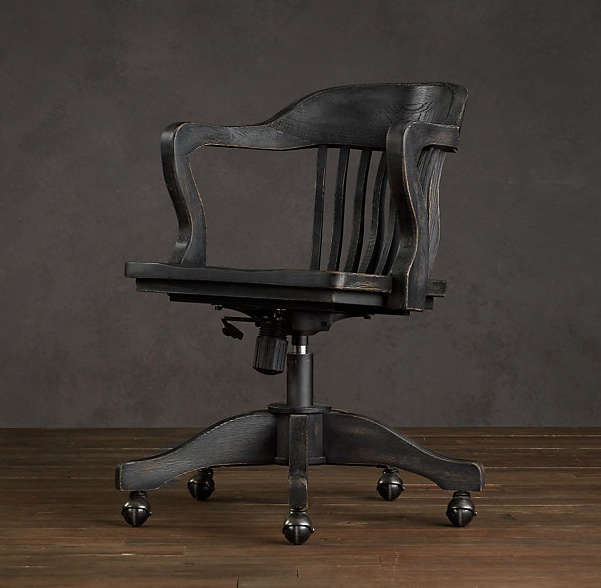
The 1940s Banker’s Chair Antiqued Black is the kind of chair that looks as if it has heard every serious conversation in the building: loan approvals, architectural sketches, overdue invoices, and at least one dramatic declaration that “the typewriter ribbon is finished.” With its dark antiqued finish, oak construction, sculpted seat, rolling base, and old-office attitude, this vintage-inspired chair brings together function, nostalgia, and just enough mystery to make a home office feel less like a laptop cave and more like a proper study.
At first glance, it may seem like just another wooden desk chair. But look closer. The banker’s chair is not trying to be trendy. It is not begging for attention with neon mesh, racing stripes, or twelve adjustment levers that require a pilot’s license. Instead, it leans on classic American office design: solid wood, a supportive back, curved arms, a swivel seat, and casters that say, “Yes, I roll, but with dignity.”
Whether you are furnishing a home office, styling a library corner, decorating a vintage-inspired workspace, or simply hunting for a chair with character, the antiqued black banker’s chair deserves a long look. It combines the visual charm of 1940s office furniture with practical updates that make it useful in modern life. In other words, it looks like it belongs beside a brass desk lamp, but it can still survive a Tuesday full of emails.
What Is a 1940s Banker’s Chair Antiqued Black?
A 1940s banker’s chair is a desk chair inspired by the office seating commonly used in banks, libraries, law offices, government buildings, schools, and administrative spaces during the early to mid-20th century. These chairs were typically made from sturdy hardwood, often oak, and designed for long hours of seated work. The style usually includes a scooped wooden seat, a curved or slatted back, supportive arms, a central swivel mechanism, and a base with casters.
The “Antiqued Black” finish gives the chair a weathered, timeworn appearance. Unlike a flat modern black paint, an antiqued finish is meant to show depth, rubbing, variation, and age. The result is a piece that feels collected rather than freshly unboxed. It works especially well in interiors that mix vintage office furniture, industrial decor, farmhouse details, classic study furniture, or even modern minimalist rooms that need one strong old-soul accent.
Many modern versions of this chair are reproductions, meaning they are not necessarily original chairs manufactured in the 1940s. Instead, they borrow the shape, materials, and mood of vintage American banker’s chairs while improving everyday usability with smoother casters, adjustable height, and more consistent construction. That combination is one reason the design remains popular: it gives you the look of an antique without requiring you to interrogate every squeak like a furniture detective.
Why the Banker’s Chair Became an Icon
The banker’s chair became popular because it solved a real workplace problem. Before ergonomic task chairs, workers still needed supportive, durable seating for long days at desks, counters, ledgers, and typewriters. A good wooden swivel chair allowed the user to turn, reach, write, file, and roll slightly without standing every five minutes. That was not just convenient; it was office efficiency before anyone put the word “workflow” on a slide deck.
Its design reflects a practical era of furniture making. The scooped seat helped distribute weight more comfortably than a flat board. The curved back supported posture. The arms provided stability. The swivel base made movement easier. The casters allowed the chair to glide around a work surface. Nothing about the form is decorative fluff, yet the final result is handsome. That is the magic of classic utility furniture: when something is built honestly, it often ends up beautiful by accident.
In the 1940s, American offices were moving from purely traditional interiors toward more efficient modern work environments. Wood furniture remained common, but office layouts were changing. Chairs like these bridged old craftsmanship and modern movement. They were sturdy enough for institutional use yet refined enough for professional spaces. Today, that same balance makes the 1940s banker’s chair feel equally at home in a historic house, a renovated loft, or a carefully styled Zoom background.
Key Design Features of the Antiqued Black Banker’s Chair
1. Solid Oak Character
Oak is one of the most important reasons this chair has lasting appeal. It is strong, dense, and visually rich, with grain patterns that show beautifully even under darker finishes. On an antiqued black banker’s chair, the finish may soften the wood’s natural color, but it does not erase the sense of substance. You can still feel that this is not a disposable seat pretending to be furniture. It has weight, texture, and presence.
2. Scooped Wooden Seat
The scooped seat is one of the chair’s most practical features. Instead of placing the user on a perfectly flat surface, the seat is shaped to offer a more natural sitting position. Is it as plush as a giant upholstered executive chair? No. But it also does not look like it belongs in a spaceship. For those who prefer a firmer seat, the wooden scoop can be surprisingly comfortable. For longer work sessions, a thin cushion can add comfort without hiding the chair’s profile.
3. Contoured Arms
The arms are not just there to look stately, although they absolutely do. Curved wooden arms help with posture, provide support when sitting down or standing up, and visually frame the chair. On an antiqued black version, the arms often become one of the most attractive details because natural wear tends to appear along edges and contact points, giving the chair that “used by generations of serious people” look.
4. Supportive Back
Traditional banker’s chairs often include a curved, slatted, or panel-style back. The goal is simple: support without bulk. The chair keeps the sitter upright, alert, and ready to sign documents with dramatic confidence. The backrest also gives the chair its recognizable silhouette. From behind, a banker’s chair looks architectural, almost like a small piece of millwork on wheels.
5. Swivel and Height Adjustment
Many banker’s chairs include a swivel mechanism and adjustable seat height. In vintage pieces, these mechanisms can be charming but occasionally temperamental. In reproductions, they are often smoother and easier to use. A height range around standard desk seating makes the chair suitable for writing desks, student desks, library tables, and home office workstations. The ability to adjust the seat helps the chair function as more than just a decorative prop.
6. Five-Leg Base with Casters
The rolling base is essential to the chair’s personality. A five-leg base offers stability, while casters make it easy to move around a desk area. If you use the chair on hardwood floors, a chair mat is a smart idea. Antique-style casters may look innocent, but floors have memories, and they remember scratches forever.
Why Antiqued Black Works So Well
Black furniture can go in several directions. It can be sleek, modern, formal, rustic, dramatic, or moody. Antiqued black sits in the most flexible zone of all. It is dark enough to anchor a room, but the aged finish keeps it from feeling harsh. It has polish, but it does not look precious. It can stand beside a walnut desk, a painted bookcase, a metal filing cabinet, or a natural oak table without starting a color argument.
The beauty of antiqued black is that it welcomes imperfection. A tiny nick on a glossy black chair looks like a tragedy. A tiny nick on an antiqued black banker’s chair looks like part of the biography. This makes it especially appealing for busy home offices, family study spaces, creative studios, and rooms where furniture is expected to work rather than simply pose.
It also photographs beautifully. Against pale walls, the chair becomes a strong focal point. Against dark walls, it creates a layered, clubby atmosphere. Paired with brass, leather, or warm wood, it can feel like an old library. Paired with white walls and a clean desk, it feels curated and intentional. Basically, antiqued black is the furniture equivalent of a good navy blazer: classic, adaptable, and always slightly more sophisticated than expected.
Best Places to Use a 1940s Banker’s Chair Antiqued Black
Home Office
This is the obvious choice, and for good reason. A banker’s chair instantly gives a home office more character. It pairs beautifully with writing desks, campaign desks, pedestal desks, and vintage-inspired work tables. If your office currently consists of a laptop, a mug, and a chair that looks borrowed from a conference room, this piece can change the entire mood.
Library or Reading Corner
Place the chair near a small desk, bookcase, or writing table, and suddenly you have a reading corner that looks intentional. Add a shaded lamp, a stack of books, and a notebook, and the space begins to whisper, “I read footnotes for fun.” Even if you mostly read mystery novels and online reviews for coffee grinders, the chair will keep your secret.
Bedroom Desk or Vanity
The chair’s compact footprint makes it useful in bedrooms where a full office chair would feel too bulky. Its arms and back give it enough presence to work with a vanity or writing desk, while the black finish adds contrast to soft bedding, pale walls, and vintage rugs.
Entryway Command Center
A banker’s chair can also work in an entryway or hallway desk area where mail, keys, schedules, and charging cables gather like tiny domestic villains. The chair makes the station look planned instead of accidental. It says, “This is where the household is managed,” even if the household is mostly managed by sticky notes and mild panic.
Creative Studio
Artists, writers, designers, and makers often appreciate furniture with texture and history. The 1940s banker’s chair fits studio spaces because it feels durable, unfussy, and inspiring. It is not so delicate that you are afraid to use it, but it still adds visual richness to the room.
How to Style the Chair Without Making the Room Look Like a Museum
The biggest mistake with vintage-inspired furniture is treating it too literally. You do not need to build an entire 1940s bank around the chair. Please do not add a teller window unless you are fully committed to the bit. Instead, mix it with pieces from different eras.
For a classic office look, pair the chair with a wooden desk, a brass lamp, framed art, and a wool rug. For a modern look, use it with a simple white or black desk and minimal accessories. For a rustic look, combine it with reclaimed wood, woven baskets, and warm neutral tones. For an industrial look, add metal shelving, exposed hardware, and leather accents.
The chair also works well with contrast. Its dark finish can balance light oak floors, cream walls, linen curtains, or a pale desk. If the room already has many dark elements, use texture to keep things from feeling heavy: a natural fiber rug, a linen pinboard, a ceramic lamp, or a green plant can soften the scene.
Buying Tips: What to Look For
When shopping for a 1940s Banker’s Chair Antiqued Black or a similar vintage banker’s chair, start with construction. Look for solid wood, tight joints, smooth swivel action, and a stable base. If the chair has casters, make sure they roll properly and do not wobble. If the seat adjusts, test the mechanism. A chair that lowers itself throughout the day may be funny once, but it becomes less charming when you slowly disappear below your desk like a submarine.
Check the finish carefully. Antiqued black should look intentionally aged, not carelessly damaged. Some rubbing, variation, and visible texture are desirable. Deep cracks, flaking finish, sticky residue, or strong chemical odors are less desirable. For original vintage chairs, look underneath the seat and base for maker’s marks, labels, hardware clues, or signs of repair.
Measure before buying. Many banker’s chairs have arms, and arms can collide with desk aprons or drawers. Check the chair width, depth, seat height, arm height, and caster clearance. A beautiful chair that cannot tuck under your desk is still beautiful, but now it is also in the way.
Care and Maintenance
Wood furniture with an antiqued finish benefits from gentle care. Dust regularly with a soft cloth. Avoid harsh chemical cleaners, abrasive pads, and enthusiastic scrubbing. Patina is not dirt; it is the visual evidence of age and finish variation. Cleaning should remove grime, not the chair’s personality.
Keep the chair away from prolonged direct sunlight, which can fade finishes and dry out wood. Avoid placing it near heating vents or damp areas. Wood expands and contracts with humidity changes, and antique-style furniture does not enjoy being treated like patio equipment. Use a chair mat on delicate floors, especially if the casters are metal or hard plastic.
If the chair develops squeaks, inspect the hardware and moving parts. A small amount of appropriate lubricant may help metal mechanisms, but keep oils away from visible wood surfaces unless recommended for the specific finish. If a joint loosens or a caster breaks, repair it promptly. Small repairs are usually easier and cheaper than waiting until the chair performs an unplanned collapse during a video call.
Original Antique vs. Modern Reproduction
Both original antique banker’s chairs and modern reproductions have advantages. An original 1940s chair offers true age, unique wear, and collectible charm. It may have old-growth wood, historic hardware, and a surface that no factory can perfectly imitate. However, it may also require repairs, have less predictable sizing, or include mechanisms that need restoration.
A modern reproduction offers consistency, easier shopping, and practical improvements. You can often find clearer dimensions, smoother adjustment, and a finish designed to coordinate with current interiors. A reproduction may not have the same collector value as an authentic antique, but it can be a better choice for daily use. The right decision depends on whether you want historical authenticity, everyday convenience, or a bit of both.
For most home offices, a well-made reproduction in antiqued black is a smart compromise. It provides the vintage look people love while avoiding some of the uncertainty that comes with century-old furniture. For collectors, an original banker’s chair with documented age and intact parts may be more exciting. For everyone else, comfort, stability, and style should lead the decision.
Is the 1940s Banker’s Chair Comfortable?
Comfort depends on expectations. If you want a deeply padded chair for eight-hour gaming sessions, this is probably not your champion. If you want supportive, upright seating for writing, studying, reading, or working at a desk, the banker’s chair can be very comfortable. Its scooped seat, arms, and back encourage a more attentive posture than many soft office chairs.
Adding a cushion can improve comfort while protecting the wooden seat. Choose a cushion that is thin enough to preserve the chair’s proportions. Oversized cushions can make the chair look puffy and confused, like it borrowed a coat three sizes too large. Leather, canvas, linen, or simple cotton cushions tend to suit the vintage character best.
The chair is especially appealing for people who dislike bulky modern office seating. It provides movement through swivel and casters, but its visual footprint remains elegant. In shared spaces such as bedrooms, living rooms, and open-plan homes, that matters. Not every work chair needs to look like it was designed for mission control.
Experience: Living With a 1940s Banker’s Chair Antiqued Black
Using a 1940s Banker’s Chair Antiqued Black changes the feeling of a workspace in a way that is hard to appreciate until the chair is actually in the room. It does not simply fill the space in front of a desk; it gives the desk a personality. A plain table suddenly feels like a writing station. A corner becomes an office. A stack of papers looks slightly more official, even if half of it is takeout menus and printer instructions.
The first thing most people notice is the weight. A good banker’s chair feels grounded. When you pull it out, it does not skitter nervously across the floor. It moves with purpose. The casters help, of course, but the chair still has the reassuring presence of real furniture. Sitting down feels different from dropping into a foam office chair. The wooden seat is firmer, the arms are more structured, and the back encourages you to sit like you are about to write something important.
The antiqued black finish is also surprisingly forgiving in daily life. Dust is visible, yes, but minor scuffs do not ruin the look. In fact, the chair almost seems to absorb small signs of use into its overall character. A little rubbing on the arm edge or seat lip looks natural. That is one of the joys of antiqued furniture: it does not demand perfection. It already has a story, so your life can join in without needing a formal invitation.
In a home office, the chair works especially well for focused tasks. It is ideal for writing emails, paying bills, journaling, sketching, reading documents, or working in shorter sessions. The upright posture helps create a mental shift. You sit down, and the chair quietly suggests that perhaps now would be a fine time to stop wandering into the kitchen for “just one more coffee.” No chair can defeat procrastination completely, but this one at least dresses for the battle.
There are practical lessons, too. A chair mat is worth it on wood floors. Checking desk clearance before buying is not optional. If the arms are too high for the desk, you will either sit too far away or develop an awkward relationship with your keyboard. A cushion can help if you sit for long stretches, but the cushion should complement the chair rather than smother it. A slim leather or neutral fabric cushion usually looks best.
The chair also has a social effect. Guests notice it. People ask where it came from. It has more conversation value than most office chairs, which is admittedly a low bar, but still. In a room full of ordinary furniture, the antiqued black banker’s chair stands out because it looks chosen. It gives the impression that someone cared about the space, not just the Wi-Fi signal.
Over time, the best part may be how versatile it becomes. It can move from office to bedroom, from desk to reading nook, from serious workspace to decorative accent. It looks good near books, plants, framed photographs, old maps, simple lamps, and modern electronics. That flexibility makes it more than a nostalgic purchase. It is a practical piece with visual staying power.
Living with this chair is a reminder that useful things do not have to be bland. A work chair can be sturdy, attractive, comfortable enough, and full of character. It can support a laptop in 2026 while looking like it once belonged near a ledger book in 1946. That blend of past and present is exactly why the 1940s banker’s chair continues to appeal to decorators, collectors, remote workers, students, and anyone who wants a workspace with a little backbone.
Conclusion
The 1940s Banker’s Chair Antiqued Black is more than a handsome desk chair. It is a tribute to practical American office design, a stylish nod to mid-century workspaces, and a useful seating option for modern homes. Its oak construction, scooped seat, contoured arms, swivel base, adjustable height, and aged black finish make it both functional and memorable.
For anyone designing a home office, library, study corner, or vintage-inspired workspace, this chair offers a rare combination: history without stiffness, style without fuss, and durability without looking industrially cold. It brings instant atmosphere to a room and proves that office furniture does not have to be boring to be useful.
Choose it if you love classic furniture, appreciate timeworn finishes, and want a chair that looks like it has a few stories to tell. Just measure your desk, protect your floors, and resist the urge to over-polish away its charm. A banker’s chair should look dignified, not freshly laminated. Let it keep a little mystery.
SEO Tags
Note: This article is written in original American English and synthesizes real information about vintage banker’s chairs, oak office seating, antiqued furniture finishes, styling practices, and wood furniture care.