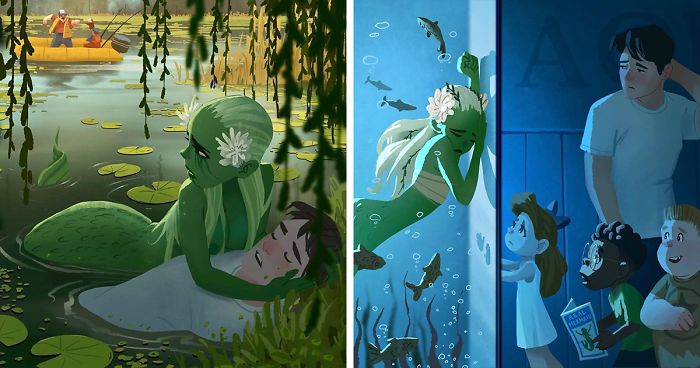
Some internet stories require a five-season streaming commitment, a detective board covered in red string, and at least three fan wikis before you understand what is happening. Andy Ivanov’s story of May, the green Mermaid of Lily Lake, manages something far trickier: it creates romance, danger, regret, sacrifice, and a surprisingly thoughtful environmental message with a sequence of digital illustrations and only a handful of words.
The Ukrainian artist first introduced audiences to his unusual green mermaid during the MerMay art challenge. Instead of treating the challenge as a collection of unrelated mermaid drawings, Ivanov connected his illustrations into one continuous story. The decision transformed a drawing exercise into a miniature visual fairy tale, and readers became invested enough to eagerly follow each new frame.
Then came the sequel.
Rather than simply giving the characters an uncomplicated happily-ever-after, Ivanov raised the emotional stakes. The second chapter explored the strange bond between the mermaid, the human who had endangered and then rescued her, and the magical natural world sustaining her life. Cute fantasy romance? Certainly. Relaxing bedtime material? Well, maybe keep tissues within reach.
How the Green Mermaid Story Began
The project is known as May the Mermaid of Lily Lake. Ivanov created its first major chapter during MerMay 2019, an annual creative challenge centered on mermaids and aquatic fantasy art.
Instead of drawing a completely different character every day, Ivanov decided to link his submissions together. That simple creative limitation gave the project something many beautiful online illustrations lack: narrative momentum.
May is not merely a decorative fantasy creature posing dramatically beside some conveniently photogenic water lilies. She is a character with vulnerability, curiosity, magical abilities, and something precious to lose.
A Meeting That Quickly Goes Wrong
The first story establishes contact between May and a young man near her lake. Unfortunately, their relationship begins about as smoothly as a first date involving nets, hunters, magical flowers, and firearms reasonably can.
The human becomes involved in May’s capture. He soon realizes that removing her from her environment could kill her. Regret replaces excitement, and he decides to return her to the lake despite the danger.
That decision has consequences. When he attempts to release her, he is shot.
May, however, possesses a magical Petal of Life. Rather than abandoning the person partly responsible for her suffering, she uses the petal to save him. The first chapter therefore ends with a reversal: the captive creature becomes the rescuer.
It is an elegantly simple plot device. The petal is both fantasy magic and metaphor. Life in Ivanov’s story is something nature can givebut it is not something humans are automatically entitled to take.
The Sequel Begins With an Impossible Awakening
Part two picks up after the shooting. The young man wakes at sunrise and discovers something rather important: he is not dead.
Considering that being shot usually puts a damper on one’s morning plans, his confusion is understandable.
May leads him deeper into her world and toward a secret place. Their pursuer, however, has not disappeared. The danger follows them.
This is where the sequel expands the mythology of Lily Lake. May reveals that the lily at the heart of her hidden sanctuary is not simply a pretty plant. It is connected directly to her existence. The earlier Petal of Life was literally part of what sustains her.
She gave away a piece of herself to save him.
Suddenly, the romance becomes much heavier.
The Flower Changes the Meaning of Everything
In a conventional fairy tale, magical flowers tend to exist so heroes can collect them, complete a quest, unlock a castle, or cure somebody who conveniently fell ill five minutes before the third act.
Ivanov makes the flower different.
It belongs where it is.
More importantly, its value depends on leaving it there.
When the pursuing man discovers the hidden sanctuary, the characters realize that he may take the flower. May knows what the intruder does not: if the flower is picked, she dies.
The scene turns a delicate lily into the central source of suspense. Something beautiful becomes endangered precisely because another person sees it as something that can be possessed.
That idea is the key to understanding the entire Green Mermaid story.
“Love and Respect Nature. Do Not Try to Own It.”
Ivanov has explained that the principal message behind the project is essentially to love and respect nature without trying to own it. Once that intention is understood, many details in the story take on additional meaning.
May cannot simply be removed from Lily Lake and displayed somewhere else. Her identity is tied to her ecosystem. Her magical flower is valuable precisely because it remains alive and connected to that environment.
Humans repeatedly cause trouble when they treat living things as objects that can be collected.
That makes the story more than a fantasy romance.
It becomes a small environmental fable.
Why That Environmental Message Works
Environmental communication can easily become an avalanche of numbers. Statistics matter, but statistics rarely have adorable green hair and an endangered magical lily.
Scientific organizations including NOAA and the U.S. Environmental Protection Agency have extensively documented how human waste, abandoned fishing equipment, plastics, and other debris can harm aquatic ecosystems. Marine animals can become entangled in discarded materials or mistake plastic for food. Freshwater ecosystems face their own pressures from pollution and altered habitats.
The Green Mermaid story does not attempt to explain those problems scientifically, nor should it. Instead, it dramatizes the underlying relationship between people and nature.
Do we see nature as a living system we belong to, or as a warehouse full of interesting things we can take home?
That question sounds considerably less like homework when it arrives attached to a love story.
Why a Few Illustrations Can Hit So Hard
The emotional effectiveness of Ivanov’s project is not accidental. Research on narrative transportation has found that people can become cognitively and emotionally absorbed in fictional worlds, particularly when they empathize with characters and anticipate what happens next.
That helps explain why serialized visual stories can spread so effectively online.
Ivanov did not upload the entire adventure as one enormous image and disappear. While creating the project, he released illustrations gradually, sometimes leaving several days between pieces. That turned passive viewing into anticipation.
One image produced a question.
The next produced another.
Will May survive? Will the boy rescue her? Why does the petal matter? Who is chasing them? What happens to the flower?
The audience is continually given just enough information to care and not quite enough information to relax.
Television writers call this serialized storytelling. Social media users call it, “Why would you stop posting THERE?”
Visual Storytelling Removes a Language Barrier
Another reason the Green Mermaid illustrations traveled widely is their accessibility.
The narrative requires very little text. Facial expressions, body language, framing, light, movement, and color carry much of the emotional information. A viewer does not need several paragraphs of exposition explaining that May is frightened when someone approaches the flower. The artwork makes the danger immediately understandable.
This is one of the oldest strengths of visual storytelling. Images can communicate emotional relationships before a reader has processed a single sentence.
Ivanov has cited Disney, Pixar, and DreamWorks as stylistic influences. That inspiration makes sense. Those studios have spent decades refining character designs capable of communicating emotion through posture, silhouettes, large expressive eyes, and carefully staged compositions.
Ivanov applies similar principles to digital illustration while maintaining a distinctive fairy-tale atmosphere of his own.
The Mermaid Is an Ideal Symbol for the Story
Mermaids have been swimming through human mythology for centuries, and they have never meant just one thing.
The Library of Congress documents centuries-old mermaid traditions in songs and folklore, while the American Museum of Natural History notes that cultures around the world have developed different forms of aquatic spirits and half-human water beings.
Sometimes mermaids represent danger. Sometimes beauty. Sometimes fertility, mystery, luck, temptation, or the frightening unpredictability of water itself.
That flexibility makes May an especially effective modern fairy-tale character.
She looks human enough for viewers to empathize with her but remains visibly connected to a world outside ordinary human society. She is simultaneously a person and a representation of the lake.
When someone tries to capture May, therefore, the action works on two levels. A character is being imprisoned, but nature itself is also being reduced to property.
Environmental Art Often Works Best When Beauty Comes First
There is an interesting parallel between Ivanov’s fantasy illustrations and real environmental art projects.
Smithsonian exhibitions have highlighted artists who transform discarded ocean plastics into enormous sculptures of sea creatures. At first glance, viewers encounter colorful, attractive animals. Only after moving closer do they notice that the “scales” and other details consist of bottle caps, containers, fishing debris, and other trash recovered from beaches.
That moment of discovery changes the artwork from decoration into an argument.
The Green Mermaid operates in a similarly indirect way.
Ivanov does not begin by lecturing readers about environmental responsibility. He introduces a charming character. Then he gives her something beautiful. Then he makes viewers understand that her life depends on protecting it.
By the time the ecological theme becomes obvious, readers already care about the outcome.
That is storytelling doing the heavy lifting while the lecture notes remain safely in the drawer.
The Sequel Also Complicates the Romance
The relationship at the center of the story is deliberately messy.
The young man participates in May’s capture before regretting his decision. He then risks himself to free her. May subsequently uses part of her own life source to save him.
This creates a relationship built not on instant perfection but on wrongdoing, remorse, sacrifice, and forgiveness.
Readers can reasonably debate whether May forgives too easily or whether the human deserves redemption. That ambiguity is actually one of the story’s strengths. A perfectly behaved hero would create far less tension.
Instead, Ivanov gives viewers somebody capable of making a terrible choice and then realizing what that choice means.
His transformation mirrors the environmental message: appreciation is not enough. You can call something beautiful while still harming it. Genuine respect requires changing how you behave toward it.
From MerMay Challenge to an Internet-Worthy Fairy Tale
The most impressive aspect of the project may be its humble origin.
Ivanov did not initially set out to construct a giant entertainment franchise with twelve spin-offs, collectible mugs, and a suspiciously expensive theme-park beverage.
He was participating in an art challenge.
By connecting individual prompts into a story, however, he created something audiences wanted to follow rather than merely admire.
According to Ivanov, producing a group of roughly a dozen story frames could take around a month or more, with additional pauses used between illustrations to build anticipation. That schedule reveals how much planning can sit behind apparently effortless social-media art.
The project continued across the 2019 and 2020 MerMay periods. At the time of the sequel, Ivanov described the second part as the conclusion of that main storyline, while suggesting that additional glimpses of the couple’s life could appear later. In 2021, he also released material functioning as a prequel, giving followers more of the characters’ beginnings and helping complete the larger narrative.
Why the Green Mermaid Story Still Feels Relevant
The internet has no shortage of beautifully rendered fantasy characters. Technical skill alone does not explain why some artworks disappear into endless scrolling while others inspire viewers to stop, share, comment, and ask for more.
May has three advantages.
First, she has a recognizable identity. The green color palette, lake setting, magical lily, and expressive design make her memorable.
Second, the illustrations contain consequences. Characters make decisions that change what happens next.
Third, the fantasy rests on an idea that exists outside fantasy: living environments cannot always survive when people remove whatever they find valuable.
Real ecosystems are obviously more complicated than magical lilies. Yet the broader principle is familiar. Healthy habitats depend on relationships among organisms, water, plants, food webs, climate, and countless other conditions. Protecting one spectacular animal while destroying everything sustaining that animal is not much of a conservation strategy.
Nature, inconveniently, refuses to organize itself like a gift shop.
Experiences and Takeaways From the Green Mermaid Story
Experiencing the Story One Frame at a Time
One useful way to understand why Ivanov’s work connected with viewers is to imagine encountering it in its original serialized form instead of scrolling through every illustration at once.
You see May. She appears gentle and curious. Something bad happens. Suddenly she is captured. The human who helped cause the problem begins realizing that captivity could kill her.
Then the moral equation changes.
A character initially positioned as part of the threat becomes part of the rescue. Before viewers have fully decided how they feel about him, he is shot. May now faces her own choice.
This rhythm creates emotional participation. Viewers are continually revising their judgment of the characters. That experience feels more engaging than simply being told, “This man made a mistake but eventually became good.”
We get to watch the mistake become regret.
A Lesson for Artists: Give Beautiful Images Something to Do
Creators can take a practical lesson from the project: strong visual art becomes even more memorable when each image changes the situation.
A beautiful mermaid portrait can earn admiration. A beautiful mermaid portrait in which the viewer notices somebody approaching the one flower keeping her alive generates a question.
Questions keep audiences moving.
For illustrators creating serialized work, that means asking what new information each frame provides. Does the image introduce danger? Reveal a relationship? Change a character’s goal? Answer an earlier mystery while creating another?
If the answer is yes, the artwork is doing narrative work rather than merely decorating the feed.
A Lesson for Readers: Caring Often Starts Small
The story also demonstrates something familiar from environmental experiences in everyday life. Large problems can feel abstract until they become attached to something specific.
“Protect biodiversity” is important but enormous.
Protecting one lake, one nesting area, one injured turtle, one local wetland, or even one fictional green mermaid is emotionally easier to process.
Real conservation organizations frequently use individual animals and habitats to help people understand much larger ecological systems for exactly this reason. People often enter a subject through a single story and discover the wider problem afterward.
May’s lily performs that role beautifully. Viewers do not need an ecology degree to understand one rule: do not pick that flower.
Once that rule matters emotionally, the larger principle becomes easier to grasp.
The Most Memorable Experience Is the Shift in Perspective
The strongest part of the Green Mermaid sequel is therefore not simply whether two characters fall in love. It is the transformation of value.
At first, the mermaid is something extraordinary to capture.
Later, she becomes someone worth protecting.
At first, the magical flower appears to be a valuable object.
Later, we understand that its greatest value comes from leaving it untouched.
That shift resembles experiences many people have with nature. A tide pool, forest, coral reef, or quiet lake may initially look like scenerya pleasant background for photographs. Learn what lives there, how fragile it is, and how its parts depend on one another, and the same place begins feeling different.
Knowledge turns scenery into habitat.
Story turns a green cartoon mermaid into somebody whose flower you desperately want that guy to stop touching.
That may not sound like sophisticated environmental philosophy, but emotionally, it gets the job done.
Conclusion
Andy Ivanov’s sequel to May the Mermaid of Lily Lake succeeds because it understands that emotional stories do not need enormous amounts of dialogue. They need characters with something valuable to lose.
Using expressive digital illustrations, fantasy romance, suspense, sacrifice, and a magical flower tied directly to his heroine’s life, Ivanov transformed a MerMay challenge into a memorable visual narrative.
The Green Mermaid story is sweet without being empty, tragic without becoming relentlessly gloomy, and environmentally conscious without turning into a public-service announcement wearing a fish tail.
Most importantly, its central message survives after the details of the plot fade: loving nature is different from possessing nature. Sometimes the most respectful thing humans can do with something beautiful is admire it, protect it, and leave it exactly where it belongs.