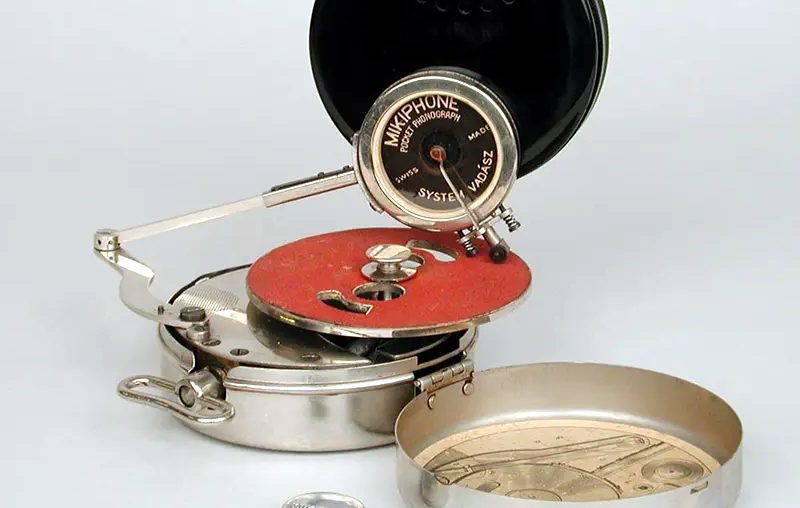
There are objects that instantly make people ask questions. A pocket-sized record player is one of them. Pull out a phone and nobody blinks. Pull out a little block that rides around a spinning vinyl record like a tiny musical Roomba, and suddenly everyone in the room becomes an audio detective. “Wait… is that actually playing the record?” Yes. Yes, it is. And no, your eyes are not buffering.
The idea behind a portable record player sounds almost ridiculous at first. Vinyl records are big, delicate, slightly dramatic discs that demand flat surfaces, clean sleeves, careful hands, and the kind of respect usually reserved for sourdough starters. Yet for decades, inventors and audio brands have tried to shrink the listening experience into something more casual, more social, and more fun. The result is a strange but fascinating family of devices: portable turntables, suitcase record players, the legendary Audio-Technica Sound Burger, and ultra-compact gadgets like RokBlok.
So, is that a record player in your pocketor just another sign that vinyl culture has officially escaped the living room? Let’s drop the needle and find out.
The Funny Little Dream of Pocket-Sized Vinyl
Vinyl has always been physical. That is the whole charm. You do not “open” a record the way you open an app. You hold it, slide it from a sleeve, admire the artwork, place it on a platter, and lower the stylus with the focus of someone defusing a very musical bomb. That ritual is exactly why many listeners still love records in a streaming world.
But the same ritual creates a problem: records are not naturally portable. A standard 12-inch LP is not pocket-friendly unless your pants were designed by a circus tent manufacturer. Traditional turntables also need stable placement, power, speakers, and enough space to spin without being elbowed by a sandwich.
That tensionbetween vinyl’s big physical personality and the modern desire to take music anywhereis what makes compact record players so interesting. They are not trying to beat your home hi-fi setup. They are trying to answer a cheekier question: what if listening to records could feel a little more like bringing a Bluetooth speaker to a picnic?
A Brief History: From Phonographs to “Vinyl Walkmans”
Recorded sound has always had one foot in science and the other in magic. Early sound recordings captured vibrations through mechanical systems, turning invisible waves into grooves that could later be played back. The Library of Congress National Jukebox, for example, preserves thousands of early commercial recordings from the first decades of the 20th century, reminding us that recorded music began as a physical groove before it became a digital file.
By the middle of the 20th century, vinyl records had become a dominant music format. Then came cassettes, CDs, MP3 players, smartphones, and streaming serviceseach one more portable than the last. Vinyl should have faded into the attic next to the fondue set. Instead, it staged one of the great comebacks in consumer audio.
The Recording Industry Association of America reported that vinyl reached its eighteenth straight year of growth in 2024, generating about $1.4 billion and making up nearly three-quarters of physical-format revenue. In other words, the format people once wrote off as dusty and inconvenient now sells like nostalgia learned how to lift weights.
Portable record players fit neatly into this revival. They serve collectors who want something playful, beginners who do not have room for a full component system, and design lovers who enjoy audio gear that looks like it escaped from a stylish 1980s lunchbox.
The Audio-Technica Sound Burger: The Sandwich That Spins
No conversation about pocket-style record players is complete without the Audio-Technica Sound Burger. Originally released in the early 1980s, the Sound Burger earned its nickname because it clamps around the record in a way that resembles a burger. If that sounds silly, congratulationsyou understand why people remember it.
The modern Sound Burger, known as the AT-SB727, keeps the retro-futuristic shape but adds practical modern features. It plays 33 1/3 and 45 RPM records, uses a belt-drive system, includes Bluetooth connectivity, and charges by USB. It is not truly pocket-sized, unless your jacket was tailored for a cartoon detective, but it is compact enough to carry in a backpack or tote bag.
What makes the Sound Burger special is not just portability. It is the way it reframes vinyl as something you can share more casually. Bring it to a friend’s apartment, connect it to a speaker, and suddenly the record becomes the center of the room. People flip through sleeves. Someone argues about whether side B is better. Somebody says, “I used to have this album,” even if they were born in 2006. Vinyl has that effect.
What the Sound Burger Does Well
The Sound Burger is compact, charming, and easy to understand. It gives beginners a low-friction way to play records without building a full stereo shrine. Its Bluetooth option also makes it more flexible for modern listening, especially for people who already own wireless speakers or headphones.
It also has a strong design identity. Many turntables look like serious black rectangles created by people who fear whimsy. The Sound Burger looks like a gadget that wants to start a conversation. That matters. In consumer audio, personality can be part of the experience.
Where It Has Limits
Still, physics remains undefeated. A compact portable turntable is easier to bump than a full-size deck. Records are partially exposed during playback, so cleanliness and careful handling matter. Bluetooth adds convenience, but it also means the analog signal is being converted and compressed before reaching your wireless speaker. Audio purists may raise an eyebrow so high it becomes a second hairline.
For serious listening, a stable full-size turntable with good speakers will usually perform better. But that is not the point. The Sound Burger is less “ultimate audiophile temple” and more “vinyl picnic machine.” Judge it by the right standard, and it makes a lot more sense.
RokBlok: The Tiny Record Player That Drives Around the Record
If the Sound Burger is a compact turntable, RokBlok is the wild cousin who shows up to Thanksgiving with a jetpack. RokBlok is a small wireless record player designed to sit directly on top of a vinyl record and move around the disc as it plays. It measures only a few inches long, includes a built-in speaker, supports Bluetooth output, and plays 33 1/3 and 45 RPM records.
The concept is wonderfully strange: instead of spinning the record on a platter, the record stays still while the device travels around it. It is the kind of product that makes people say, “That cannot work,” followed by, “Okay, but show me again.”
RokBlok’s biggest advantage is obvious: extreme portability. It is much closer to the “record player in your pocket” fantasy than most devices. You still need a flat surface and a record, of course, but the player itself is tiny enough to carry almost anywhere.
The trade-off is that novelty and fidelity are not always best friends. A small built-in speaker will not deliver the same richness as a proper stereo system. A moving device also introduces practical concerns about stability, surface quality, and record care. It is brilliant as a conversation piece and fun as a portable gadget, but it is not the tool most collectors would choose for their rare first pressing of an album they treat like a family heirloom.
Why Portable Vinyl Exists in the Age of Streaming
Here is the obvious question: why bother? We already have smartphones that can stream millions of songs. A pocket record player requires records, setup, charging, cleaning, and a willingness to look mildly eccentric in public. From a convenience perspective, streaming wins before the race even begins.
But convenience is not the only reason people listen to music. Sometimes the slower option is the more memorable one. Making coffee by hand is less convenient than pressing a vending-machine button. Writing a postcard is less efficient than sending a text. Playing a record is less practical than tapping a playlist, but it turns listening into an event.
Portable record players make that event movable. They bring vinyl into dorm rooms, small apartments, art studios, backyard hangouts, pop-up shops, and casual listening sessions. They give people a way to share music without hiding the format behind a screen.
Who Should Buy a Portable Record Player?
A portable record player makes sense for a few types of listeners. First, there is the curious beginner. If you are vinyl-curious but not ready to buy a full turntable, receiver, phono preamp, and speaker setup, a compact player can be a friendly entry point.
Second, there is the space-limited listener. Not everyone has room for a dedicated audio cabinet. A compact Bluetooth turntable can live on a shelf, desk, or small table without turning the apartment into a stereo showroom.
Third, there is the social listener. If your favorite part of vinyl is showing friends a record, discussing cover art, and passing around liner notes, portability can be a huge advantage. A compact player turns a record collection into something you can bring to the party instead of merely describing it like a proud museum curator.
Finally, there is the design lover. Some people buy audio gear partly because it looks cool. This is allowed. Anyone who says otherwise probably owns speakers the size of refrigerators and calls them “compact.”
Who Should Skip It?
Portable record players are not ideal for everyone. If your main goal is the best possible sound quality, invest in a stable full-size turntable, quality cartridge, proper speakers, and clean records. If you own valuable vinyl, you may prefer a more controlled setup that protects the record during playback.
You should also skip ultra-compact players if you expect them to replace streaming on a walk, bike ride, or commute. Vinyl is portable in the same way a picnic basket is portable: yes, you can carry it, but you are not jogging with it unless you enjoy chaos.
How to Use a Pocket-Style Record Player Without Regret
Choose the Right Records
Do not test a tiny gadget with your most valuable record. Start with common, clean, inexpensive vinyl. If the player performs well and you understand its behavior, then decide what else you are comfortable playing.
Keep Everything Flat
Portable does not mean “play it on a pillow.” Records need stability. Use a flat, firm surface away from heavy foot traffic, curious pets, and friends who talk with their elbows.
Clean the Record and Stylus
Dust is vinyl’s tiny villain. Use a record brush and keep the stylus clean according to the manufacturer’s instructions. A portable player is already working under tighter conditions than a full-size deck, so cleanliness matters even more.
Use Good Speakers When Possible
If the device supports external speakers or Bluetooth, use them. A small built-in speaker can be fun, but better speakers make the experience more enjoyable. The difference is like hearing a song through a paper cup versus hearing it walk into the room wearing a jacket.
The Bigger Meaning: Vinyl Is Not Just About Sound
Portable record players reveal something important about vinyl culture: people are not buying records only for perfect audio. They are buying touch, artwork, ritual, ownership, nostalgia, discovery, and the pleasure of slowing down. The sound matters, absolutely. But the experience around the sound matters too.
This is why a device like the Sound Burger can return decades after its original release and still find an audience. It is why a tiny moving player like RokBlok can capture attention. These products are not just audio tools; they are cultural objects. They invite people to talk, laugh, compare records, and rediscover music as something physical.
In a world where music often feels invisible, a portable record player makes it visible again. The spinning disc says, “This song occupies space.” The sleeve says, “This album has a face.” The needle says, “Please be patient; I am doing tiny magic.”
Experience Notes: Living With the Idea of a Record Player in Your Pocket
The first time you see a truly compact record player in action, your brain may need a moment to file the paperwork. We are trained to think of record players as furniture: a platter, a tonearm, a dust cover, maybe a glowing receiver nearby. A pocket-style player breaks that mental picture. It feels like someone folded a listening room into a gadget.
In everyday use, the biggest surprise is how social the experience becomes. A phone playing music is background noise. A small record player playing music becomes a gathering point. People lean in. They ask how it works. They inspect the sleeve. They want to choose the next record. Even people who claim they “do not care about vinyl” suddenly care very much when a tiny device starts pulling sound out of a groove.
The second surprise is that portable vinyl changes your relationship with albums. Streaming encourages skipping. Vinyl encourages commitment. When you bring only three records to a friend’s place, those records become the evening’s menu. You listen with more intention because you made a choice before leaving home. There is a tiny bit of ceremony in that, and ceremony is underrated.
Of course, the experience is not all smooth jazz and happy dust covers. Portable record players require patience. You need a flat surface. You need to handle records carefully. You need to accept that a compact setup may not deliver the chest-filling warmth of a full stereo system. And if you are using Bluetooth, you need to make peace with the fact that your analog record is taking a brief digital vacation on the way to your speaker.
But the charm is real. A portable record player is perfect for small rituals: playing a favorite 45 during a coffee break, bringing one album to a small dinner, testing thrift-store finds without building a full setup, or turning a quiet corner of a room into a temporary listening station. It gives music a little theater. Not Broadway theatermore like a clever street performance with better album art.
The best way to enjoy one is to stop asking it to be something it is not. It is not a replacement for a serious turntable system. It is not a magic device that makes vinyl as convenient as Spotify. It is not a museum-grade preservation tool for rare records. It is a fun, compact, conversation-starting bridge between old-school analog culture and modern portable habits.
So, is that a record player in your pocket? Maybe not literally. Maybe it is in your backpack, on your desk, or sitting in the middle of a picnic table making everyone smile. But the question captures the whole appeal. Portable vinyl is a little absurd, a little brilliant, and very human. It proves that even in a world of invisible music, people still love objects that spin, click, hum, and make a room feel alive.
Conclusion: Small Player, Big Personality
Portable record players are not here to defeat streaming or replace high-end turntables. They are here because music is more than access. It is experience. A compact turntable or pocket-style vinyl gadget makes records feel playful again, transforming the act of listening into something people can gather around.
The Audio-Technica Sound Burger shows how a retro design can return with modern features and still feel fresh. RokBlok proves that the “record player in your pocket” idea can get wonderfully weird. Together, they reveal a simple truth: vinyl’s comeback is not just about nostalgia. It is about people wanting music they can touch, share, and remember.
So the next time someone asks, “Is that a record player in your pocket or…?” you can proudly say: “Actually, yes. And it plays side A beautifully.”