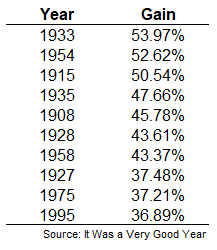
Note: This article defines the “best years” using annual S&P 500 total returns, including dividends. That matters. If you switch to price-only returns, a different index, or a different time range, the leaderboard changes a little. In other words, stock market history is not just a scoreboard; it is also a lesson in how you keep score.
Wall Street loves a dramatic comeback. One year it is handing out panic like Halloween candy, and the next it is throwing confetti from the ceiling. That is part of what makes studying the best years in stock market history so useful. These monster years are not random fireworks. They leave clues. They show what happens when fear breaks, when earnings improve, when investors stop hiding under the desk, and when the market sprints far ahead of the headlines.
If you only look at the gains, the story seems simple: great years are great, everyone smiles, and somebody on television acts like they saw it coming all along. But history is much messier and much more helpful than that. Some of the biggest up years arrived right after terrible declines. Others showed up in the middle of durable expansions. One arrived right before a historic collapse. Together, these years teach a powerful lesson: the stock market does not reward comfort nearly as often as it rewards patience, discipline, and a strong stomach.
Below is a look at the 10 best years in modern U.S. large-cap stock market history, followed by the big investing lessons they still offer today. Spoiler alert: the market rarely sends a polite engraved invitation before a rally begins.
How We Defined the “Best Years”
For consistency, this article ranks years by annual S&P 500 total return, including reinvested dividends, from the long-running historical return data set beginning in 1928. That makes the list more useful for real-world investors because dividends are part of what investors actually earn over time. It also keeps the comparison focused on the best-known large-cap U.S. stock benchmark rather than turning this into a cage match between every index ever invented.
The 10 Best Years in Stock Market History
| Rank | Year | S&P 500 Total Return | Quick Read on the Environment | Main Lesson |
|---|---|---|---|---|
| 1 | 1954 | 52.56% | Post-recession recovery and renewed confidence | Huge years often begin before investors feel fully safe |
| 2 | 1933 | 49.98% | Powerful rebound after Depression-era devastation | Some of the best gains arrive after awful pain |
| 3 | 1935 | 46.74% | Recovery momentum continued after years of stress | Big gains can come in waves, not just one burst |
| 4 | 1928 | 43.81% | Late-stage boom before the 1929 crash | A great year does not eliminate future risk |
| 5 | 1958 | 43.72% | Strong rebound after a weak 1957 | Markets can recover while investors still feel uneasy |
| 6 | 1995 | 37.20% | Broad optimism around growth, productivity, and profits | Not every great year is a rebound from disaster |
| 7 | 1975 | 37.00% | Sharp rally after the brutal 1973–74 bear market | Turnarounds can be fast enough to punish market timers |
| 8 | 1945 | 35.82% | Transition from wartime uncertainty toward expansion | Markets look forward, not backward |
| 9 | 1997 | 33.10% | Expansion-era strength and rising investor confidence | Great years also happen during ongoing bull markets |
| 10 | 1955 | 32.60% | Follow-through after the blockbuster 1954 rally | Momentum can persist longer than doubters expect |
Lesson 1: The Best Years Often Show Up After Terrible Ones
If there is one pattern that jumps off the page, it is this: some of the market’s best years begin when people are still emotionally dressed for a funeral. The rebound years of 1933, 1935, 1958, and 1975 did not emerge from calm, sunny, confidence-soaked conditions. They followed deep fear, economic stress, or sharp market weakness.
Take 1975. The previous year was ugly, with the S&P 500 down about 25.9%. Then came a nearly 37% gain in 1975. That is the kind of reversal that makes hindsight look easy and real life look ridiculous. In the moment, investors were still dealing with the emotional debris of the 1973–74 bear market, inflation worries, and recession scars. But the market did what it often does: it began recovering before the average investor felt emotionally ready.
That pattern matters because many people assume the right time to invest is when the news finally improves. History keeps laughing at that idea. By the time the all-clear sounds, a large chunk of the rebound is often already gone.
Lesson 2: The Market Is a Forward-Looking Machine, Not a Rearview Mirror
The 1945 and 1954 entries are great reminders that markets price tomorrow before tomorrow arrives. In 1945, the world was still emerging from war. In 1954, the broader market was finally shaking off long shadows from earlier economic stress, and investor confidence improved sharply. The point is not that everything was perfect. It was not. The point is that stock prices move on expectations, not on whether the present moment feels neat and tidy.
This helps explain why investors so often feel confused during the early phase of a rally. They look around, see unresolved problems, and wonder why stocks are rising. But that confusion is normal. Stocks are not grade-school report cards on current conditions. They are discounting mechanisms. They try to price future earnings, future confidence, future liquidity, and future improvement. Sometimes they get it wrong, of course. Mr. Market is clever, not omniscient. But he is almost always impatient.
Lesson 3: Great Years Are Not All Rebound Years
It would be nice if the lesson were simply, “Buy after crashes and collect trophies.” History is ruder than that. Several of the best years did not come directly after disaster. The late 1990s entries, especially 1995 and 1997, show that markets can post huge gains during long-running expansions when productivity, profits, innovation, and investor optimism line up in the same direction.
That is important because it means investors need two mental models, not one. Yes, some giant years happen as rebounds from panic. But other giant years happen because the economic machine is humming and corporate earnings are delivering. In plain English: do not assume all monster returns arrive wearing a recovery badge. Some show up wearing a growth badge.
This also challenges the lazy belief that once a market has already risen, the easy money must be over. Sometimes it is. Sometimes it really is not. The presence of prior gains does not automatically mean future gains are canceled. Bull markets can last longer than skeptics expect, mostly because skepticism is apparently an abundant natural resource.
Lesson 4: A Great Year Does Not Mean Risk Disappeared
Now for the humbling part. The year 1928 ranks among the very best on the list. It was also immediately followed by the catastrophe of 1929 and the Depression-era collapse that came after. That makes 1928 one of the most useful cautionary tales in stock market history.
The lesson is simple: a spectacular year is not proof that valuations are safe, risk is low, or the next year will cooperate. Big gains can occur near the start of powerful long-term advances, but they can also occur near the end of speculative stretches. Investors who treat one great year as a forever guarantee are basically promoting their recent success from “interesting data point” to “new religion.” Markets tend to punish that kind of overconfidence eventually.
So while the best years can teach optimism, they should also teach humility. A strong market is good news. It is not magical armor.
Lesson 5: Market Timing Looks Smart in Theory and Silly in Practice
These top-performing years reinforce one of the oldest lessons in investing: timing the market is harder than it sounds and usually more expensive than people realize. Why? Because the biggest up days and biggest up years often cluster around volatile periods. Investors who flee to the sidelines during scary markets risk missing exactly the moments that do the heaviest lifting for long-term returns.
That is why the historical evidence on staying invested is so stubborn. Some of the market’s best days happen during bear markets or very early in new bull markets. Miss those bursts, and your long-term returns can shrink dramatically. The best years in stock market history are like reminder emails from the universe: the rebound does not wait for your feelings to improve.
None of this means investors should ignore risk. It means they should respect the difference between managing risk and running away from it. Diversification, rebalancing, and matching your portfolio to your time horizon are thoughtful moves. Panic-selling because the market looks scary is usually just fear in a necktie.
Lesson 6: Dividends and Compounding Deserve More Credit
Another lesson hidden inside the rankings is that total return matters. Many investors casually discuss stock market performance as if price change alone tells the whole story. It does not. Dividends are a real part of shareholder return, and over long periods, reinvesting them can materially change outcomes.
That is why using total return data makes this list more meaningful. It better reflects how wealth compounds in the real world. It also quietly reinforces a long-term investing truth: compounding is not flashy, but it is ruthless in the best possible way. A few great years, combined with reinvested income and enough time, can do far more work than most people expect.
In other words, compounding is not the loudest person at the party. It is the quiet one who somehow owns the building twenty years later.
Lesson 7: The Winning Formula Is Usually Boring
When people study the best stock market years, they often hope to discover a secret signal, a magic ratio, or a special calendar trick that reveals when the next huge rally is coming. That is understandable. It is also adorable.
The more durable lesson is much less glamorous. Investors are generally better served by a boring but repeatable process: define goals, understand time horizon, diversify across assets, rebalance periodically, keep costs low, and stay invested through uncomfortable stretches. That approach lacks cinematic flair, but history suggests it is a much better path than trying to leap in and out of the market like a caffeinated squirrel.
The best years in stock market history reward the people who are present when they happen. And the investors most likely to be present are the ones who already had a plan.
What Investors Can Actually Do With These Lessons
1. Build a portfolio for your time horizon
A teenager saving for college in two years should not invest like a professional saving for retirement in thirty. The best years in stock market history do not erase the need to match risk with time.
2. Diversify so one bad stretch does not ruin the whole plan
Stocks may drive long-term growth, but concentrated bets can turn one bad call into a household event. Diversification helps investors survive long enough to benefit from the market’s better years.
3. Rebalance instead of reacting emotionally
After big rallies, portfolios drift. Rebalancing is the grown-up way to trim back excess risk without pretending you can predict the next headline.
4. Stop waiting for perfect clarity
Perfect clarity is lovely, rare, and usually late. The market often turns before the mood does.
5. Respect history without worshipping it
History offers patterns, not guarantees. Use it to improve decisions, not to convince yourself the future is fully mapped.
Experience Section: What Living Through a Great Market Year Actually Feels Like
Reading about the best years in stock market history on a tidy chart is one thing. Living through them is something else entirely. In real life, a great market year rarely feels like a smooth, obvious victory lap from January to December. It feels confusing. It feels suspicious. It feels like checking your account and wondering whether this is the start of something durable or just the market setting up a practical joke.
For many investors, the emotional pattern is remarkably consistent. A terrible year hits first. Confidence gets dented. Financial news grows theatrical. Friends who never cared about the market suddenly have strong opinions about recession probabilities. Then the market starts rising, but almost nobody believes it. The first reaction is not joy. It is doubt. People say the rally is fake, too fast, or detached from reality. They wait for a retest, a pullback, a cleaner entry point, a more reassuring inflation print, a less dramatic headline, or perhaps a handwritten note from the Federal Reserve. Meanwhile, prices keep climbing.
Then comes the second stage: irritation. Investors who sold near the lows or froze in cash start noticing that the recovery is not politely reversing itself. The market is moving higher without their permission. What felt like prudence begins to feel like absence. This is where many people make their next mistake. They do not calmly return to their long-term plan. They chase. They buy what has already run the most, assume the recent winners must keep winning forever, and confuse relief with strategy.
The investors who tend to navigate these great years best are not always the boldest or the most brilliant. Often, they are simply the steadiest. They kept contributing during ugly periods. They rebalanced instead of making grand declarations. They owned diversified portfolios, accepted that volatility is the admission price for long-term growth, and resisted the urge to turn every bad month into a complete rewrite of their financial life.
There is also a strangely humbling side to a great year. Even when you benefit from it, you may not feel clever. You may feel lucky, relieved, and a little annoyed that the market recovered while the headlines still looked messy. That feeling is normal. In fact, it may be healthy. Stock market history suggests that humility is often more useful than certainty. Great years reward discipline, but they also remind investors that nobody controls the timetable.
That is the human lesson behind these giant annual gains. The experience is usually less about finding genius-level forecasts and more about surviving doubt without abandoning the plan. The biggest winners in the market’s best years are often the investors who did not need the future to feel comfortable before they stayed invested in it.
Conclusion
The 10 best years in stock market history reveal something both encouraging and inconvenient. Encouraging, because the market has a long record of producing astonishing upside. Inconvenient, because those gains often arrive when conditions still look messy, scary, or incomplete. The lesson is not to be reckless. It is to be prepared.
History suggests that investors do best when they understand risk, diversify intelligently, respect their time horizon, and stay disciplined enough to remain invested when the market feels emotionally uncooperative. Some great years begin after deep losses. Others appear in the middle of strong expansions. A few even show up right before trouble. That is exactly why humility and process matter so much.
If there is one takeaway worth taping to your monitor, it is this: the best stock market years rarely feel obvious in real time. But they consistently reward investors who had a sensible plan and the patience to stick with it. Boring? Absolutely. Effective? Also absolutely.