Note: This article is written from synthesized historical and factual information from reputable U.S.-based references, including official Times Square New Year’s Eve resources, major history publications, news organizations, and cultural archives. It contains no source-link blocks or citation markup so it is ready for web publishing.
The Midnight Moment America Never Gets Tired Of
Few New Year’s Eve traditions are as instantly recognizable as the Times Square Ball Drop. You can be at a packed party, wrapped in a blanket on the couch, or pretending you are “just resting your eyes” at 11:42 p.m., and the moment that glowing sphere begins its descent, everyone suddenly becomes a professional countdown expert. Ten! Nine! Eight! Nobody needs instructions. The Times Square Ball Drop has become America’s unofficial punctuation mark at the end of the year.
But behind the sparkle, confetti, celebrity performances, and extremely patient crowds standing for hours in winter weather, there is a surprisingly rich story. The tradition began not as a television spectacle, but as a clever promotional event, a workaround after fireworks were no longer allowed, and a nod to an older maritime timekeeping device known as a “time ball.”
So, when was the first Times Square Ball Drop? The first Times Square Ball Drop took place on December 31, 1907, welcoming the year 1908. It happened atop One Times Square, then known as the Times Tower, and was organized by Adolph Ochs, publisher of The New York Times. The original ball was a 700-pound iron-and-wood sphere lit with 100 incandescent bulbs. Compared with today’s high-tech crystal-covered giant, it was basically the charming grandparent of the modern New Year’s Eve superstar.
When Was the First Times Square Ball Drop?
The first Times Square Ball Drop happened on New Year’s Eve in 1907, just before midnight, as New Yorkers gathered to welcome 1908. The event was staged at the Times Tower, the headquarters of The New York Times, which had moved to the area a few years earlier. At the time, the neighborhood was still transforming into the entertainment and advertising center we know today.
Adolph Ochs had already helped make Times Square a New Year’s Eve destination. Beginning in 1904, large crowds came to the area for celebrations connected to the newspaper’s new headquarters. Fireworks were part of the early festivities, but after city officials restricted pyrotechnics, Ochs needed a new dramatic symbol. His answer was simple, brilliant, and wonderfully theatrical: lower a glowing ball from a flagpole at midnight.
The original Times Square Ball was about five feet in diameter, weighed roughly 700 pounds, and was decorated with 100 light bulbs. A group of workers manually lowered it by rope from a flagpole above the building. No synchronized LED system. No global broadcast. No celebrity host in a scarf trying to look warm. Just a glowing ball, a crowd, and a city ready to roar.
Why a Ball? The Time Ball Connection
The Times Square Ball Drop did not appear out of thin air. It was inspired by the old practice of using “time balls,” which were once important tools for navigation and timekeeping. In the 19th century, time balls were installed in ports and observatories. At a precise time each day, the ball would drop, allowing ship captains and others to set their chronometers accurately.
By 1907, time balls were already becoming outdated as newer communication technologies made precise time easier to distribute. But as public theater, the idea was perfect. A ball dropping at a fixed moment is visual, dramatic, and easy for a crowd to understand. In Times Square, the time ball was reborn as a civic spectacle. Instead of helping sailors calculate longitude, it helped millions of people calculate how many seconds were left before they could shout “Happy New Year!” and start making resolutions they might abandon by January 12.
How Times Square Became New Year’s Eve Central
Before Times Square became the center of the New Year’s Eve universe, New Yorkers often gathered downtown near Trinity Church to hear bells ring in the new year. That tradition had old-world charm, but the early 20th century belonged to electric lights, advertising, newspapers, theaters, and crowds looking for something bigger.
When The New York Times moved into its new headquarters at Longacre Square, the area was renamed Times Square. Ochs understood the promotional power of a public celebration. A giant New Year’s Eve gathering did more than entertain; it helped stamp the newspaper’s name onto the city’s mental map. The ball drop was part civic ritual, part branding masterstroke, and part “let’s give people something they will talk about tomorrow.” It worked better than anyone could have imagined.
Times Square Ball Drop Facts That Still Surprise People
1. The First Ball Was Not Made of Crystal
Today’s Times Square Ball is associated with dazzling crystal panels and complex lighting systems, but the original version was made of iron and wood. It was lit by 100 bulbs, which sounded impressive in 1907 because electric lighting itself still carried a futuristic glow. If the modern ball is a spaceship, the first ball was a bright, determined little lantern with excellent public relations.
2. The Ball Drop Has Not Happened Every Single Year
The tradition has been remarkably consistent, but it was suspended in 1942 and 1943 during World War II because of wartime dimout restrictions in New York City. Crowds still gathered in Times Square, but instead of the illuminated ball drop, the moment was marked more solemnly with silence and chimes. Those years show how deeply the ritual had already entered public life: even without the glowing ball, people still came to the square to greet the year together.
3. The Ball Has Been Redesigned Many Times
The Times Square Ball has gone through multiple versions since 1907. Early designs used iron, wood, and incandescent bulbs. Later versions became lighter, brighter, and more elaborate. Over the decades, the ball has reflected the technology and mood of its era, from simple illumination to computerized lighting, halogen lamps, strobes, LEDs, and crystal panels.
4. Waterford Crystal Became a Major Part of the Modern Ball
Waterford Crystal is closely connected with the modern Times Square Ball. Crystal panels have helped turn the ball into a sparkling symbol of renewal, reflection, and celebration. In recent designs, the crystals have carried yearly themes, making the ball not only a countdown object but also a kind of public artwork. The result is a piece of engineering that also knows how to dress for the occasion.
5. The Modern Ball Is Enormous
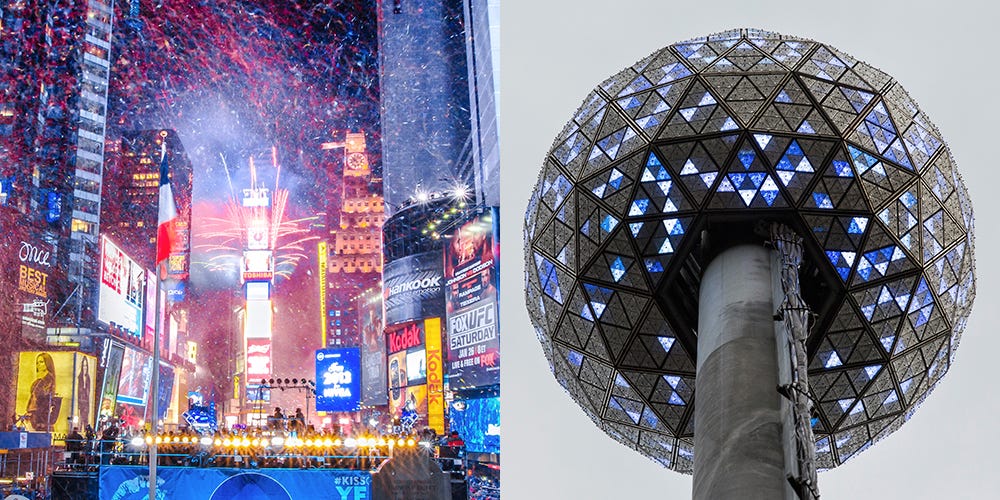
The current Times Square Ball is far larger and heavier than the 1907 original. Recent versions have measured around 12 feet or more in diameter and weighed several tons. The newest Constellation Ball design is even larger, measuring 12.5 feet across and weighing more than 12,000 pounds. It features thousands of crystal elements and advanced LED lighting. In short, it is not the kind of ornament you want rolling off the coffee table.
The Evolution of the Times Square Ball
The story of the Times Square Ball is really the story of American spectacle getting better lighting every few decades. The first ball in 1907 was practical, visible, and dramatic. Its job was to drop, glow, and give the crowd a shared moment. Later versions became more durable and more technologically advanced.
In the 1920s, the ball was redesigned with iron. During later decades, lighter materials such as aluminum were used. In the 1980s, the ball even took on a red “Big Apple” look, complete with green stem, giving the celebration a distinctly New York flavor. By the 1990s, computerized lighting and more theatrical effects entered the picture. For the millennium celebration, the ball became even more elaborate, with crystal elements and advanced lighting designed for a global television audience.
Modern viewers sometimes forget that the Times Square Ball Drop is a physical event, not just a broadcast. The ball descends down a pole above One Times Square during the final minute of the year. It reaches the bottom at midnight, signaling the start of the new year. The mechanics must be precise, the lighting must be camera-ready, and the symbolism must land at exactly the right second. No pressure, right?
Why the Times Square Ball Drop Became So Famous
The Times Square Ball Drop became famous because it combines several powerful ingredients: place, timing, spectacle, repetition, and emotion. Times Square is already one of the most recognizable urban spaces in the world. Add midnight on December 31, a glowing object descending from the sky, a giant crowd, confetti, music, and television coverage, and you have a tradition engineered for memory.
Another reason it lasts is that the ritual is easy to understand. It does not require a complicated backstory. The year is ending. The ball is dropping. Everyone counts down. The new year begins. That simplicity gives the event universal appeal. Whether you are watching from New York, California, Florida, Texas, or a living room with questionable snack decisions, the meaning is clear.
The Ball Drop also benefits from emotional timing. New Year’s Eve is naturally reflective. People think about what happened, what changed, what hurt, what worked, and what they hope comes next. The descending ball gives all those feelings a visible shape. It turns time into theater.
What Happens During the Times Square Ball Drop?
The celebration begins long before midnight. Crowds typically gather hours in advance, filling designated viewing areas in and around Times Square. The event includes live performances, celebrity appearances, countdown segments, confetti tests, lighting displays, and plenty of people wearing novelty glasses shaped like the upcoming year. Fashion experts may disagree, but New Year’s Eve eyewear has its own constitutional protections.
The main event begins at 11:59 p.m. Eastern Time, when the ball starts its descent from the top of One Times Square. During the final 60 seconds, the crowd counts down as the ball moves downward. At midnight, the ball reaches its final position, lights flash, confetti fills the air, and the new year officially begins in one of the most photographed places on Earth.
For many viewers, the television version is the tradition. National broadcasts have helped turn the Times Square Ball Drop into a coast-to-coast ritual. Even people who have never visited New York City feel connected to the event because it has been part of family rooms, restaurants, bars, and parties for generations.
Common Questions About the Times Square Ball Drop
Who Created the Times Square Ball Drop?
The tradition was created under the direction of Adolph Ochs, publisher of The New York Times. He wanted a memorable New Year’s Eve celebration connected to the Times Tower and the newly renamed Times Square. The result was a public event that outlasted its original promotional purpose by more than a century.
Where Does the Ball Drop?
The ball drops from the top of One Times Square in New York City. Although The New York Times eventually moved out of the building, the location remained central to the celebration. One Times Square is now known worldwide largely because of the New Year’s Eve Ball Drop.
How Long Does the Ball Take to Drop?
The ball’s descent takes 60 seconds. It starts moving at 11:59 p.m. and reaches the bottom at exactly midnight. That one-minute descent is the most famous minute in New Year’s Eve entertainment.
Was the First Ball Drop in 1907 or 1908?
This is a common point of confusion. The first ball drop happened on December 31, 1907, but it welcomed the year 1908. So if someone says the first celebration “rang in 1908,” they are correct. If someone asks when the event happened, the date is 1907.
Why People Still Care About the Ball Drop
Traditions survive when they keep meaning something. The Times Square Ball Drop has lasted because it gives people a shared moment in a world that often feels scattered. For one minute, attention narrows. People stop scrolling, pause conversations, and look up. The countdown gives everyone the same job. For once, even the loudest uncle at the party knows exactly what number comes next.
The ball itself is also a symbol of optimism. It shines in the dark. It moves downward, but the feeling is upward. It marks an ending, yet everyone is focused on beginning again. That combination is powerful. New Year’s Eve does not magically solve problems, but the ritual allows people to imagine that change is possible. Sometimes that is enough to make midnight feel like a doorway.
500-Word Experience Section: What It Feels Like to Be Part of the Times Square Ball Drop
Experiencing the Times Square Ball Drop, even from a distance, feels different from simply knowing the facts. On paper, it is a ball descending for 60 seconds. In real life, it feels like an entire city holding its breath. The most unforgettable part is not only the glittering sphere or the celebrity performances. It is the strange, wonderful feeling that thousands of strangers have agreed to care about the exact same second.
If you watch from home, the experience has its own cozy magic. The television is on, snacks are scattered across the table, someone is asking where the remote went, and another person is loudly insisting they are “definitely staying awake this year.” As midnight approaches, the room changes. People drift toward the screen. Conversations shrink. Phones come out for pictures or video calls. The countdown begins, and suddenly everyone is synchronized with Times Square, even if they are hundreds or thousands of miles away.
Being in Times Square itself is more intense. The waiting is long, the weather can be rude, and personal space becomes a theoretical concept. Yet people still go because the payoff is emotional. The lights are brighter than they look on television. The billboards turn the night into daylight. The crowd buzzes with languages, accents, jokes, songs, and the universal human desire to say, “I was there.” When the final minute arrives, the discomfort fades into the background. The ball begins to drop, and the crowd becomes one giant voice.
There is also something surprisingly personal about the moment. You may be standing among strangers, but your mind travels through your own year. Maybe you remember a job change, a graduation, a difficult goodbye, a new friendship, a health scare, a big win, or a quiet little victory nobody else noticed. The countdown gives those memories a frame. Ten seconds is not long, but somehow it can hold an entire year.
The best part of the Times Square Ball Drop experience is the release at midnight. Confetti erupts. People cheer. Couples kiss. Friends hug. Someone inevitably cries, and someone else immediately starts shouting about where to get pizza. That blend of grand emotion and ordinary human chaos is exactly why the tradition works. It is glamorous, silly, historic, crowded, shiny, and deeply human all at once.
Whether you witness it from Times Square, a hotel lobby, a neighborhood party, or a couch in fuzzy socks, the Ball Drop creates a shared memory. It reminds us that time moves whether we are ready or not, but we still get to greet it together. That is the real secret behind the sparkle. The ball is beautiful, but the countdown belongs to everyone.
Conclusion
The first Times Square Ball Drop took place on December 31, 1907, welcoming 1908 with a 700-pound iron-and-wood ball lit by 100 bulbs. What began as a creative replacement for fireworks and a promotional celebration for The New York Times became one of America’s most beloved annual traditions. Over the years, the ball evolved from a simple illuminated sphere into a massive crystal-covered, LED-powered symbol of renewal. Yet the heart of the ritual remains unchanged: a crowd, a countdown, and the thrilling idea that a new year can begin with light.