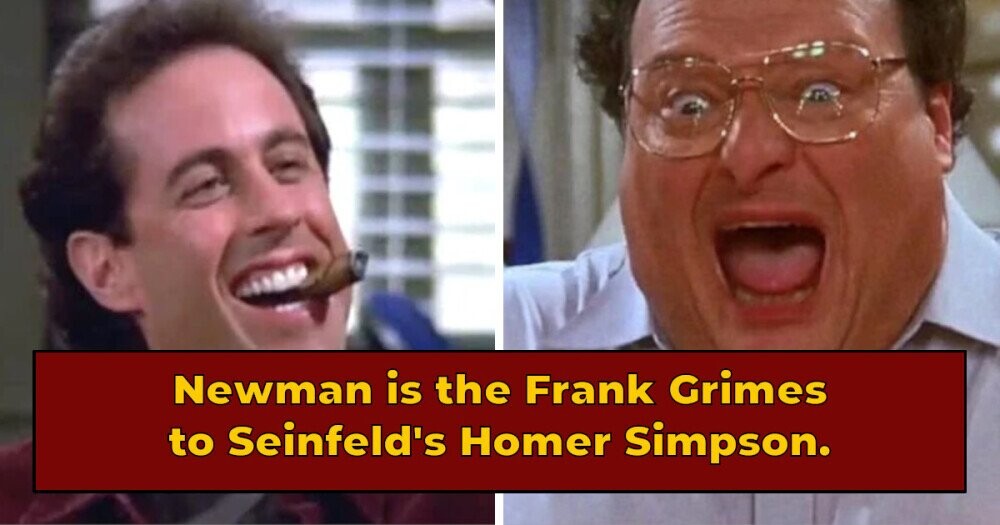
For decades, Seinfeld fans have been trained to hear two words like a tiny thunderclap: “Hello, Newman.” The music changes. Jerry squints. Newman smiles like he just swallowed a secret and a pastry. The audience knows what to do: boo the mailman, cheer the comedian, and accept that Wayne Knight’s Newman is the show’s neighborhood goblin.
But after a serious rewatchthe kind that starts as “one episode before bed” and ends with you judging fictional Manhattan residents like a municipal ethics boardthe evidence becomes hard to ignore. Newman may be Jerry’s nemesis, but he is not the real villain of Seinfeld. Jerry is.
Yes, Newman schemes. Yes, he hoards mail, growls through his dialogue, and treats the postal service like a secret empire with sorting bins. But Jerry Seinfeld, the character, does something more dangerous: he hides his selfishness behind charm, cleanliness, good sneakers, and observational comedy. Newman looks guilty. Jerry looks reasonable. That is how he gets away with it.
Newman Is Framed Like a Villain, But Mostly Acts Like a Neighbor With Grievances
Newman is introduced and repeatedly treated as Jerry’s arch-enemy. His relationship with Jerry is theatrical, almost comic-book simple. Jerry even gives him the energy of a supervillain. Newman enters rooms like he has been summoned by a curse placed on leftover Chinese food. The show wants us to laugh at him as a menace.
However, when you separate presentation from behavior, Newman’s villainy shrinks. He is petty, dramatic, lazy, and occasionally vindictive. That makes him a perfect sitcom antagonist, but not necessarily a moral monster. In many episodes, Newman is reacting to Jerry’s arrogance, participating in Kramer’s nonsense, or pursuing his own strange little goals. He is not trying to destroy the world. Half the time, he is trying to get a snack, dodge work, or win a petty argument.
Newman’s greatest crime may be that he is honest about being unpleasant. He does not pretend to be noble. He does not sell himself as the voice of reason. When Newman is resentful, he looks resentful. When he schemes, the room practically smells like cheap cologne and bad intentions. He is a cartoon cloud with a mailbag.
Jerry, on the other hand, presents himself as the normal one. That is where the trouble begins.
Jerry’s Real Superpower Is Plausible Deniability
Jerry Seinfeld is often called the “straight man” of the group, and structurally, that is true. George spirals. Elaine erupts. Kramer bursts through doors like gravity has made a personal exception for him. Jerry stands in the center, smirking, commenting, and acting as if everyone else is the problem.
But the show repeatedly reveals that Jerry is not simply observing chaos. He is creating it, feeding it, or enjoying it from a safe distance. His apartment may be tidy, but his ethics are as cluttered as Kramer’s life plan.
In “The Junior Mint,” Jerry and Kramer watch a surgery and accidentally allow candy to fall into a patient’s body. The episode is classic Seinfeld: absurd, uncomfortable, and funny because the characters respond to disaster with self-preservation instead of responsibility. Kramer is physically involved, but Jerry is not some innocent bystander. He goes along, watches, worries mostly about consequences, and treats a medical crisis like another awkward social inconvenience.
That pattern appears again and again. Jerry’s first instinct is rarely compassion. It is inconvenience management. He wants the situation cleaned upnot necessarily made right. There is a difference, and it is enormous.
Newman Has Motives. Jerry Has Entitlement.
Newman’s motives are usually obvious. He wants revenge, recognition, food, comfort, or the satisfaction of seeing Jerry bothered. These are not heroic motives, but they are understandable. Newman resents Jerry’s smugness, social status, and casual superiority. The joke is that Newman treats Jerry like a fraud, and sometimes, the joke is on us because Newman has a point.
Jerry often behaves as though the world owes him smooth service, attractive dates, uninterrupted routines, and total access to other people’s lives without emotional obligation. He breaks up with women over tiny quirks. He mocks strangers. He participates in schemes that damage other people’s relationships, jobs, or dignity. Then he steps back and says, essentially, “What’s the deal with consequences?”
In “The Merv Griffin Show,” Jerry becomes fascinated by his girlfriend’s vintage toy collection. The problem is that she does not want him touching it. A normal adult response would be disappointment, followed by moving on with life. Jerry instead turns desire into a plan. The plot becomes funny because it is outrageous, but it also exposes a core truth: Jerry can be deeply entitled when someone places a boundary between him and something he wants.
Newman may be dramatic about his grudges, but Jerry’s entitlement often wears a casual little jacket and pretends it is merely curiosity.
The “No Hugging, No Learning” Rule Makes Jerry Worse, Not Better
The famous creative spirit of Seinfeld is often summarized as “no hugging, no learning.” That rule helped make the show brilliant. The characters did not become better people every week. They did not sit in a living room at the end of an episode and explain friendship while soft music begged for an Emmy. They remained selfish, funny, insecure, shallow, and weirdly relatable.
But the rule also means Jerry never truly improves. He has the advantage of being witty and composed, so his flaws can feel less loud than George’s panic or Elaine’s rage. Yet Jerry’s refusal to grow is central to why he reads as the real villain. He is not a person who makes mistakes and learns from them. He is a person who collects mistakes like material.
That is the genius of the character. Jerry the comedian turns irritation into jokes. Jerry the sitcom character turns irritation into a lifestyle. He is always watching, judging, trimming human experience down to punchlines. Funny? Absolutely. Admirable? Let’s not get carried away.
The Finale Basically Puts Jerry’s Moral Record on Trial
The series finale remains one of the most debated endings in television history, but its central idea is fascinating: the four main characters are finally judged not for one giant crime, but for a long pattern of selfish behavior. Witnesses return. Old incidents pile up. The show becomes a courtroom of accumulated pettiness.
That structure matters because it challenges the audience’s loyalty. For years, we laughed with Jerry, George, Elaine, and Kramer. The finale asks: what if we were laughing at people who deserved consequences all along?
Jerry does not stand apart from that judgment. He is not the innocent narrator dragged down by his friends. He is one of the defendants. His cool detachment, which made him such a perfect sitcom center, becomes evidence against him. The finale’s joke is not simply that society overreacts. It is that the gang’s emotional emptiness finally meets a system that refuses to treat it as harmless.
And who is there at the end? Newman, naturally, enjoying the downfall. Is that villainous? Maybe. But it is also understandable. If your smug neighbor spent years treating you like a sewer rat in a postal uniform, you might savor the moment too.
Jerry’s Dating Life Is a Museum of Red Flags
One of the easiest places to see Jerry’s villain potential is his dating history. The parade of girlfriends on Seinfeld is legendary, but Jerry’s reasons for losing interest are often comically microscopic. A laugh, a habit, a physical detail, a lifestyle choice, a single awkward sentenceany of these can become a relationship-ending crisis.
The humor works because everyone has private preferences. But Jerry takes selectiveness to an absurd moral altitude. He often behaves as if other people exist to satisfy his standards while he owes them very little vulnerability in return. He wants novelty without inconvenience, attraction without compromise, intimacy without mess.
That is not romantic pickiness. That is emotional consumerism with better jokes.
Newman, by contrast, is rarely positioned as a romantic ideal, but he is not constantly auditioning people for the role of “person who must never annoy me.” Jerry’s dating life makes him look less like a charming bachelor and more like a man running quality control on humanity.
Newman Is a Better Villain Because He Makes Jerry Reveal Himself
The best antagonists do not merely oppose heroes; they expose them. Newman works because he pulls Jerry out of his polished routine. Around Newman, Jerry becomes openly hostile, childish, and territorial. The mask slips.
That is why their scenes are so memorable. Newman does not need to defeat Jerry. He only needs to enter the apartment. Suddenly, Jerry’s whole “reasonable observer” identity collapses into contempt. Newman brings out the version of Jerry that was always there: judgmental, snobbish, and weirdly intense about tiny social wars.
In that sense, Newman is less the villain than the mirror. Jerry hates him because Newman is everything Jerry refuses to see in himself: petty, vain, competitive, and desperate to win. Newman simply has fewer filters and worse posture.
Jerry Is Funny Because He Is Terrible in a Controlled Way
Calling Jerry the real villain does not mean he is not funny. In fact, it is the opposite. Jerry’s controlled awfulness is one of the engines of the show. He can turn a minor inconvenience into a courtroom argument. He can make ordinary social life feel like a battlefield governed by invisible rules. He is the patron saint of “technically correct, emotionally bankrupt.”
The comedy depends on that tension. Jerry is smart enough to identify absurdity but too self-involved to rise above it. He sees the ridiculousness of human behavior, then immediately contributes to it. He is both critic and culprit.
That is why Seinfeld still feels sharp. The show does not ask us to admire Jerry. It asks us to recognize him. We all have a tiny Jerry inside usthe voice that judges too quickly, wants clean exits, and believes our annoyances deserve federal attention. Watching Jerry is funny because he says the quiet part out loud. Watching him closely is uncomfortable because sometimes the quiet part is not very kind.
So, Is Newman Innocent?
No. Let’s not give Newman a medal and a government pension. He is still Newman. He can be sneaky, bitter, lazy, and gleeful when others fail. He has the energy of a man who would steal your parking space, deny it, and then write a poem about your suffering.
But Newman’s villain status is exaggerated by presentation. He has the music, the glare, the greeting, the theatrical delivery. Jerry has something more powerful: narrative privilege. Because the show is named after him, because he is funny, because his apartment is the central hub, we are encouraged to treat his perspective as default.
Once you stop doing that, the moral map changes. Newman becomes less like the devil and more like a local nuisance with excellent timing. Jerry becomes the true chaos engine hiding in plain sight.
Viewer Experience: What Changes When You Rewatch Seinfeld This Way
Rewatching Seinfeld with the idea that Jerry is the real villain creates a completely different experience. The first time through, many viewers naturally side with Jerry because he seems calm. He is the one making jokes, keeping the apartment clean, and reacting to George’s panic or Kramer’s entrances with the weary patience of a man trapped in a human zoo. But once you know the rhythms of the show, Jerry’s calm starts to look less like maturity and more like insulation.
The rewatch turns small moments into evidence. A sarcastic comment here, a selfish decision there, a dating complaint that sounds funny until you imagine being the person on the receiving end. Jerry is not usually explosive, which makes his flaws easier to miss. George melts down spectacularly. Elaine can go scorched earth. Kramer causes physical chaos. Jerry’s damage is cleaner. He pushes people, judges people, enables people, and then stands just far enough away from the wreckage to pretend he was only observing.
This is especially noticeable when Newman appears. On a casual watch, Newman feels like the villain because Jerry reacts to him with instant disgust. On a closer watch, the question becomes: why does Jerry get to decide who the villain is? Newman’s presence irritates Jerry because Newman refuses to admire him. He sees Jerry as smug and overrated. Since the audience is trained to like Jerry, Newman’s resentment seems ridiculous. But after enough episodes, Newman’s attitude begins to feel less random. Maybe he is not jealous for no reason. Maybe he has spent years watching Jerry float through social disasters with a grin and somehow remain the “normal” one.
That is the fun of this interpretation. It does not ruin Seinfeld; it makes the show richer. The jokes still work. The awkwardness still snaps. Kramer still enters like a man being delivered by catapult. But Jerry’s role becomes more interesting. He is not merely the host of the madness. He is part of the infection. His apartment is not a safe zone from absurdity; it is the command center.
For many fans, this also explains why the finale, despite its controversy, has aged better as an idea than as a pure laugh machine. The courtroom structure says what a rewatch slowly reveals: these people have left a trail. The comedy has consequences, even if the characters usually escape them. Jerry’s punishment is not that he suddenly becomes bad at the end. It is that the show finally stops letting his charm protect him.
That shift is why the “Jerry is the villain” argument is so satisfying. It lets Newman remain funny without pretending he is harmless. It lets Jerry remain hilarious without pretending he is good. Most importantly, it respects what made Seinfeld revolutionary in the first place. This was never a sitcom about role models. It was a sitcom about the tiny selfish impulses people usually hide under manners, small talk, and decent hair. Jerry just happened to hide them best.
Conclusion: Newman Wore the Villain Costume, Jerry Wrote the Rules
Newman will always be one of television’s great comic antagonists. Wayne Knight gave him a voice, a rhythm, and a sinister sparkle that made every entrance feel like a federal incident. But being Jerry’s enemy does not automatically make Newman the true villain of Seinfeld.
The real villain is the character who understands social rules well enough to manipulate them, breaks boundaries when it suits him, judges everyone around him, and still expects to be treated as the reasonable man in the room. That character is Jerry.
Newman may be the storm cloud. Jerry is the climate.