Some abandoned houses whisper. Others practically clear their dusty throats and say, “Please sit down. This story is heavier than it looks.” The abandoned estate at the center of this 20-photo story belongs firmly in the second category. It is not just another crumbling mansion with peeling wallpaper, broken windows, and furniture that looks like it has been waiting for guests since the Reagan era. It is a place shaped by family, memory, grief, and the strange silence that settles when everyday life stops mid-sentence.
The house, reportedly located in France, became known among urban explorers because of its heartbreaking backstory. According to the published account, the family who once lived there was involved in a fatal car accident in the 1980s. The mother survived, while her husband and two children did not. What remained was not only a large home full of belongings, but a private world altered by loss. Years later, the walls were covered with handwritten thoughts, poems, and fragments of feeling, turning the rooms into something between a diary, a memorial, and a museum no one officially opened.
This article explores the story behind the abandoned house, the emotional pull of the 20 pictures, the ethics of photographing personal spaces, and why abandoned homes fascinate us so deeply. Spoiler alert: it is not just because old wallpaper has more drama than most streaming shows.
Why This Abandoned House Feels Different
Many abandoned places are visually interesting because time has changed them. A school without students, a theater without applause, or a farmhouse with weeds in the kitchen all create a powerful sense of absence. But this house carries something more personal. It does not simply look unused; it feels interrupted.
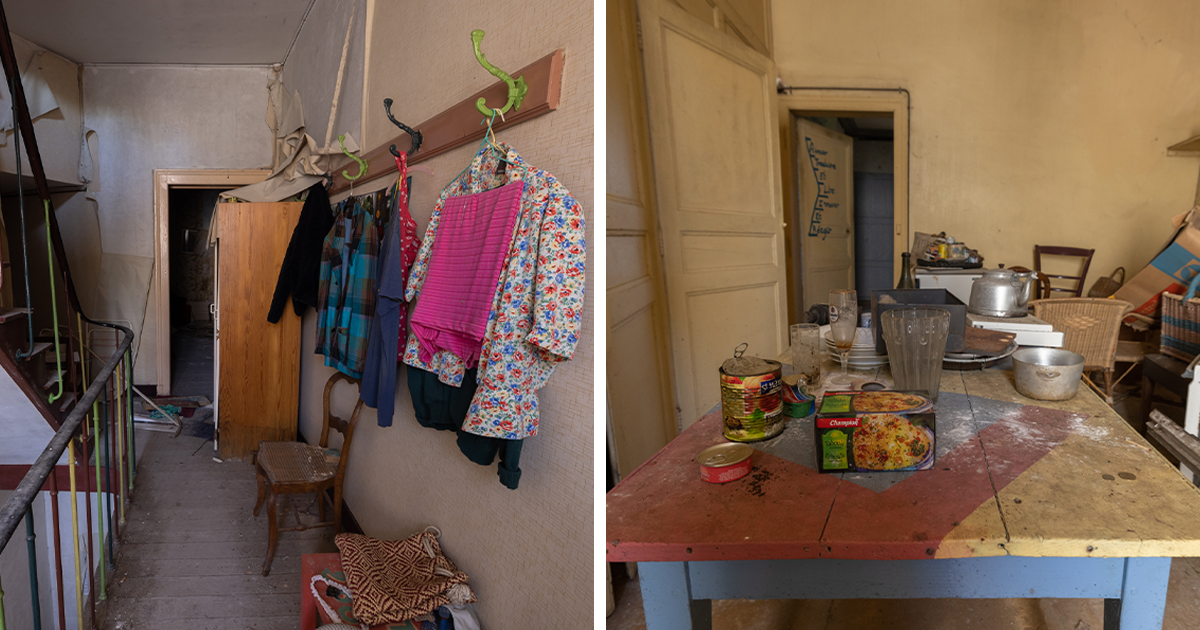
In the photographs, rooms still contain the ordinary evidence of domestic life: clothing, furniture, framed pictures, kitchen items, beds, and small personal objects. These are not grand historical artifacts locked behind museum glass. They are the kind of things people touch every day without thinking. A chair pulled near a wall. A dresser top holding the quiet clutter of a life. A bedroom that suggests routines, rest, and family history.
That ordinary quality is what makes the abandoned estate so moving. Tragedy does not always announce itself with dramatic architecture. Sometimes it lingers in a folded garment, a child’s room, or a dining table where nobody gathers anymore.
The Story Behind the 20 Pictures
The photo essay describes a family whose life changed after a devastating car accident in the 1980s. The surviving mother reportedly continued living in the estate for years, surrounded by memories. Over time, she wrote across the walls, leaving behind poems, thoughts, and phrases that seem to reach toward comfort, belief, loneliness, and survival.
One of the translated lines shared from the house suggests that she did not feel entirely alone there. That sentence gives the home its emotional center. In a normal house, writing on the wall might be treated as damage. In this house, it becomes testimony. It is not decoration; it is evidence of someone trying to live with the unbearable weight of absence.
The 20 pictures matter because they do not need jump scares, spooky music, or someone whispering “Did you hear that?” into a camera. Their power comes from restraint. The exterior shows a house that still stands. The dining room reveals walls layered with words. Bedrooms hold traces of family life. The kitchen, bathroom, and living room suggest that time did not erase the home all at once. It simply kept arriving, day after day, until the place became a preserved silence.
Abandoned Homes as Emotional Time Capsules
An abandoned home is different from an abandoned factory or hospital. Industrial ruins often speak about work, economics, or changing communities. A home speaks in a more intimate language. It contains taste, habit, personality, and memory. The wallpaper is not just wallpaper; it is someone’s choice. The dishes are not just dishes; they once belonged to meals, mornings, and probably at least one argument about who forgot to buy bread.
That is why abandoned house photography can feel so intimate. When a photographer enters a domestic space, the camera is not simply recording architecture. It is looking at someone’s private world after the people are gone. The best photographers understand this tension. They do not treat the place like a haunted amusement park. They approach it as a fragile record of human life.
In this French estate, the effect is even stronger because the walls themselves appear to speak. The house is not only holding memories; it is covered in them. The writing transforms rooms into pages. The estate becomes a book that was never formally published, and the photographs become a careful way of reading it.
The Role of Urban Exploration Photography
Urban exploration, often called urbex, focuses on hidden, vacant, forgotten, or abandoned man-made places. The genre can include everything from old mansions and closed schools to empty factories, theaters, tunnels, and military sites. At its best, urban exploration photography preserves visual stories that might otherwise disappear through decay, demolition, vandalism, or simple neglect.
Still, urbex comes with serious ethical questions. A place can be abandoned and still privately owned. A door can be open and still not be an invitation. A house can look empty and still contain deeply personal belongings. Responsible storytelling means remembering that “no one lives here now” is not the same as “nothing here matters.”
That is especially true in a house connected to family tragedy. The photographer’s job is not to turn grief into a spectacle. It is to document the emotional atmosphere with care, distance, and respect. The strongest images in this kind of story are not the most shocking ones. They are the ones that make viewers pause, lower their voices, and remember that every abandoned place was once someone’s present tense.
What the Dining Room Walls Reveal
The dining room appears to be one of the most unforgettable parts of the house. Its walls are covered with writings, including personal lines, quotations, and poetic fragments. A dining room is usually a social room. It is where families eat, talk, celebrate, complain, laugh, and pass plates with the seriousness of a tiny food-based government. In this house, the dining room became something else: a space where grief found a surface.
Writing on walls has a strange power. It is public and private at the same time. A notebook can be closed. A wall cannot. By placing words across the rooms, the surviving resident seemed to make emotion part of the architecture. The home no longer just contained grief; it displayed it, lived with it, and perhaps argued with it.
For viewers, these written walls change the way we interpret the photographs. Without them, the estate might seem like another elegant ruin. With them, the house becomes a human document. The peeling paint and old furniture matter, but the words give the place a voice.
Why Personal Objects Hit Harder Than Grand Architecture
Large abandoned estates are visually impressive, but the smallest objects often do the emotional heavy lifting. A staircase may show age. A chandelier may show former wealth. But a pair of shoes, a framed family photo, or clothing left in place suggests a specific life.
Personal objects remind us that history is not only made of wars, presidents, famous buildings, and museum labels written in extremely serious fonts. History is also made of laundry, recipes, school mornings, favorite chairs, bathroom mirrors, and the small domestic rituals that rarely feel important until they are gone.
That is why these 20 pictures are not just “abandoned house photos.” They are images of interrupted belonging. They ask viewers to look carefully, but not greedily. They invite curiosity, but they also demand restraint.
The Beauty and Danger of Decay
There is no denying the visual beauty of decay. Sunlight through broken shutters, vines climbing stone, faded fabric, dust on a piano, and paint curling like old paper all create a cinematic atmosphere. Nature and time are excellent set designers, though admittedly terrible landlords.
But abandoned buildings are not safe playgrounds. Old structures can contain weak floors, unstable roofs, mold, asbestos, lead paint, broken glass, exposed nails, animal waste, and other hazards. Even when a room looks calm in a photograph, the reality outside the frame may be risky. That is why abandoned locations should never be entered casually, illegally, or without permission and proper professional judgment.
For readers, the safest way to experience places like this is through responsible photography, historical research, preservation projects, public heritage sites, and documented stories. The goal is to appreciate the meaning of these spaces, not to turn danger into a weekend hobby with a flashlight and poor decision-making skills.
Respecting the Family Behind the Story
Stories of tragedy require careful language. It is easy for the internet to turn loss into a headline, a thumbnail, or a spooky caption. But behind this abandoned estate was a family. There were children who had toys, clothes, rooms, and futures imagined for them. There was a husband and father. There was a mother who survived and then had to live in the long shadow of what happened.
That human reality should guide how the story is told. The house is fascinating, yes. The photographs are haunting, absolutely. But the deeper value of the story is not shock. It is empathy. It reminds us that grief can change the way a person lives in space. It can make a home feel protective, painful, sacred, and impossible to leave.
When viewers look at the 20 pictures, the respectful response is not “cool creepy house.” It is closer to “someone lived, loved, lost, and left traces here.” That shift matters. It turns passive viewing into emotional understanding.
Why We Are Drawn to Abandoned Houses
Abandoned houses attract attention because they create instant questions. Who lived here? Why did they leave? Why are the plates still in the kitchen? Why is there a bed behind a wall? Why does that chair look like it is judging me?
Human beings are natural storytellers. When we see a place full of clues, our minds begin arranging them into narrative. The problem is that abandoned homes rarely give complete answers. They offer fragments. A photograph. A child’s item. A handwritten phrase. A room left almost intact. The mystery is part of the pull.
But mystery should not become invention. Responsible writing about abandoned places should separate what is known from what is guessed. In this case, the known public account describes a family accident, a grieving survivor, and a home filled with writings and belongings. Beyond that, the house deserves humility. Not every silence needs to be filled with speculation.
The House as a Memorial Without a Plaque
Most memorials are intentional. They have names, dates, flowers, stone, bronze, or official language. This abandoned estate is different. It became a memorial accidentally, through survival, absence, and time. No curator arranged the rooms. No designer chose the lighting. No committee debated the wording, which is probably for the best because committees can make even grief sound like a parking regulation.
Instead, the house memorializes the family through what remains. The walls hold writing. The rooms hold belongings. The photographs hold the final layer: a visual record shared with the outside world. Whether the estate still stands in the same condition or has changed since the images were taken, the photo essay preserves a moment in the building’s long afterlife.
That is one reason abandoned place photography can matter. Buildings disappear. Objects are removed. Weather enters. Vandals arrive. Owners make decisions. Time does not pause just because a story is powerful. A thoughtful photograph can become the last respectful witness to a place before it changes forever.
How to Read the 20 Pictures Without Exploiting the Pain
Viewing images of an abandoned family home requires a different mindset than scrolling through ordinary design inspiration. This is not a “vintage French estate aesthetic” mood board. It is a record of loss. The viewer should approach the images the way one might enter a quiet room: slowly, respectfully, and without grabbing at everything.
Notice the light, but also notice what the light falls on. Notice the furniture, but think about use, not just style. Notice the writing, but understand that it came from a real emotional life. Notice the children’s belongings, but do not reduce them to props. The most ethical way to view the photos is to remember that the camera captured traces, not characters in a fictional horror movie.
That kind of viewing makes the story more powerful, not less. Respect does not flatten mystery. It deepens it.
What This Story Teaches About Memory
The abandoned house shows that memory does not live only in the mind. It attaches itself to places. A room can remember through arrangement. A hallway can remember through echoes. A wall can remember through writing. A kitchen can remember through the tools left behind.
When a family home is abandoned after tragedy, the building may become a container for unfinished emotion. To outsiders, it may look frozen. But emotionally, it is active. It keeps asking questions about love, loss, survival, privacy, and what should happen to the things people leave behind.
The 20 pictures are compelling because they do not resolve those questions neatly. They let the viewer sit with discomfort. That may be the most honest thing they can do.
Additional Reflections: Experiences Connected to This Story
Experiencing a story like this, even through photographs, can feel surprisingly personal. You may begin by clicking because the title promises an abandoned house, tragedy, and 20 pictures. Then, somewhere between the exterior shot and the handwritten dining room walls, curiosity changes into quiet attention. The house stops being “content” and becomes a place where you feel like you should speak softly, even if you are only reading on a phone while your coffee gets cold.
That emotional shift is the most memorable part of stories about abandoned homes. The images do not simply show decay; they remind us how fragile normal life is. One decade, a house is full of meals, laundry, birthdays, misplaced keys, and someone yelling from another room, “Have you seen my sweater?” Decades later, the same rooms may sit in silence while strangers try to understand what happened from the objects left behind. It is a strange and humbling transformation.
The abandoned French estate also highlights the difference between looking and witnessing. Looking is quick. It says, “That room is eerie.” Witnessing stays longer. It asks, “Who lived here, and what does this room deserve from me?” That distinction matters because the internet often rewards speed. We scroll, react, and move on. But some stories ask us not to move on too quickly.
In a personal sense, the house may remind readers of places from their own lives that no longer exist in the same way: a grandparent’s kitchen, a childhood bedroom, a closed neighborhood store, or a street that changed beyond recognition. Most of us know what it feels like to return somewhere and realize the past has packed its bags without leaving a forwarding address. The abandoned house magnifies that feeling. It shows a home where the past did not leave cleanly. It stayed in fragments.
There is also a lesson here for photographers, writers, and anyone who shares real stories online. The more emotional a place is, the more carefully it should be handled. A dramatic headline may attract attention, but the body of the story must give people back their dignity. That means avoiding cruel speculation, respecting private grief, and remembering that abandoned objects are not free souvenirs for the imagination. They belonged to lives that mattered.
For readers fascinated by abandoned places, the best response is not to hunt for the location or imitate the visit. A better response is to support preservation-minded storytelling, learn local history, visit legal heritage sites, and appreciate photographers who document fragile spaces without turning them into treasure maps. The point is not to break into the past. The point is to understand it.
Ultimately, the story of this abandoned house stays with us because it combines beauty with sorrow. The rooms are visually striking, but the emotional weight comes from what they represent: a family interrupted, a survivor’s grief, and a home transformed into an accidental archive. The 20 pictures do not give us the whole life of the family, and they should not pretend to. What they give us is a glimpsetender, unsettling, and unforgettableof how love and loss can remain written into a place long after the front door closes.
Conclusion
The abandoned house belonging to a family affected by a 1980s car accident is more than a visually haunting estate. It is a reminder that homes are emotional landscapes. They hold routines, relationships, private language, and the quiet evidence of people who once filled the rooms with life. Through the 20 pictures, viewers encounter not only decay, but memory: handwritten walls, personal belongings, family spaces, and the lingering presence of grief.
Handled respectfully, stories like this can deepen our understanding of abandoned places. They show why preservation matters, why ethical photography matters, and why curiosity must be balanced with compassion. This house is not just a ruin. It is a story of tragedy and loss, still speaking through walls, rooms, and photographs.
Note: This article is written as an original, publication-ready SEO feature based on publicly available information and broader research about abandoned places, preservation, grief, safety, and ethical photography. It does not reproduce the original photo essay text or include unnecessary citation placeholders.