Note: This article is a fan-culture analysis and creative comparison, not an official crossover, sequel, or licensed collaboration between the Sailor Moon and Harry Potter franchises.
Imagine this: Usagi Tsukino is late for class again, toast in mouth, sprinting through Tokyo with Luna yelling life advice from a fence. Suddenly, an owl drops a letter sealed in wax. Across the world, a Hogwarts student opens a book about planetary guardians and wonders why the Moon has a better defense system than the Ministry of Magic. That is the playful spark behind Sailor Moon Meets Harry Potter, a crossover idea that feels both wildly unexpected and strangely natural.
On the surface, the two franchises come from different storytelling planets. Sailor Moon, created by Naoko Takeuchi, is a Japanese magical girl phenomenon about friendship, destiny, cosmic evil, reincarnation, and heroic teenagers who save the universe while still worrying about exams, crushes, and snacks. Harry Potter, written by J.K. Rowling, is a British fantasy series built around Hogwarts, magical education, friendship, hidden worlds, moral choices, and the long shadow of dark magic. One gives us tiaras, transformation brooches, planetary powers, and speeches about love and justice. The other gives us wands, houses, enchanted corridors, and a school where the staircases apparently have commitment issues.
Yet both stories understand something timeless: growing up feels magical, terrifying, funny, and confusing all at once. That is why fans keep imagining what would happen if Sailor Guardians walked through the halls of Hogwarts or if Hogwarts students discovered that the solar system already has a team of teenage defenders with better uniforms and far more dramatic entrances.
Why “Sailor Moon Meets Harry Potter” Works So Well
The phrase Sailor Moon Meets Harry Potter works because both worlds are built on secret identities, chosen families, and young heroes learning that power is not just about talent. It is about courage, loyalty, sacrifice, and knowing when to trust your friends instead of trying to win the entire boss fight alone.
Usagi begins as an ordinary 14-year-old girl who would rather nap than save civilization. Harry begins as a lonely boy who has no idea he belongs to a magical world. Both are pulled into destiny before they fully understand the rules. Both discover mentors, rivals, ancient threats, magical objects, and friendships that become stronger than bloodline or prophecy.
The big difference is flavor. Sailor Moon says, “Love can defeat darkness, and yes, we will sparkle while proving it.” Harry Potter says, “Love can defeat darkness, but first please survive a school year full of suspicious teachers, cursed objects, and exams.” Put them together, and you get a crossover concept with emotional depth, comedy, action, and enough magical bureaucracy to make Professor McGonagall request a very strong cup of tea.
The Magical Systems: Moon Power vs. Wand Magic
One of the most interesting parts of a Sailor Moon and Harry Potter crossover is the clash between their magical systems. In Harry Potter, magic is often learned through study, wand technique, spell pronunciation, potion work, and inherited magical ability. Hogwarts turns magic into a curriculum. There are essays, rules, exams, and teachers who can turn a cheerful afternoon into a pop quiz.
In Sailor Moon, magic is more symbolic and cosmic. The Sailor Guardians draw power from planets, identity, emotional strength, and destiny. Their transformations are not just wardrobe upgrades; they are declarations of purpose. Sailor Moon does not simply cast a spell. She becomes the champion of love and justice, which sounds dramatic until you remember that she also cries, panics, and somehow still saves everyone.
If these systems met, Hogwarts professors would probably try to classify Guardian powers. Is the Silver Crystal a magical artifact? A celestial relic? A form of ancient defensive magic? Would a transformation brooch be allowed in Charms class, or would it violate school uniform policy? Meanwhile, Luna would take one look at Hogwarts and ask why a school full of children is guarded by moving staircases, ghosts, secret chambers, and a forest that seems to have read the phrase “student safety” and laughed.
Sorting the Sailor Guardians into Hogwarts Houses
No crossover discussion would be complete without the great internet ritual: sorting characters into Hogwarts houses. It is not a perfect science, but it is fun, and fun is a valid research method when handled responsibly and with snacks.
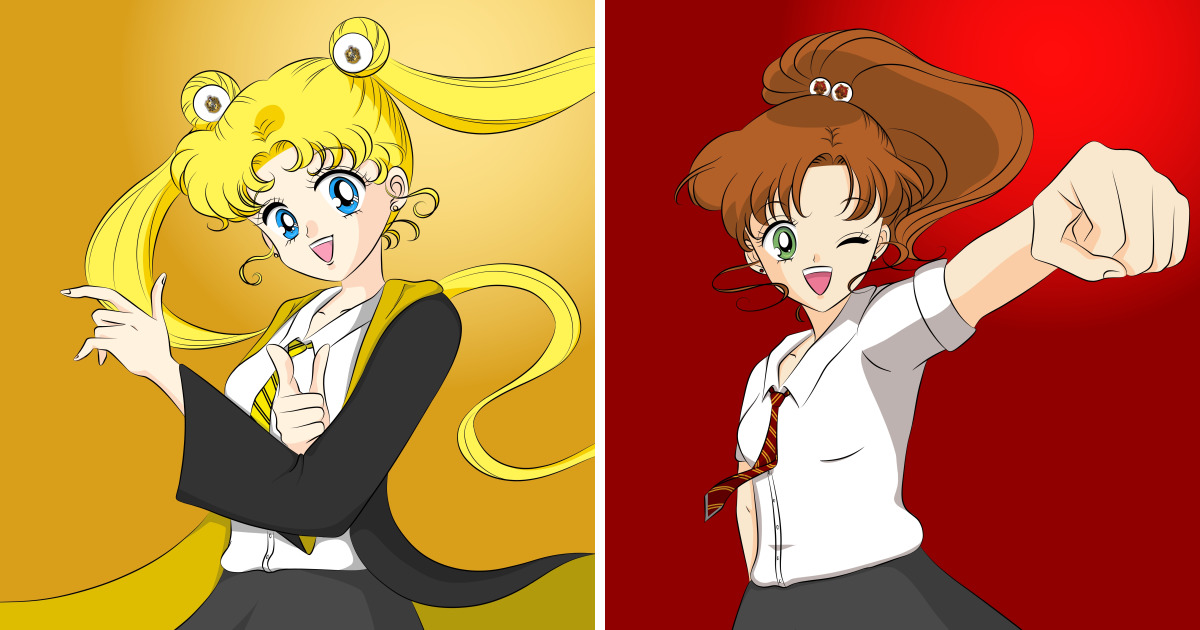
Usagi Tsukino: Hufflepuff with Gryffindor Rising
Usagi is often underestimated because she is emotional, clumsy, and easily distracted. But her greatest strengths are loyalty, empathy, and the refusal to abandon people even when they are difficult, dangerous, or currently possessed by evil. That makes her a strong Hufflepuff candidate. Still, her courage in battle gives her a bright Gryffindor streak. She may cry before the fight, during the fight, and after the fight, but she still shows up.
Ami Mizuno: Ravenclaw, Obviously
Ami is the Sailor Guardian of intelligence, strategy, and calm thinking. She would thrive in Ravenclaw, where curiosity and learning matter. She would also become the student who finishes the assigned reading, the extra reading, and the reading the professor mentioned once in 1973. Hermione Granger would respect her immediately, then challenge her to a library-based academic duel that lasts three semesters.
Rei Hino: Gryffindor with Slytherin Discipline
Rei is bold, intense, spiritual, and fiercely protective. Her fire-based power matches her personality: passionate, sharp, and not interested in nonsense. Gryffindor suits her courage, but Slytherin’s ambition and self-control also fit her disciplined shrine maiden background. She would not tolerate Peeves for more than seven seconds.
Makoto Kino: Hufflepuff-Gryffindor Powerhouse
Makoto is loyal, brave, nurturing, and physically formidable. She can cook you dinner, defend you from a monster, and still apologize if the seasoning is slightly off. Her blend of warmth and strength makes her a natural bridge between Hufflepuff and Gryffindor. At Hogwarts, she would be adored in Herbology and feared in any duel involving lightning.
Minako Aino: Gryffindor with Main Character Energy
Minako is charming, theatrical, brave, and ambitious. As Sailor Venus, she carries leadership experience and a performer’s confidence. Gryffindor fits her boldness, though she has enough ambition and image management to make Slytherin glance over and say, “We see you.” She would absolutely try out for a Hogwarts performance club, then accidentally turn it into a schoolwide idol event.
Character Chemistry: Who Would Become Friends?
The most entertaining part of Sailor Moon Meets Harry Potter is imagining the character dynamics. Usagi and Ron Weasley would bond over food, comic timing, and the shared experience of being braver than they initially appear. Ami and Hermione would become an unstoppable study alliance, though their first meeting might involve politely competing over who can answer more questions in class.
Rei and Hermione might clash at first because both have strong opinions and limited patience for foolishness. Over time, they would respect each other’s discipline. Makoto and Hagrid would likely become friends through their shared appreciation for misunderstood creatures, hearty meals, and protective instincts. Minako would treat the moving portraits like an audience and probably become famous at Hogwarts within 48 hours.
And then there is Luna. Luna the cat meeting Professor McGonagall in Animagus form would be a scene fans would replay forever. One is a talking guardian cat with royal-cosmic responsibilities. The other is a legendary professor who can transform into a cat and still look disappointed in you. Their conversation would contain more authority than an entire Ministry department.
Villains: Dark Kingdom Meets Dark Magic
Both franchises use darkness as more than a visual effect. In Sailor Moon, villains often feed on energy, loneliness, jealousy, obsession, or corrupted desire. In Harry Potter, dark magic is tied to fear, control, prejudice, immortality, and the refusal to accept human limits. A crossover villain would not need to be louder than either canon. The real threat would be ideological: a force that tries to separate people from love, memory, friendship, and hope.
That is why the Sailor Guardians fit so well in the wizarding world. Their power is not only combat-based. It is restorative. Sailor Moon’s greatest victories often come from healing, reaching people emotionally, and refusing to treat love as weakness. In Hogwarts terms, she is the student who somehow turns Defense Against the Dark Arts into Emotional Honesty Against the Dark Arts.
Fashion, Symbols, and the Power of Transformation
Sailor Moon is famous for transformation sequences, celestial symbols, tiaras, bows, boots, and color-coded identities. Harry Potter is famous for robes, house scarves, wands, crests, and school uniforms. Both use clothing and objects as signs of belonging. A Hogwarts scarf tells people your house. A Sailor Guardian uniform announces your cosmic role, your planet, and your readiness to deliver a speech before battle.
A crossover visual design could be stunning. Imagine Guardian-inspired Hogwarts robes with planetary embroidery, moon-phase wand handles, house scarves redesigned with celestial charms, or a Yule Ball where the Sailor Guardians arrive in gowns inspired by their planetary colors. The mix of Japanese magical girl aesthetics and British boarding-school fantasy has strong visual SEO appeal because it gives readers something easy to imagine and artists something irresistible to draw.
Themes Both Fandoms Love
Friendship as Real Power
Both stories reject the idea of the isolated hero. Harry survives because of Ron, Hermione, mentors, allies, and the sacrifices of others. Usagi triumphs because the Sailor Guardians stand together across time, space, and emotional chaos. Neither world treats friendship as decorative. Friendship is strategy. Friendship is survival. Friendship is also the person reminding you that you forgot your homework again.
Destiny vs. Choice
Prophecy matters in both worlds, but it never replaces choice. Sailor Moon has a royal past and cosmic destiny, yet her compassion in the present defines her. Harry carries a famous scar and a dangerous prophecy, yet his choices determine who he becomes. This shared theme gives crossover writers and readers a strong emotional foundation.
Growing Up Under Pressure
Both franchises understand that teenagers can carry enormous responsibility while still being teenagers. They worry about grades, friends, romance, identity, and belonging. Then an ancient evil shows up and ruins the weekend. That mix of ordinary life and epic danger is exactly what makes both stories last.
How a Sailor Moon and Harry Potter Crossover Could Work
A smart crossover would not simply drop characters into one another’s worlds for novelty. It would ask what each universe reveals about the other. For example, Hogwarts could discover an old astronomical chamber connected to planetary magic. The Sailor Guardians could investigate strange distortions in the Moon Kingdom’s history caused by forbidden wizarding artifacts. The conflict could involve a magical eclipse that weakens celestial power while amplifying dark spells.
The best version would balance humor and stakes. Usagi struggling with Potions would be funny. Ami mastering Arithmancy in a week would be believable. Rei sensing dark energy in the castle would create tension. Makoto bonding with magical plants would be wholesome. Minako trying to understand Quidditch as a performance opportunity would be chaos in the best way.
But the heart of the story would be emotional. Harry might learn from Usagi that softness can be strength. Usagi might learn from Harry that courage sometimes means walking into fear without knowing whether love will be enough. Both lessons matter.
Why Fans Keep Loving Crossovers
Crossovers are popular because they let fans ask playful “what if” questions. What if two types of magic met? What if two heroes with similar burdens compared notes? What if characters from different cultures, genres, and storytelling traditions discovered that they are fighting versions of the same darkness?
Sailor Moon Meets Harry Potter is especially appealing because it joins two fandoms with deep emotional memory. Many fans discovered one or both stories when they were young. They remember watching transformations on television, reading books late at night, collecting merchandise, debating favorite characters, taking house quizzes, or arguing over which Sailor Guardian had the best attack. A crossover activates that nostalgia without needing to replace either original world.
SEO-Friendly Reader Takeaway
For readers searching for Sailor Moon Meets Harry Potter, the appeal is not just “anime plus wizard school.” It is the meeting of two major fantasy languages: celestial heroine mythology and magical boarding-school adventure. The crossover concept works because both franchises value friendship, courage, identity, transformation, and the idea that young people can face impossible darkness without losing their humor or humanity.
In a media world full of multiverses, reboots, and fan theories, this crossover remains powerful because it does not require official confirmation to be meaningful. It lives in fan art, essays, cosplay, character sorting debates, and late-night conversations that begin with, “Okay, but what house would Sailor Mars be in?” That question alone could fuel a thousand comment sections.
Personal Experiences and Fan Reflections: Living Inside the Crossover Dream
For many fans, imagining Sailor Moon Meets Harry Potter feels less like inventing something random and more like opening a door between two childhood bedrooms. On one side, there is the glow of anime transformations, planetary symbols, moonlight, friendship speeches, and the emotional thunderstorm that is Usagi Tsukino trying her best. On the other side, there are castle corridors, house scarves, spellbooks, owl letters, and the thrill of believing that somewhere, hidden behind ordinary life, a magical world might be waiting.
The experience of loving both franchises often begins with contrast. Sailor Moon is bright, emotional, stylish, and openly dramatic. It says feelings matter. It lets characters cry, laugh, argue, dream, fail, and transform anyway. Harry Potter offers a different comfort: the structure of school years, houses, lessons, mysteries, and friendships formed through shared danger. One feels like moonlight and pop music; the other feels like candlelight and old stone. Together, they create a fantasy mood that is both sparkling and cozy.
A fan who grew up with both might remember pretending a pencil was a wand one day and a transformation pen the next. A school hallway could become Hogwarts before lunch and a monster-of-the-week battlefield after math class. That kind of imaginative play is not silly; it is one of the ways young readers and viewers practice identity. Which house would I be in? Which Sailor Guardian do I relate to? Am I brave like Gryffindor, loyal like Hufflepuff, brilliant like Ami, passionate like Rei, protective like Makoto, radiant like Minako, or emotionally messy but determined like Usagi? The answer can change depending on the year, the mood, and the amount of homework due tomorrow.
Cosplay also makes this crossover feel alive. Fans can blend Hogwarts robes with Sailor Guardian colors, design wands topped with planetary symbols, or imagine house uniforms with moon charms and star embroidery. At conventions, this kind of mashup often works because people understand it instantly. A Sailor Moon wand-holder in Ravenclaw blue or a Gryffindor-inspired Sailor Mars design tells a whole story without needing a paragraph of explanation. It is visual fan language: funny, affectionate, and creative.
There is also emotional comfort in combining these worlds. When life feels overwhelming, Sailor Moon reminds fans that kindness is not weakness. Harry Potter reminds them that belonging can be found, not just inherited. Together, they create a fantasy of being chosen not because you are perfect, but because you are willing to care. That is powerful. Usagi is not the strongest because she never doubts herself; she is strong because she keeps loving people through fear. Harry is not heroic because he understands everything; he is heroic because he chooses loyalty and courage despite loss and confusion.
That is the real magic behind Sailor Moon Meets Harry Potter. The crossover is not only about tiaras meeting wands or Hogwarts hosting a Moon Kingdom exchange program, although both would be delightful. It is about two beloved stories telling fans that ordinary young people can become extraordinary when they find friends, face darkness, and keep their hearts open. Also, yes, it is about Luna judging the entire Hogwarts staff. Some things are simply necessary.
Conclusion
Sailor Moon Meets Harry Potter is a crossover idea with lasting charm because it blends two fantasy traditions that speak to the same emotional truth: magic is most meaningful when it reveals character. Wands, crystals, spells, transformations, houses, planets, castles, and moonlight are wonderful, but they are not the core. The core is friendship. The core is choice. The core is learning that even when destiny knocks loudly on the door, you still get to decide what kind of person answers.
Whether readers arrive as anime fans, Potterheads, cosplay artists, fan fiction writers, or curious newcomers, this crossover concept offers a rich playground for imagination. It is funny, visually exciting, emotionally sincere, and surprisingly deep. In other words, it is exactly the kind of magical collision the internet was built to discuss, debate, illustrate, and lovingly overthink.