Some lives are so cinematic that even the quiet moments look staged. Elvis Presley’s life was one of them. A boy in a tiny Tupelo house became a Memphis teenager with a guitar, then a national television earthquake, then a Hollywood star, a soldier, a Las Vegas headliner, a gospel singer, a cultural symbol, and eventually a legend whose home still draws pilgrims like a rock-and-roll cathedral with better wallpaper.
This article looks at 12 photos of Elvis Presley’s life and legacy as if each image were a doorway. Instead of simply saying, “Here is Elvis looking cool,” we will ask what each picture reveals: the ambition, the pressure, the style, the contradictions, and the strange electricity that made him more than a singer. Elvis was not merely photographed; he seemed to bend the camera toward him, like the lens had suddenly remembered it had a job to do.
Why Elvis Photos Still Matter
Elvis Presley images remain powerful because they capture the birth of modern celebrity in real time. Before social media, before viral clips, before every musician needed a personal brand manager and at least three backup ring lights, Elvis helped create the visual language of pop fame. The curled lip, the black hair, the flashy jackets, the shaking legs, the military uniform, the white jumpsuiteach became part of a public story that fans still recognize instantly.
Looking through famous Elvis Presley photos is not just nostalgia. It is a way to understand American music history, youth culture, race, fame, television, movie marketing, military service, and the business of memory. His career moved through country, rhythm and blues, gospel, pop, film musicals, and arena spectacle. In that sense, Elvis’s photo archive is not only a family album. It is a cultural map.
1. The Tupelo Childhood Photo: Where the Story Begins
The first essential image is not glamorous. It is the mental picture of Elvis as a child in Tupelo, Mississippi, born on January 8, 1935, in a small two-room house. His twin brother, Jesse Garon Presley, was stillborn, leaving Elvis as the only child of Vernon and Gladys Presley.
A childhood photo of Elvis matters because it strips away the later mythology. Before the rhinestones and screaming crowds, there was poverty, family closeness, church music, and a boy growing up in the Depression-era South. The smallness of the house makes the largeness of the legacy feel almost absurd. History loves a dramatic contrast, and Elvis gave it one: a front porch beginning and a global ending.
2. Young Elvis With a Guitar: The First Hint of Trouble
One of the most charming types of early Elvis photos shows him as a young man with a guitar, looking less like a polished star and more like someone who has discovered a secret. That guitar was not just an instrument. It was a passport.
As a teenager in Memphis, Elvis absorbed country music, gospel, pop ballads, and rhythm and blues. He listened, copied, remembered, and blended. This is the key to understanding his artistry: Elvis did not invent rock and roll alone, and serious music history should never pretend he did. But he became one of the most visible figures who carried a mixture of American sounds into the mainstream, especially for young white audiences who might not otherwise have heard the Black musical traditions that shaped him.
3. Sun Records Elvis: The Spark in Memphis
A photo of Elvis at or around Sun Records belongs near the center of any Elvis Presley life story. In 1954, producer Sam Phillips recorded Elvis in Memphis, and the combination of Presley with guitarist Scotty Moore and bassist Bill Black helped produce a new sound that felt loose, nervous, playful, and dangerous.
The famous early recording of “That’s All Right” did not arrive wearing a crown. It sounded like three musicians chasing a feeling and accidentally opening a door. Sun-era Elvis photos show a young performer still close enough to everyday life that fame had not yet hardened around him. His clothes were sharp, but not yet royal. His face had confidence, but not yet exhaustion. It was the before picture of a cultural explosion.
4. The Television Breakthrough: Elvis Enters America’s Living Room
The 1956 television images of Elvis are among the most important photos of his career. On national TV, he became both a sensation and a scandal. Adults worried. Teenagers screamed. Cameras tried to frame him politely while his hips filed a complaint against polite society.
These photos show why Elvis Presley became a symbol of youth rebellion. He looked different, moved differently, and sang with a force that felt less like entertainment and more like a power outage in the family living room. Television did not merely show Elvis to America. It amplified him. Suddenly, rock and roll had a face, a hairstyle, and a very busy pelvis.
5. The Gold Suit Photo: Style Becomes Strategy
The gold lamé suit is one of the great visual statements in pop history. It says, without asking permission, “Yes, I am aware that subtlety exists, and no, I will not be using it today.”
Elvis’s fashion choices helped turn him into an icon. His clothes mixed Southern flash, Hollywood polish, and stage bravado. In photos, the gold suit works because it announces a new kind of male performer: glamorous, physical, theatrical, and commercially magnetic. Elvis was not standing outside celebrity culture. He was helping build the front entrance.
6. The “Jailhouse Rock” Photo: Hollywood Finds Its Rebel
Any list of 12 photos of Elvis Presley’s life and legacy needs an image from Jailhouse Rock. The 1957 film gave Elvis one of his defining movie moments, especially the title dance sequence. The Library of Congress later selected Jailhouse Rock for the National Film Registry, recognizing its cultural importance.
The best stills from the film show Elvis as the ultimate young rebel: sharp jaw, striped prison outfit, intense stare, and enough attitude to make a brick wall feel underdressed. His later movies often softened the danger, placing him in sunny locations with romantic plots and pleasant songs. But Jailhouse Rock preserved the edge. It captured Elvis before Hollywood sanded down too many corners.
7. Elvis in Uniform: The King Becomes Private Presley
Photos of Elvis Presley in the U.S. Army are fascinating because they interrupt the fantasy. In 1958, at the height of his fame, Elvis was inducted into military service. Images of him getting his haircut, wearing fatigues, or serving overseas in Germany show the collision between celebrity and duty.
For fans, the Army photos were shocking. The hair alone probably deserved its own national day of mourning. Yet these images also helped reshape Elvis’s public image. He was not just a rebellious rock star; he became a young American man serving like others of his generation. The uniform gave him respectability, but it also marked a turning point. When he returned, the music world had changed, and so had he.
8. Elvis and Priscilla: Romance Under the Spotlight
Photos of Elvis and Priscilla Presley are part of the public memory of his private life. Their relationship, marriage, and family became woven into the Elvis story, especially through images of glamour, home life, and carefully managed appearances.
These photographs remind us that celebrity love stories are never just love stories once the public owns a piece of them. Every smile becomes evidence. Every outfit becomes a clue. Every family portrait becomes a brand asset whether the people in it want that or not. Elvis and Priscilla’s images still attract attention because they combine beauty, mystery, and the uneasy feeling that fame can decorate a room while quietly removing the exits.
9. The Movie-Star Elvis Photo: Blue Hawaii and the Softened King
Elvis starred in 33 films, and many movie stills show a different version of him: relaxed, tanned, romantic, often holding a guitar in a location where no ordinary person would reasonably need one. Films such as Blue Hawaii helped make him a dependable box-office presence and introduced his charm to audiences beyond rock-and-roll fans.
The movie-star Elvis photo is important because it shows the commercial machine around him. Hollywood turned him into a product that could sing, flirt, and sell soundtrack albums. Some films were light as whipped cream, and about as nutritionally complex, but they kept Elvis visible. They also softened his image for mainstream audiences. The rebel became a leading man. The danger became vacation-friendly.
10. The 1968 Comeback Special: Black Leather, Full Voltage
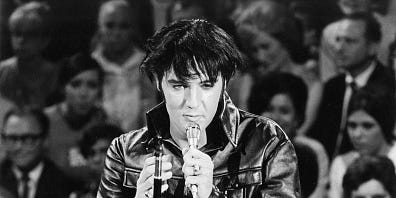
If one photo could make a jukebox stand up straight, it might be Elvis in black leather during the 1968 television special often called the Comeback Special. After years focused heavily on films, Elvis returned to live performance with a rawness that reminded audiences what had been missing.
The black leather images are iconic because they look like a man reclaiming himself. Elvis appears intense, amused, nervous, and completely alive. The setting was intimate. The music had bite. The visual message was simple: the movie years had not erased the performer. He was still in there, and he had brought the good jacket.
11. The Las Vegas and Aloha Jumpsuit Photos: Elvis Goes Global
The white jumpsuit photos from Elvis’s later career are among the most recognizable images in entertainment history. In Las Vegas and during the 1973 Aloha from Hawaii broadcast, Elvis became larger than a rock singer. He became an international spectacle.
Aloha from Hawaii was a milestone television event, broadcast live by satellite to audiences in multiple countries. The photos from this period show Elvis in full mythic mode: high collar, cape-like drama, jeweled costume, powerful stage stance. It is easy to parody this Elvis, and many have, usually with sunglasses and questionable sideburn glue. But beneath the parody is a serious achievement. He helped define the modern concert superstar as a visual event, not just a musical one.
12. Graceland Photos: The Legacy Becomes a Place
The final photo is Graceland. Elvis bought the Memphis mansion in 1957, lived there for two decades, and died there on August 16, 1977. After opening to the public in 1982, Graceland became one of America’s most famous music landmarks and a major destination for fans from around the world.
Photos of Graceland are powerful because they show how legacy becomes physical. The gates, the mansion, the Jungle Room, the cars, the costumes, the gold records, the Meditation Gardeneach turns memory into something visitors can stand near. Graceland is not only a house museum. It is a shrine to American pop culture, a place where grief, fandom, tourism, and history all politely wait in the same line.
The Bigger Legacy Behind These 12 Elvis Photos
Elvis Presley’s legacy is complicated, which is one reason it remains alive. He was a brilliant performer shaped by the music of the American South, including Black gospel, rhythm and blues, country, and pop. He brought certain sounds to massive audiences, but he also benefited from an unequal music industry that often rewarded white performers more generously than Black innovators. A serious look at Elvis must hold both truths at once.
He was inducted into the Rock and Roll Hall of Fame in 1986, the Country Music Hall of Fame in 1998, and the Gospel Music Association’s Gospel Music Hall of Fame in 2001. The Recording Academy recognized his achievements, including a Lifetime Achievement Award in 1971, and his gospel recordings earned him Grammy wins. In 2018, he was posthumously awarded the Presidential Medal of Freedom.
But awards only explain part of the story. The deeper reason Elvis photos still circulate is that he represents transformation. He changed from poor Southern boy to local musician, from local musician to national controversy, from controversy to movie star, from movie star to comeback artist, from comeback artist to global spectacle, and from mortal celebrity to enduring symbol. Few public figures have been so repeatedly reinvented by photographs.
What These Photos Teach Us About Fame
The 12 photos of Elvis Presley’s life and legacy tell a story about fame’s strange bargain. The camera gave Elvis immortality, but it also froze him into versions of himself. Young Elvis never versions of himself. Young Elvis never ages. Army Elvis never leaves the barracks. Comeback Elvis is always in black leather. Aloha Elvis is always shining under stage lights. Graceland Elvis is always just out of reach.
That is the magic and the sadness of celebrity photography. It preserves moments while simplifying people. Elvis was funny, generous, ambitious, anxious, spiritual, lonely, disciplined, impulsive, and human. A photo can suggest those layers, but it cannot fully contain them. Still, the best Elvis images come close. They let us see why audiences believed something extraordinary was happening when he walked into frame.
Experiences Related to “12 Photos of Elvis Presley’s Life and Legacy”
Spending time with Elvis Presley photos is a different experience from reading a standard biography. A biography gives you the timeline. Photos give you the temperature in the room. You can feel the early nervous energy in a Sun Records image, the almost comic shock of television audiences realizing that the future had arrived and was wearing tight pants, and the polished confidence of a movie still designed to sell both romance and records.
One of the most interesting experiences is noticing how each era has its own Elvis. The Tupelo and Memphis photos feel human and close. They make Elvis seem like someone who might have stood behind you in a grocery line, humming without realizing it. The 1950s stage photos feel explosive. They are full of movement, as if the still image is barely strong enough to hold him. The Army photos feel disciplined and strangely quiet, showing a young man forced to step outside the machinery of fame. The Hollywood photos feel sunny and controlled, with the rougher rock-and-roll edges tucked neatly into a studio-approved collar.
Then comes the 1968 Comeback Special, and the experience changes again. Those photos feel less like publicity and more like proof of life. Elvis appears alert, focused, and hungry to perform. For viewers who only know the later jumpsuit image, the black-leather Elvis can be a revelation. He looks like the original spark has not gone out; it has simply been waiting behind a dressing-room door.
The Las Vegas and Aloha photos create yet another reaction. They are grand, theatrical, and almost unreal. Some people laugh first because the jumpsuits have been copied, parodied, and Halloween-costumed into pop-culture shorthand. But after the laugh, there is usually admiration. It takes confidence to stand in front of a global audience dressed like a superhero designed by a rhinestone committee and still make people listen to the voice.
Visiting Graceland, or even looking closely at Graceland photos, adds a final emotional layer. The house makes Elvis feel both enormous and ordinary. You see the rooms, the furniture, the cars, the records, and the personal spaces, and suddenly the icon becomes a person who lived somewhere, liked certain colors, owned things, entertained friends, and needed privacy. That is why Elvis’s legacy remains powerful. It is not only about the hits. It is about the distance between the boy in Tupelo and the mansion in Memphis, between the human life and the global image, between the photographs we keep and the person they can never fully return to us.
Conclusion
The story of 12 photos of Elvis Presley’s life and legacy is really the story of American popular culture learning how to see itself. Through Elvis, cameras captured youth rebellion, musical fusion, celebrity marketing, Hollywood reinvention, military service, live-performance spectacle, and the transformation of a private home into a public landmark.
Elvis Presley remains unforgettable because his best images still feel alive. They do not simply document what he did; they explain why people reacted so intensely. In one frame, he is a shy Southern boy. In another, he is a rock-and-roll fire alarm. In another, a soldier. In another, a movie star. In another, a comeback artist. In another, a jeweled global icon. Put those photos together, and you do not just get a gallery. You get a life that changed the sound, look, and ambition of popular music.