Medical note: This article is for education only. Scoliosis is a three-dimensional spinal condition, and the safest exercise plan depends on your curve pattern, age, symptoms, bone health, and medical history. Work with a healthcare provider, orthopedic specialist, or physical therapist before starting or changing a scoliosis exercise program.
What Is Scoliosis, Really?
Scoliosis is often described as a “sideways curve” of the spine, but that definition is a bit like calling a thunderstorm “some damp weather.” Scoliosis usually involves a lateral curve plus rotation of the vertebrae, meaning the spine does not simply lean left or right; it may also twist. That rotation is why one side of the rib cage or one shoulder blade may look more prominent during a forward-bend test.
Many cases are idiopathic, which means doctors do not know one single cause. Adolescent idiopathic scoliosis often appears around the growth-spurt years, while adults may have scoliosis that began earlier in life or developed later because of degenerative changes in the spine. Some people have no pain at all. Others experience stiffness, muscle fatigue, uneven posture, back pain, hip discomfort, or a sense that one side of the body “works harder” than the other.
This is where Pilates enters the conversation. Pilates cannot magically straighten a structural spinal curve like a human ironing board. However, when taught carefully, it may help many people with scoliosis improve core support, posture awareness, mobility, breathing mechanics, balance, and day-to-day comfort.
Can Pilates Help Scoliosis?
Pilates is a controlled movement system that emphasizes breath, alignment, core strength, flexibility, and precise muscle control. Those goals overlap nicely with common scoliosis management priorities: improving spinal support, reducing muscular imbalance, encouraging better movement habits, and helping the body feel less like a badly packed suitcase.
Research on Pilates for scoliosis is promising but not perfect. Some studies suggest Pilates-based programs may reduce pain, improve posture, increase flexibility, support trunk strength, and improve quality of life. Programs that combine Pilates with scoliosis-specific approaches, such as the Schroth method, have shown benefits in adolescents with mild to moderate idiopathic scoliosis. However, Pilates by itself should not be marketed as a guaranteed curve-correction treatment. The evidence is still developing, and scoliosis care must be individualized.
The most realistic way to think about Pilates for scoliosis is this: it is not a cure, but it may be a useful tool. A hammer is not a whole toolbox, but when used correctly, it can still do excellent work.
Benefits Of Pilates For Scoliosis
1. Better Core Strength Without Aggressive Impact
A well-designed Pilates program strengthens the deep abdominal muscles, back muscles, pelvic floor, diaphragm, and hip stabilizers. These muscles help support the spine during walking, sitting, lifting, and standing. For someone with scoliosis, improved core control may reduce the feeling of being pulled off-center.
Unlike high-impact workouts, Pilates is often low-impact and adaptable. Many exercises can be performed on a mat, reformer, chair, or Cadillac with modifications. That makes it easier to train strength without jumping, pounding, or forcing the spine into positions it does not appreciate.
2. Improved Posture Awareness
People with scoliosis may become used to their asymmetry. One shoulder might hike up, one hip might shift, or the ribs may rotate without the person noticing. Pilates teaches body awareness through slow, intentional movement. Over time, a person may learn to recognize when they are collapsing into their curve, gripping one side of the back, or standing with weight dumped into one hip.
That awareness matters because posture is not just about looking “tall.” It affects breathing, comfort, fatigue, and how evenly muscles share the workload. Pilates gives the nervous system a clearer map of the body.
3. More Flexible, Less Grumpy Muscles
Scoliosis can create tightness in the hips, chest, shoulders, hamstrings, and spinal muscles. Pilates uses controlled mobility rather than random stretching. Instead of yanking on tight tissues like you are trying to start an old lawn mower, Pilates encourages length, breath, and control.
For example, side-lying breathing, gentle spinal articulation, hip mobility work, and supported chest opening may reduce tension around the rib cage and pelvis. The goal is not to become a human pretzel. The goal is usable mobility with stability.
4. Better Breathing Mechanics
Because scoliosis can affect rib position and trunk rotation, some people breathe more easily into one side of the rib cage than the other. Pilates often uses lateral rib breathing, which encourages expansion through the sides and back of the ribs. This can pair well with scoliosis-specific breathing concepts when supervised by a trained professional.
Breathwork may also reduce unnecessary muscle guarding. Many people with back discomfort unknowingly hold their breath during movement. Pilates helps replace that “brace for disaster” habit with calmer, more coordinated breathing.
5. Pain Management And Daily Function
Pilates may help reduce pain for some people by improving strength, mobility, posture, and movement confidence. For adults with scoliosis, this can be especially valuable. A smart routine may make sitting at a desk, carrying groceries, walking, or getting out of bed feel less like negotiating with a tiny angry committee in your lower back.
Pain relief does not mean the curve has disappeared. It usually means the body is better supported, less irritated, and moving with more options.
Risks Of Pilates For Scoliosis
1. Generic Pilates May Not Match Your Curve
A standard Pilates class may be excellent for general fitness, but scoliosis is not one-size-fits-all. A right thoracic curve, left lumbar curve, double curve, adult degenerative scoliosis, post-surgical spine, and mild adolescent curve all require different considerations. What feels helpful for one person may irritate another.
This is why a teacher who understands scoliosis, or a physical therapist trained in scoliosis-specific exercise, can make a major difference. The goal is not just “do Pilates.” The goal is “do the right Pilates, in the right way, for the right spine.”
2. Too Much Flexion, Twisting, Or Extension Can Irritate Symptoms
Some Pilates exercises involve rolling the spine, deep forward bending, loaded rotation, or strong back extension. These movements are not automatically forbidden, but they may be too aggressive for certain scoliosis patterns, disc issues, osteoporosis, nerve symptoms, or post-fusion spines.
Exercises such as roll-ups, teasers, corkscrews, advanced swan variations, and loaded twisting should be approached carefully. If an exercise increases pain, numbness, tingling, sharp discomfort, or a sense of compression, stop and modify.
3. Overcorrecting Can Create New Tension
People sometimes hear “stand straight” and respond by forcing themselves into a military posture that would make a marching band nervous. Scoliosis correction should not feel like stiff bracing all day. Overcorrecting can increase tension in the neck, ribs, lower back, and hips.
Good Pilates work should feel controlled but breathable. Think “lengthened and supported,” not “locked in place like a mannequin in a windstorm.”
4. Children And Teens Need Extra Care
In growing children and teens, scoliosis can progress during growth spurts. Exercise may be part of a care plan, but it should not replace medical monitoring, X-rays when recommended, bracing when prescribed, or specialist guidance. Parents should be cautious of any program that promises to fix scoliosis quickly with a few secret moves. Spines are not infomercial products.
5. Red Flags Require Medical Attention
Stop exercising and seek medical guidance if scoliosis is accompanied by worsening pain, weakness, numbness, tingling, loss of coordination, bowel or bladder changes, fever, unexplained weight loss, night pain, breathing difficulty, or pain after trauma. These symptoms deserve more than a foam roller and optimism.
How To Start Pilates For Scoliosis Safely
Step 1: Get A Professional Assessment
Before beginning Pilates for scoliosis, get assessed by a qualified healthcare provider or physical therapist. Ideally, you should know your curve type, Cobb angle, symptoms, skeletal maturity if you are a teen, and any related issues such as disc degeneration, osteoporosis, spinal fusion, hip imbalance, or nerve symptoms.
A physical therapist can help identify which side needs more length, which muscles need strengthening, and which positions should be modified. If you can find someone trained in scoliosis-specific exercise, such as Schroth-based therapy, even better.
Step 2: Choose The Right Instructor
Look for a Pilates instructor who asks questions before teaching. A good instructor will want to know about your diagnosis, pain triggers, medical restrictions, and exercise experience. They should be comfortable modifying exercises and should not pressure you into advanced moves just because they look impressive on social media.
Green flags include calm cueing, attention to breathing, individualized alignment, gradual progression, and a willingness to collaborate with your physical therapist. Red flags include “push through pain,” “this will cure your scoliosis,” or “everyone should do the exact same routine.” Your spine deserves better customer service.
Step 3: Start With Foundational Movements
Begin with low-load exercises that teach breathing, pelvic control, spinal length, and gentle core activation. Do not rush into advanced reformer choreography or mat exercises that require high spinal control. Scoliosis-friendly Pilates usually starts quietly before it gets fancy.
Step 4: Use Pain As Information
Mild muscle effort is normal. Sharp pain, nerve symptoms, pinching, or pain that lingers after class is not a badge of honor. It is feedback. Modify the position, reduce range of motion, use props, slow down, or stop the exercise.
Step 5: Be Consistent, Not Dramatic
Two or three short, well-designed sessions per week are usually more useful than one heroic workout followed by four days of walking like a folding chair. Consistency helps the nervous system learn new patterns. Pilates works best when it becomes a practice, not a punishment.
A Beginner-Friendly Pilates Routine For Scoliosis
The following sample routine is general and should be customized by a professional. Move slowly, breathe comfortably, and stop if symptoms increase.
1. 90/90 Breathing
Lie on your back with your feet on a chair, knees bent at about 90 degrees. Place your hands on the sides of your ribs. Inhale gently into the back and sides of the rib cage. Exhale slowly and feel the lower ribs soften. Repeat for 6 to 10 breaths.
Why it helps: This encourages rib mobility, diaphragm coordination, and a calmer starting position.
2. Pelvic Clocks
Lie on your back with knees bent and feet flat. Imagine your pelvis is a clock. Gently tilt toward 12 o’clock, then 6 o’clock, then side to side. Keep the movement small and smooth. Repeat for 1 to 2 minutes.
Why it helps: Pelvic clocks improve awareness of pelvic position and lower-back movement without heavy loading.
3. Heel Slides
Lie on your back with knees bent. Exhale and gently engage your lower abdominals. Slide one heel away, then return. Keep the pelvis steady. Alternate sides for 8 to 10 repetitions.
Why it helps: Heel slides train core control while the legs move, which is useful for walking and daily activity.
4. Modified Dead Bug
Lie on your back with arms reaching toward the ceiling and knees bent. Slowly lower one heel toward the floor while keeping the ribs and pelvis quiet. Return and switch sides. Do 6 to 8 repetitions per side.
Why it helps: This strengthens the deep core without forcing spinal flexion.
5. Side-Lying Lengthening
Lie on your side with a small towel under your waist if needed. Reach the top arm overhead and breathe into the side ribs. Keep the breath easy, not forced. Hold for 4 to 6 breaths, then switch sides if appropriate.
Why it helps: This may encourage rib-cage expansion and side-body length. A therapist can tell you which side needs more emphasis.
6. Bird Dog Preparation
Start on hands and knees. Keep the neck long and spine supported. Slide one leg back without lifting it high. Return and switch. If stable, add the opposite arm. Do 6 repetitions per side.
Why it helps: Bird dog variations train spinal stability, hip control, and shoulder support.
7. Supported Bridge
Lie on your back with knees bent. Exhale and lift the pelvis only as high as comfortable. Keep the ribs soft and avoid pushing into the lower back. Lower slowly. Repeat 6 to 10 times.
Why it helps: Bridges strengthen the glutes and posterior chain, which help support posture and daily movement.
8. Wall Alignment Check
Stand with your back near a wall. Let the head, ribs, pelvis, and feet find a comfortable, tall position without forcing perfect symmetry. Breathe for 30 to 60 seconds.
Why it helps: This builds standing awareness and can help transfer Pilates work into real life.
Mat Pilates Or Reformer Pilates: Which Is Better For Scoliosis?
Both can be useful. Mat Pilates is accessible, affordable, and easy to practice at home. It teaches body control using your own body weight. However, mat exercises can be challenging because there is less equipment support.
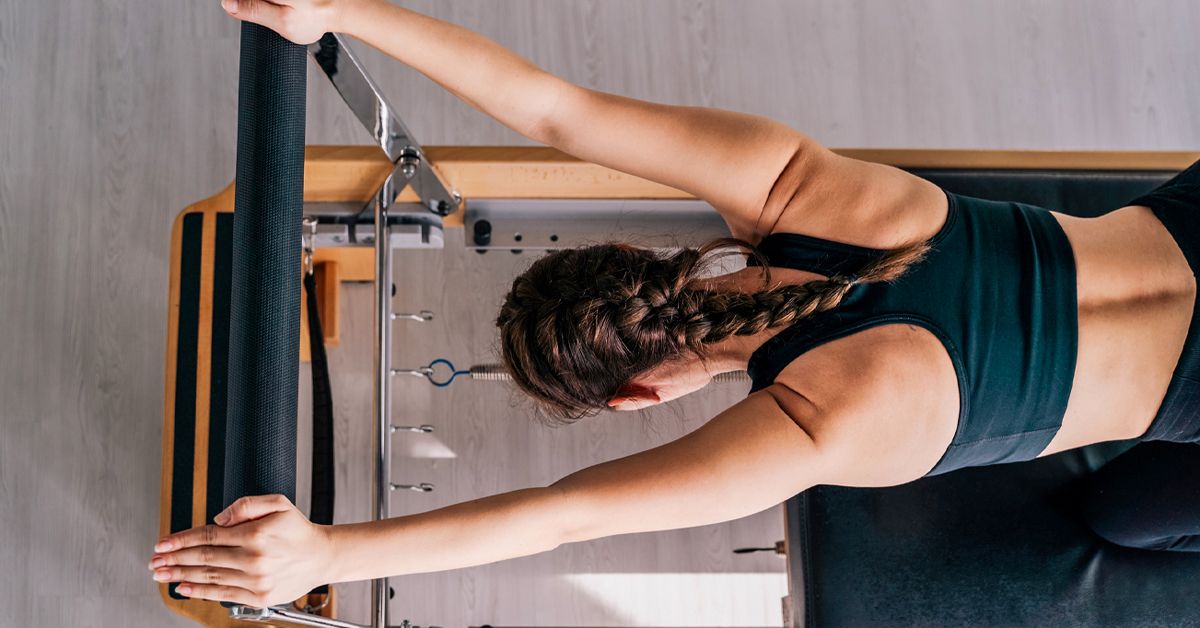
Reformer Pilates uses springs, straps, and a moving carriage. For scoliosis, the reformer can offer feedback, assistance, and resistance in a controlled way. It may help people feel where their body is in space. However, the reformer is not automatically safer. Poor cueing on equipment can still overload the spine.
The best choice depends on the instructor, your body, and your goals. A skilled teacher matters more than a shiny machine. A reformer is a tool, not a magic scoliosis eraser with springs.
What To Avoid In Pilates With Scoliosis
You do not necessarily need to avoid every challenging movement forever, but beginners should be cautious with certain categories:
- Deep spinal rolling, especially repeated roll-ups or rolling like a ball if they cause discomfort
- Loaded twisting or fast rotation
- Strong back extension without support
- Exercises that increase rib flare, neck tension, or lower-back compression
- Symmetrical cueing that ignores your scoliosis pattern
- Any movement that causes sharp pain, numbness, tingling, or lingering symptoms
A helpful rule: Pilates should leave you feeling more organized, not more crooked, cranky, or confused.
How Often Should You Do Pilates For Scoliosis?
Many people do well with two to three Pilates sessions per week, especially when combined with walking, gentle strength training, and scoliosis-specific exercises if prescribed. Beginners may start with 15 to 30 minutes. More advanced students may work up to 45 to 60 minutes.
Quality matters more than quantity. Ten mindful minutes of breathing and alignment can be more useful than an hour of forcing your body through exercises that do not fit your spine. Progress should be measured in comfort, control, confidence, endurance, and function, not just in how dramatic the workout looks.
Pilates And Schroth: Do They Work Together?
The Schroth method is a scoliosis-specific physical therapy approach that uses customized postural correction, breathing, elongation, and muscle activation based on a person’s curve pattern. Pilates is broader and often used for general strength, mobility, and body control.
For some people, combining Schroth principles with Pilates-style conditioning may be helpful. Schroth can provide the curve-specific correction strategy, while Pilates can build strength, coordination, and movement confidence. However, this combination should be guided by trained professionals. Without the curve-specific piece, Pilates may improve fitness and pain but may not address scoliosis mechanics as directly.
Conclusion: Is Pilates Good For Scoliosis?
Pilates can be a smart, low-impact way to support scoliosis management when it is customized, supervised, and practiced consistently. It may help improve core strength, posture awareness, flexibility, balance, breathing, and pain. It can also help people feel less afraid of movement, which is no small thing when your spine has been described with angles, curves, and X-ray measurements.
But Pilates is not a replacement for medical care, bracing when needed, scoliosis-specific therapy, or surgical consultation in severe cases. The safest path is a team approach: medical evaluation, individualized exercise, skilled instruction, and patient consistency. In other words, your spine does not need a miracle. It needs a plan.
Experience Notes: What Pilates For Scoliosis Can Feel Like In Real Life
For many people with scoliosis, the first surprise in Pilates is not how hard the exercises are. It is how much they notice. Suddenly, the body starts sending little postcards: “Hello from your left rib cage, where we have not expanded since 2014,” or “Greetings from your right hip, currently doing everyone’s job.” That awareness can be uncomfortable at first, but it is also useful. You cannot change movement habits you cannot feel.
A common experience is discovering that “neutral” does not feel neutral. Someone with scoliosis may lie on the mat and feel one side of the ribs touching the floor more clearly than the other. One shoulder may want to hover. One side of the pelvis may feel heavier. During breathing exercises, one lung area may feel like a spacious studio apartment while the other feels like a closet full of winter coats. This does not mean anything is wrong with the practice. It means the practice is revealing patterns that were already there.
Another real-world lesson is that smaller movements often work better. Many beginners want to do the big, impressive Pilates exercises right away. They picture elegant teasers, long planks, and reformer moves that look like ballet met a spaceship. But with scoliosis, the humble exercises often matter most: breathing into the ribs, learning how the pelvis moves, keeping the spine long during heel slides, or noticing whether the neck grips during core work. These tiny details can change how the body feels during bigger activities like walking, driving, lifting laundry, or sitting through a meeting that should have been an email.
People also often report that Pilates helps them feel more balanced, even if their curve does not visibly change. That is important. Scoliosis is not only about appearance or X-ray numbers. It is also about how the body performs. A person may notice they can stand longer without back fatigue, breathe more easily during exercise, or recover faster after a long day. Some feel less tension in the shoulders or fewer lower-back flare-ups. Others simply feel more confident moving, which can be powerful after years of being told to “be careful” without being shown how.
There can be frustrating days too. Progress is rarely a straight line. Stress, sleep, hormones, work posture, travel, or a sudden decision to move furniture like a superhero can all affect symptoms. On those days, the best Pilates session may be gentle breathing, supported stretching, and a few stabilizing movements. That still counts. In fact, learning how to adjust the practice to match the body’s needs is one of the most valuable skills Pilates can teach.
The best experience usually comes from curiosity rather than perfection. Instead of asking, “Am I straight yet?” ask, “Can I breathe more evenly? Can I move with less tension? Can I feel both feet? Can I support my spine without clenching every muscle like I’m guarding a treasure chest?” These questions lead to better practice. Pilates for scoliosis is not about forcing the body into a textbook shape. It is about giving the body more support, more options, and a friendlier relationship with movement.